Weighing the Earth: The 1774 Schiehallion Experiment
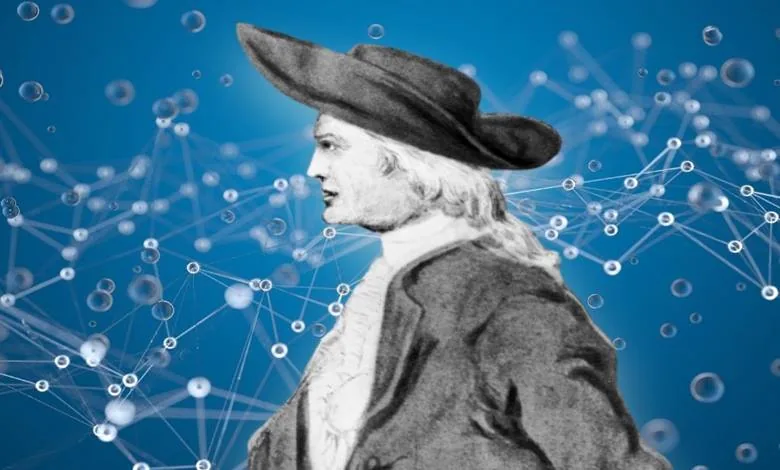
The story of how Earth's mass was measured begins in 1774 on a lonely Scottish mountain called Schiehallion, where astronomer Nevil Maskelyne set out to weigh the planet using a plumb line and a rock. It sounds like a folktale, but it was careful physics. Maskelyne noticed that a hanging weight was pulled slightly sideways by the nearby mountain, and that tiny deflection became the key to the whole puzzle. From that hillside observation, generations of scientists edged closer to a number we now take for granted: the mass of the world beneath our feet.
In 1774, Nevil Maskelyne measured how much the mountain Schiehallion deflected a plumb line, using the result to estimate Earth's density. Later, Henry Cavendish refined the measurement with a torsion balance, publishing in 1798. Together these experiments gave science its first reliable figure for how Earth's mass was measured.
- In 1774, Nevil Maskelyne conducted the Schiehallion experiment in Scotland to measure the gravitational pull of a mountain.
- The experiment used the slight deflection of a plumb line to estimate the density of the Earth.
- In 1798, Henry Cavendish published results from a torsion balance that measured gravitational attraction between lead spheres and refined the value.
- These experiments produced the first reliable estimates of Earth's density, often cited near 5.5 grams per cubic centimeter.
- The work built directly on Isaac Newton's law of universal gravitation, which linked mass, distance, and gravitational force.
You Can't Put a Planet on a Scale
Earth's mass is about 5.97 × 10²⁴ kilograms, which is 5.97 septillion kilograms. Nobody has ever placed the planet on a scale, and nobody ever will. The figure comes from a clever workaround: scientists measured how Earth's gravity tugs on other bodies instead of weighing the planet itself.
Look at the number again and let it sink in. Write 5.97 and then tack on 24 zeros behind it. That is the mass of every ocean, every mountain, every grain of sand and every one of us, bundled into a single figure.
So how do you pull a number like that out of the sky? You start with a law of nature, take a detour up a Scottish mountain, and finish in a closed room with a few lead spheres straining toward each other on a twisted wire. That is the whole arc of how Earth's mass was measured, and every stage of it is stranger and more patient than the last.
The starting gun fired in 1687, when Isaac Newton published his law of universal gravitation. Any two bodies attract each other with a force proportional to their masses and inversely proportional to the square of the distance between them. In principle, that single rule held the answer to Earth's mass.
In practice, there was a hole in the plan. The law could tell you the pull between two objects, but to turn that pull into a mass for the whole planet you needed to know Earth's density, and nobody did.
The trick that followed was not to weigh the Earth at all. It was to watch the Earth bend something small, and then do the arithmetic backward.
The Formula Arrives, but One Number Is Missing
In 1687, Isaac Newton published the Principia, and inside it sat the law of universal gravitation: any two bodies pull on each other with a force proportional to their masses and inversely proportional to the square of the distance between them, written today as F = G·m₁m₂/r². That single relationship is the engine behind the entire story of how Earth's mass was measured. It told scientists the shape of the answer long before they could reach it.
Look closely at what the law actually hands you. If you know the force, the distance, and the gravitational constant G, you can solve for a mass. Earth tugs on everything around it, from falling apples to the Moon, so its mass is baked into every one of those pulls. The path to weighing a planet looked open.
Then came the snag. The law gives you mass only if you already know something else about the body doing the pulling, and for Earth, that something was density. Mass equals volume times density. The volume part was never the problem. Earth's size had already been pinned down roughly through earlier measurement, so its volume was sitting there, waiting. Density was the blank.
Think about why that blank was so stubborn. A planet is not a uniform lump of anything. There is rock, there is metal, there is who knows what buried miles down where no one could look. Guessing Earth's average density meant guessing what the whole planet was made of, all the way to the core, and nobody in Newton's day had a way to check that guess.
So the situation in 1687 was this: the greatest physicist alive had handed over the formula, and the formula was useless for Earth's mass until someone could measure the planet's average density. That measurement would take more than a century, a Scottish mountain, and eventually a few lead balls in a sealed room.
The Mountain That Bent a Plumb Line: Schiehallion, 1774
Nevil Maskelyne, Britain's Astronomer Royal, climbed a Scottish mountain in 1774 to weigh the world with a telescope and a hanging weight. The plan behind it is simple to state: if you can roughly estimate a mountain's mass, you can compare its pull on a nearby object with the pull of the whole Earth, and from that comparison work out our planet's average density. That is how Earth's mass was measured for the first time, not in a laboratory but on a windswept hillside in Perthshire.
The mountain was Schiehallion, and it was picked for a very practical reason. Its shape is unusually regular and nearly symmetric, which made the job of calculating its volume far less hopeless than it would be for some jagged, lopsided peak. A plumb line, after all, should point straight at the center of the Earth. Put a giant lump of rock beside it and the rock's own gravity should tug the line a hair off true, toward the mountain.
Maskelyne set up his instruments on opposite sides of Schiehallion and made careful astronomical observations of where his plumb line actually hung. The deflection was real. The mountain's mass was pulling the line slightly toward itself, exactly as the theory demanded, and the shift was small enough to be easy to miss and large enough to measure.
Measuring the bend was only half the battle. The mathematician Charles Hutton then used detailed land surveys to model the mountain's shape and volume, so the size of its gravitational pull could be turned into a number for the Earth. His answer: an average density of about 4.5 g/cm³. Today's accepted figure is roughly 5.51 g/cm³, so the estimate came out low.
And there the method hit its ceiling. The result depended entirely on how well Hutton could guess what lay hidden inside the mountain. Nobody could see the rock's internal structure, so the volume was only ever an educated approximation, and any error in it fed straight into the density of the Earth. The experiment had worked. It just could not be pushed further from the outside.
Michell's Design, Cavendish's Hands: The Torsion Balance
The Schiehallion experiment had done its job, but it carried a flaw nobody could fix. The estimate of Earth's density rested on a mountain whose interior nobody had ever seen. What lay inside Schiehallion, whether solid rock or hidden voids, was pure guesswork, and that guesswork capped how accurate the whole result could ever be.
John Michell saw the way out. Instead of weighing a mountain, why not move the problem into a laboratory and measure the tiny gravitational pull between two objects whose masses you already know? He designed a torsion balance for exactly this purpose. He never got to run it. Michell died in 1793, and the apparatus passed into other hands.
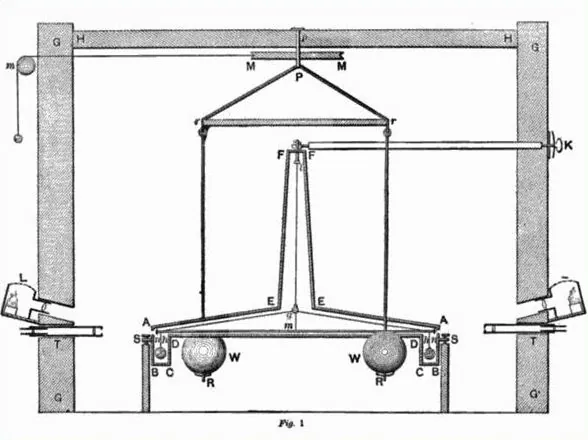
Those hands belonged to Henry Cavendish. He took over Michell's design, refined it, began his measurements in 1797, and published the results the following year under the title Experiments to Determine the Density of the Earth. The credit for the concept is Michell's. The credit for actually pulling off one of the most delicate measurements in history is Cavendish's.
The apparatus, piece by piece
- Two small lead spheres, one fixed to each end of a horizontal rod.
- The rod hung from its center by a thin wire.
- Two much larger lead spheres were brought close to the small ones.
- Their pull nudged the small spheres, rotating the rod and twisting the wire.
That twist was the whole measurement, and it was minuscule. A stray air current or a shift in temperature could wreck it. So Cavendish sealed the apparatus inside a closed room and watched the movements from outside, reading the tiny swings without disturbing them. From how far the wire twisted and how long the system took to oscillate, he worked out the gravitational force between the lead spheres.
This is the pivot point in the story of how Earth's mass was measured. The mountain was out. The laboratory was in. And a design left behind by a man who died before he could use it became the instrument that finally put a number on the planet beneath our feet.
5.48 vs. 5.51: A Result Within 1% of Today's Value
Cavendish reported Earth's average density as roughly 5.48 times that of water in 1798. The modern accepted mean density is about 5.51 g/cm³. The gap between them is well inside 1%, and it was achieved at the very end of the 18th century with lead balls, a twisted wire, and a great deal of patience.
Hold those two numbers side by side for a moment. One came from a closed room in England in 1797, from a rod that barely twitched. The other comes from satellites and decades of refined geodesy. Less than one percent apart.
And once density was in hand, the rest was arithmetic. Earth's size had already been measured, so its volume was known. Mass is simply volume times density. Multiply the two and you land on the figure we still quote today: about 5.97 × 10²⁴ kilograms. That is how Earth's mass was measured, not by hoisting a planet onto a scale but by weighing a tiny gravitational tug in a laboratory.
| Value | Density (times water) | Source |
|---|---|---|
| Cavendish, 1798 | ≈ 5.48 | Experiments to Determine the Density of the Earth |
| Modern accepted mean | ≈ 5.51 g/cm³ | Modern reference value |
The experiment's afterlife turned out to be just as remarkable as the result. Improved versions of the torsion balance were later put to work measuring G, the universal gravitational constant in Newton's law. More than two centuries on, G remains among the fundamental constants hardest to pin down precisely, with a stubbornly large uncertainty that frustrates metrologists to this day. The same delicate twist of a wire that weighed a world is still the tool we reach for when we try to measure gravity itself.
Frequently asked questions
How did scientists first calculate the mass of the Earth?
They never weighed the planet directly. Instead, they measured Earth's average density by observing how gravity pulls on other bodies, then multiplied that density by Earth's known volume. Newton's 1687 law of universal gravitation gave them the framework, and the density figure was the missing piece that unlocked the mass.
What was the Schiehallion experiment and what did it find?
In 1774, British Royal Astronomer Nevil Maskelyne measured how much a plumb line was deflected by the pull of Schiehallion, a mountain in Perthshire, Scotland. Mathematician Charles Hutton surveyed the mountain's shape and volume from the data. Together they estimated Earth's average density at about 4.5 g/cm³, roughly 4.5 times the density of water.
How did Henry Cavendish measure Earth's density in 1797?
Henry Cavendish suspended a horizontal rod with small lead spheres on each end from a thin wire, then brought two much larger lead spheres close by. Their faint gravitational tug twisted the wire by a tiny, measurable amount. Working in a sealed room to block air currents, he began measurements in 1797 and published his results in 1798, finding a density of about 5.48 g/cm³.
Who designed the torsion balance that Cavendish used?
The device was the work of John Michell, the English scientist who conceived a torsion balance for measuring gravitational attraction between known masses. Michell died in 1793 before he could run the experiment himself, and the apparatus passed to Cavendish, who refined it and carried out the measurement.
Why can't you simply weigh the Earth on a scale?
Two reasons. No scale on Earth could hold a planet this size, and there is no external vantage point from which to observe the whole thing and weigh it directly. Scientists had to infer the mass indirectly, through gravity's effect on other bodies and through density combined with volume.
What is Earth's mass in kilograms and how is it known?
Earth's mass is about 5.97 × 10²⁴ kilograms, or 5.97 septillion kilograms. It is known by multiplying Earth's average density, pinned down through experiments like Cavendish's, by the planet's volume, which had already been estimated from earlier measurements of Earth's size.
How close was Cavendish's density result to the modern value?
Remarkably close. Cavendish reported about 5.48 g/cm³, while the modern accepted value is about 5.51 g/cm³. That gap is well under 1%, which means a measurement made at the close of the 18th century still lands within a hair of what we accept today. Editorial note: Details that remain unconfirmed, including some historical figures and precise measurement values, are presented as approximations rather than settled fact.
Got a take on this? Add your voice to the conversation below →
No comments yet. Be the first.