Earth's Axial Precession: The 26,000-Year Wobble That Flips Seasons
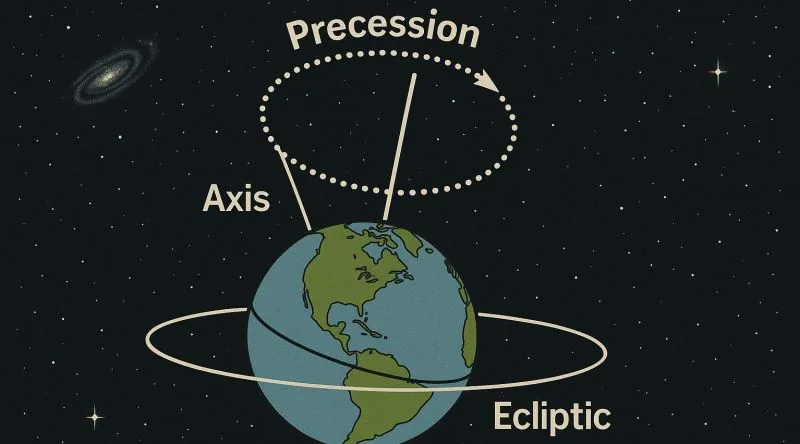
Earth's axial precession is the slow, 26,000-year wobble of our planet's rotational axis that gradually shifts the timing of the seasons, effectively flipping them every 13,000 years. This gentle cosmic dance, driven by the gravitational pull of the Sun and Moon on Earth's equatorial bulge, means that in about 13,000 years, summer in the Northern Hemisphere will occur when Earth is closest to the Sun, a complete reversal from today. It's a humbling reminder that even the most stable-seeming constants of our world are, on a long enough timeline, beautifully fluid.
Earth's axial precession is a 26,000-year wobble of the planet's rotational axis, caused by gravitational forces from the Sun and Moon. This slow circular shift changes the orientation of Earth's axis in space, which gradually alters the timing of the seasons and the positions of the equinoxes, leading to a full seasonal flip every 13,000 years.
- Earth's axial precession is a slow circular wobble of the planet's rotational axis that takes about 26,000 years to complete a full cycle.
- The gravitational pull of the Sun and the Moon on Earth's equatorial bulge is the primary cause of this axial wobble.
- Because of precession, the timing of the seasons gradually shifts, causing them to flip completely over a period of roughly 13,000 years.
- The phenomenon is also known as the precession of the equinoxes, as it slowly moves the points where the celestial equator intersects the ecliptic.
- A smaller, shorter-period wobble called nutation is superimposed on the main precession, adding minor irregularities to the axis's movement.
The Hidden Wobble That Reshapes Our Seasons
Earth's axial precession is a slow, centuries-long wobble in our planet's tilt that quietly rearranges when summer and winter arrive, completing one full cycle roughly every 26,000 years. Most of us learned two motions in school: Earth circling the Sun and spinning on its own axis. But there's a third, far more subtle movement that directly controls the timing of our seasons, and it barely gets a mention.
Think of a spinning top. You set it down, it whirls confidently, and then, after a few moments, it starts to lean and wobble in a slow circle. Our planet does the same thing, though on a scale so vast we never feel it. The gravitational pull from the Sun and the Moon tugs at Earth's equatorial bulge, and that gentle, persistent tug sets our axis swaying. The full sweep takes about 26,000 years, a span so long that human civilization has existed for only a fraction of one complete turn.
This wobble matters because it shifts which hemisphere faces the Sun at any given point in our orbit. After 13,000 years, half a cycle, the seasons effectively flip to opposite positions. The change is imperceptible within a single lifetime, yet over millennia it redraws the rhythm of life itself. An article published on May 26, 2025, brought this overlooked motion into the spotlight, inviting readers to imagine a cold July night 13,000 years from now. That image sticks, because it makes the invisible suddenly tangible.
The Two Familiar Moves: Orbit and Spin
Every schoolkid learns that Earth does two things: it circles the Sun and it spins like a top. The first trip around our star takes roughly 365 days and 6 hours, which is why we add an extra day every four years. The second, a full rotation on its own axis, takes about 24 hours, giving us our familiar day-and-night rhythm. These two motions are so drilled into us by fourth-grade science class that we rarely stop to question them.
But here's the thing about that tidy picture: it's incomplete. Those two famous moves are just the opening act. Earth has two more tricks up its sleeve, movements that are slower, stranger, and arguably more consequential for the climate we actually experience. And unlike the orbit and the spin, these other motions barely register in our everyday awareness, even though they quietly rearrange the seasons over thousands of years.
Think of it this way: the orbit and the spin are the headline acts, the ones that get all the applause. Yet the story of Earth's axial precession, that slow wobble that changes everything, only makes sense once you've got these basics firmly in mind. Because before you can understand how the seasons drift, you need to appreciate the steady, reliable beat of the year and the day that frame all the rest.
Precession: The Top That Keeps Wobbling
Earth's axial precession is a wobble, plain and simple. Imagine a spinning top that has been going for a while, starting to lose its perfect balance. It doesn't fall over immediately, but its axis begins to trace a slow, lazy circle in space. That is precisely what our planet does, and it takes about 26,000 years to complete just one full cycle of this staggering, silent turn.
What causes this monumental wobble? The blame falls on the gravitational pull of the Sun and the Moon. Earth isn't a perfect sphere; it bulges slightly at the equator, like a ball of dough that has settled a bit. The Sun and Moon tug at this equatorial bulge, and because Earth is spinning, that constant pull creates a torque that slowly pushes the axis to lean in a different direction. The result is a shift so gradual that a single human lifetime registers none of it, yet over millennia, it changes everything we know about our calendar.
Because the axis is slowly reorienting, the timing of our seasons shifts too. Roughly every 13,000 years, the seasons effectively flip to the opposite positions in our orbit. The reason we currently enjoy summer in the Northern Hemisphere during June, July, and August is tied to the specific angle of this precession right now. In about 13,000 years, the situation will be reversed, and the experience of a cold July night will take on a whole new meaning.
What That Wobble Does to Our Seasons
Here's the wild part: in about 13,000 years, the Northern Hemisphere will experience summer in December and winter in June. That's the direct consequence of Earth's axial precession, the slow wobble of our planet's axis that takes roughly 26,000 years to complete one full cycle. The shift happens so gradually that no human lifetime will ever witness it.
Think of a spinning top. When you send it across the floor, it doesn't just spin upright. It wobbles, its axis tracing a slow circle in the air. Our planet does the same thing, and the gravitational pull from the Sun and the Moon is what keeps that wobble going. Because the axis gradually tilts to the other side, the timing of when each hemisphere receives solar energy shifts too.
Right now, the Northern Hemisphere enjoys summer in June, July, and August. That timing comes from our current axial tilt. But as the wobble continues, the seasons will slowly migrate around the calendar. In 13,000 years, the arrangement flips completely. The months we now associate with cold and snow will bring heat, and vice versa.
The change is imperceptible in a single lifetime. A person born today and living to old age will never notice the difference. The shift accumulates over centuries and millennia, not years. It's a geological slow dance, one that reshapes the rhythm of our year without us ever feeling the movement.
Nutation: The Nod Within the Wobble
If precession is the slow, grand sway of Earth's axis, nutation is the subtle nod layered on top of it. Think of the difference between circling your head around slowly and then adding a tiny up-and-down bob while you do it. That smaller, rhythmic oscillation is nutation, and it rides along with the much larger precessional drift.
Nutation is essentially a periodic wobble in the angle of precession itself. While Earth's axial precession takes roughly 26,000 years to complete one full cycle, nutation operates on a far shorter timescale, with its most noticeable component completing its cycle in about 18.6 years. This shorter wobble is driven primarily by the Moon's orbital mechanics, since the Moon's orbit is tilted relative to Earth's equator, causing the gravitational pull to vary slightly as the Moon travels around our planet. The result is a gentle nodding motion, typically just a few arcseconds in amplitude, that slightly shifts the exact position of the celestial pole over time.
So while precession slowly redirects the entire orientation of Earth's axis over millennia, nutation adds a smaller, faster beat to that motion. Both movements work together to shape the precise path our planet's axis traces through the sky. The slow circle is precession; the subtle quiver within that circle is nutation. It's a quiet detail in Earth's complex rotational behavior, but it's one that astronomers must account for when tracking the positions of stars with extreme precision.
Frequently asked questions
What is Earth's axial precession?
Earth's axial precession is a slow, circular wobble of our planet's rotational axis, like a spinning top leaning as it slows down. This wobble is caused by the gravitational pull of the Sun and Moon tugging on Earth's equatorial bulge. One complete wobble takes roughly 26,000 years to finish.
How does precession change the seasons?
Precession slowly shifts when each season occurs over thousands of years. Because the axis points in a different direction, the timing of summer and winter gradually moves. About every 13,000 years, the seasons flip to opposite positions, so a month that once felt like summer eventually feels like winter.
Why does Earth wobble on its axis?
Earth wobbles because the Sun and Moon pull unevenly on our planet's equatorial bulge, which is the slight widening around the middle caused by rotation. This gravitational torque pushes the axis in a slow circular motion. Think of how a top wobbles as it spins, and you have the basic idea.
How long does one full precession cycle take?
One complete cycle of Earth's axial precession takes about 26,000 years. That means the axis slowly traces a full circle in the sky over that vast span of time. To put it in perspective, recorded human history covers only a small fraction of a single cycle.
What is the difference between precession and nutation?
Precession is the slow, steady circular wobble of Earth's axis, while nutation is a smaller, faster nodding motion layered on top of it. Imagine nodding your head up and down while slowly turning in a circle, and you combine both movements. Nutation adds small oscillations to the larger precessional swing.
Got a take on this? Add your voice to the conversation below →
No comments yet. Be the first.