Galileo Galilei: How He Measured Dante's Hell in 1588
In 1588, a young Galileo Galilei took on an unusual job: working out the dimensions of Hell from the clues in Dante's Inferno. He was in his twenties, still years away from the telescope. As the story goes, the Catholic Church set him the task, though that part of the tale is shaky. What began as a literary puzzle turned into serious arithmetic. Hidden inside those estimates was a mistake that would later help him explain why large animals cannot simply be scaled-up versions of small ones.
In 1588, Galileo Galilei worked on the size and shape of Dante's Hell, using the poem's measurements to build a geometric model. His calculations were rough and probably wrong, but the exercise is widely linked to his later thinking about the square-cube law, the principle that volume grows faster than surface area as an object gets bigger.
- Galileo tackled Dante's Inferno in 1588, while he was still a young scholar in his twenties.
- He treated the poem as a set of measurements and tried to reconstruct Hell's dimensions in geometric terms.
- The project is widely linked to his later thinking about the square-cube law, which explains why scaling up a body breaks its proportions.
- His figures are not considered reliable by modern standards, and the exercise is remembered more for its method than its answers.
The Poet Who Built Hell
Dante Alighieri wrote the Divine Comedy between 1307 and 1320, and the finished poem runs to roughly 14,223 lines, though the exact count shifts a little from edition to edition. It is split into three parts: Inferno (Hell), Purgatorio (Purgatory) and Paradiso (Paradise). The first of those three is the one that refused to stay on the page.
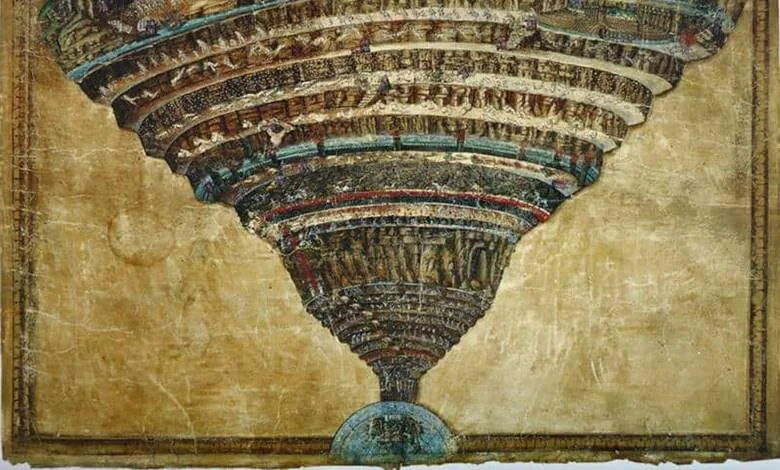
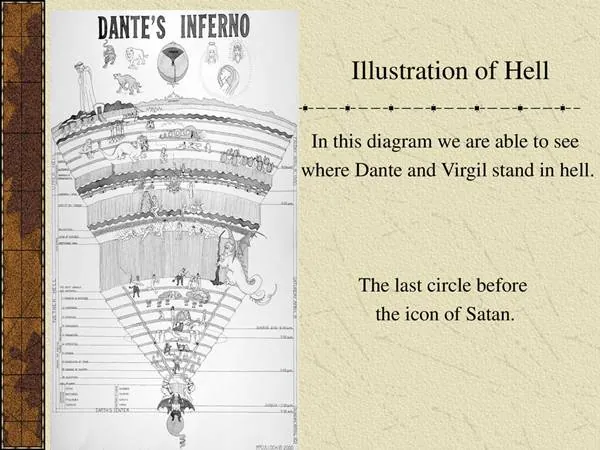
Picture what Dante actually drew. Hell is not a lake of fire or a smoky cavern. It is a colossal cone, bored down from the surface of the Earth to its very center, built from nine circles that narrow as you descend. Each ring holds a different class of sinner, and the punishments grow harsher the deeper you go. At the bottom, in the ninth and deepest circle, sit the traitors.
That is a piece of engineering as much as poetry. Dante gave his underworld slopes and ledges, distances and drop-offs, and he left enough clues in the verse that a careful reader could, in principle, sketch it. People tried. In the 16th century, long after the poem was finished, scholars were still treating the geography and geometry of this imaginary place as a genuine research problem, not a metaphor.
The Renaissance painter Sandro Botticelli turned those descriptions into a large, detailed drawing known as the Mappa dell'Inferno, the Map of Hell. The Florentine mathematician and architect Antonio Manetti went further and worked out a geometric model of the place, with the cone's apex meeting the center of the Earth.
So when a young Galileo Galilei needed a subject to prove himself, the question hanging in the air was oddly literal: how big, exactly, is Dante's Hell? That is where this strange story begins.
Botticelli's Map and Manetti's Model
By the late 1400s, Dante's Hell had stopped being a purely literary place and started becoming a measurable one. The Renaissance painter Sandro Botticelli drew a detailed illustration known as the Mappa dell'Inferno, or Map of Hell, turning Dante's words into a visual geography of descending circles. And before Botticelli's drawing took shape, the Florentine mathematician and architect Antonio Manetti had already done something even more striking: he analyzed Dante's Hell with a geometric model.
Manetti, who lived from 1423 to 1497, did not treat the Inferno as a metaphor. He treated it as a structure with a site, a shape, and a size. In his model, Hell was a giant cone whose apex sat at the center of the Earth. That placement mattered. It lined up neatly with the cosmology of the period, where the world had a fixed middle and everything could, in principle, be located and calculated.
Think about the intellectual climate for a moment. A poet's imagined underworld could be sketched, mapped, and measured without anyone finding the exercise absurd. Botticelli gave it an image. Manetti gave it a geometry. Together they turned a question that sounds like a riddle into a genuine problem for a mathematician.
And that is the doorway a young scholar would soon walk through. The groundwork was set. The cone had a center, the circles had proportions, and the numbers were waiting for someone bold enough to run them.
A Young Galileo Gets the Hell Assignment
At the start of his scientific career, Galileo Galilei wanted one thing: a secure academic post at a respected university. The road there looked much like it does today. Pick a field, specialize, publish on it, and let the work speak for you. Galileo, careful and ambitious, chose the safest topic he could find: the centers of balance of differently shaped objects.
He stayed with it for several years before publishing, and the patience paid off. The findings drew attention, and the young man from Pisa began to be taken seriously as a mathematician, not just a promising student. That reputation opened the door to the academic position he had been chasing.
Then came the assignment nobody would have predicted. His task was to calculate the exact dimensions and location of the Hell described in Dante's Divine Comedy. In that era's cultural and religious climate, the job was treated with complete seriousness. Galileo did not treat it as a joke either. He set out to put a poetic narrative on a scientific footing, to prove the structure of Hell mathematically.
As the story goes, the Catholic Church commissioned Galileo in 1588, when he was 24 years old. That framing is contested. The 1588 date and the age of 24 are plausible, but the claim of an official Church commission is likely embellished, so treat it as the story rather than the record.
What is not in doubt is the ambition behind the work. Here was a young scholar handed a poet's imagined underworld and asked to give it measurements, a location, a shape you could draw on paper. Galileo took the challenge on its own terms, and the attempt would eventually push him toward a question far bigger than Dante's cone.
Jerusalem, the Duomo, and the Math of Hell
Galileo Galilei opened his copy of Dante's Inferno like a surveyor reading a plot map, and the first question he had to settle was embarrassingly practical: how wide could the roof of Hell possibly be? Before he could measure a single circle, he had to pick a center for the world. Following the cosmology of his era, he placed Jerusalem at the middle of the inhabited earth, then let Dante's geography do the rest.
That choice was the hinge of the whole calculation. Tracing the poem's clues about where the cone begins and where it bottoms out, he reasoned that the mouth of Hell's circle had to match the radius of the Earth itself. From that assumption he worked out a diameter for the great funnel, and the figure that came back was reportedly around 5,550 kilometers, though this number cannot be reliably confirmed. Picture a pit wide enough to swallow a continent, tapering down through nine rings to a point at the planet's core.
Then came the part that turned poetry into engineering. Galileo needed a real building to compare it against, and he had one close at hand: the dome of Florence's cathedral, the Duomo. He knew that dome spanned 45 meters across, and reportedly only about 3 meters of shell held it up, though that thickness figure is less certain. That ratio, a wide span carried by a thin skin, was his yardstick.
He scaled it up. If a 45-meter dome could stand on a shell a few meters thick, what thickness would a structure thousands of kilometers wide demand? Run the proportion and the answer was monstrous. As the story goes, the roof of Dante's Hell would have to be somewhere near 600 kilometers thick, a figure that likewise cannot be reliably confirmed, or the whole thing would come crashing down on the sinners beneath it.
| Structure | Span | Shell thickness |
|---|---|---|
| Florence Duomo dome | 45 meters | Reportedly about 3 meters (unconfirmed) |
| Dante's Hell cone | Reportedly about 5,550 kilometers (unconfirmed) | Reportedly about 600 kilometers (unconfirmed) |
The argument landed. Aristocratic circles of the day took it up with real enthusiasm, passing around a mathematical proof of a place no one had ever seen. It was the kind of performance that made a young scholar's name travel through the salons of Florence, and it read as exactly what it was meant to be: rigor applied to the most unlikely subject imaginable.
What Galileo could not yet see was that his tidy proportion was quietly broken. A shape that holds firm at the size of a dome does not keep its strength when you blow it up to the size of a world. The Hell he had proved stable was, by the very physics he was groping toward, impossible.
The Reward, the Mistake, and the Square-Cube Law
Galileo Galilei did take the chair of mathematics at the University of Pisa in 1589. Contrary to the popular version, though, that post was not handed to him as a prize for mapping Dante's Hell. The Hell calculation had opened doors and won him an aristocratic audience, but the chair came through his own academic path, and the two stories have been fused together ever since.
What matters more is what happened next, quietly. Galileo soon saw that his Hell model rested on a broken assumption. A structure that holds firm at small scale cannot keep the same structural strength when you blow it up. His first instinct had been tidy: as a building's width grows, its thickness should grow in the same proportion. That proportional rule, he realized, is structurally invalid. If Dante's Hell really had those vast layers, the layers could not stand under their own weight. The thickness would have to grow faster than proportionally, not in step with the width.
That realization pulled him toward the square-cube law, and this part is solid physics. Scale an object's dimensions by a factor, and its surface area grows by the square of that factor while its volume grows by the cube. Double the dimensions and the surface area becomes four times larger, the volume eight times larger. The gap between those two numbers is the whole problem in miniature: mass piles on faster than the surfaces that carry it.
Galileo did not rush to publish his correction. The Hell calculation had already pried open an academic door, so he acted strategically and kept the error close. But the question stuck with him. How do physical properties shift as objects grow? That curiosity about scaling laws ran through his later work, and in Two New Sciences he laid out how strength and size pull against each other. The Hell calculation as the trigger is the embellished part of the story; the science he drew from it is not.
Why the Square-Cube Law Still Matters
Scale up a beam by a factor of two and its surface area grows fourfold, but its volume, and therefore its weight, grows eightfold. That gap is the whole story of the square-cube law, and it is still a working principle in engineering today, four centuries after Galileo Galilei first wrestled with it while mapping Dante's Inferno.
Walk into any structural engineer's office and you will find the law at work. Beams, bridges and roofs cannot simply be enlarged like photographs. As they grow longer and wider, they must also grow disproportionately thicker, or they will sag and buckle under their own mass. A roof scaled up in every direction with the same proportions would eventually collapse on itself, because the load it carries climbs faster than the material available to resist it. The fix is always the same: add bulk where the weight accumulates.
Biology runs into the identical wall. As an animal grows larger, its skeleton has to increase far more in volume than the rest of its body to keep supporting it. Bones are the beams of the living world, and they obey the same arithmetic. This physical constraint plays a decisive role in the evolutionary development of living things, quietly setting the ceiling on how big a land animal can get before its own frame becomes the enemy.
The starting point for all of this understanding was Dante's imagined Hell. A poem about the afterlife, of all things, nudged a young mathematician toward a law that now governs bridges, cathedrals and the bodies of every creature on Earth.
It is a strange inheritance. Galileo Galilei set out to measure the dimensions of Dante's Inferno, and what he found instead was a rule about how size itself behaves. The Hell cone he tried to size never existed. The law he uncovered does, and it holds every time a crane lifts a longer girder or a biologist asks why there are no insects the size of horses.

Frequently asked questions
What did Galileo Galilei calculate about Dante's Inferno?
Working from Dante's text, Galileo Galilei estimated the size of the Hell cone described in the Inferno. As the story goes, he put its diameter at roughly 5,550 kilometers and the thickness of its roof at about 600 kilometers, figures he reached by scaling up from the Florence Duomo and treating Jerusalem as the center of the world. Neither figure can be reliably confirmed.
How did Galileo estimate the size of Dante's hell?
He read Dante's verses closely for geographical and structural clues. Accepting the cosmology of his day, he placed Jerusalem at the center of the world, concluded that the circle of Hell had a diameter equal to Earth's radius, and then applied a proportional ratio borrowed from the dome of the Florence Duomo to scale the whole structure upward.
What role did the Florence Duomo play in Galileo's hell calculation?
The cathedral dome in Florence served as his measuring stick. He knew its span was 45 meters across, and reportedly worked from a shell only about 3 meters thick, using that width-to-thickness ratio as the template for the far larger roof of the Hell cone. The 45-meter diameter is solid; the 3-meter thickness figure is less certain.
Was Galileo's calculation of hell's dimensions correct?
No. He soon recognized that his proportional scaling rested on a false assumption: that a structure strong at small scale keeps its strength when enlarged in the same ratio. A span that huge could not hold its own weight under that rule, so the elegant model he had built quietly fell apart on physical grounds.
What was the square-cube law that Galileo discovered from his hell calculation?
The square-cube law holds that when an object's dimensions scale by a factor, its surface area grows by the square of that factor and its volume by the cube. Double the size and the area jumps fourfold while the volume jumps eightfold. Galileo did formulate these scaling laws, though the popular idea that the Hell problem directly triggered them is unverified.
Did Galileo publish his correction about the square-cube law?
Not at the time. He kept the realization to himself, since the Hell model had already opened academic doors for him. He returned to the question of how scaling affects structural strength much later, laying it out in his Two New Sciences , the work that secured his place in the history of mechanics.
How did calculating hell help Galileo get a job at the University of Pisa?
Contrary to the popular version, the Hell calculation was not a reward that won him the post. Galileo obtained the chair of mathematics at the University of Pisa in 1589, and records suggest the appointment came through his earlier published work on centers of gravity, not as payment for mapping Dante's underworld.
Why did the Catholic Church ask Galileo to measure hell?
As the story goes, a Church commission in 1588, when Galileo was 24, asked him to pin down the dimensions of Dante's Hell. The 1588 date and his age are plausible, but the commission itself is likely embellished. What is certain is that the young mathematician took the task seriously and treated the poem as a problem in geometry. Editorial note: Details that remain unconfirmed, including the exact figures Galileo used and the precise content of his lectures, are presented here as uncertain rather than settled fact.
Got a take on this? Add your voice to the conversation below →
No comments yet. Be the first.