Woodpecker Skull: Nature's 20-Peck-a-Second Helmet

The woodpecker skull is one of nature's great engineering puzzles, and scientists have studied it closely to understand how these birds hammer trees at up to 20 pecks per second without hurting their brains. A bird that slams its face into hardwood thousands of times a day should, by any reasonable logic, end up with a concussion. Instead it flies off to find another tree. That contradiction has pulled researchers into decades of anatomy work and inspired a generation of helmet designers.
Woodpeckers survive rapid, forceful pecking through a combination of an elongated hyoid bone that wraps around the skull, spongy bone that may help absorb shock, and a beak and skull structured to redirect impact forces. Researchers study these features to inform safer helmet and protective gear designs.
- Woodpeckers can strike wood at rates reported at up to roughly 20 times per second, a repeated high-impact motion.
- The hyoid bone in woodpeckers is unusually long and loops around the skull, a structure linked to shock management.
- Spongy, plate-like bone within the woodpecker skull is thought to help absorb and distribute impact forces.
- The arrangement of beak and skull works together to redirect energy away from the brain.
- These anatomical features have inspired biomimicry research into helmet and protective equipment design.
A Bird That Shouldn't Survive Its Own Head
Picture a woodpecker on a trunk, head snapping forward in a blur. It can hammer its beak into the wood up to 20 times every second. Each strike slams the bird's skull to a dead stop, then it cocks back and does it again, and again, and again.
Now picture a human head doing that.
Here's where the story gets wild. Each peck lands with a deceleration force that is often quoted at roughly 1,000 times gravity. Treat that as a working figure rather than a locked-in constant, because the estimates scientists publish vary quite a bit. And the popular image that follows it, that a human brain would simply bleed out on the first hit, is an illustration people reach for, not a lab result. It is a vivid way of saying: this should be catastrophic.
Yet the bird just keeps pecking. That gap between what the physics says should happen and what the woodpecker actually does is the whole puzzle, and the answer lives in a woodpecker skull built like nothing else in the bird world.
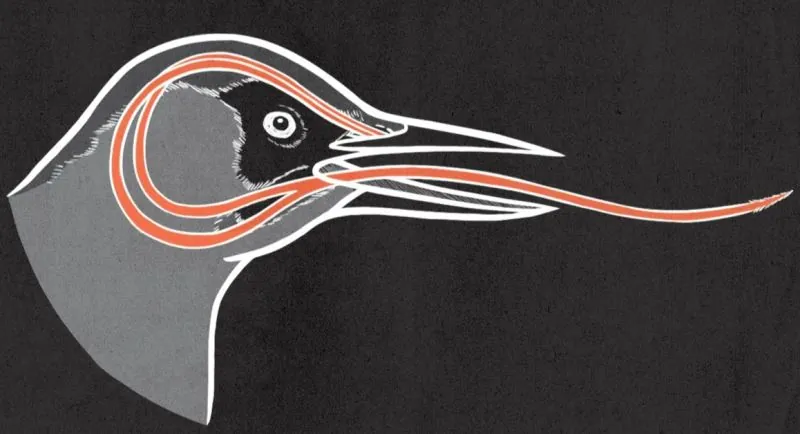
Most birds carry an ordinary little hyoid bone, small and unremarkable. In woodpeckers, that same bone has evolved into something extraordinary. It begins at the base of the beak, threads up through the nasal cavities, wraps around the entire skull, and finishes near the eye sockets. Imagine a bony harness looping the whole head from the inside out.
At the moment of impact, this structure spreads the shock across the skull instead of letting it concentrate in one spot. The trick isn't absorbing every ounce of force. It's scattering it, so no single point takes the full blow.
The Hyoid Bone: A Seatbelt Wrapped Around the Skull
Here is the twist most people miss about the woodpecker skull: the secret is not a tougher head, it is a stranger one. Inside a woodpecker sits a bone called the hyoid, and in most birds it is a small, unremarkable structure. In woodpeckers it has grown into something wildly elaborate, an oversized, ribbon-like bone that takes a route no ordinary skull would suggest.
Trace it with your finger and the path sounds almost invented. The hyoid begins at the base of the beak, threads up through the nasal cavities, loops all the way around the outside of the skull, and finishes near the eye sockets. It is as if the bird were wearing a bony harness, or a belt cinched around its own head.
That shape does a very specific job. When the beak slams into bark, the hyoid keeps the force from landing in one spot and driving straight into the brain. Instead, it spreads the shock across the whole skull, sending the energy outward in every direction at once. The protection is not about absorbing the blow completely. It is about distributing it, so no single point has to take the full hit.
Picture a seatbelt in a crash. It does not erase the impact. It keeps the impact from concentrating on your chest. The woodpecker's hyoid works the same way, and it is one reason a bird can hammer a tree at up to 20 strikes per second and still fly off to do it again. The deceleration in each peck is often quoted at roughly 1,000 times gravity, a force that, as the popular story goes, would be instantly fatal to a human brain.
Engineers have noticed. Woodpecker anatomy now feeds into the design of safer helmets, flight recorders and impact-resistant materials, all borrowing the same idea: spread the load, do not just brace for it.
Spongy Bone and a Small Brain: The Second and Third Lines of Defense
The woodpecker skull does not rely on the hyoid alone. Behind that bone sling sits a second cushion: a layer of spongy, porous bone tissue packed between the base of the beak and the front of the skull. The familiar account says this trabecular bone soaks up the blow before it ever reaches the brain, and in popular write-ups it is presented as a clean, built-in shock absorber.
Here is where the story gets interesting, and where the scientists start arguing. Recent biomechanical work questions how much that spongy layer actually softens the impact. Some researchers suspect its job is less about absorbing force and more about stiffening the skull or spreading the load, and the debate is far from settled. So treat the "second shock absorber" line as a popular description, not as settled physics.
The third line of defense is stranger still. Some recent research suggests the woodpecker's small brain structure itself may play a role in preventing concussion. A smaller, tightly packed brain may simply have less room to slosh around inside the skull, which would limit the kind of rattling that injures a human brain. It is a compelling idea, but it remains reported and debated rather than firmly established, so hold it loosely.
What we can say with confidence is that these layers do not work in isolation. The hyoid arches around the skull, the spongy bone sits at the front, and the compact brain rides inside, and together they spread and blunt each strike's effect. Engineers have taken notice: woodpecker anatomy is now a template for safer helmets, black boxes and impact-resistant materials. Nature solved the problem long before anyone thought to study it.
What Engineers Are Stealing From the Woodpecker Skull
Engineers study woodpecker anatomy to design safer helmets, black boxes and impact-resistant materials. This is not a loose metaphor. Woodpecker-inspired biomimetic engineering is a real, documented research area, and the woodpecker skull sits right at its center. The bird's head, shaped over ages of hammering, has become a blueprint for the things we build to keep people and data safe.
Think about what a helmet has to do. It has to survive a sudden blow and keep the fragile thing inside it intact. That is the woodpecker's whole life. The skull's architecture spreads force across a wide surface instead of letting it spike in one spot, and that principle translates directly into foam liners, layered shells and the geometry of a crash cage.
The same logic reaches into aviation. A black box has to keep recording through a violent impact, and the way a woodpecker head distributes shock offers a model for housings that bend and deflect rather than crack. Impact-resistant materials follow the same thread: absorb energy, spread it, and protect what is underneath.
Nature figured this out millions of years before we did. Engineers are just now catching up.

Frequently asked questions
How do woodpeckers peck 20 times a second without brain damage?
A woodpecker can hammer a tree up to 20 times per second, and the secret to surviving that is the woodpecker skull itself. An unusually long hyoid bone wraps around the skull like a belt, spreading the shock of each strike across the whole head instead of letting it concentrate in one spot above the brain.
What is the hyoid bone and how does it protect a woodpecker's brain?
The hyoid is a slender bone that, in most birds, stays small and unremarkable. In woodpeckers it has evolved into something far more elaborate: it begins at the base of the beak, threads through the nasal cavities, wraps around the entire skull, and ends near the eye sockets, acting like a biological seatbelt that disperses impact energy.
Why don't woodpeckers get concussions from pecking trees?
No single trick explains it. The hyoid bone distributes force across the skull, and a layer of spongy bone near the beak base is often described as a second shock absorber, though recent biomechanical research questions how much it really cushions. Some studies also suggest the birds' small brain structure helps, a finding that remains debated.
How does spongy bone in a woodpecker's beak absorb impact?
Between the base of the beak and the front of the skull sits porous, trabecular bone tissue. The familiar account holds that this spongy layer works alongside the hyoid system to soften every strike. That said, recent research questions the degree to which this tissue actually softens impact, so treat it as a plausible but unproven contributor.
What engineering designs are inspired by woodpecker skulls?
Engineers study woodpecker anatomy to build safer helmets, sturdier black boxes, and impact-resistant materials. The woodpecker skull is a documented model for biomimetic shock-absorbing design, and researchers keep returning to it because the bird solves a violent engineering problem millions of years before humans thought to ask.
How much force does a woodpecker's peck generate?
The deceleration force of each peck is often quoted at roughly 1,000 times gravity. The exact figure is not firmly fixed. And the popular claim that such a force would cause instantly fatal bleeding in a human brain is a vivid illustration rather than an established scientific finding.
Do woodpeckers have a special brain structure for shock absorption?
Some recent research suggests the birds' small brain structure may play a role in preventing concussion, but the findings are debated and the causal link is not firmly established. The woodpecker skull's most solid protection remains the hyoid bone, whose shock-spreading anatomy is well documented.
How does the woodpecker hyoid bone wrap around the skull?
It is a remarkable path. The hyoid starts at the base of the beak, passes through the nasal cavities, encircles the entire skull, and finishes near the eye sockets. This documented anatomy lets the bone act like a belt around the head, distributing impact energy across the woodpecker skull rather than delivering it to a single point. Editorial note: details that remain unconfirmed or are still debated in the research literature are presented here as hedged and provisional rather than settled fact.
Got a take on this? Add your voice to the conversation below →
No comments yet. Be the first.