Janney Coupler: The 1873 Invention That Revolutionized Rail
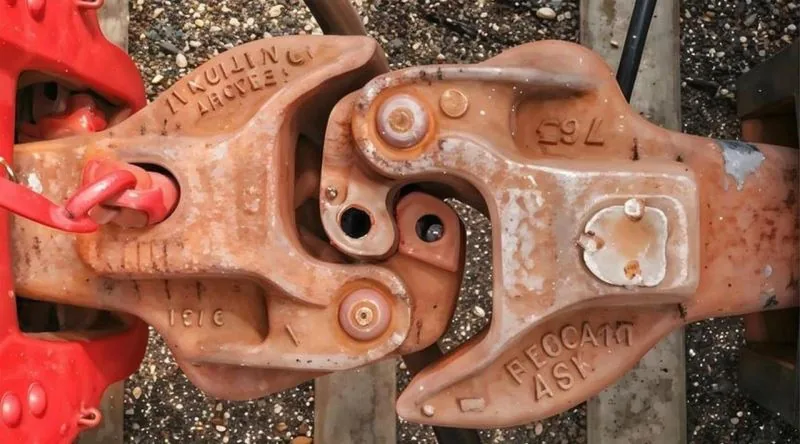
The Janney coupler is an automatic railway coupling designed by Eli H. Janney in 1873, and it went on to replace the dangerous old way of joining cars by hand on railroads around the world. Before it arrived, connecting two cars meant a worker standing between them, guiding a heavy pin while the steel rolled together. The men who did that job were called brakemen, and many of them lost fingers, hands, or their lives in the gap. Janney's design took the human body out of that space, and the change it set in motion reshaped railroading for good.
Eli H. Janney patented an automatic railroad car coupler in 1873. His design let cars lock together on contact, removing workers from between moving trains. It is widely used in the United States and around the world, and it shaped coupling systems used far beyond its home rails.
- Eli H. Janney, an American inventor, received a patent for his automatic car coupler in 1873.
- The device replaced the old coupling method, which required a worker to stand between cars to connect them by hand.
- Janney's coupler locked automatically when cars met, so no one had to reach into the gap during coupling.
- The design is one of the most reliable railway couplers, widely used in the United States and around the world.
- The American Society of Mechanical Engineers recognized the Janney coupler as a historic mechanical engineering landmark.
The 1873 Invention That Changed Railroading Forever
In 1873, an American inventor named Eli H. Janney designed a small piece of iron that would quietly reshape how the world moves freight: the Janney coupler. He secured U.S. Patent No. 138,405 that same year, and the device went on to become one of the most reliable railway couplers in use, both across the United States and around the globe.
Picture the problem it solved. Before this, linking two railcars was hands-on, dangerous work. A worker had to stand between the cars and drop a pin by hand while the steel crept closer. The Janney coupler took that job away from human fingers. As the cars roll together, the knuckle swings shut and a lock pin drops into place on its own. No one has to reach into the gap.
That automatic lock is the heart of the design. It holds the knuckle closed so cars cannot drift apart under load, and it lets the whole coupling withstand the enormous pull and push forces of heavy freight. In the United States, these couplers are manufactured to standards set by the Association of American Railroads, which is why the fitting is sometimes loosely called an AAR coupling, though that alternate name is not the standard one. The Janney name is the one that stuck.
The payoff reached far beyond one patent drawing. Because workers no longer had to step between cars to couple and uncouple them, coupling accidents dropped, and the automatic lock sped up operations in the yard. The same standardized knuckle could connect different car types and train sets, so a locomotive could pull whatever the railroad needed it to pull. The American Society of Mechanical Engineers later recognized the Janney car coupler as an International Historic Mechanical Engineering Landmark, a nod to how much hinges on that one humble piece of iron.
How the Janney Coupler Locks Itself
Picture a switchyard at dusk. A locomotive backs a string of freight cars toward a cut of standing wagons, and the last gap closes to a few inches. Nobody stands between the cars with a lantern. The Janney coupler does the work itself: the knuckle pivots shut as the two heads meet, and a lock pin drops into place behind it. Two railcars join themselves, and the yard crew never touches the joint.
That is the mechanical magic in one sentence. The coupler is a hinged jaw, the knuckle, mounted on the car's drawhead. As the opposing knuckle pushes against it, the jaw swings closed. The moment it seats, a gravity or spring-loaded lock pin falls into the pocket behind the knuckle and holds it shut. No lever, no pin, no hand signals. The couplers lock automatically when cars approach each other, so no manual intervention is needed to make the connection.
The lock is also what keeps the train together. Because the pin sits behind the closed knuckle, the joint cannot open under load, so the design includes a locking mechanism that prevents cars from accidentally separating. That matters when a single train is dragging thousands of tons. Janney-type couplers withstand high pull and push forces, and they are standard equipment in heavy freight transport. In the United States they are manufactured to Association of American Railroads standards, the specification that lets a car built in one shop couple to a car built in another.
The payoff shows up in the yard. Coupling and uncoupling demand far less physical intervention from workers, which is exactly why the automatic joint cut down on accidents: nobody has to reach between two cars to guide a link and drop a pin. The automatic locking mechanism also raises operational speed, and the standardized knuckle face lets the same coupler work across different car types and train sets.
One bit of housekeeping on names. The Janney coupler is well established, and so is the knuckle coupler label, but you will sometimes hear it called an AAR coupling. Treat that as loose shorthand rather than an official title.
The Safety Revolution: Fewer Hands Between the Cars
Picture the old way of joining two freight cars. A brakeman stands on the track, one hand steadying a heavy iron link, the other guiding a pin, while thousands of tons of rolling steel creep toward him. A misjudged gap, a slipped pin, a car that doesn't stop where it should. Every coupling was a gamble, and the men working the yard knew it.
The Janney coupler took that gamble off the table. When two cars meet, the knuckle pivots shut and a lock pin drops into place on its own. Nobody has to stand between the cars to guide a link or hammer a pin home. The worker steps back, the cars do the rest, and the locking mechanism holds the knuckle closed so the two cars stay together under load instead of drifting apart on a grade.
That shift mattered most for the people doing the job. Coupling and uncoupling with the Janney design demands far less physical intervention from yard crews, and that is exactly where the accident reduction comes from. The danger zone between two cars shrinks from a workplace to a place nobody needs to be.
Speed followed safety. Because the lock engages automatically, trains can be assembled and broken up faster, and a crew can move through a long cut of cars without stopping to wrestle with hardware. The same standardized knuckle interface works across different car types and train sets, so a locomotive, a boxcar and a flatbed all speak the same mechanical language. That interchangeability is a quiet part of why the Janney coupler became one of the most widely used and reliable railway couplers in the United States and around the world.
In the US, couplers of this type are built to Association of American Railroads standards, a set of specifications covering dimensions, materials and performance for interchange service. The design has to survive enormous pull and push forces, and it does, which is why heavy freight transport leans on it so heavily. The American Society of Mechanical Engineers recognized the Janney car coupler as an International Historic Mechanical Engineering Landmark, a formal nod to how much a single locking knuckle changed the way railroads move freight.
From a Single Patent to a Standard the World Trusts
Walk into a rail yard in the United States and count the couplers on the cars. Every one of them answers to a single set of rules. The Janney coupler is manufactured in the US to AAR standards, and that phrase carries real weight: AAR stands for the Association of American Railroads, the body whose specifications govern how a coupler is shaped, what it is made of and how much load it must survive before it ever touches a track.
That is the quiet miracle of a good standard. A part born from one inventor's idea in 1873 becomes a shared language. A shop in one state builds a knuckle, a repair crew in another swaps it out, and the two pieces fit because both were measured against the same book. The AAR's Manual of Standards and Recommended Practices does the unglamorous work of making that possible, section by section.
And the reach does not stop at the border. The Janney coupler is one of the most reliable railway couplers in the world, used widely across the United States and far beyond it, and it plays an important role in railway transport worldwide. You will not find a more convincing proof of a design's worth than watching different countries adopt it on their own tracks.
Part of that spread comes down to brute strength. The coupler takes high pull and push forces without complaint, which is exactly what heavy freight demands when a long train stretches and compresses over every grade. The locking mechanism holds the knuckle shut, so cars do not drift apart under load. Automatic locking means the coupling happens on its own as the cars meet, and that same speed carries over to switching and marshalling, where different car types and train sets have to connect without fuss.
None of this stayed a private achievement. The American Society of Mechanical Engineers (ASME) designated the Janney car coupler an International Historic Mechanical Engineering Landmark, a formal nod from the engineering profession that this small piece of iron changed how the world moves freight. The ASME record stands as the reference behind this account.
A patent from 1873, a standard from the AAR, a landmark from the ASME. Three stamps on one stubbornly simple idea.
Frequently asked questions
Who invented the Janney coupler, and when?
Eli H. Janney, an American inventor, designed it in 1873 and received U.S. Patent No. 138,405 for his automatic car-coupling that same year. His knuckle-style design became one of the most reliable couplers in the world, widely used across the United States and in many countries around the globe.
How does the Janney coupler lock automatically?
As two cars roll together, the curved knuckle swings closed and a gravity or spring-loaded lock pin drops behind it, holding the jaw shut. Nothing needs to be latched by hand. That same locking mechanism keeps the knuckle from creeping open, so cars cannot drift apart on their own under the pull and push of a moving train.
Why is the Janney coupler considered safer than older coupling methods?
Older coupling methods forced workers to step between the cars to drop a pin or guide a link, and a slip or an unexpected jolt could crush a hand or worse. The Janney coupler removes that moment entirely, since the connection happens automatically as the cars meet. Fewer hands between the cars means fewer yard accidents.
Was the Janney coupler adopted worldwide?
It is widely used in the United States and around the world, and it remains one of the most trusted railway couplers anywhere. Its standardized knuckle interface lets different car types and trainsets connect to one another, which is a big part of why it spread so far.
What are the AAR standards for Janney couplers?
In the United States, Janney-type couplers are manufactured to standards set by the Association of American Railroads, published in the AAR's Manual of Standards and Recommended Practices. These rules fix the dimensions, materials and performance the coupler must meet so that equipment from different railroads can interchange in heavy freight service.
Did the Janney coupler reduce railway accidents?
Yes. By cutting out the manual work of coupling and uncoupling, the design reduced the injuries that came from workers reaching between cars. It also sped up operations: automatic locking lets trains be assembled faster, and the coupler's strength under high pull and push forces made it a workhorse of heavy freight transport. Editorial note: Details that remain unconfirmed, including the precise timeline of early adoption, are presented as such and hedged accordingly.
Got a take on this? Add your voice to the conversation below →
No comments yet. Be the first.