The Dark Tower: Stephen King's Hidden Web of Connections
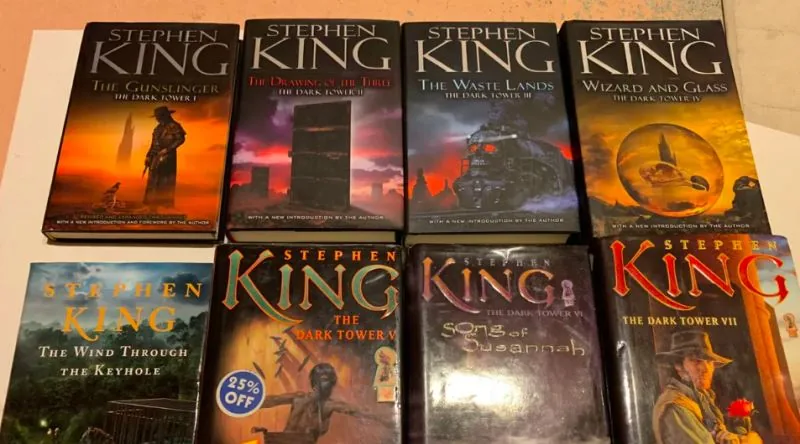
Stephen King's The Dark Tower connections run through more than thirty years of his fiction, linking Roland Deschain's quest to The Stand, It, 'Salem's Lot and Doctor Sleep. For longtime readers, the series is less a separate story than the spine of a whole imagined world. Once you notice the doorways, the walkin' dude and the thinny, you start seeing them everywhere, in novels you read years before you ever picked up The Gunslinger.
The Dark Tower connections tie Stephen King's long-running series to much of his other fiction. Randall Flagg appears in The Stand and elsewhere, Father Callahan crosses from 'Salem's Lot, and the thinny and the Beam echo through It, Doctor Sleep and beyond. King has long described the series as his central work.
- Randall Flagg, the antagonist of The Stand, is also the Man in Black who shadows Roland across the Dark Tower series.
- Father Callahan, first seen in 'Salem's Lot, returns in Wolves of the Calla and later books as a key ally.
- The thinny, a destructive ripping sound in the fabric of reality, appears in both The Dark Tower and later King novels.
- King has publicly called The Dark Tower his masterpiece and the center of his fictional universe.
- Joe Hill, King's son, has written work that shares threads with the Dark Tower and King's wider mythology.
The Dark Tower Connections: Stephen King's Hidden Web of References
The Dark Tower connections run through nearly everything Stephen King has written, and some of the clearest ones live in the small, strange details. Father Callahan is the cleanest example. He first appears in 'Salem's Lot, fighting vampires, then leaves town and vanishes from the page. He turns up again in the fifth Dark Tower book, Wolves of the Calla, at a place called Calla Bryn Sturgis, where he helps Roland and his ka-tet on their quest. One character, two books, decades apart.
King's reach goes beyond his novels. The TV series Haven, adapted from one of his short stories, is said to be packed with nods: the name Flagg on an old scroll in the opening credits, an episode built around the giant killer lobstrocities, and a town troubled in ways that might mean it holds a door into Roland's world.
The Stand and the Long Shadow of Randall Flagg
In The Stand, King's 1978 novel, a superflu nicknamed Captain Trips wipes out nearly the entire U.S. population. Randall Flagg is the villain there, and he is the villain of The Dark Tower series too. Many fans of the series, the writer of the original account included, count The Stand as the first Dark Tower book.
Flagg's old enemy in The Stand, Mother Abagail, is reportedly mentioned in the fourth Dark Tower book, Wizard and Glass. Treat that one as a maybe.
Short Stories, Small Towns, Shared Ground
Everything's Eventual, King's 2002 collection, is set partly in Derry, Maine, and introduces Dinky Earnshaw, a telepathic breaker who later works for the forces in the Dark Tower books. In that same story, a character named Skipper Brannigan torments Dinky; the original account claims Skipper is later named in the series as a friend of one of the characters, though that link is unconfirmed.
The town of Lud, which appears in the third Dark Tower book, The Waste Lands, also surfaces in Rose Madder. That one is solid.
Bridgton, Maine, is the setting of the short story The Mist, from Skeleton Crew, and the same town's pharmacy is reportedly mentioned in both that story and the series. The original account floats the idea that an experiment opened a "thinny" there, one of the shimmering tears in reality scattered across the series, letting the monsters through the fog. Keewaydin Lake in Maine is said to appear in both the sixth Dark Tower book and Bag of Bones, though Bag of Bones actually centers on Dark Score Lake, so that claim looks shaky.
It, the Turtle, and the Deadlights
The deadlights, that terrible light from beyond, are shared by It's Pennywise and the Crimson King. Stuttering Bill and the magical Turtle, Maturin, also turn up in both the series and It. The original account adds that matching wallpaper with roses and green-hatted elves hangs in the Dutch Hill house in the series and the house on Neibolt Street in It, and that the 2003 version of The Gunslinger names an end-world creature called Legion while the voices in It's sewers call themselves Legion. Both details are unconfirmed, so hold them loosely.
When King Wrote Himself In
In the later Dark Tower books, King writes himself into the story. In the sixth book it emerges that he is supposed to be struck by a minivan and die on June 19, 1999. In the seventh, his own characters save him. In 11/22/63, Jake Epping sees a Takuro Spirit, an alternate-America car brand from the Dark Tower books. The original account also claims that date marks a Vermont Yankee nuclear reactor explosion in that novel, a detail that can't be confirmed.
In Doctor Sleep, adult Dan Torrance is said to use Jake Chambers' famous line, "There are other worlds than these." The line is Jake's, from The Gunslinger; Dan saying it is unverified.
Prequels, Portals, and the Wider Mythos
The Eyes of the Dragon can be read as a kind of prequel, with Randall Flagg as an evil wizard who frames a young prince named Thomas for the murder of his father the king. The original account says Thomas and his servant Dennis then chase Flagg, a story also read in the third Dark Tower novel; that pursuit detail doesn't match the books, so take it with salt.
From a Buick 8 offers a car that reportedly opens onto todash spaces, and its previous owner may have been one of the low men, though both points are interpretive. In Insomnia, Patrick Danville appears; he later becomes Roland's companion in the final Dark Tower book. The original account claims one of the Crimson King's incarnations is revealed as King Herod, and lists Ed Deepneau, Derry, ka, ka-tet, Ralph Roberts and "todana" among the crossovers, none of which could be verified.
Black House is set in French Landing, Wisconsin, and reportedly carries a long list of ties: Blaine the Mono, Ted Brautigan, can-tah, Jake Chambers, Eddie and Susannah Dean, Roland Deschain, ka, Legion, Opopanax, the speaking demon, the Territories, and the Dark Tower itself. Not every item checks out. Ur is said to mention the magical rose and the Tower and to show low men without naming them. Desperation is claimed to feature both can-tah and can-toi, and Hearts in Atlantis is said to include Ted Brautigan, the Crimson King, Derry, Roland, the ability to dim, Randall Flagg, Bobby and Liz Garfield, Carol Gerber, ka-tet, low men and John Sullivan. Those lists are reported, not confirmed.
Odds and Ends Across the Shelf
The original account also points to Nozz-A-La, a bizarre-world take on Coca-Cola, in both Kingdom Hospital and the series; a fading ability that makes a person harder to detect in both the series and Sleepwalkers; Zelda Goldman in Pet Sematary treating the Wizard of Oz as a version of Death, with Roland's ka-tet later visiting a version of Oz's palace; the Bridgton pharmacy turning up in Cujo; and Captain Trips and Jerusalem's Lot both appearing in Night Shift. Each of these is unverified. In Cell, comic-book artist Clayton Riddell reportedly writes a Western fantasy called The Dark Wanderer about an apocalyptic cowboy named Ray Damon who uses six-shooters much like Roland's, and later meets a child's push toy called Charlie the Choo-Choo, the sinister children's book Jake Chambers buys in the series. Neither detail is confirmed.
In the short story N, the standing stones in Ackerman's Field are said to resemble the demon-haunted speaking rings of Middle-earth. NOS4A2, by King's son Joe Hill, is reported to reference Middle-earth and "the clearing at the end of the path," a euphemism for death used in the seventh Dark Tower book.
Editorial note: details that remain unconfirmed are presented as such, and readers should treat any speculative links between books as interpretation rather than established fact.
Got a take on this? Add your voice to the conversation below →
No comments yet. Be the first.