Fascism Timeline: Mussolini's 1919 Founding to 1945 Fall
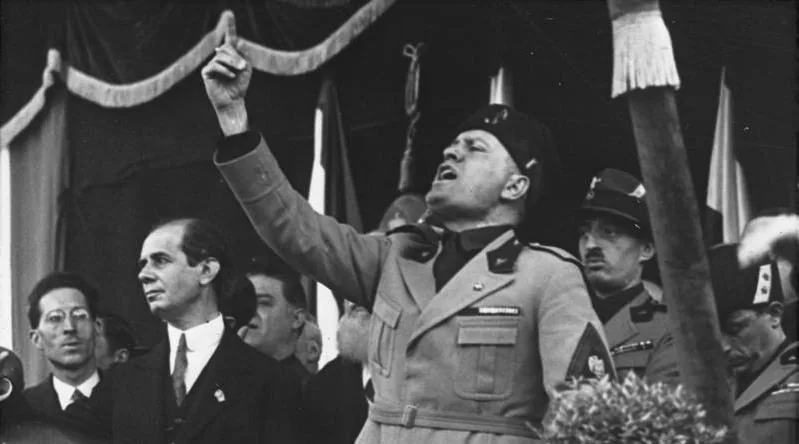
This fascism timeline runs from March 1919, when Benito Mussolini founded the Fasci di Combattimento in Milan, to the end of the Second World War and the collapse of the regimes it inspired. It is a story of how a movement built in a rented hall took over a state in three years, then exported a template that half of Europe would eventually copy. The dates matter because they show how quickly ordinary politics can be replaced, and how long it took the world to push back.
Mussolini founded the Fasci di Combattimento in Milan in March 1919. His Fascists took power after the March on Rome in October 1922, and by the late 1920s Italy was a one-party dictatorship. Fascist-style movements spread across Europe in the 1930s, and the regimes fell with the Axis defeat in 1945.
- Mussolini launched the Fasci di Combattimento in Milan on 23 March 1919, drawing mostly on war veterans and nationalist radicals.
- The March on Rome in late October 1922 pressured King Victor Emmanuel III into appointing Mussolini prime minister.
- The Lateran Treaty of 1929 settled the dispute between Italy and the Vatican and strengthened Mussolini's standing at home.
- Oswald Mosley founded the British Union of Fascists in 1932, one of many European movements modeled on Italian Fascism.
- Mussolini was deposed in July 1943 and killed by partisans in April 1945, and the Axis regimes were defeated by the war's end.
A Socialist Breaks Ranks: Where the Fascism Timeline Begins
Benito Mussolini was a socialist journalist who would soon serve in the Italian army. In 1915, he walked away from socialist policy and threw his voice behind the war. That break is where this fascism timeline starts, not with a party, but with a man changing sides.
Picture him in that moment. He had written for the socialist press. He had decided that neutrality was the wrong answer and that Italy should fight, and he began building toward the Partito Fascista Rivoluzionario (PFR). Keep the dates straight here, because 1915 is the break, not the founding. The party itself comes later, in 1919, when Mussolini establishes the Fasci di Combattimento in Milan and its manifesto stakes out Italian nationalism.
Four years, one war, and a journalist turned interventionist. Everything that follows on this timeline grows out of that single turn.
1919: The Fasci di Combattimento and the Fascist Manifesto
On 23 March 1919, in a hall in Milan, Benito Mussolini launched the Fasci Italiani di Combattimento, and the manifesto issued under that name preached Italian nationalism to the crowd. It was not a party yet, not in any formal sense. It was a league of fighting squads, and it marks the founding moment of the fascism timeline in Italy.
Imagine the room before the speeches. Veterans back from the trenches, a scatter of nationalists, a few restless young men who had spent the war years waiting for something to happen and now found the waiting unbearable. Some came in uniform. What they joined that spring was a movement named after the fasces, the bundle of rods and an axe carried in ancient Rome as a sign of authority. The name told you the mood. Discipline, force, the many bound together so they could not be broken.
The manifesto they signed that year leaned hard on nationalism. Italy had won the war, or so the argument went, and come away with scraps while the great powers divided the spoils. That grievance needed somewhere to go, and the Fasci offered it a home. The squads, the black-shirted bands that would later swell into a paramilitary wing, were still small in 1919. The structure was loose, the financing thin, the whole thing closer to a club of angry men than to a government in waiting.
Yet the founding mattered far more than its numbers suggested. Mussolini had already broken with the socialists and thrown his weight behind the war, and in Milan he began assembling something the old parties could not quite name. A fighting league rather than a party, organized around squads, promising action where the politicians offered talk. From that March day forward, the movement had a name, a manifesto, and a man determined to use both.
1919 to 1920: The Nazi Party's Founding (and a Correction)
Anton Drexler did not found the National Socialist German Workers' Party in 1920. He co-founded a smaller outfit, the German Workers' Party, in January 1919, in Munich. That group was renamed the NSDAP in February 1920, and the swastika came into use as its emblem around that same year, not on day one. The 1920 date floating around is reported, but it compresses two separate events into one.
So the tidy line on the fascism timeline, "1920, the Nazis are founded," is half true and half shorthand. What actually happened in 1920 was a rebranding. A fledgling workers' party got a louder name, a hostile worldview, and a symbol that would soon be impossible to forget. The swastika was adopted around 1920, which means the party's visual identity arrived after the party itself.
The ideas, though, were already set. Drexler's circle chased an expansionist nationalism, the belief that Germany's destiny lay in taking more land and more power. They built their politics on two pillars of resentment: an anti-Semitic outlook and a fierce anti-Marxism. And they preached a specific ideal, the Volksgemeinschaft, a "people's community" reserved for those they counted as belonging to a superior Aryan race.
Picture the beer halls of Munich in those early months. Small meetings, cheap pamphlets, and a handful of men convinced they were building something historic. Nobody outside the room was watching yet. The party that would later swallow a continent was, in 1920, just finding its name.
1921 and 1922: The March on Rome and Mussolini's Appointment
On 30 October 1922, King Victor Emmanuel III handed Benito Mussolini the job of prime minister of Italy. That single appointment is the hinge on which the whole fascism timeline turns: a street movement became a government, and it happened without a shot fired at the gates of Rome.
How did it get there? Through 1921 and 1922, the Blackshirts, the party's paramilitary wing, swelled with unemployed veterans and men who felt the postwar years had cheated them. They bullied socialists off the streets, seized towns, and made it clear that they were willing to use force where the state hesitated. The pressure built until the squads converged on the capital for a mass rally in Rome, a show of strength dressed up as a demand for power.
It worked. The party, freshly renamed the National Fascist Party (Partito Nazionale Fascista), stepped into office, and Mussolini took the premier's chair. The march did not win the government by storming it; the threat of the march, and the king's decision to avoid a fight, did the job.
A movement born on street corners in 1919 was running the country by the end of 1922.
That contrast is the heart of this stretch of the fascism timeline. In just over three years, Mussolini had gone from founding the Fasci di Combattimento to sitting at the head of the Italian state, and the rest of Europe was about to take notice. A certain admirer in Munich was watching closely.
1923 to 1926: Hitler's Putsch, the Dictatorship, and OVRA
On 8 and 9 November 1923, Adolf Hitler, an admirer of Mussolini, led a failed coup in Munich that became known as the Beer Hall Putsch. He was later tried for treason. In doing so, he turned the Italian model into a script that other would-be dictators would try to follow, a key turning point in any fascism timeline.
Mussolini's own consolidation came in stages. By 1925 he had grown strong enough to declare Italy a fascist state and to take the title "Il Duce," meaning leader. Popular accounts often say he dissolved parliament that year. The record suggests otherwise: the Chamber was not formally dissolved in 1925, it was replaced in 1939. What happened in the mid-1920s was the squeezing out of opposition deputies and the steady hollowing of parliamentary power, not a single ceremonial stroke.
Then came the machinery of repression. In 1926 Italy established OVRA, a secret police organization built to crush anti-fascist opposition. Its methods were intimate and ugly: it leaned on denunciations turned in by ordinary citizens, and it reportedly pressured priests into spying inside the Vatican. You can picture the atmosphere, neighbors watching neighbors, a knock that arrives because someone talked.
The link to Nazi Germany is where the story gets slippery. A popular version holds that OVRA laid the groundwork for the Gestapo, the German secret police that Heinrich Himmler would establish in 1933. That direct lineage is not well established in the historical record. The Gestapo was in fact established in 1933 under Hermann Göring, with Himmler taking over in 1934. So the two forces shared a climate and a purpose, but the neat family tree is a claim the sources do not firmly support.
1929 to 1931: The Lateran Treaty and the Depression
On February 11, 1929, Mussolini and Cardinal Pietro Gasparri signed the Lateran Treaty in Rome. The Catholic Church formally recognized the Kingdom of Italy, and in return the papacy's sovereignty was confirmed over a new Vatican City State of roughly 44 hectares. It was a bargain that handed the regime something money could not buy: respectability.
Notice what the Church actually recognized. Contrary to the popular shorthand, the treaty text named the Kingdom of Italy, not a "fascist state." Still, the effect was the same in the streets. A regime that had spent years breaking heads with its black-shirted squads now stood shoulder to shoulder with the Pope, and the Vatican gained a cash settlement along with its patch of sovereign ground inside Rome.
Then the floor gave way. In May 1931 the Austrian bank Creditanstalt collapsed, and the shock ran straight through Germany, where foreign investors pulled back fast. By early 1932 German unemployment had climbed to roughly 25 percent. Factories sat quiet. Savings vanished. Men who had never voted for anything extreme began listening to anyone who promised a way out.
The fascists had a ready answer, and it was ugly. They pinned the crisis on immigrants, on minorities, on leftist internationalism, on anyone foreign or organized. Scapegoats are cheap, and in a depression they sell.
What followed is one of the stranger threads in the fascism timeline. The pull of these ideas reached across the Atlantic. Henry Ford, the American automaker, cooperated with businesses operating in Nazi Germany and would later receive the Grand Cross of the German Eagle from Hitler in 1938. Respectability, it turned out, could be bought on both sides of the ocean.
1932 to 1934: Mosley, the Nazi Seizure, and French Fascists
In October 1932, Oswald Mosley founded the British Union of Fascists, a move that came directly after he traveled to Italy to study Mussolini's regime up close. Mosley was no fringe figure. He had already left the Conservative Party and later won two seats in Parliament as an independent Labour member, so his turn to fascism gave the movement a respectable English face. His new party borrowed the trappings of Italian blackshirts and sold itself as a modern, national alternative to a faltering political class.
Two years later, in 1934, the British press gave Mosley a powerful megaphone. The Daily Mail, the paper run by press baron Lord Rothermere, threw its weight behind the British Union of Fascists, and Rothermere's famous headline urged readers to back the blackshirts. A second claim, that the Daily Mirror backed the party too, is much less certain and should be treated with caution. What is clear is the pattern: fascism had become a brand that press barons could sell to a nervous middle class.
Across the Channel, events moved faster. In January 1933, Adolf Hitler was appointed chancellor of Germany, not swept in by a coup but handed the office through the normal machinery of the Weimar Republic. By 1 April 1933, the Nazi regime had organized a nationwide boycott of Jewish businesses, with stormtroopers posted outside Jewish shops and the Star of David painted on windows. Jews were pushed further out of public life with each passing month.
France had its own copycat movements. Marcel Bucard led the Mouvement Franciste, an anti-Semitic fascist group that styled itself after the Italian model. The original account says Bucard's followers rose up in Paris in 1934 to protest the economic crisis and attempted a right-wing coup that collapsed. That revolt and coup attempt are not well documented, so treat them as unverified. What is solid is the man and his movement: Bucard built one of France's most openly anti-Semitic fascist organizations during these years.
The wider lesson of this stretch of the fascism timeline is speed. In eighteen months, a British aristocrat, a German chancellor and a French street agitator were all reading from the same playbook, and the newspapers were helping them print it.
1936 and 1937: Spain, Brazil, and the Global Reach of Fascism
In 1936, Italy and Germany threw their weight behind Francisco Franco's nationalist forces in a war against Spain's Second Spanish Republic, a democratically elected government. The fighting tore Spain apart for three years, until 1939. That conflict pulled the fascism timeline out of Italy and Germany and onto a world stage, and it did not stop at Spain's borders.
What made Spain different was who showed up to fight. Antifascist volunteers and groups from all over the world poured into the country to defend the government and stand against the rising tide of fascist repression. Ordinary people, not just soldiers, decided this was their fight too.
It was not enough. The Falange, a fascist-leaning party, ended up taking power, and all that resistance could not stop it.
The same year, the story jumped across the Atlantic. Fascism was spreading everywhere now, and Brazil felt it. In 1937 the dictator Getulio Vargas banned Brazilian Integralism, a fascist-leaning and anti-liberal movement that drew its muscle from a green-shirted paramilitary group. One signature from a strongman, and a movement was gone.
Two countries, two very different endings. In Spain, the fascists won. In Brazil, a dictator shut them down before they could grow.
1939 to 1941: War, Japan, and the Holocaust
On 1 September 1939, German troops crossed into Poland, and two days later Britain and France declared war. That is the moment the fascism timeline stops being a story about marches and speeches and turns into a story about world war. Italy had already invaded Ethiopia in October 1935, and Germany had annexed Austria in March 1938. Poland was the step too far.
Fascist ideology had always been hungry for national glory and land. Expansion was never a side effect; it was written into the program. So the war that followed was not an accident of a single border dispute. It was the logic of the movement running at full speed.
Japan: a contested label
In 1940, Japan's military leadership pushed the idea that preserving traditional culture and national character required military dictatorship and regional expansion. The country chased what some scholars call "Showa statism," a loose label for Japanese fascism. The original account also says leftist political opponents were arrested one by one that year, but that specific framing is not firmly established. Treat it with care. "Showa statism" is a scholarly characterization rather than a fixed official doctrine. The broader turn toward militarism and expansion in that period is real. The label is a debate.
1941: the Holocaust
Then came the genocide. After years of escalating persecution, the Nazis began rounding up Jewish populations for mass slaughter. Approximately six million Jews were killed in the Holocaust. Anyone judged unfit for the fascist idea of the Volksgemeinschaft, the imagined "people's community," was destroyed alongside them. The persecution that had started with boycotts and exclusion ended in industrialized murder.
This is the part of the fascism timeline that no chronology can make tidy. The dates stack up neatly, 1939, 1940, 1941, and behind each one there are faces and names that the calendar cannot hold.
1943 to 1945: Mussolini's Fall and the Nuremberg Trials
In June 1940, Benito Mussolini marched Italy into World War II chasing a dream of rebuilding the Roman Empire. The dream collapsed. By 1943 he was reduced to running the Italian Social Republic, a German-puppet state, as leader of the Republican Fascist Party. When the Allies won the war, the reckoning came not on a battlefield but in a courtroom at Nuremberg in 1945 and 1946.
Picture the man who once strutted across Rome. After the Allies landed and the Fascist regime buckled, Mussolini's own Grand Council turned on him, and the king had him arrested. German paratroopers sprang him from captivity, and Hitler set him up as the figurehead of a rump state in northern Italy. It was a strange twilight: the speeches still echoed, but the tanks and the decisions belonged to Berlin. The Republican Fascist Party kept the rituals alive while real power slipped away with every Allied advance.
Then the war ended, and the victors faced a question the fascism timeline had never answered before. What do you do with men who turned a political movement into an industrial killing machine? The Nuremberg trials, held from 1945 into 1946, gave the answer. Nazi leaders stood in the dock and were convicted on three broad counts: war crimes, crimes against peace, and crimes against humanity. The verdicts did not just punish individuals. They wrote a new line into international law, the idea that a state's leaders could be held personally accountable for what they ordered.
So the story that began with a socialist journalist breaking ranks in 1915 ends with a gavel. Not a last stand, not a heroic collapse, but a courtroom in a battered German city, where the ideology that promised national rebirth was read out as a list of crimes. That is where the fascism timeline closes its circle.
Frequently asked questions
What was the March on Rome and why did it matter?
The March on Rome was a fascist power grab in October 1922, when Benito Mussolini's Blackshirt paramilitaries, many of them unemployed veterans, massed on the capital and pressured the government. King Victor Emmanuel III appointed Mussolini prime minister on 30 October 1922, handing fascism its first national government.
When did Mussolini declare Italy a fascist state?
Mussolini declared Italy a fascist state in 1925, taking the title "Il Duce" and crushing the opposition. One correction to the popular version: parliament was not formally dissolved that year. The Chamber of Deputies was eventually replaced by a chamber of fascist corporations in 1939.
How did Mussolini's fascism inspire Adolf Hitler?
Hitler admired Mussolini and openly copied his playbook. In November 1923 he launched his own bid for power in Munich, the failed Beer Hall Putsch, and was later tried for treason. The putsch flopped, but it made Hitler a national name and taught him to seek power through elections.
What was the Lateran Treaty and how did it help Mussolini?
The Lateran Treaty of 1929 settled the long feud between Italy and the Catholic Church. The Church recognized the Italian state, and papal sovereignty over the Vatican City State, a patch of about 44 hectares in Rome, was confirmed. For Mussolini, the deal bought enormous legitimacy.
Who founded the British Union of Fascists and when?
Oswald Mosley founded the British Union of Fascists in October 1932, after visiting Mussolini in Italy. Mosley had been a Conservative and then a Labour MP before striking out on his own. His Blackshirt movement borrowed uniforms, salutes and rhetoric straight from Rome.
How did the Spanish Civil War connect to fascism?
Italy and Germany backed Francisco Franco's nationalist forces from 1936 against Spain's elected Second Republic. The war ground on until 1939, drawing antifascist volunteers from around the world to defend the Republic. Franco's victory kept Spain under right-wing dictatorship for decades.
What happened to fascism after World War II?
After the Allies won in 1945, fascism's bubble burst. The Nuremberg trials of 1945 and 1946 convicted Nazi leaders of war crimes, crimes against peace and crimes against humanity. Mussolini himself had been killed by partisans in 1945, and his puppet state collapsed with Germany's defeat.
Was Henry Ford connected to Nazi Germany?
Yes. Ford's German operations cooperated with Nazi businesses, and in 1938 Hitler awarded Ford the Grand Cross of the German Eagle, the highest honor for foreigners. Ford's antisemitism and his global business reach made him a useful ally for the regime. Editorial note: Details that remain unconfirmed are presented as such and hedged, and no figures have been added beyond what the record supports.
Got a take on this? Add your voice to the conversation below →
No comments yet. Be the first.