Egon Schiele's The Family: A 1918 Pandemic Portrait
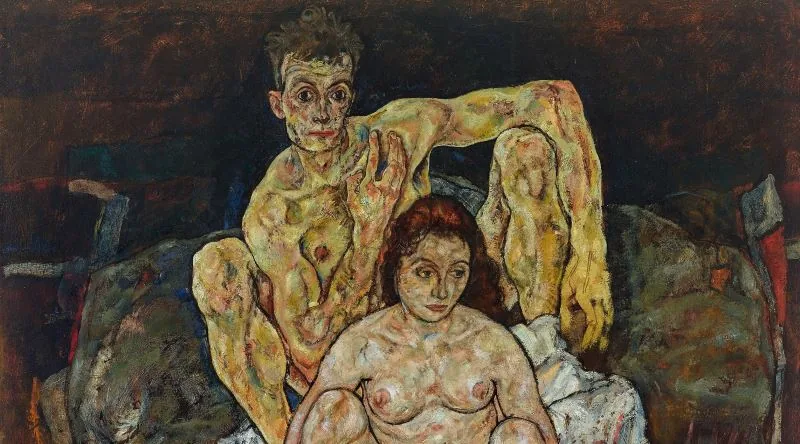
Egon Schiele painted The Family in 1918, the same year the Spanish flu killed him and his pregnant wife Edith. The canvas shows three figures huddled together, a man, a woman, and the child they were expecting, and it has come to stand as one of the most haunting images of a pandemic year. Schiele made it in the final months of his short life, and the painting carries everything he was about to lose. It is a family portrait painted by a man who would never meet his child.
Egon Schiele painted The Family in 1918, depicting himself, his wife Edith, and the child they were expecting. That autumn, both he and Edith died of Spanish flu. The painting is widely read as a portrait of a family that never came to be.
- Egon Schiele created The Family in 1918, the last year of his life.
- The painting shows three figures: a man resembling Schiele, a woman modeled on his wife Edith Harms, and the child they were expecting.
- Edith Harms, Schiele's wife, appears in the painting alongside the couple's expected child.
- Schiele and Edith both died in 1918, the year the painting was made.
- The Family is often described as one of his final major works and a reflection of the grief and dread of the pandemic.
A Painting That Arrived With the Flu
In 1918, Egon Schiele painted The Family, a canvas now held by the Belvedere in Vienna. That same year, the Austrian Expressionist died, at just 28. He was born in Tulln, Austria, in 1890, and by the time he made this work he had become one of the defining figures of Austrian Expressionism. The painting is dated 1918, and it carries the weight of a year that broke Europe twice over.
Two catastrophes collided in those final months. World War I was grinding toward its armistice, and alongside it came the influenza pandemic, which began in the spring of 1918 and spread with brutal speed. Troops were moving across the continent, trains were running, zeppelins were in the air, and every one of those routes carried the disease into new cities and new countries. Estimates put pandemic deaths at 50 to 100 million people. The war's military deaths came to roughly 9 to 10 million. The virus killed far more than the fighting did.
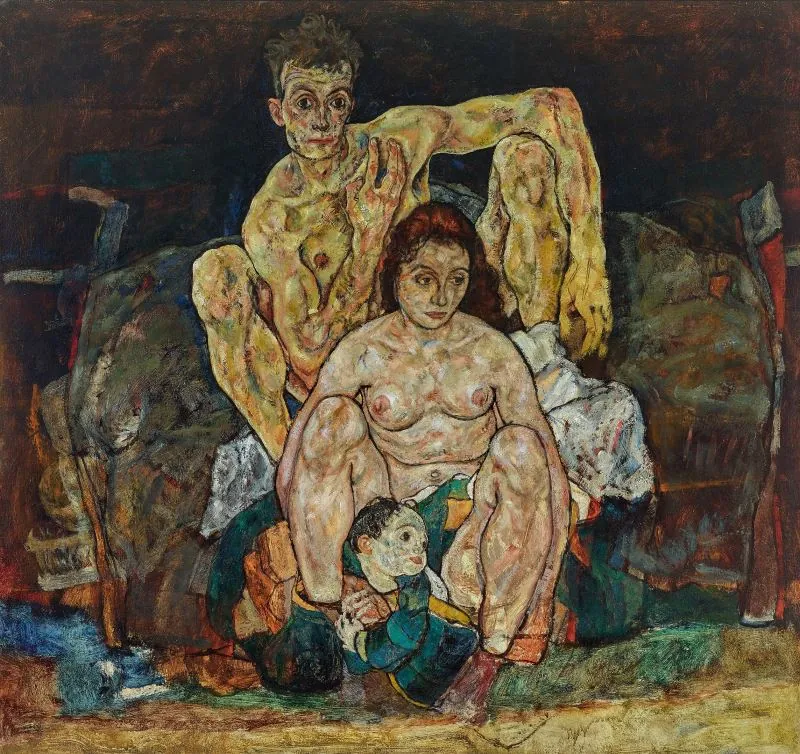
Schiele's painting depicts the artist himself, his wife Edith Harms, and their unborn child. That reading is the standard one in art history, and it makes the image almost unbearable to look at once you know the year. How much Schiele sensed of what was coming is impossible to say. What the picture does hold, from the first glance, is a sense of doom and dread.
And it looks nothing like his usual work. In his best-known canvases, his figures fill the whole frame as if shoved toward a cliff edge. Limbs bend at unnatural angles, bodies are drawn as hard bone, veins, broken lines, tense nerves. Here, everyone seems to have frozen and finally let go. For the first time in Schiele's work, the bodies turn soft and smooth. They have surrendered, and they wait for the dark to swallow them.
Who Is in Egon Schiele's The Family?
The three figures in Egon Schiele's The Family (1918) are the artist himself, his wife Edith Harms, and the child they were expecting. That identification is the standard art-historical reading of the canvas, and it is what makes the picture so unsettling: a painter assembling his own household on the canvas while the world outside was collapsing.
Start with the man. Schiele was an Austrian Expressionist, born in Tulln in 1890 and dead by 1918, so this canvas comes from the final year of his short life. Beside him sits Edith, and between them, pressed into the composition, the unborn child. Three people waiting. Nobody in the frame looks like they are leaving the room.
How much Schiele actually sensed about his own approaching death is genuinely hard to pin down. Did he foresee the tragedy, or was he simply painting a family he hoped to have? The honest answer is that we cannot say. What is unmistakable from the very first glance is the atmosphere: a sense of apocalypse and dread that settles over the group before you have even registered who they are.
Egon Schiele, the painter himself, posed as father.
Edith Harms, his wife, seated close at his side.
Their unborn child, held in the space between them.
The strangest part is the stillness. Schiele's figures usually twist and strain, limbs bent at unnatural angles, bones and veins and raw nerves pushing through the skin. Here, something has softened. The bodies look smooth, almost resigned, as though everyone has finally stopped struggling and is waiting for the dark to swallow them.
The Softest Figures Egon Schiele Ever Painted
Look at almost any other Egon Schiele figure and you feel the canvas closing in. His people fill the whole surface, pressed against the edges as if shoved into an abyss with no air left at the borders. Limbs twist into angles the body was never meant to hold. Flesh gets drawn as hard bone, raised veins, broken contour lines, nerves pulled tight like wire.
Then you reach The Family, painted in 1918, and something gives. The bodies here go still. Not stiff, not braced, just quiet. For the first time in Schiele's work the figures seem to gain a softness and a smoothness, their outlines rounded where his earlier line work cut like a blade. Art historians routinely describe this canvas as more tender and more resigned than the tense, contorted figures that made his name.
Resignation Instead of Struggle
That shift is the whole story of the picture. His usual subjects fight the frame. These three have stopped fighting. They have handed themselves over, sitting in a huddle of skin and shadow, waiting for the darkness that is coming to swallow them. It is a surrender, and it reads less like despair than like exhaustion finally allowed to rest.
What makes the stillness stranger is who is in it. Schiele painted himself, his wife Edith Harms, and the child they were expecting, all in a single 1918 composition now held by the Belvedere in Vienna. How much of his own approaching death he sensed, how much of the tragedy he saw coming, is impossible to say for certain. But the calm in those softened bodies carries a weight his jagged early portraits never did. You can almost hear the room go quiet.
From Canvas to Pandemic History
Egon Schiele's 1918 canvas The Family has drifted far from the private room it was made in. Today it turns up again and again wherever people talk about the 1918 influenza pandemic, the outbreak remembered as the Spanish flu. The painting has become a kind of visual shorthand for a catastrophe that killed more people than the guns of World War I ever did.
That shift from family portrait to public emblem is worth sitting with. The picture was painted in the same year the flu swept through Europe, and in the same year Schiele died. What began as an intimate image of a man, his wife and their child now circulates as a warning about mass death. The story of how that happened is less a single moment than a slow, quiet accumulation of reproductions.
A Private Portrait Becomes Public Property
Ask where the painting actually gets used and the answer gets slippery. It is often said that encyclopedia entries and historical essays on the Spanish flu reach for Schiele's canvas as their illustration, and that claim shows up in plenty of retellings. But it is reported rather than firmly documented. Treat the encyclopedia-and-essay detail as a widely repeated belief, not a settled fact.
What is not in doubt is the sheer frequency of the image in pandemic discussions. Writers and curators keep returning to it, and that steady repetition is what did the work. A canvas that once belonged to one household now belongs to a shared memory of 1918.
Why This Image and Not Another
The painting has been called the strongest and most frightening illustration that a disease has ever received in the history of painting. That is a bold claim, and it lands because of what the figures do not do. They do not fight or flee. They sit, softened and resigned, waiting.
For a pandemic that killed tens of millions, that stillness says more than any scene of chaos could. The flu of 1918 arrived in the closing months of World War I, moving with troops and trains across a continent, and it killed far more people than the war itself. Schiele's family, painted that same year, seems to already know what is coming.
So the painting carries two histories at once. It is a husband and wife and an unborn child, and it is also a monument to a year when the world lost more than it could count. The fact that it now hangs in public view, endlessly copied, is the last turn in a story that started in a studio and ended in the middle of a global grief.
Frequently asked questions
What does the painting depict?
Egon Schiele's 1918 painting The Family shows three figures pressed close together against a bare background: the artist himself, his wife Edith Harms, and the child they were expecting. The standard reading treats the trio as a portrait of a household on the edge of a future that never arrived.
Who are the figures in the painting?
The three figures are Schiele, his wife Edith Harms, and their unborn child. Schiele painted it in 1918, the year both he and Edith died. Art historians read the unborn child as their expected baby, which makes the canvas a family portrait drawn before the family existed.
Why is The Family tied to the 1918 flu pandemic?
Schiele painted it in 1918, while the influenza pandemic swept through Europe in the final months of World War I. That outbreak killed tens of millions of people, far more than the military deaths of the war itself. The painting's dread sits right inside that moment.
Was Edith Schiele pregnant when he painted it?
According to the standard reading of the work, yes. Edith Harms, Schiele's wife, appears in The Family alongside a child, and art-historical commentary treats that figure as the baby she was carrying. Both she and Schiele died in 1918, the year the canvas was made.
What happened to Schiele and Edith in 1918?
Both died that year. Egon Schiele, born in 1890 in Tulln, Austria, was an Austrian Expressionist painter and a central figure of that movement. He and Edith Harms both died in 1918, the same year he painted The Family, and the canvas is now held by the Belvedere in Vienna.
How big is The Family?
Reported figures put it at roughly 152 by 162 centimeters, though the exact dimensions are not firmly settled. What is certain is the date, 1918, and the softer treatment of the bodies, which art-historical commentary often describes as more tender and resigned than Schiele's earlier contorted figures. Editorial note: Details that remain unconfirmed, including the precise dimensions of the canvas and the extent of Schiele's intentions, are presented as uncertain rather than settled fact.
Got a take on this? Add your voice to the conversation below →
No comments yet. Be the first.