Sun Starburst Photography: The Physics Behind Angular Rays

Have you ever looked at a photo of the sun and noticed it came out as a sharp, spiky star instead of a soft glowing ball? That is not a filter and it is not an app. It is diffraction, plain old physics happening inside your lens as light squeezes past the edges of the aperture blades. Once you see why it happens, you can chase that clean, dramatic starburst on purpose instead of catching it by accident.
A sun starburst appears when light diffracts around the edges of the aperture blades in your lens. A small aperture with straight, clean blade edges produces sharp, defined rays. The number of rays depends on the blade count, and odd blade counts generally produce twice as many visible points as even ones.
- Diffraction, the bending of light around the edge of an obstacle, is what creates the rays of a sun starburst.
- Stopping down to a small aperture like f/11 or f/16 usually strengthens the starburst effect.
- The shape and count of the rays are set by the aperture blades, so lens design matters as much as settings.
- An odd number of aperture blades typically doubles the visible points compared with an even number.
- Rounded aperture blades tend to soften the rays, while straight-edged blades keep them crisp.
The Accidental Discovery That Explains the Sun Emoji
This whole thing started with a single photo. Someone pointed a camera at the sun, and the frame that came back held something unexpected: crisp, angular rays fanning out from the bright core. The closer they looked at the high-resolution shot, the more those jagged spikes stood out, until the pieces clicked. It is the very same effect that gives the sun emoji its sharp, pointed rays.
Here's the part most people get wrong. Those rays are not a filter, not a preset, not something an editing app painted on afterward. Sun starburst photography is a physical optical phenomenon, and the light really does fan out into spikes inside the lens itself. The effect even has its own name among photographers: the sunstar effect. Once you know that, every glowing sun in a photo stops looking like decoration and starts looking like physics you can watch happen.
What makes it worth chasing is how specific the result is. The rays don't appear at random. They follow a rule tied to the tiny blades that shape the lens opening, and that rule decides whether you get a handful of spikes or a dense, star-like burst. The answer lives in the hardware, and it is simple enough that you can predict it before you even press the shutter. A lens is not just a window you point at the sky. It leaves a signature, and the sun is bright enough to show it.
Stopping Down: How a Tiny Aperture Starts the Show
To make the sun throw out those sharp points in a photo, you close the lens aperture way down to tiny values like f/16 or f/22. That setting physically shrinks the opening inside the lens. The aperture blades keep sliding inward until only a pinhole-sized gap is left, and the whole effect depends on that narrow opening.
Here is where the physics kicks in. A blazing, point-like source such as the sun streams through that narrow gap and strikes the hard edges of the aperture blades. Light normally travels in straight lines, but at these sharp edges it bends and scatters, a phenomenon optics calls diffraction. Diffraction bunches the light into certain directions, and the result is the star-shaped rays you see in the final frame. That is the entire engine behind sun starburst photography: no filter, no software, just light meeting a small hole edged by metal.
People often call the same look the sunstar effect. Once you understand the cause, the sun emoji's pointed rays stop feeling like a cute design choice and start looking like a physics diagram.
Why the Ray Count Isn't Random: The Even-Odd Rule
Count the spikes on a sun starburst and you are basically reading your lens's spec sheet. The rule photographers cite is simple: an even number of aperture blades gives you a ray count equal to the blade count, while an odd number of blades doubles it. So a 6-blade lens throws 6 rays, and a 7-blade lens throws 14. That is the general rule, and the numbers follow it.
The general rule is what matters here: count the blades, and if the number is even the rays match it, while an odd count doubles. That is why two photographers standing in the same field at the same second can get completely different stars, just because they are holding different glass.
| Aperture blades | Parity | Rays produced |
|---|---|---|
| 6 | Even | 6 |
| 7 | Odd | 14 |
| 9 | Odd | 18 |
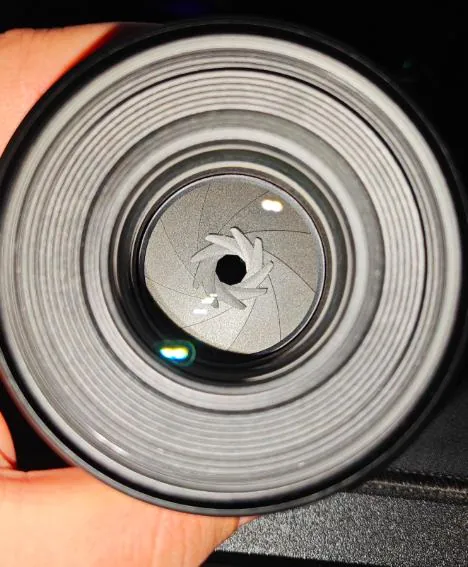
A real-world check sits in the Canon RF 85mm f/2 Macro IS STM, a lens with 9 aperture blades. Nine is odd, so theory says 18 rays, and shoot into the sun with that glass stopped down and the count should land right around there. It is a tidy test of a rule that shows up all over sun starburst photography, and you can run it yourself on any lens whose blade count you can look up.
This is the part that surprises people. The pretty star is not a filter, not an app, and not a preset. It is the shape of the hole the light squeezed through, recorded honestly.
The Canon RF 85mm f/2 Macro IS STM: Nine Blades, Eighteen Rays
The lens behind this whole discovery was a Canon RF 85mm f/2 Macro IS STM. It has 9 aperture blades. Nine is an odd number, so the arithmetic of sun starburst photography says this lens should throw an 18-ray star. That is the theoretical count, and it follows straight from the rule.
Here is where the general rule earns its keep. Count the aperture blades. If the count comes out even, the number of rays matches the number of blades. If it comes out odd, you double it. That one line explains why two photographers in the same spot can get completely different stars, simply because they are holding different glass.
| Aperture blades | Parity | Rays in the star |
|---|---|---|
| 9 (Canon RF 85mm f/2 Macro IS STM) | Odd | 18 |
So the next time you frame the sun and see those crisp points fanning out, remember you are not looking at a filter, a preset, or a bit of editing flair. You are looking at the shape of the hole the light had to squeeze through, and at the number of metal leaves that made it. The lens is drawing its own signature across the sky.

Frequently asked questions
Why does the sun look like a star with rays in a photograph?
The rays come from diffraction. When you stop the aperture down to a small setting like f/16 or f/22, the opening in the lens shrinks to nearly a pinhole. Light from a brilliant point source such as the sun squeezes through that narrow gap, strikes the sharp edges of the aperture blades, and bends and scatters into concentrated beams. Photographers call the result the starburst effect, or the sunstar effect.
How does aperture size change the starburst?
At f/16 or f/22 the aperture blades close in tight, and light passing that narrow gap hits the blade edges hard, so the diffraction rays stand out crisp and long. That tight opening is what the effect depends on. The starburst is a product of the small aperture and the blade edges, not a filter you add later.
What exactly is diffraction?
Diffraction is light bending and scattering as it grazes a sharp edge. Normally light travels in a straight line, but when it slips past the hard rim of the aperture blades it gets redirected, and the scattered waves gather along certain directions. That concentration is what draws the neat star-shaped rays across your frame. Nothing aesthetic is added. It is pure optics.
Why do some lenses produce more rays than others?
The count depends on the aperture blades: how many there are, and whether that number is even or odd. An even blade count gives you a ray for each blade. An odd blade count doubles it, because of how the rays line up across the opening. So the same small aperture can yield very different starbursts depending on the lens design.
How many rays does a 9-blade lens produce?
Eighteen. The Canon RF 85mm f/2 Macro IS STM carries a 9-blade circular aperture, and because 9 is odd, the odd-blade rule doubles it to a theoretical 18-ray starburst. That is why the rays from that lens fan out in such a dense, angular pattern rather than a simple cross.
Can any lens get a starburst?
In principle, yes. Stop a lens down to a small aperture and diffraction will start throwing rays, though the exact number and shape follow the blade design. A lens with more blades, or an odd count, will render a different star than a simpler one. The trick is the tight opening, not a special filter.
Why does the sun emoji have those angular rays?
Because it mirrors the real thing. The pointed, spiky beams you see in the sun emoji are a nod to the same optical starburst that shows up when you photograph the sun through a stopped-down aperture. The emoji is a tiny sketch of physics doing its work in front of your lens. Editorial note: Details that remain unconfirmed, such as specific blade counts for individual lens models, are presented as general guidance rather than fixed fact.
Got a take on this? Add your voice to the conversation below →
No comments yet. Be the first.