Thatcher Illusion: Why Upside-Down Faces Fool Your Brain
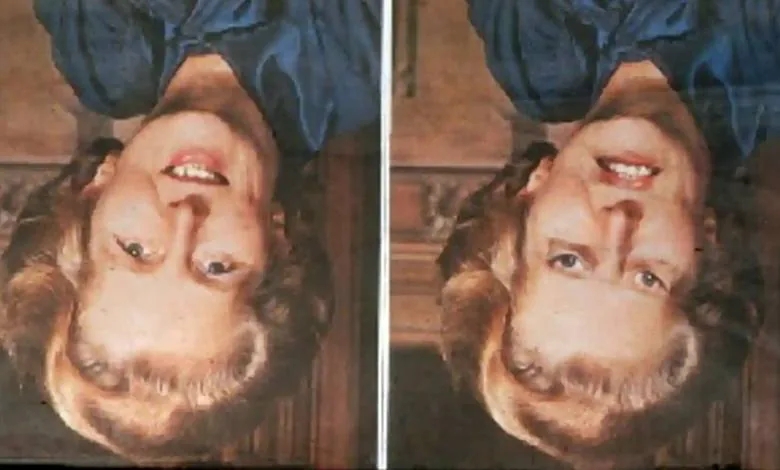
The Thatcher illusion is the striking visual phenomenon where an upside-down face with inverted eyes and mouth looks almost normal, but appears grotesquely distorted the moment you turn it right-side up, a quirk of human perception first documented by psychologist Peter Thompson in 1980. It happens because your brain processes upright faces holistically, as a single unified whole, but switches to a feature-by-feature analysis when the face is inverted, hiding glaring errors in plain sight.
The Thatcher illusion occurs when a face with inverted eyes and mouth is viewed upside down, making the distortions nearly invisible. Discovered by Peter Thompson in 1980, it reveals that the brain relies on holistic face processing for upright faces but switches to analyzing individual features when faces are rotated, explaining why the same face looks normal in one orientation and monstrous in another.
- In 1980, British psychologist Peter Thompson first described the Thatcher illusion, naming it after former UK Prime Minister Margaret Thatcher, whose photo he used in his original demonstration.
- The illusion works because the brain processes upright faces holistically, perceiving the entire face as one integrated configuration rather than a collection of separate parts.
- When a face is inverted, holistic processing breaks down and the brain falls back on analyzing individual features, which causes the upside-down eyes and mouth to go unnoticed.
- Studies using the Thatcher illusion have shown that individuals with prosopagnosia, a condition characterized by difficulty recognizing faces, often fail to perceive the distortion even in upright faces, reflecting impaired holistic processing.
- Research on the Thatcher effect in monkeys has demonstrated that similar inversion effects occur in non-human primates, suggesting that holistic face processing is an evolutionarily conserved trait.
The Face That Fooled a Nation
Take a photograph of Margaret Thatcher, the first female prime minister of the United Kingdom who took office in May 1979, and flip it upside down. Now take a second copy of that same photo, but before flipping it, turn her eyes and mouth upside down within the face. Hold both images side by side, inverted, and they look nearly identical. You would swear nothing is wrong with either one. Then rotate them upright, and the second face becomes a grotesque, unsettling horror show. That jarring moment of reveal is the Thatcher illusion, and it has been tricking brains since 1980.
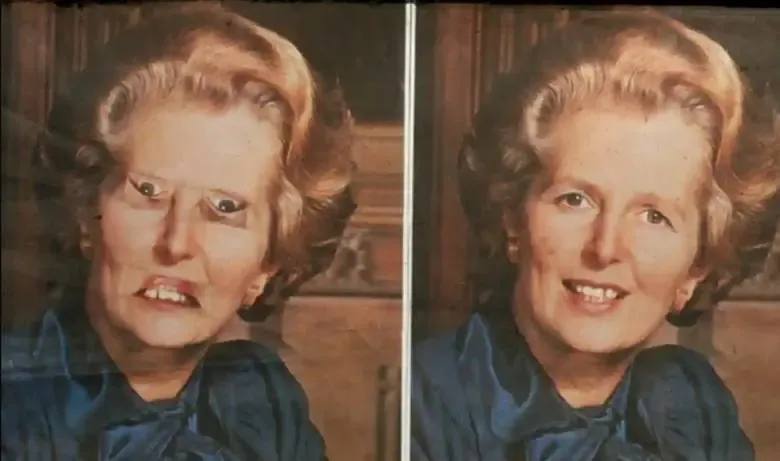
The illusion was discovered by Peter Thompson, a vision scientist at the University of York in England, roughly four decades ago. He noticed something strange about how we perceive faces: when a face is upright, our brains read it as a whole, taking in the arrangement of features all at once. Flip that same face upside down, and the brain switches strategies, examining individual parts like the eyes and mouth separately. Because each feature still points in the correct direction, the distorted face passes inspection. The brain never notices that the eyes and mouth are inverted until the image is turned right side up again, at which point holistic processing kicks back in and the error becomes impossible to ignore.
A Trick With a Long Pedigree
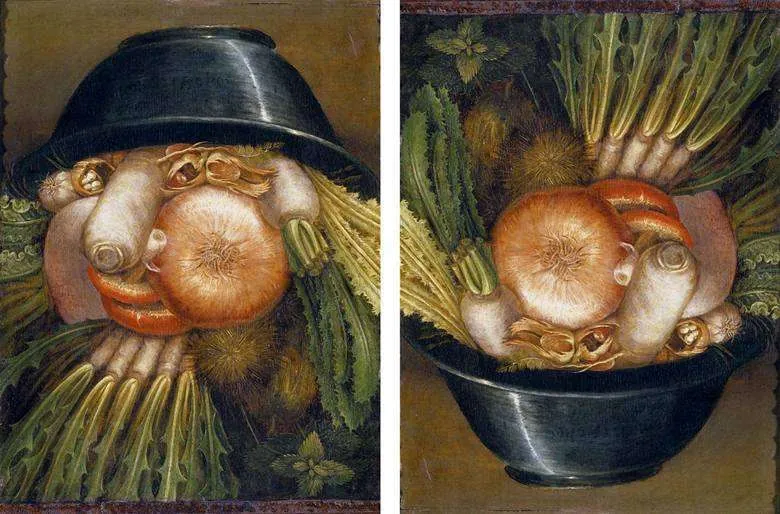
Long before Margaret Thatcher's face became a laboratory staple, painters were quietly exploiting the same perceptual blind spot. In the 16th century, Milanese artist Giuseppe Arcimboldo built portraits entirely from fruit, vegetables, and other objects, and he knew exactly what he was doing: his composite faces look perfectly human when viewed upright, but flip the canvas and they dissolve into nothing more than a bowl of produce. The trick worked because our brains refuse to see an upside-down face as a face at all.
Centuries later, British artist Rex Whistler refined the game with his "double-meaning portraits," paintings that reveal an entirely different face when turned upside down. What makes these works so fascinating is how stubbornly our perception resists the flip: you cannot predict what the inverted face will look like without physically rotating the page. These early experiments in visual trickery prove a simple truth. Recognizing an inverted face is genuinely hard work for the human brain, and that difficulty is precisely what makes the Thatcher illusion so compelling when it finally arrived in the 1980s. The old masters had stumbled onto the same neural quirk that vision scientist Peter Thompson would later formalize at England's York University, and their canvases stand as proof that this perceptual puzzle is part of a long artistic tradition rather than an isolated curiosity.
Why Your Brain Misses the Horror
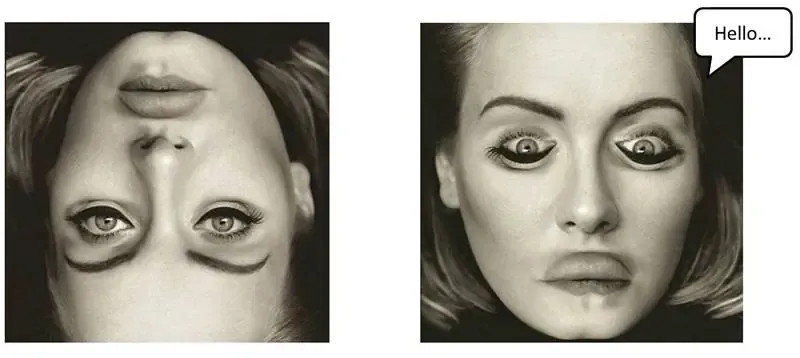
Think about what happens when you glance at an inverted face. Your brain stops reading the face as a unified whole and instead starts checking the parts: the eyes, the mouth, the nose. Here is the trick. Each of those features is actually oriented correctly relative to the face itself, even though the entire face is upside down. The eyes are still right-side up within the face. The mouth is still right-side up within the face. So your brain looks at each piece, finds nothing wrong with any of them individually, and moves on. Nothing triggers an alarm.
This is the classic face-inversion effect, a well-documented phenomenon in vision science that researchers have studied for decades. When the image rotates back to its normal upright position, everything changes. Holistic processing kicks back in, your brain suddenly sees the entire face as one coherent unit, and the horror becomes instantly, unmistakably obvious. The eyes and mouth are grotesquely reversed, and you wonder how you ever missed it.
Researchers have identified many brain regions that work together to process faces, forming a distributed network that scans for proportions and arrangements. Your brain constantly tracks patterns like the distance between the eyes or the position of the brow line. This system is remarkably efficient at recognizing faces and reading expressions in a fraction of a second, but it has a blind spot. Inverting a face throws the whole system off, and the Thatcher illusion exploits that vulnerability perfectly.
What Face Blindness and Autism Reveal
People with prosopagnosia, or face blindness, cannot recognize friends and family members by sight, yet they often still read emotions on faces without trouble. Research indicates that these individuals are typically less sensitive to the configural distortions in Thatcher faces, not faster at spotting them as some popular accounts suggest.
The reason traces back to a specific structure in the brain. In acquired prosopagnosia, the fusiform gyrus, a region on the underside of the temporal lobe, is usually damaged. That damage explains why a person might walk past their own sibling at a café, utterly clueless, while simultaneously catching a subtle shift in someone's mood from a raised eyebrow or a tight mouth. The ability to read emotional expressions lives in a different network, one that survives the injury.
This split between recognizing identity and reading emotion is what makes the Thatcher illusion so revealing. The illusion depends on holistic processing, the brain's habit of taking in a face as a whole rather than as a collection of parts. People with prosopagnosia, lacking that integrated view, are less fooled by the upside-down trick. They inspect the pieces individually, so the inverted eyes and mouth look wrong even when the face is flipped.
Autism offers another window into the same puzzle. Autism is defined partly by difficulty reading social and emotional cues, and the eyes and mouth are where those cues live. Some research has explored how autistic individuals process faces, and there are indications that they may prioritize facial features differently. However, specific claims about a study involving exactly twenty autistic participants have not been confirmed in the scientific literature, so those details should be treated with caution rather than as established fact.
The general direction of research suggests that autistic individuals may struggle to prioritize the flood of information coming from eyes and mouths. The Thatcher illusion, by scrambling that information, gives researchers a controlled way to watch the brain decide what matters. If future work confirms these patterns, behavioral therapies could help autistic people tune into those social signals more effectively.
Frequently asked questions
What is the Thatcher illusion?
The Thatcher illusion is an optical trick where a face with flipped eyes and mouth looks completely normal when viewed upside down, but becomes grotesque the moment you rotate it right side up. Peter Thompson first demonstrated this effect in 1980 using a photograph of Margaret Thatcher, the United Kingdom's first female prime minister, who took office in May 1979.
Who discovered the Thatcher illusion?
Peter Thompson, a vision scientist at York University in England, discovered the illusion in 1980. He published his findings in the journal Perception, and the effect quickly became one of the most famous demonstrations in face perception research. The illusion bears Thatcher's name simply because her portrait was the first face he used to demonstrate it.
Why does the Thatcher illusion work?
Your brain processes upright faces holistically, taking in the whole arrangement of features at once, but switches to analyzing individual features separately when a face is inverted. That is why an upside-down face with reversed eyes and mouth escapes detection. Rotate it upright, and your brain immediately recognizes the configural distortion as something deeply wrong.
How does the Thatcher illusion relate to prosopagnosia?
People with prosopagnosia, also known as face blindness, are typically less sensitive to the configural distortions in Thatcher faces, not faster at spotting them as some popular accounts claim. This condition is often linked to damage in the fusiform gyrus, particularly the right fusiform face area, which is a key brain region for processing faces.
What does the Thatcher illusion reveal about autism?
Research in this area is still emerging. Some studies have suggested that autistic individuals may process facial features differently than neurotypical people, but specific claims about a study involving exactly twenty participants have not been confirmed. The general direction points to differences in how facial information is prioritized, which could inform future therapeutic approaches.
Did researchers find the Thatcher effect in monkeys?
Yes, a 2009 study by Adachi and colleagues demonstrated the Thatcher effect in monkeys, showing that this face perception quirk is conserved across primate species. This finding suggests the brain's holistic face-processing mechanism evolved deep in our evolutionary lineage, long before humans walked the earth.
What brain regions are involved?
The fusiform gyrus, especially the right fusiform face area, plays the starring role in face perception and the Thatcher illusion. Damage to this region is commonly associated with acquired prosopagnosia. Face processing involves a distributed network of many brain regions, though the exact count is not a settled figure in the scientific literature.
Got a take on this? Add your voice to the conversation below →
No comments yet. Be the first.