Starry Night Mathematics: Van Gogh's Hidden Turbulence
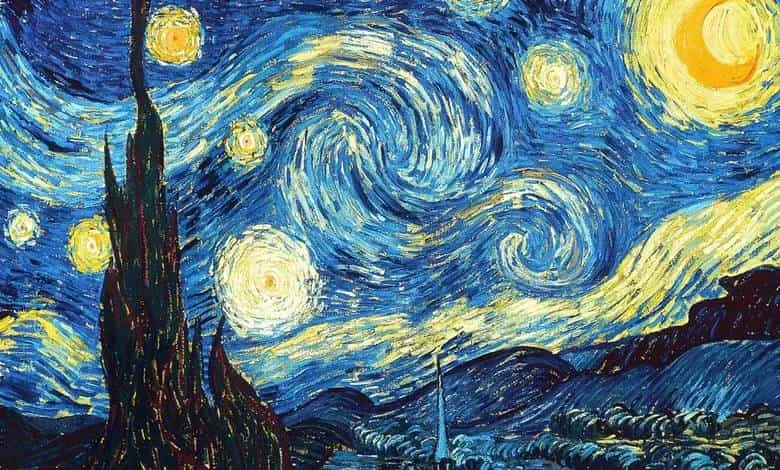
There is a hidden mathematics in Vincent van Gogh's 1889 masterpiece "The Starry Night." The brushstrokes mirror the exact turbulence equations physicist Andrey Kolmogorov formulated decades later, a discovery made by researchers analyzing the painting's swirling patterns. When you stand before this iconic canvas, painted during van Gogh's stay at the asylum in Saint-Rémy-de-Provence, you are looking at a mind that intuitively grasped the physics of chaotic fluid motion long before science caught up. The painting has captivated viewers for over a century, but the Starry Night mathematics tucked inside those luminous swirls adds a profound new layer to its enduring mystery.
Researchers studying "The Starry Night" found that van Gogh's swirling brushstrokes statistically match the patterns predicted by Kolmogorov's theory of turbulence. Painted in 1889 while the artist was a patient at the Saint-Paul-de-Mausole asylum near Saint-Rémy, the painting's celestial eddies behave like real fluid dynamics. The work now hangs in the Museum of Modern Art in New York City.
- Vincent van Gogh painted "The Starry Night" in 1889 while staying at the Saint-Paul-de-Mausole asylum in Saint-Rémy-de-Provence, France.
- The painting's swirling sky patterns were found to follow the statistical laws of turbulence that physicist Andrey Kolmogorov described in the 1940s.
- Researchers analyzed a digital version of the painting and compared the brightness of its pixels to test for turbulent flow patterns.
- "The Starry Night" has been part of the permanent collection at the Museum of Modern Art in New York City.
- The painting's turbulent patterns appear in the sky, while the ground-level elements like the village and cypress tree do not follow the same mathematical structure.
The Night Sky That Behaves Like a Fluid
Vincent van Gogh's The Starry Night has become as famous for the mathematics hidden beneath its swirling surface as for its breathtaking beauty. Painted in 1889, the work hangs today at the Museum of Modern Art in New York City, where millions of visitors each year stand before its luminous, churning sky. What they may not realize is that the same statistical patterns governing the chaos of moving fluids appear to be encoded in those famous brushstrokes.
Step outside on a clear night and look up. The real sky, with its stars of varying brightness and color scattered across the darkness, can feel like a dizzying, three-dimensional experience. It genuinely resembles what van Gogh put on canvas. The painting captures something true about how the heavens actually appear to the human eye, not just how an artist imagined them.
That resemblance is where the mathematics comes in. Turbulence, defined simply, is the disorder of a moving fluid or gas. Think of smoke curling from a chimney, water rushing over rocks, or air churning behind a speeding airplane. Expressing that chaos mathematically has proven extraordinarily difficult. To even attempt it, mathematicians need to understand solutions to the Navier-Stokes equations, a set of formulas developed in the 1800s that describe how fluids move.
Enter Andrey Nikolaevich Kolmogorov, a Russian mathematician who devoted himself to the puzzle of turbulence. Rather than tracking every individual swirl and eddy, Kolmogorov took a statistical approach. He proposed a relationship between how a fluid's velocity changes and the rate at which its energy dissipates due to friction. His work in the 1940s laid the foundation for today's turbulence models, giving scientists a framework to make sense of chaos on a grand scale.
In recent years, researchers applied Kolmogorov's equations to a digital version of The Starry Night. They compared the brightness of pixels across the image and found that the patterns matched the statistical signatures of turbulent flow. The painting, it turns out, behaves like a fluid on canvas. The swirls and eddies van Gogh painted by hand follow the same mathematical rules that govern smoke, water, and air.
The Turbulent Life Behind the Canvas
Vincent van Gogh was 35 years old when he sliced off the lower half of his left ear with a razor, wrapped the flesh in paper, and carried it to a brothel in Arles, France, where he handed it to a cleaning woman and told her to keep it carefully. The year was 1888, and the artist's mind was unraveling in ways that would ultimately give the world one of its most beloved paintings. Before he could paint the swirling sky of The Starry Night, he first had to survive himself.
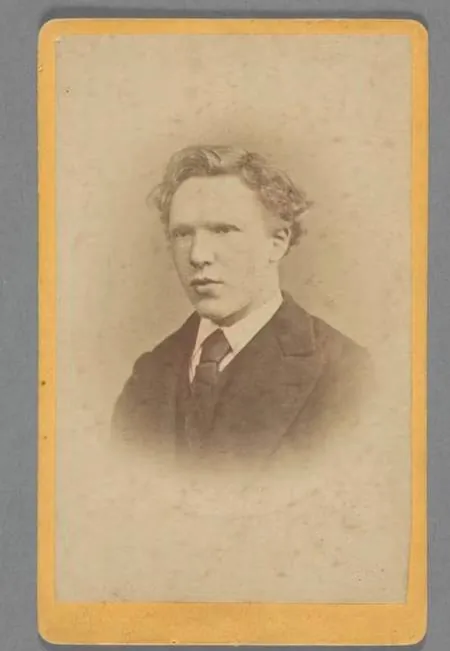
Van Gogh arrived in this world on March 30, 1853, in the Brabant village of Zundert, a small farming community in the southern Netherlands. His father served as a village pastor, a modest role in a family that otherwise counted bankers, art dealers, and wealthy merchants among its ranks. The mismatch between his family's ambitions and his own restless nature would define much of his early life.
Before he ever picked up a brush with serious intent, Van Gogh worked as an art dealer. At sixteen, he moved to The Hague to apprentice at a gallery, and for a time he performed well. But when his employers transferred him to London, something shifted. He felt cut off from his family, lonely, and increasingly defiant. His surly demeanor cost him the job, and in the aftermath he turned to religion, hoping to find both comfort and a way to redeem himself in his parents' eyes.
The religious path did not stick either. He attempted to study theology but lacked the discipline, spending his days on long walks and exploring the city instead. Before long, he clashed with religious authorities and drifted away. His family worried; here was a 24-year-old man who still had not found his place in the world.
Then came the letter to his younger brother Theo, announcing his intention to become an artist. No one knows exactly what prompted the decision, though it may have been his last remaining route to respectability. With no salary of his own, Van Gogh relied entirely on Theo's financial support while he taught himself to paint. That brotherly lifeline would sustain him for the rest of his life.
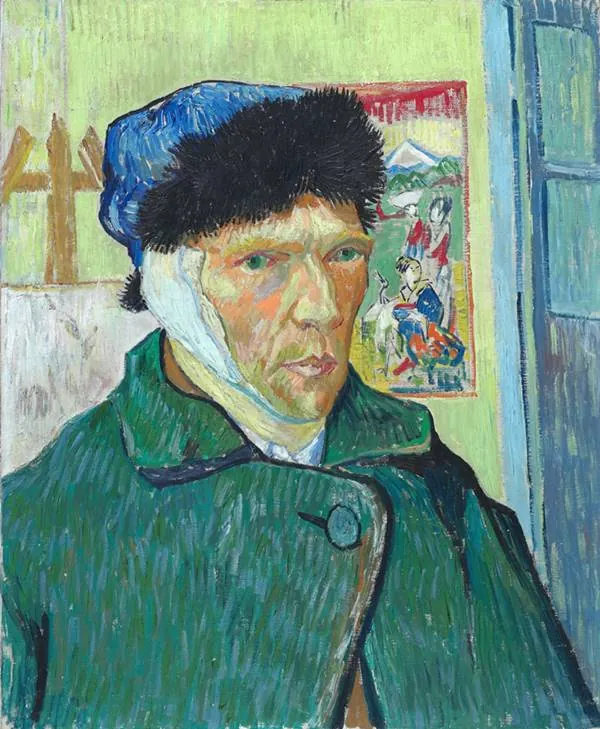
The ear incident in Arles left him unconscious at home that same evening. Friends found him and rushed him to a nearby hospital. The severed ear arrived at the hospital too, but too much time had passed for reattachment. The episode produced two lasting works: Self-Portrait with Bandaged Ear and Pipe and Self-Portrait with Bandaged Ear, both painted after his release.
In the months that followed, Van Gogh's condition deteriorated. He struggled with depression, epileptic seizures, and delusions. In May 1889, he checked into the Saint-Paul-de-Mausole asylum in Saint-Rémy in southern France. The hospital environment gave him something he desperately needed: peace. Over the next twelve months, he produced roughly 150 paintings within those walls.
It was from his room's window at Saint-Rémy that Van Gogh reportedly painted The Starry Night. Researchers who studied the positions of the Moon and Venus, along with letters he wrote to his brother, have suggested the painting may depict the sky as it appeared on the morning of May 25, 1889. That date remains speculative, however, and many art historians believe the work is likely a composite drawn from multiple nights rather than a single observed scene.
What exactly afflicted Van Gogh remains unknown. Doctors have proposed numerous diagnoses over the years, including digitalis poisoning from foxglove, a heart medication sometimes prescribed in that era. According to this hypothesis, the drug may have caused the yellow halos that appear so prominently in The Starry Night and The Night Café. It is a compelling theory, but it remains unproven speculation.
Van Gogh left Saint-Rémy on May 16, 1890, moving closer to his brother Theo in Paris. He settled in Auvers-sur-Oise, where he continued to paint. His mental state never fully recovered. He died two days after shooting himself in the chest. Today, The Starry Night hangs in the Museum of Modern Art in New York City, where its turbulent sky continues to draw millions of visitors each year.
The Hidden Math in the Swirls
To figure out whether the swirling patterns in The Starry Night actually behave like real turbulence, scientists took a digital version of the painting and studied it pixel by pixel. What they found was startling: the brightness patterns in the paint match equations formulated by Russian mathematician Andrey Kolmogorov in the 1940s. The famous night sky isn't just beautiful. It's mathematically turbulent.
Here's how the analysis worked. Researchers compared the brightness of individual pixels across the image, looking for statistical relationships in how light and dark cluster together. In genuine turbulent flow, whether in a rushing river or air churning behind a plane, energy cascades from large swirls into smaller ones in a predictable way. Kolmogorov's equations describe that cascade precisely.
The pixel brightness in The Starry Night follows the same statistical signature. That's a remarkable result for a painting completed in 1889, decades before Kolmogorov even began his work on turbulence theory.
And The Starry Night isn't the only canvas hiding this pattern. Road with Cypress and Star, another Van Gogh painting, also shows a mysterious resemblance to turbulent flows when analyzed the same way. Many of Van Gogh's paintings contain this distinct fluid structure hidden within, closely tracking Kolmogorov's equation.
The finding raises an intriguing question. Van Gogh produced his most turbulent-looking works during periods when his psychological state was itself in turmoil. Was his better reflection of turbulence during those chaotic stretches a coincidence? Or did his mood somehow trigger something in him that let him capture fluid dynamics more accurately on canvas? Nobody knows for certain.
What makes this analysis especially significant is what it represents for art and science alike. This method may be the first time the subjective expression of an artwork's effect has been numerically supported. Instead of just saying the painting feels turbulent, researchers can now point to numbers that back up that impression. The emotional power of the painting and the physics of real fluids turn out to speak the same language.
Frequently asked questions
What is the mathematical secret behind Van Gogh's Starry Night?
The brightness patterns in the swirling sky of Van Gogh's Starry Night match the equations for turbulent flow formulated by Russian mathematician Andrey Kolmogorov in the 1940s. This means the painting's famous whirls and eddies follow the same statistical rules that govern how energy dissipates in moving fluids like water or air. It is a striking connection between art and physics.
How does Starry Night match Kolmogorov's turbulence equations?
Researchers examined a digital version of the painting and compared the brightness of its pixels. They found that the patterns in the luminance matched Kolmogorov's equations describing how energy dissipates in a turbulent fluid. In plain terms, the way the paint swirls and brightens mirrors the way real turbulence behaves in nature, revealing a distinct fluid structure hidden in the artwork.
Why did Van Gogh paint Starry Night while in an asylum?
Vincent van Gogh checked into the Saint-Paul-de-Mausole asylum in Saint-Rémy, southern France, in 1889. The hospital environment gave him a sense of peace after a turbulent period, and he painted the work from his room's window. During his roughly 12 months there, he produced around 150 paintings, including this masterpiece.
Where is Starry Night displayed today?
The painting is housed at the Museum of Modern Art in New York City, where it has been part of the collection for decades. Art lovers from around the world can view it in person, and it remains one of the most visited and photographed works in the museum's galleries.
Did Van Gogh's mental state influence the turbulence in his paintings?
It is unknown whether his reflection of turbulence during psychologically turbulent periods was a coincidence or if his mood triggered something. The question remains open among researchers. Some speculate that his emotional intensity shaped his brushwork, but no one has proven a direct link between his mental health and the mathematical patterns in his work.
What did researchers find when analyzing the brightness patterns in Starry Night?
When scientists analyzed the brightness patterns in the painting, they found that they matched the equations formulated by Kolmogorov. This revealed a distinct fluid structure pattern in the artwork. The findings suggest that Van Gogh intuitively captured something about the physics of turbulence that mathematicians would not formalize until decades later.
Who was Andrey Kolmogorov and how is he connected to Van Gogh?
Andrey Kolmogorov was a Russian mathematician known for his groundbreaking work on turbulence. His 1940s equations describing turbulent flow were found to match the patterns in Van Gogh's painting. Kolmogorov used a statistical approach to connect changes in fluid velocity with the rate at which energy dissipates due to friction, laying the foundation for modern turbulence modeling.
What happened to Van Gogh's ear and how did it affect his art?
At age 35, Van Gogh cut off the lower half of his left ear with a razor and gave it to a cleaning woman at a brothel in Arles, telling her to keep it carefully. The incident led to two self-portraits, including Self-Portrait with Bandaged Ear , and contributed to his later fame. The story became one of the most famous tales in art history. Editorial note: Any facts which remain unconfirmed are presented as such, including the precise nature of van Gogh's mental state during the painting's creation and the exact degree to which his artistic choices were intentional versus intuitive.
Got a take on this? Add your voice to the conversation below →
No comments yet. Be the first.