El Dorado Legend: The Real Story Behind the City of Gold

The El Dorado legend begins not with a city, but with a man, the Muisca people of Colombia, and a gold-dusted ceremony on Lake Guatavita. That ritual, a new ruler covered in gold offerings to the gods, sparked a fever that drove European explorers to their doom. It is a story of literal treasure, tragic misunderstanding, and a myth so powerful it still shapes our idea of lost riches today.
The El Dorado legend started as a Muisca tribal ritual near modern Bogotá, Colombia, where a new leader was covered in gold dust and offered treasures to a sacred lake. Spanish conquistadors misunderstood this as a location, launching futile expeditions that eventually turned a gilded man into a mythical city of gold.
- The Muisca people performed a gold-dust coronation ritual at Lake Guatavita in the Colombian Andes before Spanish arrival.
- Spanish explorers in the 16th century, including Gonzalo Pizarro, mounted massive expeditions into the Amazon based on rumors of the gilded man.
- Lake Guatavita became the focal point of numerous treasure-hunting attempts, including several drainage efforts.
- Sir Walter Raleigh led failed expeditions to South America in the 16th century, searching for a city of gold he called El Dorado.
- The legend transformed from a person to a place over the 16th century, cementing the phrase "city of gold" in global culture.
The Spark: A King, Gold Dust, and a Sacred Lake
The origin of the El Dorado legend begins not with a glittering metropolis, but with a single man and a single moment of ceremony. In the central Andes of what is now Colombia, the Muisca people practiced a ritual that would ignite the imagination of an entire continent of European explorers.
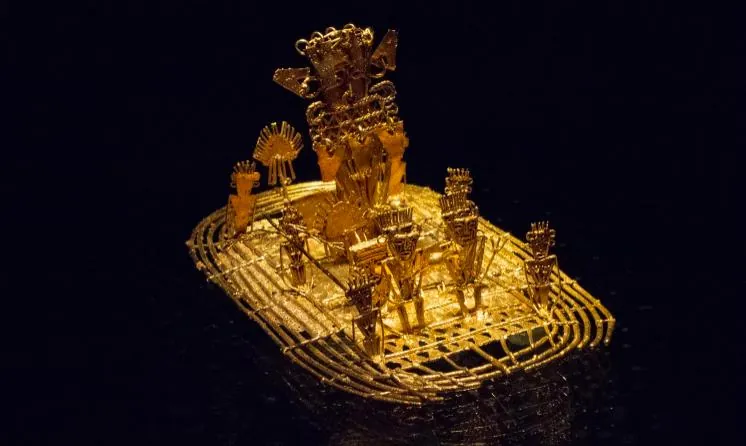
Picture the scene: a new Muisca king, covered head to toe in gold dust and adorned with precious stones, walks to the edge of Lake Guatavita. The lake sits high in the mountains near present-day Bogotá, its still waters reflecting the sky above. As his people watch from the shore, the king steps onto a raft and glides to the center of the water. There, he washes the gold from his body, letting the dust sink into the depths as an offering to the gods who dwell beneath the surface.
That gilded man, that shimmering figure disappearing into a sacred lake, is the true seed of the El Dorado legend. The name itself, El Dorado, means "the golden one" in Spanish, and it referred to this ritual king long before anyone dreamed of a city built from gold.
The ceremony was real. Chroniclers documented it. But as the story traveled from Muisca villages to Spanish ears, it transformed. The golden man became a golden kingdom. The kingdom became a city. And the city became the impossible dream that would obsess explorers for centuries.
What started as a spiritual act of devotion, a king giving his glittering skin back to the lake, morphed into the promise of streets paved with treasure. The origin of the El Dorado legend is a lesson in how a single ritual, witnessed and retold, can grow into something far larger than the truth that birthed it.
What "El Dorado" Actually Means
El Dorado is Spanish for "the gilded one" or "the golden one," and the name originally pointed at a person, not a place. In the early 1500s, when Spanish explorers first heard the term from Indigenous guides, they were hearing about a ritual, not a city of gold. The Muisca people of Colombia's central Andes had a ceremony where their new ruler was covered in gold dust before bathing in Lake Guatavita as an offering to the gods.
Here is where the confusion begins, and it is a confusion that would drive men mad for centuries. The Spanish word "dorado" simply means gilded or golden. So when the conquistadors asked about "El Dorado," they were asking about "the gilded one," meaning the king himself. But somewhere along the line, the question shifted. Instead of asking who is the golden man, they started asking where is the golden city.
Over time, the term stretched to cover everything at once. El Dorado became a legendary city, then a kingdom, then a tribal chief covered in gold, depending on who was telling the story. Some accounts describe a wealthy ruler who coated himself in gold dust for ceremonies. Others describe an entire city where the buildings were supposedly made of solid gold. The ambiguity was the fuel. Because nobody could agree on what El Dorado actually was, nobody could prove it did not exist.
That flexibility made the El Dorado legend especially powerful. A fixed target can be checked off a map and abandoned. A shape-shifting target, one that could be a man one day and a metropolis the next, kept the dream alive through every failed expedition. The gilded king of Lake Guatavita became the symbol of untold wealth, and the name attached to that symbol refused to stay still.
The Hunt: Explorers Who Chased a Dream
By the 1500s, the origin of the El Dorado legend had become an obsession that gripped the imagination of Europe's boldest adventurers, sending them into the unknown jungles of South America on quests that would consume fortunes, lives, and decades. The promise of a city built entirely of gold was simply too tantalizing to resist, even when every expedition returned empty-handed.
Two names stand out in this feverish pursuit. Sir Walter Raleigh, the English courtier and explorer, made voyages to South America in search of the golden city, convinced he could find it somewhere along the Orinoco River. Then there was Gonzalo Pizarro, the Spanish conquistador and half-brother of Francisco Pizarro, who led a massive expedition that pushed deep into the Amazon basin. His journey became legendary for its brutality and suffering, with hundreds of men and horses lost to disease, starvation, and attacks from indigenous groups.
Neither man found what he sought. Raleigh returned to England disgraced, while Pizarro's expedition limped back with only a fraction of its original force. The pattern repeated itself across the century: explorers would hear rumors of a golden kingdom further inland, push deeper into the wilderness, and return with nothing but hardship to show for it.
The tragedy of these expeditions is that the origin of the El Dorado legend was never about a city at all. The Spanish had misunderstood the Muisca people's ritual of their gilded chief bathing in Lake Guatavita, near what is now Bogotá, and transformed it into a geographic destination that never existed. The explorers were chasing a metaphor dressed up as a place, and their obsession with finding it drove them to extraordinary lengths, including attempts to drain the lake itself in search of treasure.
What makes these failed searches so haunting is how they reshaped the map of the continent. Rivers were charted, mountains crossed, and indigenous nations encountered, all because men believed in a golden city that was never there. The dream itself became the engine of exploration, even as it destroyed the men who chased it.
Lake Guatavita: The Treasure That Wasn't There
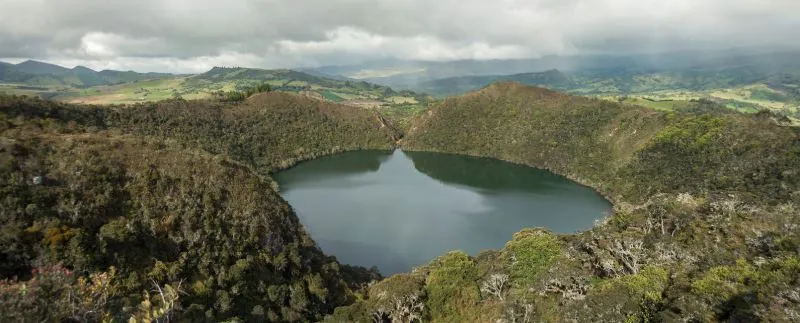
If you want to touch the physical heart of the El Dorado legend, you have to travel to a crater lake sitting high in the Andes, near Bogotá, Colombia. Lake Guatavita is the exact spot where the story begins, and it is also where the dream of endless gold went to die, repeatedly, at the hands of men armed with shovels and grand ambitions.
The Muisca people, who lived in Colombia's central Andes long before the Spanish arrived, held a coronation ritual here that would change the world's imagination forever. Their new ruler, covered from head to toe in gold dust and precious stones, would wade out onto the lake on a raft and toss offerings into the dark water as a gift to the gods. When Spanish chroniclers heard about this ceremony in the 16th century, they didn't think "what a beautiful tradition." They thought "there must be a fortune at the bottom of that lake."
The first serious attempts to drain Lake Guatavita came in the 16th century, when Spanish conquistadors cut a notch into the crater rim, hoping to lower the water level. They managed to drop it by a few meters before the work became too difficult, and what did they find? A modest amount of gold, enough to fuel the fantasy but nowhere near the hoard they had imagined. Later attempts with more ambitious plans succeeded in lowering the lake significantly, and the recovered gold was substantial, but still nowhere near the mythical fortune. The treasure stopped coming once the mud and silt clogged the works, and the lake slowly refilled, swallowing whatever remained.
The most dramatic attempts came in the 19th century, long after the Spanish had given up. A British company arrived with serious engineering equipment and a plan to completely drain the lake. They tunneled through the crater wall and managed to lower the water significantly, exposing a thick layer of black mud at the bottom. The company's workers scraped through this sludge and found gold artifacts, but the mud was so deep and the work so slow that the operation collapsed under its own cost. The company went bankrupt, and the lake was left to refill once more. Some of the gold they did recover ended up in museums, but the great treasure never materialized.
Today, Lake Guatavita sits quietly in its crater, a protected natural reserve and a popular hiking destination. No one is draining it anymore. The lake has become a symbol of the El Dorado legend in its purest form: the allure of what might be hidden just beneath the surface, forever out of reach. The gold that was actually recovered from those drainage attempts, while historically priceless, was never the mountain of riches the legend promised. The real treasure, it turns out, was the story itself, and the lake still guards the rest.
From Myth to Metaphor: El Dorado's Lasting Legacy
The origin of the El Dorado legend has proven far more durable than any single expedition or treasure map. Even with no concrete evidence of a golden city ever surfacing, the myth has carved out a permanent place in how we talk about ambition, mystery, and the human hunger for more.
Ask anyone to picture El Dorado, and they will likely describe a city gleaming with gold. But the legend's power goes deeper than that. It has become shorthand for the pursuit of dreams, the pull of the unknown, and the strange way we keep chasing things that may not exist. The name itself, which means "the golden one" in Spanish, now carries weight far beyond its origins in Colombia's central Andes.
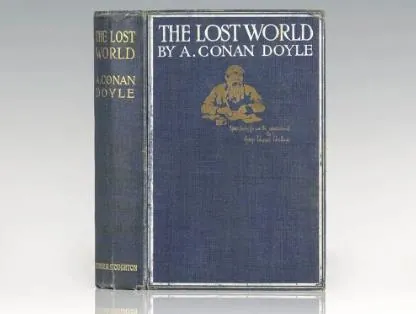
Poets, novelists, and filmmakers have all reached for the myth when they wanted to capture that particular ache of wanting something just out of reach. The theme of a hidden, prehistoric world has been a favorite in adventure fiction for generations. Sir Arthur Conan Doyle's The Lost World is one well-known example that draws on the idea of a secret, ancient realm, though the novel was not directly inspired by the El Dorado story. Either way, the pattern is unmistakable: a brave explorer, an uncharted place, and the promise of wonders no one has seen before.
What makes the legend so sticky is its flexibility. El Dorado was never just one thing. At different points in history, people described it as a city, a kingdom, or even a tribal chief covered in gold. That ambiguity only added to its allure. The less certain the details, the more room for imagination to run wild.
Today, the myth persists in popular culture and historical debate alike. Scholars still argue over what the Muisca rituals actually looked like and how the story morphed into a tale of a golden metropolis. The legend refuses to fade, not because anyone has found proof, but because it speaks to something universal. Every generation rediscovers El Dorado in its own way, whether in a novel, a film, or a quiet thought about what lies beyond the next horizon.
Frequently asked questions
What is the origin of the El Dorado legend?
The origin of the El Dorado legend traces back to the Muisca people, an indigenous civilization in Colombia's central Andes. Their rulers performed a coronation ritual where the new king was covered in gold dust before bathing in Lake Guatavita as an offering to the gods. Spanish chroniclers in the 16th century transformed this ceremony into a story about a city made entirely of gold.
Who were the Muisca people and how did they influence the El Dorado myth?
The Muisca were an indigenous society living on the high plains of Colombia's central Andes long before Europeans arrived. Their gilded king ceremony, performed at Lake Guatavita near modern-day Bogotá, directly inspired the entire El Dorado myth. When Spanish explorers heard about a ruler covered in gold, they assumed such wealth meant a golden city existed somewhere nearby.
Why did European explorers like Sir Walter Raleigh search for El Dorado?
European explorers chased El Dorado because the legend promised unimaginable wealth in the 16th century. Sir Walter Raleigh and Gonzalo Pizarro both led major expeditions into South America hoping to find the golden city and claim its riches for themselves and their crowns. Every single one of these expeditions failed, yet the dream of finding gold kept drawing new adventurers deeper into the continent.
Was Lake Guatavita ever drained to find El Dorado's treasure?
Yes, Lake Guatavita near Bogotá was drained multiple times by treasure hunters hoping to recover gold from the Muisca ritual offerings. In the 16th century, Spanish conquistadors cut a notch in the lake's rim to lower the water level, and they did find some gold objects along the edges. Later attempts in the 19th and 20th centuries used more advanced methods, but the results mostly disappointed everyone involved.
What does the name El Dorado actually mean in Spanish?
El Dorado translates to "the gilded one" or "the golden one" in Spanish, and it originally referred to a person, not a place. The name described the Muisca king who was covered in gold dust during his coronation ceremony. Over time, Europeans shifted the meaning from a golden man to a golden kingdom, and finally to a golden city that never actually existed.
Did anyone ever find the city of El Dorado?
No, the city of El Dorado was never definitively discovered, and historians widely consider it a legend rather than a real place. Despite centuries of searching, no explorer ever produced concrete evidence of a golden city in South America. The myth persists because it captures something powerful about human ambition, the willingness to risk everything for the chance at unimaginable wealth. Editorial note: Some details of the Muisca ritual and early Spanish encounters rely on colonial-era accounts, and any facts which remain unconfirmed are presented as such.
Got a take on this? Add your voice to the conversation below →
No comments yet. Be the first.