Quantum Mechanics in Everyday Life: 10 Mind-Bending Scenarios
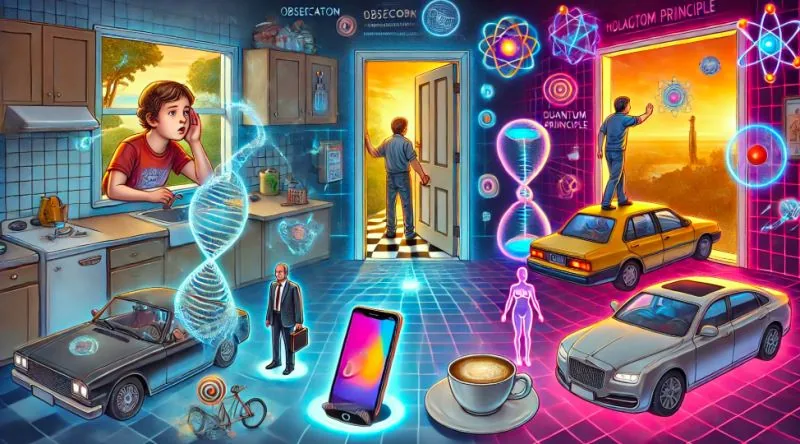
Quantum mechanics in everyday life is usually invisible, but this story explores 10 mind-bending scenarios that imagine superposition, entanglement, and tunneling working at human scale. It's a thought experiment for curious readers in 2025, one that turns the strange rules of the subatomic world into vivid, relatable situations. You'll never look at your morning coffee the same way again.
Quantum mechanics in everyday life is a thought experiment that asks what would happen if quantum phenomena like superposition, entanglement, and tunneling operated on human-sized objects. This article presents 10 imagined scenarios, each grounded in real quantum principles, to make these abstract concepts feel tangible and fun.
- Superposition would let your keys be in multiple places at once until you look for them.
- Entanglement could link two coffee cups so that stirring one instantly affects the other.
- The observer effect suggests that watching your toast might change whether it lands butter-side up.
- Quantum tunneling would allow you to walk through a wall, albeit with a very low probability.
- The Heisenberg uncertainty principle implies you couldn't know both where your phone is and how fast it's moving.
What if Quantum Mechanics Ran Your Morning Routine?
Imagine waking up and realizing your phone isn't where you left it. In a quantum world, that wouldn't be a problem at all, because your phone would be everywhere at once. The rules that govern atoms and particles, the strange logic of quantum mechanics in everyday life, would completely rewrite how you experience even the simplest moments of your day.
Take the observer effect, for starters. In physics, this is the idea that looking at or measuring a quantum system actually changes its state. It sounds abstract until you picture it in human terms. Say you ask your little nephew to check if you're in the kitchen. The moment he peeks around the corner, your position gets "fixed." He sees you there, or he doesn't. But here's the wild part: if he never looked, you could exist in both places at once. You'd be simultaneously in the kitchen making coffee and upstairs hunting for socks. The act of being watched is what pins you down to a single spot.
This connects directly to quantum superposition, the principle that a particle exists in multiple states at the same time until you measure it. Now scale that up to your everyday life. You left your phone at a café yesterday. In a quantum world, that phone would simultaneously be on your coffee table at home, in the backseat of a taxi, and still sitting on the café chair where you forgot it. All of those locations would be equally real, equally true. You wouldn't panic about losing it, because it wouldn't be lost. It would just be everywhere. The trouble starts when you call it. That's the measurement, the moment of truth. The instant the call connects, the phone "chooses" one location and abandons all the others. Your coffee table wins, or the taxi does, and suddenly you're sprinting down the street chasing a ringing sound.
Entanglement and the Synchronized Twin Effect
Quantum entanglement is the strangest family bond in physics. Two or more particles become linked so deeply that measuring one instantly determines the state of the other, even if they are light-years apart. This is not a metaphor; it is a verified phenomenon that physicists have demonstrated in laboratories for decades.
To get a feel for it, picture the Turkish comedy "İyi Aile Çocuğu" starring Kemal Sunal. In one memorable scene, a pair of twins share a supernatural link. When one twin gets hurt, the other winces and clutches the same spot, no matter how far apart they stand. The audience laughs because it is absurd, yet that absurdity maps surprisingly well onto what entangled particles actually do.
Here is where the analogy needs a careful hand. Entanglement does not transmit physical pain, nor does it send any usable information across the distance. The Turkish article that first made this comparison was quick to point that out, and the distinction matters. If your twin in Istanbul stubbed a toe, you would not feel a thing in Ankara. Entanglement is not telepathy with a physics degree.
What it creates instead is a synchronized connection that defies classical intuition. Measure one particle's spin, and its partner's spin snaps into a correlated value at the very same instant. Albert Einstein famously called this "spooky action at a distance," and he spent years trying to poke holes in it. The experiments kept proving him wrong. Entanglement is real physics, verified again and again, and it quietly powers emerging technologies like quantum cryptography and quantum computing.
The twin scene works because it captures the eerie simultaneity, the sense that two separate things are behaving as one. That is the heart of entanglement, and it is exactly the kind of oddity that makes quantum mechanics in everyday life feel so far removed from what we experience at human scale. In our world, twins do not share pain. In the quantum world, particles share fates.
When Choices Split Reality: Decoherence and Mr. Nobody
Decoherence is the reason your coffee cup stays on the table instead of also floating in your neighbor's kitchen. In quantum mechanics, a system loses its superposition when it interacts with the environment, and that interaction is what forces reality to pick just one outcome. But imagine if that process slowed down, even a little. Every decision you made would branch into a different reality, and you would live every single one of them at once.
Quantum decoherence works like this: a particle in superposition exists in multiple states simultaneously, but the moment it touches anything around it, the environment effectively "measures" it and collapses those possibilities into one definite state. It happens constantly, everywhere, which is why the macroscopic world feels solid and predictable. The air molecules, the light photons, the vibrations in the floor, they are all acting as observers, pinning reality down before you ever notice the alternatives.
Now, flip that scenario. If decoherence were dramatically slower or weaker, the environment would not be so quick to collapse things. Your choices would keep all their branches alive. Say you are torn between two romantic interests, a brunette and a redhead. In one universe, you marry the brunette. In another, you marry the redhead. Both marriages happen. Both lives unfold. You would not just wonder "what if," you would actually experience every path your decision could have taken.
This is exactly the premise of the film Mr. Nobody, where the protagonist lives out multiple lifetimes based on different choices he makes as a child. The movie uses this branching reality idea to explore love, regret, and the weight of decisions. It is science fiction, but the physics behind it is real. Decoherence is a genuine process, verified in laboratories.
If this were everyday life, you would never lose anything permanently. A lost phone would not be gone; it would just be in another branch where you left it somewhere else. A missed train would not matter, because another version of you caught it. Every regret, every missed opportunity, every road not taken would be a road actually traveled, somewhere in the multiverse.
It sounds liberating, but it is also exhausting. You would carry the weight of every possible outcome, not just the one you happened to live through. The choices you made would still matter, but so would the ones you did not make. That is the strange bargain of a world without fast decoherence: infinite freedom, but also infinite consequence.
Parking, Tunneling, and Other Everyday Impossibilities
Werner Heisenberg's uncertainty principle quietly guarantees that you will never perfectly park a car. The rule states that you cannot know both the exact position and the exact momentum of a particle at the same time, and the more precisely you pin down one, the fuzzier the other becomes. Try it next time you pull into a tight spot: focus hard on exactly where your bumper should stop, and your speed goes haywire. Focus on controlling your speed, and suddenly you are parked at a crooked angle, three inches from where you meant to be.
The same slipperiness would make locked doors useless, though not in a way that helps you. Quantum tunneling lets a particle pass through an energy barrier it should not be able to cross, simply by exploiting its wave-like nature. In the everyday world, that would mean walking through a locked door without calling a locksmith. The catch is that the probability is so astronomically low you would stand there for longer than the age of the universe before it happened even once.
Then there are quantum fluctuations, the restless jitter of empty space itself. Nothing in the universe sits perfectly still, not even a vacuum. If those fluctuations scaled up to human size, your coffee cup might tremble on its own, shifting a few millimeters left or right with nobody touching it. Every object around you would carry a faint, constant buzz, and you would find yourself asking why things keep moving with no visible cause.
Quantum teleportation sounds like the most exciting of the bunch, but it comes with a brutal catch. The full atomic structure of your favorite book could theoretically be recreated on the other side of the world, yet the original would be destroyed in the process. Think cut-and-paste, not copy-and-paste. The original article admits a personal hesitation here: nobody in their right mind would risk a leather-bound copy of Pride & Prejudice on such a gamble.
The Universe as a Hologram and the Final Word from Feynman
Here is where things get properly strange, even by quantum standards. In a delayed-choice experiment, the choice you make about how to measure a particle today can determine whether that same particle behaved like a wave or a particle yesterday. It sounds like time travel, and it is the kind of result that makes physicists pause mid-sentence.
Classical logic says cause comes before effect, always. But in these experiments, the measurement you choose to perform seems to reach backward and settle what the particle was doing before you even decided to look. To be clear, nobody is rewriting history here. The experiment does not mean you can change the past, only that the neat, tidy sequence of events we assume is perhaps less rigid than we like to think.
Then there is negative mass, which sounds like something from a cartoon but has been observed in real laboratories. In certain quantum systems, specifically in superfluids, researchers have watched particles behave as if they had negative mass. Push one of these particles and it comes toward you instead of moving away. Kick a football with this effect and it would roll back to your foot, physics rules flipped completely upside down.
And if that is not enough to unsettle you, consider the holographic principle. This idea, which grew out of deep questions about how black holes store information, suggests that everything happening in our three-dimensional universe might actually be encoded on a two-dimensional boundary. Like a hologram on a credit card that projects a full 3D image, the universe we experience could be a projection of data stored somewhere else entirely. We feel solid and three-dimensional, but the real information might live on a flat surface at the edge of everything.
If your brain is starting to hurt, you are in excellent company. Ramamurti Shankar, a physics professor at Yale University, has a speech he gives to students starting quantum mechanics for the first time. He delivers the bad news and the good news in one breath: quantum mechanics is genuinely hard to grasp, but nobody actually understands it. Not the professors, not the researchers, not the geniuses.
Richard Feynman, one of the most celebrated physicists of the twentieth century, put it even more bluntly. He said that if you think you understand quantum mechanics, you do not understand quantum mechanics. His exact words were that nobody truly understands it, and coming from a man who helped develop the theory, that admission carries weight.
Shankar tells his new students not to worry about being the only ones lost. In a week, he promises, they will all join the club of people who do not understand quantum mechanics. That is the strange comfort of this field. The more you learn, the more you realize how much remains mysterious. And that mystery, that humbling uncertainty, is exactly what makes quantum mechanics in everyday life feel so different from the world we think we know. The rules we grew up with are just an approximation, a comfortable illusion that works at our scale. Beneath it all, reality is far weirder, and far more fascinating, than we ever imagined.

Frequently asked questions
What would happen if quantum superposition applied to a lost phone?
Quantum superposition is a real principle where a particle exists in multiple states at once until it is measured. If that applied to your phone, it could genuinely be on your coffee table at home and in a taxi at the same time. The moment you called it, which is the act of measurement, it would settle into just one location. You would never have to panic about losing it, because until you looked, it was technically everywhere.
Why can't we know both the position and speed of a particle at the same time?
This limitation comes from the Heisenberg uncertainty principle, established by Werner Heisenberg. The principle states that the more precisely you know a particle's position, the less precisely you can know its momentum, which is its mass multiplied by its velocity. The act of measuring one property inevitably disturbs the other. It is not a flaw in our instruments, but a fundamental rule of nature.
What is quantum entanglement and how does it work?
Quantum entanglement is a phenomenon where two or more particles become linked so that the state of one instantly determines the state of the other, regardless of the distance between them. If you measure one particle, you immediately know the state of its partner, even if they are on opposite sides of the planet. This correlation is real and has been confirmed in laboratories many times.
Could quantum tunneling let us walk through locked doors?
Quantum tunneling is a verified process where a particle passes through an energy barrier that classical physics says it cannot cross. It happens because particles have wave-like properties, allowing them to occasionally appear on the other side. In theory, a person could tunnel through a locked door, but the probability is so astronomically low that you would wait longer than the age of the universe for it to happen. You are better off calling a locksmith.
What is the holographic principle?
The holographic principle is a theoretical idea suggesting that all the information contained in a volume of space can be encoded on a two-dimensional boundary around it. This means the universe we experience in three dimensions might actually be a projection of data stored on a flat surface. The idea emerged from studies of black holes and remains an active area of theoretical physics research.
Did Richard Feynman really say no one understands quantum mechanics?
Yes, Richard Feynman, the Nobel Prize-winning physicist, famously said "I think I can safely say that nobody understands quantum mechanics." He made this statement in his book "The Character of Physical Law." Feynman understood the mathematics perfectly, but he meant that no one has an intuitive grasp of what the math describes. Even the greatest minds in physics find the quantum world deeply strange. Editorial note: Any facts which remain unconfirmed are presented as such, with hedged language, so that the line between established physics and imaginative speculation stays clear.
Got a take on this? Add your voice to the conversation below →
No comments yet. Be the first.