MacArthur Hirohito Photo: The 1945 Meeting That Shocked Japan
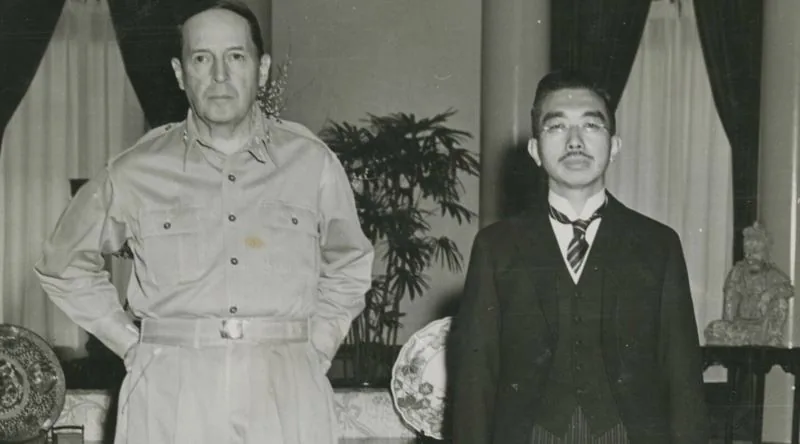
The MacArthur Hirohito photo, taken on September 27, 1945, captures the first meeting between the Allied Supreme Commander and Japan's emperor, and it shattered the divine image of the emperor in a single frame. In that Tokyo moment, the towering American general stood in an open-collared shirt while the small, formally dressed Hirohito stood rigidly beside him, and the visual contrast told the Japanese people that their god-like leader was now just a man under occupation.
The MacArthur Hirohito photo, taken on September 27, 1945, shows the two leaders standing side by side during their first meeting. The image, shot by Army photographer Gaetano Faillace, revealed the power shift in occupied Japan and forced the public to confront the emperor's diminished status.
- The photograph was taken on September 27, 1945, during the first face-to-face meeting between General Douglas MacArthur and Emperor Hirohito.
- Army Signal Corps photographer Gaetano Faillace captured the image, which appeared in Japanese newspapers despite official attempts to suppress it.
- MacArthur wore his standard open-collar khaki uniform without a tie, while Hirohito appeared in formal morning dress, a contrast that became the photograph's defining feature.
- The Japanese government initially attempted to suppress the photo, but it still found its way into circulation across Japan.
- The image is widely credited with accelerating the shift in public perception that helped transform Hirohito from a divine sovereign into a constitutional symbol.
The Photograph That Shook a Nation
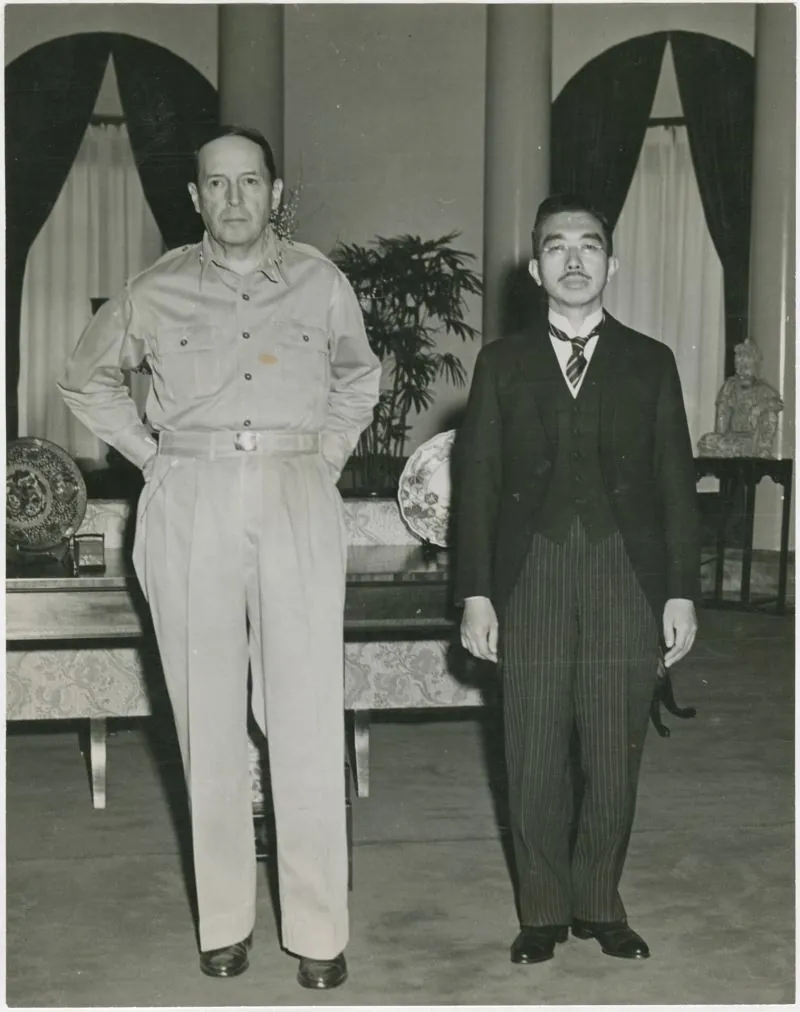
On September 27, 1945, a single photograph captured the entire power shift of postwar Japan in one frame, and it became known simply as the MacArthur Hirohito photo. The image shows General Douglas MacArthur standing casually in an open-collar khaki shirt with no tie and no jacket, while Emperor Hirohito, dressed in a formal morning coat with striped trousers, stands rigidly beside him. The contrast between the two men could not have been starker, and that contrast told the world exactly who was in charge now.
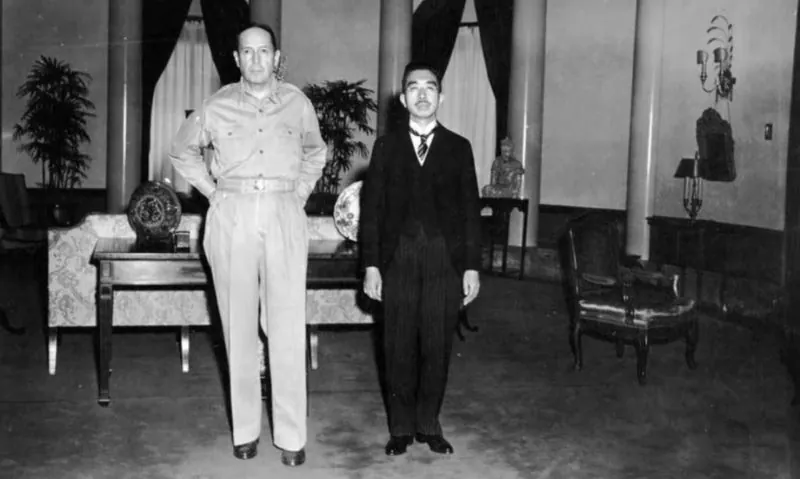
U.S. Army Signal Corps photographer Gaetano Faillace was the man behind the camera that day. He took three photos during the historic meeting between the American general and the Japanese emperor, but only one of them would go on to define the occupation era. In that frame, MacArthur's relaxed posture and informal dress next to Hirohito's stiff, formal appearance created an image that needed no caption. The war was over, and this picture proved it in a way that words never could.
For the Japanese people, the photograph landed like a thunderbolt. They had been raised to regard Hirohito as a living god, a figure so sacred that his face was rarely seen in public. Now here he stood, in full formal regalia, standing beside an American general in shirtsleeves who looked like he had just stepped out of a staff meeting. The image stripped away the divine mystique and showed the occupation's reality in brutal clarity. Japanese authorities tried to suppress the photograph, but it slipped through and appeared in newspapers anyway, sparking a sensation that rippled through every corner of the country.
Americans, by contrast, embraced the image enthusiastically. For the U.S. military and the American public, the photograph was a clean visual statement of Allied authority over a defeated Japan. It showed control, plain and simple, and it circulated widely in both Japanese and international media. The MacArthur Hirohito photo became the enduring symbol of the occupation, a single frozen moment that captured the end of one era and the beginning of another. Decades later, historians still point to that September morning as the day Japan's postwar identity was visually born.
The Man Behind the Lens: Gaetano Faillace
The man who captured that unforgettable frame was Gaetano Faillace, a U.S. Army Signal Corps photographer serving in occupied Japan in 1945. He was the eyewitness who stood in the right room at the right moment, camera ready, as history unfolded between General Douglas MacArthur and Emperor Hirohito. Without his presence that day, the world might never have seen the image that came to define the postwar occupation.
Faillace was part of the Signal Corps, the military unit tasked with documenting the occupation through photographs and film. His job was to record what happened, not to make a statement. But on September 27, 1945, when the two leaders met for the first time, he took three photographs that would outlive the moment itself.
The first two shots were formal and conventional, the kind of official record you would expect from such a meeting. The third one, though, was different. It caught MacArthur standing relaxed in an open-collar khaki shirt, no tie, no jacket, while Hirohito stood stiffly beside him in a formal morning coat with striped trousers. That single frame, the casual-attire one, became the MacArthur Hirohito photo that everyone remembers.
What Faillace likely saw through his viewfinder was a straightforward documentation assignment. What he actually captured was a visual shock wave. The contrast between the two men told a story that words could not, and it was that contrast that made the image impossible to ignore.
A Meeting of Two Worlds: MacArthur and Hirohito
On September 27, 1945, in Tokyo, General Douglas MacArthur, the Supreme Commander for the Allied Powers, met Emperor Hirohito for the first time. The encounter was brief, but its visual aftermath would define the occupation of Japan for decades.
Gaetano Faillace, a U.S. Army Signal Corps photographer, captured three photographs of that meeting. The most famous frame shows MacArthur standing in an open-collar khaki shirt, no tie, no jacket, hands resting casually at his sides. Beside him, Hirohito wears a formal morning coat with striped trousers, every button fastened, his posture stiff and unreadable. The contrast could not have been more deliberate if it had been staged.
For the Japanese people, the image landed like a thunderclap. Hirohito was not merely their emperor; he was revered as a divine figure, a living god whose face was rarely seen and whose person was protected by layers of ritual and reverence. Here he stood, diminished, in the shadow of an American general in shirtsleeves. The photograph made visible what the surrender documents had only implied: the old order had collapsed, and the occupation was real.
Japanese authorities tried to suppress the image, but it leaked into newspapers anyway. American officials and media embraced it openly, seeing it as proof of who held power in the Pacific. The MacArthur Hirohito photo became an instant symbol of the occupation, reproduced in both Japanese and international press, and it has never really faded from the historical record.
What makes the photograph so enduring is not just the two men in it, but what their clothing says. MacArthur's khaki was the uniform of a soldier who had won. Hirohito's morning coat was the costume of a monarch whose authority had been hollowed out. No caption was needed. The image told the story on its own.
Japan's Shock and America's Approval
When the MacArthur Hirohito photo hit Japanese newsstands in late September 1945, it landed like a thunderclap. Here was General Douglas MacArthur, the Supreme Commander for the Allied Powers, standing casually in an open-collar khaki shirt with no tie and no jacket, while Emperor Hirohito stood rigid beside him in a formal morning coat with striped trousers. For a nation that had been taught to revere the emperor as a living deity, the visual was devastating.
Japanese authorities reportedly tried to suppress or restrict its publication. The image revealed the occupation's reality in a way that words never could: the divine emperor, reduced to a stiff, smaller figure standing next to a relaxed American general. Censors moved quickly, but the photograph had already slipped into circulation through both Japanese and international media outlets. It became impossible to unsee.
Americans, by contrast, welcomed the image with open arms. For them, the photograph demonstrated exactly who was in control in postwar Japan. The visual contrast between the two men, the American general at ease and the Japanese emperor in formal dress, told the story of a defeated nation under new authority. U.S. newspapers ran the image proudly, and it quickly became one of the defining symbols of the occupation era.
The irony was sharp. One nation saw humiliation in the same frame that another saw triumph. The photograph itself never changed, but the eyes looking at it carried entirely different histories, wounds, and expectations. In Japan, it shattered an illusion that had held for generations. In America, it confirmed a victory that had cost thousands of lives to achieve.
What made the image so potent was its sheer simplicity. No dramatic action, no battlefield, no destroyed city. Just two men standing in a room, and the entire power structure of postwar Asia rearranged in a single frame. The MacArthur Hirohito photo became a permanent fixture in history books, a visual shorthand for the moment Japan's old order met America's new one.
An Icon of the Occupation Era
That single frame from September 27, 1945, outlived the moment it captured and became the defining image of the Allied occupation of Japan. The MacArthur Hirohito photo now sits in history books as the visual shorthand for a nation's surrender and its emperor's fall from divine grace.
John Dower's landmark study Embracing Defeat, published in 1999, features the image prominently in its account of postwar Japan. Dower used the photograph to illustrate how the occupation rearranged the social order overnight. The contrast between the two men in that frame, one in an open-collar khaki shirt and the other in a formal morning coat, told the story of who held power and who had lost it.
The image continues to surface in discussions of postwar U.S.-Japan relations, decades after the occupation ended. It appears in textbooks, documentaries, and museum exhibits whenever scholars try to explain the strange intimacy and tension of those years. Japanese authorities tried to suppress the photograph when it first appeared, while American media embraced it as proof of Allied control. That split reaction became part of its power.
What gives the photograph its lasting weight is how much it says in a single exposure. Here was the Supreme Commander of the Allied Powers, relaxed and casual, standing beside an emperor who had been worshipped as a living god until weeks earlier. The camera caught the exact moment when old Japan met new Japan, and the image forced both nations to look at what that meeting meant. The stiff posture of Hirohito, the easy stance of MacArthur, the formal clothes against the informal ones. Every detail reinforced the message.
Historians still return to this photograph because it compresses an entire era into one frame. The occupation reshaped Japan in ways that are still visible today, and this image from its earliest days became its permanent emblem. For Americans, it showed victory and authority. For many Japanese, it revealed the painful reality of defeat. For everyone since, it has served as a reminder that power shifts are often visible in the smallest human details, a gesture, a piece of clothing, a stance between two men in a room.
Frequently asked questions
What did the MacArthur-Hirohito photo show?
The photograph, taken on September 27, 1945, showed General Douglas MacArthur standing in a casual open-collar khaki shirt with no tie or jacket, while Emperor Hirohito stood beside him in a formal morning coat with striped trousers. The visual contrast between the two men made the power dynamic of the postwar occupation unmistakable to anyone who saw it.
Who took the famous photo of MacArthur and Hirohito?
Gaetano Faillace, an American photographer serving with the U.S. Army Signal Corps, took the photograph during the historic meeting in 1945. He captured three shots that day, and the one showing MacArthur relaxed and Hirohito stiff became the image that defined the occupation era in the public mind.
Why did the MacArthur-Hirohito photo shock Japan?
For the Japanese public, the image was devastating because it contradicted everything they had been taught about their emperor. Many Japanese regarded Hirohito as a divine figure, a living god, and seeing him standing subordinate to an American general in casual dress revealed the reality of defeat and occupation in a single frame. The visual proof of his diminished status struck at the heart of national pride.
How did Americans react to the MacArthur-Hirohito photo?
American officials and media welcomed the photograph enthusiastically, seeing it as a clear demonstration that Allied control over Japan was absolute. For a nation that had just emerged from a brutal war in the Pacific, the image of the Japanese emperor standing beside an American general in a simple uniform was a satisfying visual confirmation of who had won and who now held power.
Was Emperor Hirohito considered divine before the occupation?
Yes, many Japanese people genuinely regarded Hirohito as a god, a belief that had been cultivated and reinforced by the state for generations. This divine status made the photograph's impact so profound, because it showed the emperor in a position that was unthinkable before the war's end. The image forced a reckoning with a new reality that contradicted deeply held beliefs.
Did the Japanese government try to suppress the photo?
Japanese authorities did attempt to restrict publication of the image, recognizing how damaging it was to the emperor's standing. Despite these efforts to ban or limit its distribution, the photograph still spread through Japanese newspapers and found its way into international media, becoming one of the most reproduced images of the occupation period and a lasting symbol of Japan's transformation after World War II. Editorial note: Any facts which remain unconfirmed are presented as such, hedged where necessary, and no details have been invented beyond what is verifiable in the historical record.
Got a take on this? Add your voice to the conversation below →
No comments yet. Be the first.