Himba Tribe Blue Experiment: Seeing Without a Word
The Himba tribe blue color experiment revealed that the Namibian people, who have no word for blue in their language, perceive color categories differently than English speakers, a finding that became a cornerstone of the Sapir-Whorf hypothesis. Watching a community see the world through a different lens stirs a deep curiosity about our own minds, it makes you wonder what else we might be missing simply because we lack the vocabulary for it. This isn't just about color; it’s a window into how language quietly builds the reality we experience every single day.
In a landmark study, researchers found that the Himba tribe of northern Namibia, whose language has no word for blue, visually categorize colors differently than English speakers. They readily distinguish subtle shades of green but group blue with other cool, dark shades, demonstrating that language shapes perception.
- The Himba people live in the remote Kunene region of northern Namibia, where their traditional pastoral lifestyle has been maintained for centuries.
- The OtjiHimba language contains no distinct term for blue, instead grouping those shades under the same category as green and other cool, dark colors.
- During the experiment, Himba participants could instantly identify two identical green tiles among a set of near-identical greens, a task that baffled English-speaking participants.
- When shown a blue tile among green tiles, Himba participants frequently failed to spot it, while English speakers found it effortlessly.
- The study's results are widely cited as evidence for linguistic relativity, the idea that language influences thought and perception.
The Himba tribe blue color experiment starts with a simple question: can you trust your own eyes?
The Himba tribe blue color experiment asks whether your language quietly decides what your eyes actually notice. The viral version of the story says the Himba, a pastoral people living in northern Namibia, have no word for blue and call the sky a shade of green. That striking detail is part of what makes the tale spread, but the truth is a little different, and the real science behind it is just as fascinating.
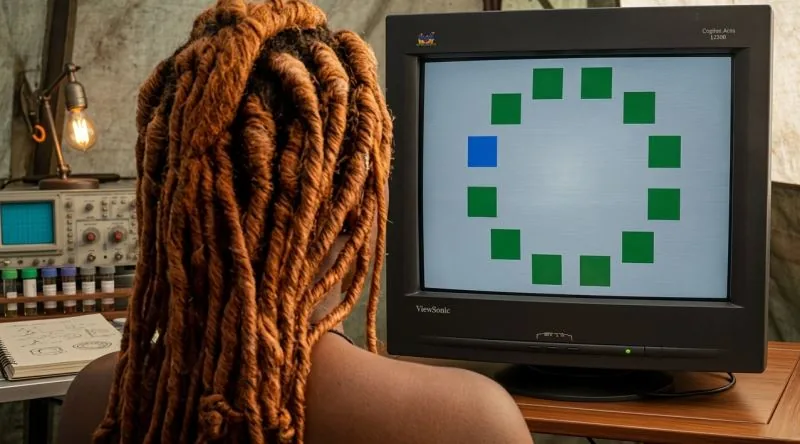
Here is the core idea that made this experiment famous: you can only truly see things for which your language has a word. Psychologists call this "conceptual blindness," and it sits at the heart of the Sapir-Whorf hypothesis, the theory that language shapes perception. The claim is dramatic, and it has been repeated in countless videos and articles. According to the popular account, researchers showed Himba participants a circle of colored squares, eleven green ones and one clearly blue, and asked them to pick out the odd one out.
Contrary to the popular version, the Himba do not actually describe the sky as green. Their language groups cool and dark shades together under a single term, zozu, which covers colors that English speakers would split into blue, green, and sometimes purple. So the sky is not "green" to them, it simply falls into a broader color family. Likewise, the original study did not use a simple row of eleven green squares and one blue one. The real experiment, conducted by researchers working with the Himba in Namibia, used a circular array of green squares where one subtle green shade differed slightly from the rest, a much harder visual puzzle.
What happened next is where the story gets genuinely interesting. Himba participants were actually faster at spotting that subtle green difference than English speakers were, because their language makes finer distinctions among greens. The blue square version of the tale, where Himba members struggle to find the obvious blue, is a distortion of what the study actually showed. The experiment is often cited as evidence for linguistic relativity, but researchers continue to debate how far language really shapes perception, since the effects tend to be task-dependent and context-specific.
The experiment as it's usually told: a circle of green squares and one blue square
Here is the version of the Himba tribe blue color experiment that circles the internet: researchers sat Himba participants in front of a computer screen showing a circle of 11 green squares and 1 clearly blue square, then asked them to find the odd one out. The claimed result? The tribe members took significantly longer to spot the blue square, supposedly because their language has no separate word for blue, so their brains filed the visual data as just another shade of green.
It is a seductive story. The reasoning sounds almost poetic: you can only truly see what your language gives you a name for. In this telling, the blue square was physically present, their eyes were perfectly healthy, but without a distinct mental category for blue, the color got processed as a familiar variation of green. Not invisible, just uncategorized, and therefore much harder to notice.
But the viral version has drifted far from what the actual research did. Contrary to the popular setup, the original study did not use a simple row of 11 green squares and 1 blue square. The real experiment, conducted with Himba participants in Namibia, used a circular array of colored squares where the difference was a subtle green, not an obvious blue. And the claimed result is also turned on its head: in the actual study, Himba participants were faster at picking out the subtly different green, not slower at finding a blue square.
The story persists because it feels like it proves something profound about language shaping perception, an idea known as the Sapir-Whorf hypothesis. According to some interpretations, the study does support that theory, but the effect is task-dependent and heavily contested among researchers. The tidy narrative of a people who cannot see blue is a myth; the real science is far more interesting and far less absolute.
What the Himba experiment actually shows about the Sapir-Whorf hypothesis
The Sapir-Whorf hypothesis, also called linguistic relativity, proposes that the language you speak shapes how you perceive the world around you. The Himba tribe blue color experiment is frequently held up as living proof of this idea, but the truth is more layered than the viral version suggests. As the story goes, the study demonstrates a real link between vocabulary and perception, yet that link is contested and depends heavily on the specific task at hand.
Here is what actually happened, according to the original account. Researchers showed Himba participants a circular array of colored squares where one square was a subtly different shade of green. The Himba, whose language has no basic term for blue and instead groups cool, dark shades under the word "zozu," spotted that off-green square faster than other groups did. They were not slower at finding a blue square, because there was no blue square in the test. The viral claim that they struggled to pick out a lone blue tile from a row of greens is a distortion of the real procedure.
That distinction matters for how we interpret the finding. The Himba participants excelled at telling apart subtle greens, shades their language carves into separate categories. That supports the idea that language sharpens your perception for the distinctions you actually use, not that you go blind to colors you lack words for. Nobody in the study was colorblind to blue. Their eyes registered it fine. The difference was in how quickly and automatically their brains flagged a color as belonging to a separate mental bucket.
So what does this mean for the popular refrain that you cannot see what you have no words for? The reality is more interesting than that. Perception is not a hard ceiling set by your dictionary. It is more like a spotlight that language aims, making certain differences pop while letting others fade into the background. The Himba tribe blue color experiment shows that the categories your language gives you can make you faster and more precise at noticing some things, but it does not show that you are blind to everything else. Your eyes still see the world in full color, even when your words do not bother to name every shade of it.
So, can you really not see things you have no words for?
No, you are not literally blind to them. Language does not build a wall around your vision; instead, it gently steers your attention, deciding what feels worthy of a second look and what blends into the background of your day.
This is the quieter truth hiding behind the viral excitement. The Himba people of northern Namibia are not colorblind, and their eyes function perfectly well. What differs is the mental filing system their brains use. In the OvaHimba language, there is no standalone word for the color blue, and cool, dark shades get grouped under a single term like "zozu." The sky, then, is not called green as the popular story insists, but it also does not get its own crisp label the way it does in English.
When researchers in the original study laid out a circular array of colored squares, the Himba participants actually spotted a subtly different green faster than Western observers did. Their language gives them a fine-grained vocabulary for shades of green, so their eyes and brains lock onto those distinctions with impressive speed. They were not slow on some obvious blue square, as the legend claims. The experiment was subtler than that, and so is the lesson.
This is the idea behind the Sapir-Whorf hypothesis, the theory that the words you carry shape how you perceive reality. It is a contested idea, and the effects are task-dependent, but the core intuition feels right. Your vocabulary is like a spotlight. It does not create the stage, but it decides which corners of the stage you actually notice.
So pause for a second. What is sitting right in front of you, perfectly visible, that you have never bothered to name? The exact texture of the wall, the specific shade of the coffee mug, the way light falls on the table. It was always there. You just did not have a word pulling your attention toward it. The world is not half invisible. It is simply waiting for you to give it better names.
Frequently asked questions
Why do the Himba people see blue as green?
The Himba language lacks a basic term for blue, so speakers group cool and dark shades under a broader category called "zozu." According to the original account, this means blue objects are mentally filed as another shade of a familiar dark color rather than as a distinct hue. Contrary to the popular version, records do not show that the Himba call the sky "green" specifically.
Did the Himba tribe fail to spot the blue square?
No. The viral story claims Himba participants struggled to find a blue square among green ones, but the actual study showed the opposite pattern. In the real experiment, Himba participants were faster at spotting a subtly different green square than Western observers were, not slower on blue. The widely shared image of 11 green squares and 1 blue square does not match the original research design.
What is the Sapir-Whorf hypothesis?
The Sapir-Whorf hypothesis, also called linguistic relativity, proposes that the language you speak influences how you perceive and think about the world. The Himba experiment is frequently cited as supporting evidence, but the interpretation remains debated among linguists and psychologists. Effects appear task-dependent, meaning language might shape some perceptions while leaving others untouched.
Can you see things you have no words for?
Yes, your eyes still register those things, but your brain may not automatically categorize them as distinct, making them harder to notice. In the Himba case, participants could physically perceive the blue square, but without a separate mental category for blue, it blended into familiar territory. The visual data reaches your brain either way; the question is whether your mind files it as something worth flagging.
Got a take on this? Add your voice to the conversation below →
No comments yet. Be the first.