Gaussian Curvature: Why a Folded Pizza Slice Won't Flop
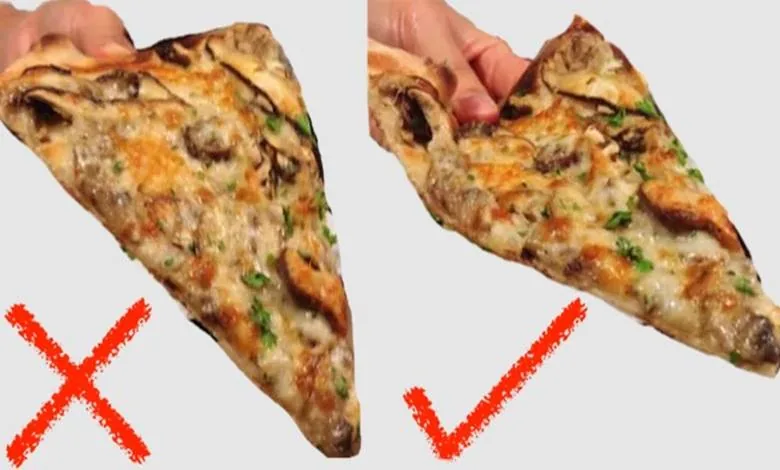
You pick up a slice of pizza, lift it toward your mouth, and right at the last second the tip sags and flops over, threatening to drop pepperoni and cheese onto your shirt. The dough simply isn't stiff enough to carry the weight of what's piled on top. Then you bend the slice into a U, lengthwise, and take a bite. The droop stops. That small kitchen move sits on top of one of the most powerful results in mathematics, and the same idea explains why eggshells resist cracking and why thin concrete shells can span a racetrack.
Gaussian curvature measures how a surface bends in two directions at once. A flat sheet has zero, an eggshell has positive, and a saddle has negative. Because this quantity stays fixed when a surface bends without stretching, a folded pizza slice cannot flop, and thin curved shells can be remarkably stiff.
- Gauss's Theorema Egregium, published in 1827, states that Gaussian curvature is preserved under any bending that does not stretch or tear the surface.
- A folded pizza slice gains stiffness because the fold forces one direction to stay straight, and the surface cannot curve in the other direction without stretching.
- Eggshells are strong because their positive Gaussian curvature resists being flattened without cracking.
- The Spanish-Mexican architect and engineer Félix Candela used thin hyperbolic paraboloid shells, which have negative Gaussian curvature, to build wide roofs with very little concrete.
- Eduardo Torroja's Zarzuela racecourse roof in Madrid is an early landmark of thin-shell concrete design.
The Fold That Saves Your Pizza
You pick up a slice of pizza, lift it toward your mouth, and right at the last second the tip sags and flops over, threatening to dump pepperoni and cheese onto your shirt. The dough simply isn't stiff enough to carry the weight of what's piled on top. Maybe you should have gone lighter on the toppings. Or maybe you just need to bend the slice into a U, lengthwise, and take a bite.
Fold it and the droop stops. The slice holds flat and steady in your hand, and you eat in peace. No pizza nearby? Grab a plain sheet of paper and try the same thing: bend it one way and it stiffens in the other. That small kitchen move sits on top of one of the most powerful results in mathematics, a theorem about curved surfaces called Gaussian curvature.
Carl Friedrich Gauss proved it in 1827 and gave it a name that still sounds impressive: Theorema Egregium, Latin for "remarkable theorem." What Gauss showed is that a surface carries a kind of curvature number at every point, and that number refuses to change when you bend or roll the surface without stretching or tearing it. You can curl a flat sheet of paper into a tube, but the number stays the same the whole time.
That single rule explains the pizza, the paper, and a whole lot more. Once you see it, you start noticing it in leaves, in cardboard boxes, and in some of the strangest buildings ever poured from concrete.
The "Remarkable Theorem" That Explains the Orange Peel Test
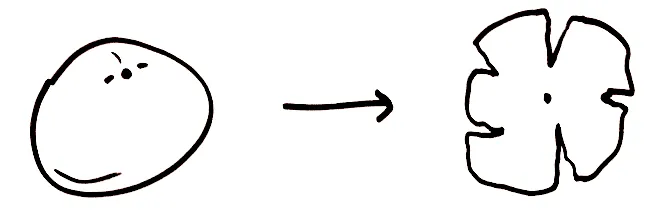
Try the orange peel test. Work your thumbnail under the skin, pull it free in one piece, then press that fragrant curl flat against the counter. It will not lie down. It buckles, splits, and fights you the whole way.
Wrapping paper around the orange fails the same way. No matter how carefully you smooth it, wrinkles and creases appear. The skin and the paper are telling you something deep about surfaces, and the messenger is a single number: Gaussian curvature.
Here is the idea in plain terms. Pick any point on a surface and find the two most extreme paths through it, the most concave and the most convex. Multiply their curvatures together, and you have the Gaussian curvature at that point. A cylinder gives zero, because one of those paths runs dead straight. That is exactly why a flat sheet of paper rolls into a tube without complaint. A sphere is different. Every path across it bends by the same amount, so its Gaussian curvature is a positive number, and no amount of patience will turn a flat sheet into a ball without cutting or tearing it.
The orange peel obeys the same law. Round and flat simply cannot be converted into one another when Gaussian curvature is in the way.
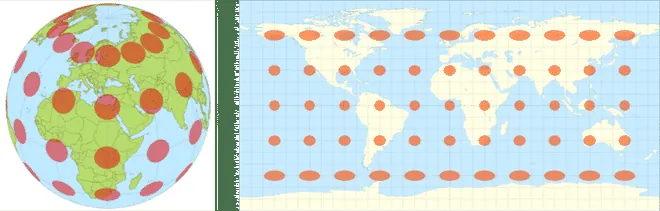
It also explains a frustration you have probably felt with a folded map. Drawing the globe on flat paper without distortion is impossible. The world maps you are used to show angles correctly, but they stretch areas badly. Draw a set of equal circles on a sphere, then look at them on the map, and they come out warped and uneven. The paper is not lying to you. It is obeying Gauss.
What Gaussian Curvature Actually Means
Gauss wanted a way to measure the bend of a surface that would not change when you flexed or rolled it. That stubborn, bend-proof number is what we call Gaussian curvature, and it is the reason a sheet of paper can become a cylinder but never a sphere.
Start with an ant crawling on a surface. At any point it has a whole menu of paths to choose from: it can walk in a tight circle, march along a straight line, or trace something in between, like a helix winding around. Gauss's clever move was to build his definition out of that menu rather than out of how the surface happens to sit in the room.
Here is the recipe. Find the two most extreme paths through your chosen point, the one that curves in the most (most concave) and the one that curves out the most (most convex). Then multiply their curvatures together. Curvature counts as positive for a concave path, zero for a straight one, and negative for a convex one. The product of those two extreme values is the Gaussian curvature at that point.
Try it on a cylinder. The ant's two extremes are the curved circular path around the tube and a dead-straight line running along its length. The straight path contributes zero, so the product collapses to zero. Mathematicians say a cylinder is flat, and that is exactly why you can roll a flat sheet of paper into one without a single wrinkle.
Now drop the ant onto a sphere. There is no straight path anywhere on it. Every route the ant can take bends by the same amount, so the product comes out positive. This is the wall you hit when you try to wrap paper around an orange: creases and folds appear no matter what you do. Peel the orange instead and the skin will not lie flat without a cut.
The idea reaches far past the kitchen. Because Gaussian curvature is baked into the surface itself, it lets us ask about the shape of everything, without ever stepping outside it. As far as is known, the universe itself is flat.
Why Folding a Pizza Slice Works, and Why Leaves Do It Too
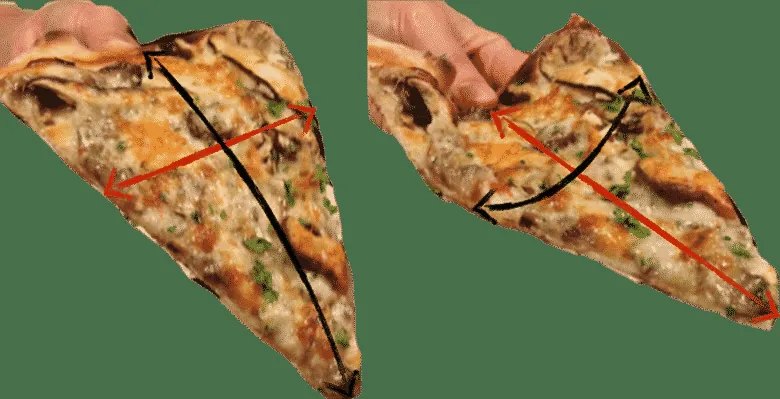
Lay a pizza slice flat on the table and its Gaussian curvature is exactly zero. Gauss's theorem says that once you bend a surface, at least one direction through it has to stay perfectly straight. Hold the slice the usual way and that straight line runs sideways, so the tip sags toward the floor. Fold the slice crosswise and the straight direction swings toward your mouth, and the whole thing stiffens in your hand.
Try it with a scrap of paper if the pizza is gone. Bend it one way and it resists bending the other way on its own, without any extra material or glue. That single trick explains a whole list of things you have probably handled without noticing.
Look closely at a blade of grass. Most blades are creased along the central vein, and that fold stiffens them against drooping. The same logic keeps a leaf from collapsing under its own weight.
A flat slice: Gaussian curvature zero, free to flop.
Folded crosswise: the straight line points at your mouth, and the slice holds.
A creased blade of grass: strength from a fold, not from thickness.
Once you see it, you start spotting it everywhere. Corrugated cardboard, a rolled sheet, the curl of a taco shell. None of them got strong by getting thicker. They got strong by getting curved.
Curvature Is Strength: Torroja, Soda Cans and Corrugated Cardboard
Engineers learned the pizza lesson long before anyone named it. Curvature is not decoration; it is a way to make a thin surface behave like a thick one. The clearest proof sits in Madrid, where Spanish engineer Eduardo Torroja designed a very thin concrete roof extending outward at the Zarzuela racecourse. The roof is just a few centimeters thick, but it stretches across a wide span. The curve is what holds it up.
Picture a flat sheet of concrete a few centimeters thick. It would sag under its own weight. Bend it into a curved shell and the load travels along the surface instead of fighting it. The same trick keeps the structure light, and lightness is strength you can afford.
Try standing on an empty soda can. It will hold your weight, even though the metal is barely thicker than a sheet of paper. The curved cylindrical surface resists the downward push. Flatten a dent into the side first and the can crumples instantly, because you have broken the curve that was doing the work.
Corrugated cardboard boxes and corrugated metal sheets run on the same logic. Those ridges aren't decoration. They let the material stay thin and light while still holding up under heavy loads. Run your finger along a cardboard box and you feel the ridges; each one is a tiny arch holding its shape.
Nature got there first. Look closely at a blade of grass and you will often find it folded along its central vein. That fold gives the leaf extra strength and keeps it from drooping, the same principle Torroja used in concrete at Zarzuela.
Double Curvature: Eggshells, Cooling Towers and the Pringles Shape
Grab a soda can, an egg and a Pringles crisp and you are holding three lessons in Gaussian curvature. A can is curved in one direction and flat in the other, so it still flattens back into a sheet. An eggshell is curved in both directions, and its Gaussian curvature is not zero. That single difference is where the real strength begins.
Here is a test you can run at the kitchen counter tonight. Take an egg from the fridge, set it in your palm and wrap your fingers around it. Take your rings off first. Now squeeze. The shell pushes back, and it keeps pushing back. The reason is the double curve: press the convex dome and it compresses, while the concave flanks stretch under tension, and the two forces balance each other out. A shell that thin should crack under a firm grip. It does not, because the shape is doing the work.
Engineers lean on the same trick at a much larger scale. The iconic silhouette of a nuclear power plant cooling tower is a hyperboloid, a shape chosen because it curves in both directions. Ordinary chimneys are strong but tip and buckle far too easily. A hyperboloid shell locks itself in place, so it resists buckling while using as little material as the job allows. The waist in the middle is not decoration. It is the curve holding the whole thing up.
Then there is the Pringles crisp. It has a proper name, the hyperbolic paraboloid, and it is a saddle: it curves up one way and down the other. The Spanish-Mexican architect and engineer Félix Candela understood this shape better than almost anyone. Working in Mexico, he built enormous thin concrete roofs on the hyperbolic paraboloid, showing just how slender and elegant concrete can be when the geometry is on its side.
Why does the saddle hold so well? Every structure has to carry weight down to the ground, and it does that through two forces. Compression squeezes the material inward. Tension pulls its edges outward and stretches it. The hyperbolic paraboloid gets the best of both worlds. Its concave U-shaped parts stretch under tension, its convex arch-shaped parts compress, and the push and pull settle into a delicate balance. The result stays thin and still comes out remarkably strong.
Once you see it, you cannot unsee it. Corrugated cardboard, the folded vein running down a blade of grass, the curve of a stadium roof: each one is Gaussian curvature quietly earning its keep.
Frequently asked questions
Why does folding a pizza slice keep it from drooping?
Folding the slice into a U shape turns its one straight direction toward your mouth, so the slice stiffens instead of flopping over. This works because of Gaussian curvature: bending a surface cannot change it, so at least one direction must stay straight. The fold redirects that straight line and holds the slice firm.
What is Gaussian curvature, in plain terms?
Gaussian curvature at a point is the product of the curvatures of the two most extreme paths through that point, the most concave and the most convex. Curvature counts as positive for concave paths, zero for straight ones, and negative for convex ones. Multiply the two extremes and you get the number that defines the point.
What does Gauss's Theorema Egregium actually say?
Carl Friedrich Gauss proved the Theorema Egregium, Latin for "remarkable theorem," in 1827. It states that bending a surface cannot change its Gaussian curvature. So a flat sheet keeps zero curvature no matter how you flex it, and at least one direction through any point has to remain straight. That single rule explains the pizza trick.
Why is a cylinder flat but a sphere is not?
A cylinder has one straight path running along its length, with zero curvature, so multiplying the extremes gives zero. That is why paper rolls into a cylinder without wrinkling. A sphere has no straight path at all; every route curves the same way, giving positive curvature, so it cannot be flattened without cutting or tearing.
How did Félix Candela use hyperbolic paraboloids?
Félix Candela, the Spanish-Mexican architect and engineer, built large thin-shell concrete roofs shaped as hyperbolic paraboloids, the same saddle form as a Pringles chip. Those doubly curved shells showed how slender concrete can carry heavy loads. His structures stand as proof that curvature, not bulk, is what gives a surface its strength.
Was Eduardo Torroja's Zarzuela roof really only a few centimeters thick?
Yes. Spanish engineer Eduardo Torroja designed the thin concrete roof that extends outward over the grandstand at the Zarzuela racecourse in Madrid. It spans a wide area on a shell just a few centimeters thick, because its curvature supplies the stiffness that thickness otherwise would.
Why can you squeeze an egg in your hand without crushing it?
An eggshell curves in both directions at once, so its Gaussian curvature is not zero. Doubly curved surfaces cannot be flattened without tearing, and that geometry locks the shell against pressure. Wrap your fingers around an egg and squeeze evenly, and it holds. The strength comes from the shape, not the material.
Why can't you flatten an orange peel without tearing it?
An orange peel is curved in two directions, so its Gaussian curvature is nonzero. Gauss's theorem guarantees such a surface cannot be pressed flat without stretching or cutting. Try to smooth a peeled segment onto the counter and it splits or buckles. The peel has to be cut, because the geometry leaves no other option. Editorial note: any details that remain unconfirmed are presented as such, and figures are included only where they could be verified.
Got a take on this? Add your voice to the conversation below →
No comments yet. Be the first.