Elliptic Curve Cryptography: From Renaissance Art to Bitcoin
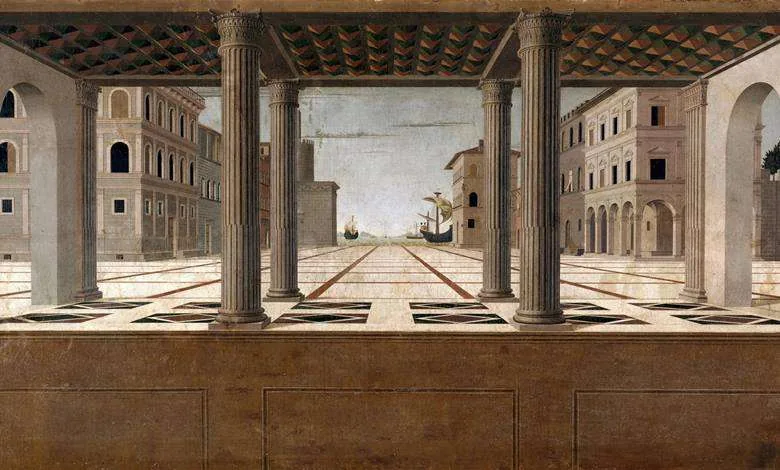
Elliptic curve cryptography is the math that secures Bitcoin and most of the modern internet, and its roots reach back to Filippo Brunelleschi's perspective experiments in Florence around 1420. When Brunelleschi painted the Florence Baptistery onto a mirror, he was chasing a painter's trick: how to show three-dimensional depth on a flat surface. Nobody in that workshop could have guessed that the rules he uncovered would one day guard billions of dollars in digital currency. The line from Renaissance art to your Bitcoin wallet is long, but it is unbroken.
Renaissance artists in 1400s Florence developed perspective geometry to paint depth realistically. Mathematicians later formalized this as projective geometry, which eventually helped inspire elliptic curve cryptography, the public key system that now secures Bitcoin and much of the internet.
- Filippo Brunelleschi demonstrated linear perspective in Florence around 1420, using a painted panel and a mirror to show how parallel lines converge at a vanishing point.
- Girard Desargues advanced projective geometry in the 1600s, treating parallel lines as meeting at a point at infinity, an idea that later proved useful in algebra.
- Neal Koblitz and Victor Miller independently proposed using elliptic curves for public key cryptography in 1985.
- Bitcoin, launched in 2009, uses the secp256k1 elliptic curve to generate and verify the digital signatures that authorize transactions.
- Elliptic curve cryptography offers comparable security to RSA with much smaller keys, which matters for devices with limited computing power.
From Renaissance Canvas to Bitcoin: The Unlikely Story of Elliptic Curve Cryptography
Every time you send Bitcoin, you lean on a piece of mathematics called elliptic curve cryptography. It is the security system underneath Bitcoin and a growing list of other cryptocurrencies, and it is spreading fast across the wider internet too. The strange part? Its roots run back to a Renaissance dome in Florence.
Filippo Brunelleschi, the architect who capped the Florence Cathedral with its famous dome in the 1400s, worked out the rules of perspective that painters used to make flat panels look three-dimensional. Those rules quietly tied the visual geometry of art to the tidy world of Euclidean geometry, the points and lines you meet in school. That link is where the whole chain begins.
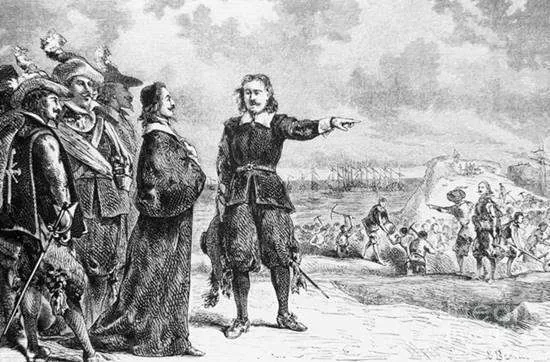
The first real push came in the 17th century from Girard Desargues, a French mathematician who was born in Lyon in 1591 and worked as an engineer and architect as well. He is remembered as one of the founders of projective geometry, the branch that studies how shapes behave when they are projected onto a surface. His signature result, Desargues' Theorem, deals with triangles seen in perspective from a single point and a single line.
Desargues had a problem, though. He wrote in a dense, heavy style that his contemporaries found hard to follow, so his ideas mostly failed to land. As the story goes, his key contributions appeared in a book with a print run often cited as around 50 copies, a tiny number even by the standards of his day, though the exact figure is hard to pin down.
He did not leave the field empty-handed. Desargues added the notions of points and lines at infinity to Euclidean geometry, so that even parallel lines could be said to intersect. In his system, every pair of lines meets at exactly one point, with no special exception carved out for parallel lines. Pascal is often described as Desargues' most serious follower during his lifetime, and Pascal added a theorem of his own to the young field, though whether he was truly the only one is hard to confirm.
Desargues' Revolutionary Geometry: Points at Infinity and the Birth of Projective Geometry
Here is the move that made Desargues dangerous to the tidy geometry of his day. He added points at infinity and lines at infinity to the familiar world of straight lines and flat planes taught in school. In his system, every pair of lines meets at exactly one point. Full stop. Parallel lines are not a special case, not an exception to be handled separately. They simply meet at a point sitting infinitely far away.
That single adjustment did something quietly enormous. A parabola and a hyperbola, which look like entirely different creatures next to a closed ellipse, can all be treated inside one framework once you add one or two infinite points. The curves stop being strangers and start sharing a family tree. Formal unity, from one strange idea.
Desargues wrote his ideas in dense, forbidding prose, and his contemporaries mostly shrugged. The work was then ignored for more than a century.
Reclamation came slowly. Monge reportedly worked on related questions, though whether he independently reached Desargues' conclusions is not fully confirmed. Then in the 19th century, Jean-Victor Poncelet systematized projective geometry into a formal theory, giving the field the structure Desargues never managed to sell.
From Obscurity to System: Monge, Poncelet, and the Revival of Projective Geometry
Girard Desargues died in 1661 with his most radical ideas sitting in a book almost nobody had read, and for more than a hundred years that is exactly where they stayed. For over a century, almost nobody paid attention to what he had written about perspective and projective geometry. The concepts of points at infinity and lines at infinity, which he introduced to Euclidean geometry, were simply too strange for his contemporaries. Parabolas and hyperbolas could be folded into the same framework as ellipses by adding one or two points at infinity, giving different curves a formal unity that Euclidean geometry could not offer.
That unity sat dormant. Then, more than a century later, the French mathematician Gaspard Monge reportedly worked on the same kinds of questions without building on Desargues' papers. Monge, who lived from 1746 to 1818, is best known for descriptive geometry, the method of representing three-dimensional objects in two dimensions. Whether he genuinely reached Desargues' conclusions on his own is not something the historical record settles cleanly, but the timing matters: the questions Desargues had raised were becoming urgent again.
The person who turned those scattered insights into something a mathematician could actually use was Jean-Victor Poncelet. In the 19th century, Poncelet turned projective geometry into a formal theory with his 1822 treatise, Traité des propriétés projectives des figures. Where Desargues had offered brilliant fragments in difficult prose, Poncelet built a structure. He took the ideas that had been ignored for a century and gave them the organization, the vocabulary, and the proofs that made them teachable.
French mathematicians had now managed to fuse projective geometry with Euclidean geometry. What remained was to fuse it with algebra, specifically the Cartesian coordinate system that students still use to plot equations. That step set the stage for everything that followed, including the mathematics that would eventually underpin elliptic curve cryptography.
Abel's Elliptic Integrals and the Inverses That Changed Mathematics
While Jean-Victor Poncelet was putting the finishing touches on his 1822 book systematizing projective geometry, a Norwegian mathematician named Niels Henrik Abel was wrestling with a very different problem: elliptic integrals. These awkward expressions had originally been developed to calculate the circumference of an ellipse, and mathematicians had been grinding through them directly for decades.
Abel spotted something nobody else had. In certain cases, the inverse of an elliptic integral was far easier to handle than the integral itself. That single shift in perspective opened the door to the objects we now call elliptic curves, and working with the inverse turned out to be far easier than wrestling with the integral directly.
It is a strange kind of irony that the man who found this door died almost as soon as he opened it. Abel died at 26, commonly cited as tuberculosis, though the precise timing relative to his key publication is uncertain. The detailed theory of elliptic curves, the full architecture that would eventually support elliptic curve cryptography, was left for others to build.
That gap between the insight and the finished theory is worth sitting with. Abel handed mathematics a key and then vanished from the room. The inverse of an elliptic integral was no longer a computational nightmare to be beaten into submission; it was a curve with structure, a shape you could study, add points on, and eventually build security systems around. But none of that was obvious in 1829, and nobody at the time could have guessed where the thread would lead.
What Abel's inverse really did was turn a calculation into a geometric object. An elliptic integral is a stubborn thing, a tangle of roots and arc lengths that resists elementary formulas. Its inverse, by contrast, behaves like a function with a graph, and that graph is a curve. Once you have a curve, you can ask geometric questions. You can ask what happens when two of its points meet, what symmetries it carries, and whether its rational points form any kind of pattern. Those questions were not Abel's to answer. He had already spent the last of his time on earth getting the paper into print.
The rest of the story belongs to the mathematicians who came after him, and to the twentieth-century researchers who would eventually recognize that Abel's curves held something far more practical than anyone in his century could have imagined.
Möbius, Poincaré, and the Group Structure of Elliptic Curves
French mathematicians had managed to fuse projective geometry with the Euclidean geometry we all learn in school. But marrying that new geometry to the Cartesian coordinate system, the grid students use to plot equations, fell to a German: August Möbius. He introduced homogeneous coordinates, a system often cited as a building block for the math behind elliptic curve cryptography, though the direct link is debated.
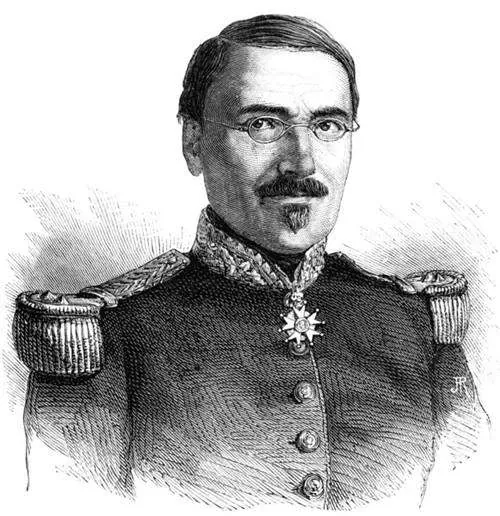
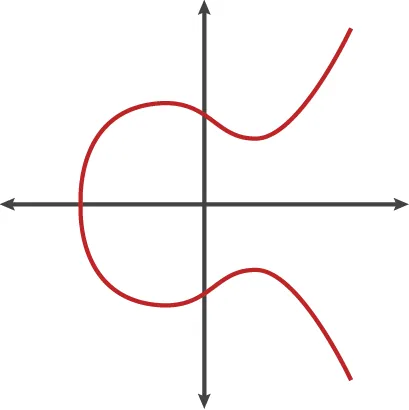
Then came the insight that turned a curve into a machine. Around the turn of the century, the French mathematician Henri Poincaré is credited with noticing something peculiar about the rational points sitting on the graph of an elliptic curve: they form a special structure. Take two rational points on the curve, combine them through a defined operation, and the result is always another rational point on that same curve. The set closes in on itself.
What makes that structure so useful is one clean property. The group law on an elliptic curve is commutative, so P plus Q always lands in exactly the same place as Q plus P. That commutativity is not a footnote. It is the reason the arithmetic on these curves behaves predictably enough to build a security system on top of, and it is the property that would later carry the whole idea of elliptic curve cryptography out of pure mathematics and into the real world.
Miller and Koblitz: The Birth of Elliptic Curve Cryptography in the Mid-1980s
In the mid-1980s, two mathematicians working on opposite sides of the country arrived at the same idea without ever comparing notes. Victor S. Miller was at IBM, and Neal Koblitz was at the University of Washington. Each of them looked at the group structure on an elliptic curve, the same structure Henri Poincaré had studied on rational points, and realized it could carry a public-key encryption system. That realization, reached independently by both men, is the direct beginning of what we now call elliptic curve cryptography.
Think about what they were proposing. A public-key system needs a mathematical operation that is easy to perform but brutally hard to reverse. Multiplying a point on an elliptic curve by a large number is easy. Recovering that number from the resulting point is not. Miller and Koblitz saw this asymmetry and understood its value for encryption. The curve was no longer just an object of pure mathematical curiosity. It was a lock.
The timing was not accidental. The group law on an elliptic curve is commutative, and that clean structure made the cryptographic construction workable. The abstract theory that had accumulated over more than a century, from Desargues through Abel and Poincaré, suddenly had a practical purpose. Pure mathematics had been sitting on a tool that cryptography did not yet know it needed.
What makes this moment worth pausing on is the independence. Miller and Koblitz did not collaborate. They did not publish together. They simply recognized the same opportunity at roughly the same time, which suggests the idea was ready to be found. The mathematics had matured to the point where someone was bound to make the connection. Two someones did.
How ECC Secures Your Data: Public-Key Encryption with Elliptic Curves
Almost every secure connection you make online, from a bank login to a private message, rests on one idea: public-key encryption. You hold onto a private key, share a derived public key openly, and need both to decrypt a message. That is the whole trick, and elliptic curve cryptography is one elegant way to run it.
Here is how the abstract math turns into a working lock. To set up a secure channel, both sides pick the same curve and the same starting point, then each secretly adds that point to itself a random number of times. Each sends the other the point they landed on, and those points become their public keys. In the final step, each party applies their own secret additions to the public key they received. Both arrive at the same shared number, and that number is what encrypts and decrypts the data.
The reason this works at all comes down to a property mathematicians confirmed long ago: the group law on an elliptic curve is commutative, so the order in which you add points does not change the result. Your secret path and theirs meet at the same destination. An eavesdropper who sees the exchanged points cannot easily reverse the process to recover either secret count.
The method arrived in cryptography relatively late. Victor S. Miller of IBM and Neal Koblitz of the University of Washington proposed it independently in the mid-1980s. The claim that the first practical tools only appeared in 2004 does not hold up; workable implementations and standards emerged in the late 1990s and early 2000s. Bitcoin, which launched in 2009, uses ECC and did more than anything to make the name familiar.
Its advantages over RSA are real. ECC packs more security into each bit, runs faster, and easily beats the security of common 2,048-bit RSA keys. Shorter keys mean pages load quicker and servers carry less processor load. Some post-quantum proposals borrow elliptic curve mathematics, such as isogenies, even though ECC itself is vulnerable to quantum attacks.
Why Bitcoin Chose ECC: Speed, Security, and the Quantum Frontier
When Bitcoin launched in 2009, it did not invent a new kind of lock. It borrowed one: elliptic curve cryptography, the math that already let two strangers agree on a secret without ever meeting. By staking its entire security model on ECC, Bitcoin turned a niche academic idea into the backbone of a global financial network and pushed the method into the public eye in a way no standards committee ever managed.
But ECC arrived late to the party. Because it entered the encryption world relatively late, it never made it into the early standards that shaped the web, so for years it sat on the sidelines while older systems did the heavy lifting. That gap is exactly why Bitcoin mattered so much. The cryptocurrency needed something lean and fast, and ECC delivered.
One version of the story still makes the rounds, claiming the first practical elliptic curve cryptography tools appeared in 2004. That does not match the record. Working implementations and standards had already emerged in the late 1990s and early 2000s, and by the time Bitcoin came along the building blocks were ready to be picked up.
The advantages over RSA are not subtle. ECC provides higher security per bit and runs faster, and it is significantly more secure than the commonly used 2,048-bit RSA keys. That efficiency compounds at scale. Shorter keys mean web pages load faster and servers carry less processor load, which matters when millions of connections are happening at once.
Then there is the horizon nobody can ignore. Some post-quantum proposals draw on elliptic curve mathematics, such as isogenies, even though the curves themselves remain vulnerable to quantum attack. Whether that research delivers a working shield is still an open question, but the same mathematics that secures your wallet today may help secure what comes after it.
Frequently asked questions
What is elliptic curve cryptography and how does it work?
Elliptic curve cryptography is a public-key encryption method built on the algebraic structure of elliptic curves over finite fields. Two parties pick the same curve and the same starting point, then each performs a secret number of point additions along that curve. They exchange the resulting points as public keys, and each repeats the other's additions to arrive at one shared number used to encrypt and decrypt data.
How did Renaissance perspective geometry lead to elliptic curve cryptography?
Filippo Brunelleschi's perspective rules pushed mathematicians toward projective geometry, the branch that Girard Desargues helped found in the 17th century. Desargues added points at infinity and lines at infinity to Euclidean geometry, treating every pair of lines as meeting exactly once. That framework later unified different curves, and elliptic curves inherited its group structure, which is what modern encryption relies on.
Who invented elliptic curve cryptography and when?
In the mid-1980s, Victor S. Miller of IBM and Neal Koblitz of the University of Washington independently proposed public-key encryption based on elliptic curve groups. Neither was copying the other; both recognized that the commutative group law on an elliptic curve could support a secure key exchange. Their parallel insight in 1985 marks the direct origin of elliptic curve cryptography.
Why does Bitcoin use elliptic curve cryptography instead of RSA?
Bitcoin emerged in 2009 and is built on elliptic curve cryptography, a choice that helped popularize the method. ECC delivers higher security per bit than RSA, runs faster, and uses far smaller keys. Those shorter keys mean web pages load faster and servers carry less processor load, which matters for blockchain and everyday web applications alike.
What is projective geometry and why does it matter for encryption?
Projective geometry is a type of geometry that includes points at infinity and treats parallel lines as intersecting, so every pair of lines meets exactly once. Girard Desargues introduced these ideas in the 17th century, and Jean-Victor Poncelet systematized the field in the 19th century. That framework unifies curves under one structure and underpins the elliptic curve groups at the heart of elliptic curve cryptography. Editorial note: Details that remain unconfirmed are presented as such, and no dates or figures have been invented.
Got a take on this? Add your voice to the conversation below →
No comments yet. Be the first.