Doorway Effect: Why You Forget Why You Entered a Room
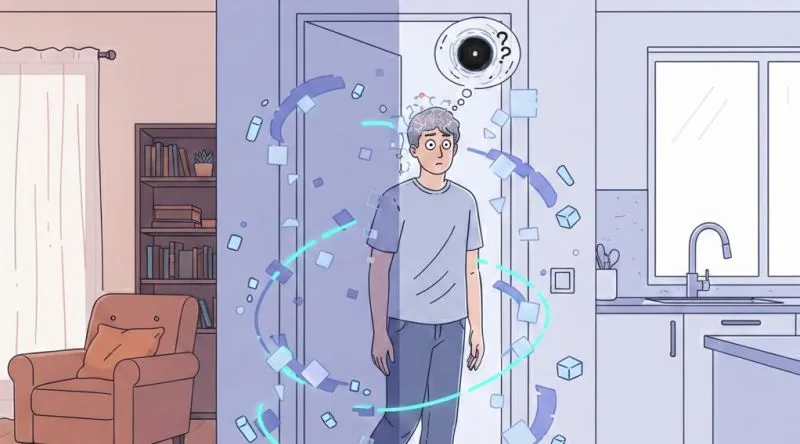
The doorway effect is the everyday experience of walking into a room and instantly forgetting why you went there, and it was studied in detail by psychologist Gabriel Radvansky at the University of Notre Dame. You stand in the kitchen, blinking at the counter, certain you came in for something. The thought was right there a second ago. It is not a sign that your memory is failing. It is a sign that your memory is working exactly as designed, filing away the last chapter of your day the moment you cross a threshold.
The doorway effect is a memory quirk in which passing through a doorway makes you forget what you were about to do. Psychologist Gabriel Radvansky and his team at the University of Notre Dame demonstrated it across real rooms and virtual environments. The brain treats each doorway as an event boundary, and researchers suggest this involves setting the previous room's thoughts aside for the new space.
- The doorway effect was demonstrated in a series of experiments by Gabriel Radvansky and colleagues at the University of Notre Dame, published in 2006 and 2011.
- In one experiment, participants walked through a doorway carrying an object and were more likely to forget what they had picked up than participants who simply moved across the same room.
- The same forgetting pattern appeared in virtual reality experiments, where participants navigated digital rooms and passed through digital doorways.
- Researchers explain the effect through event segmentation, the brain's habit of dividing continuous experience into distinct chapters.
- Forgetting at a doorway is not permanent memory loss; the information is often still available if you return to the room where you first had the thought.
You Walk Into the Kitchen and Forget Why, That's the Doorway Effect
You stand up from the couch, cross the living room, step over the threshold into the kitchen, and stop cold. The water you came for has vanished from your mind. That blank second has a name: the doorway effect, a term used in the scientific literature, and it is not a sign that you are forgetful, aging, or simply distracted. It is your brain doing exactly what brains do.
Picture the sequence in detail. You are in the living room, comfortable, and the thought forms: I want a glass of water. You walk. Your foot lands on the kitchen tile. And the intention is gone, replaced by the small, absurd question, why did I come here? Most people read that moment as a personal failing. The research points the other way.
Gabriel Radvansky, a psychology professor at the University of Notre Dame, has spent years studying this. His work shows that the human mind does not record experience as one continuous ribbon. It chops experience into discrete episodes, sometimes described as "event files," and a physical doorway is one of the cues the brain uses to mark an event boundary. Cross the threshold and the mental folder for the living room closes; a new one opens for the kitchen.
Here is where a popular version of the story goes wrong. The doorway effect is often described as the same thing as event segmentation theory. It is not. Event segmentation theory, associated with researchers like Jeffrey Zacks, is a broader framework about how we parse continuous experience into meaningful chunks. The doorway effect is a specific memory finding that sits alongside that framework, not a synonym for it.
As for why the old room's contents slip away, the original accounts suggest the brain updates its working model of the current situation at each boundary, and some explanations describe this as clearing the previous scene to make room for the new one. That "cache clearing" framing is plausible, but it is not firmly established. What is far better documented is the pattern itself: in Radvansky's experiments, people forget more when they move through a doorway than when they walk the same distance within a single room.
So the next time you arrive in the kitchen with an empty purpose, take it as a sign of a working system. Your brain just turned the page.
The Doorway Effect and the Notre Dame Research Behind It
Professor Gabriel Radvansky, a psychology researcher at the University of Notre Dame in Indiana, turned a household annoyance into a laboratory question. His team's experiments showed that people really do forget more often right after they walk through a doorway. The finding gave the phenomenon its scientific name: the doorway effect.
Radvansky and his colleagues published the core work in two studies. The first, with David Copeland in 2006, appeared in Memory & Cognition, volume 34, issue 5, pages 1150 to 1156, under the title "Walking through doorways causes forgetting: Situation models and experienced space." Five years later, Radvansky teamed up with Sabine Krawietz and Andrea Tamplin for a follow-up in the Quarterly Journal of Experimental Psychology, volume 64, issue 8, pages 1632 to 1645. Both papers point the same direction: the mind does not record experience as one unbroken stream. It chops life into segments, and each segment gets its own mental file.
That is the heart of the doorway effect. The brain builds what researchers call event files, discrete packets that bundle together what is happening, where it is happening, and what you meant to do about it. A physical doorway registers as an event boundary, a clean cut between one file and the next. Your intention to grab a glass of water from the kitchen gets filed under the living room. Step through the door, and the new room opens a fresh file. The old one is still there, just harder to reach.
Why would a brain work this way? One proposed account holds that crossing an event boundary prompts the mind to set aside the previous context, freeing cognitive capacity for whatever the new space demands. That explanation is plausible and fits the pattern of the data, but it is not firmly established as the definitive mechanism. What is well documented is the effect itself, and it is not limited to houses. In virtual environments, including computer games, participants moving from one room to another showed the same kind of memory dip. The boundary matters, not the walls.
Two related reviews round out the picture. Jeffrey Zacks and Khena Swallow published "Event segmentation" in Current Directions in Psychological Science in 2007, volume 16, issue 2, pages 80 to 84. A year later, Christopher Kurby and Zacks published "Segmentation in the perception and memory of events" in Trends in Cognitive Sciences, volume 12, issue 2, pages 72 to 79. Together they show that event segmentation is a broad feature of how humans perceive and remember, and the doorway is simply one of its most ordinary triggers.
Does Walking Through a Doorway Really Cause Forgetting? What the Experiments Found
Yes, and the effect shows up even when there is no actual door. Gabriel Radvansky and his colleagues at the University of Notre Dame ran two sets of experiments, published in Memory & Cognition in 2006 and in the Quarterly Journal of Experimental Psychology in 2011, in which participants carried objects through rooms and then had to remember them. People consistently forgot more after crossing a room boundary than after moving the same distance inside a single room.
Then came the part that surprised everyone. The same memory drop appeared when participants were navigating rooms in computer games and virtual environments. No walls, no hinges, no doorframe you could stub a toe on. A spatial boundary drawn in software was enough to nudge the doorway effect into existence. That tells us the trigger is not the physical architecture of a house. It is the brain's own reading of "new place, new scene."
This fits neatly into a wider body of work on how we chop experience into pieces. Jeffrey Zacks and Khena Swallow laid out the framework in Current Directions in Psychological Science in 2007, volume 16, issue 2, pages 80 to 84. A year later, Christopher Kurby and Zacks expanded it in Trends in Cognitive Sciences, volume 12, issue 2, pages 72 to 79. Their point: we do not record life as one unbroken tape. We cut it into events, and the cuts matter for what we can later retrieve.
One thing worth flagging, because it circulates widely online. The story that this "cache clearing" evolved because our ancestors had to shift focus from safe caves to threatening forests is speculation, not an established scientific explanation. It sounds tidy. It is not evidence.
So the next time you stand in the kitchen with no idea why, you are not failing. You are watching your own memory do exactly what it was built to do at the threshold.
Why Returning to the Room You Came From Helps You Remember
You are standing in the kitchen, and the reason you walked there has vanished. The doorway effect at work. The practical fix is almost embarrassingly simple: turn around and walk back into the room you just left. The original environment can act as a retrieval cue, and for many people that return trip is a quick route back to the thought you lost.
Here is why it works. Your brain files each room as its own folder, and the intentions formed in that room stay stored in that folder's context. The living room holds the plan to grab water. The kitchen holds nothing about water. So when you cross the threshold, you are asking the kitchen to hand you a note that was filed in the living room.
Go back, and you re-enter the context where the intention was born. The couch, the light, the half-finished show on the screen, all of it becomes a set of retrieval cues. It is the same trick as retracing your steps to find misplaced keys. The setting is the index, and stepping into it pulls the right page.
Notice what this advice is not. It is not a guarantee, and it is not some single magic fix that beats every other method. Researchers frame it as a plausible, reported aid grounded in how context-dependent memory tends to behave. Treat it that way: a helpful tool much of the time, not a law of the universe.
So the next time you stand in a doorway with an empty mind, resist the urge to strain. Straining rarely digs the thought out. Walking back does. The room you came from still has your intention tucked inside it, waiting for you to return.
Frequently asked questions
What is the doorway effect in psychology?
The doorway effect is the everyday experience of forgetting what you intended to do right after walking through a doorway. In scientific literature the term describes a measurable dip in memory that occurs when a person passes from one room into another, first documented in the work of psychologist Gabriel Radvansky and his colleagues. It is a normal feature of how memory organizes experience, not a sign of decline.
Why do I forget what I came into a room to do?
Your brain stores experience in segmented "event files" rather than as one continuous stream, and a doorway acts as an event boundary that closes the previous file. The intention you formed in the living room stays filed with that room, so the kitchen version of you cannot reach it. Researchers describe the boundary as triggering an update of the current situation model, though the popular idea that the brain actively discards old information to free up capacity remains plausible rather than firmly established.
Who discovered the doorway effect and where was the research done?
Professor Gabriel Radvansky and his team at the University of Notre Dame carried out the core research. Their 2006 study in Memory & Cognition , titled "Walking through doorways causes forgetting," tested participants moving through real rooms, and a 2011 follow-up appeared in the Quarterly Journal of Experimental Psychology . Jeffrey Zacks and Khena Swallow at Washington University in St. Louis contributed the related framework of event segmentation.
How does the brain use event boundaries to organize memory?
Event boundaries are the moments when one episode ends and the next begins, and the brain uses them to separate experience into manageable chunks. Zacks and Swallow outlined this in a 2007 paper in Current Directions in Psychological Science , and Christopher Kurby and Zacks expanded on it in a 2008 review in Trends in Cognitive Sciences . Doorways are one of the most reliable physical cues that mark such a boundary.
Was the doorway effect tested in virtual environments like video games?
Yes. Radvansky and his colleagues reported similar memory declines when participants moved between rooms inside computer games and virtual environments, not just physical buildings. That finding matters because it separates the effect from the simple act of walking. If a doorway on a screen produces the same forgetting, the trigger is the spatial transition itself, not the physical movement of your body.
Why does returning to the original room help you remember?
Returning to the room you came from restores the context in which the intention was formed, and memory is strongly tied to the setting where it was encoded. Stepping back into the living room can bring the forgotten errand back with it, a pattern known as context-dependent memory. Calling this the quickest fix is an overstatement, since it works for some people and some situations rather than all of them. Editorial note: Details that remain unconfirmed or vary between studies are presented here as such, and specific experimental figures are described only in general terms.
Got a take on this? Add your voice to the conversation below →
No comments yet. Be the first.