Dark Forest Theory: Why the Fermi Paradox Isn't Solved
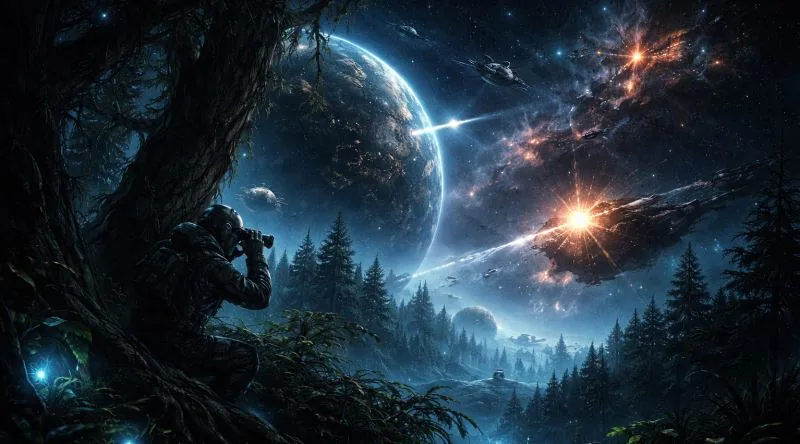
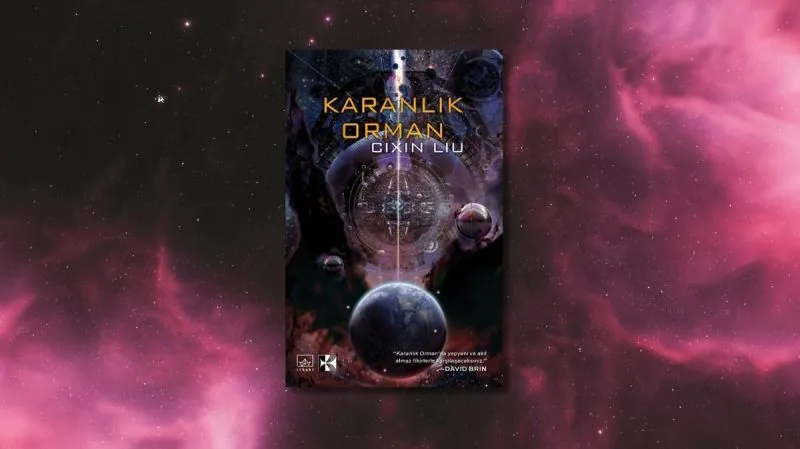
The Dark Forest Theory is a science fiction idea that claims every advanced civilization in the galaxy stays silent and hidden to avoid being destroyed by others. It was proposed by Chinese author Liu Cixin in his 2008 novel The Dark Forest, the second book in the Remembrance of Earth's Past trilogy, and it has since become one of the most talked-about answers to the Fermi Paradox, the famous question of why we have never heard from aliens. The idea is genuinely unsettling, because it turns an empty sky into a warning rather than a welcome. But when you examine it closely, the theory leans on assumptions about alien minds that nobody can actually verify. That is where its famous logic starts to come apart.
The Dark Forest Theory holds that intelligent civilizations stay hidden because any contact risks annihilation by a stronger, unseen rival. Liu Cixin laid it out in 2008 as a possible answer to the Fermi Paradox. It is a compelling story, but it depends on unproven assumptions about alien motives and behavior.
- The Dark Forest Theory was proposed by Liu Cixin in his 2008 novel The Dark Forest and its sequels.
- It proposes that the galaxy is silent because advanced civilizations deliberately hide to avoid being detected and destroyed.
- The theory is one of several proposed answers to the Fermi Paradox, the question of why we see no evidence of alien life.
- Its central logic assumes that alien civilizations would be hostile, expansionist, and quick to eliminate potential rivals.
- Critics argue these assumptions are unproven and that the theory says more about human fear than about the actual universe.
A Sci-Fi Novel's Dark Warning
In 2008, the Chinese science fiction writer Liu Cixin published The Dark Forest, the second book in his Remembrance of Earth's Past trilogy. Tucked inside its pages was an idea that would soon escape the novel entirely and take on a life of its own in late-night conversations and internet forums everywhere: the Dark Forest Theory.
The image it paints is simple, and that is exactly why it sticks. Picture the universe as a vast, pitch-black forest. Every civilization wandering through it is a hunter, armed and silent, listening for the faintest snap of a twig. In this telling, survival comes down to two choices. You either find the other hunter first and eliminate them, or you stay perfectly still and pray no one ever notices your footsteps.
Some readers have claimed the theory resolves the Fermi Paradox, the old puzzle of why the cosmos looks so empty when the math suggests it should be crowded. If every civilization is hiding, the silence suddenly makes sense. That framing is a big part of why the idea traveled so far beyond the book.
Here is the part worth holding onto, though. The Dark Forest Theory is unfalsifiable and speculative rather than scientifically established. It is a thought experiment, not a testable claim, and it cannot be proven or disproven by any observation we know how to make. It borrows real ingredients, like game theory and the sheer distances between stars, but the finished dish is speculation dressed up as inevitability.
What makes it so unsettling is how neatly it turns curiosity itself into a liability. Every signal we send, every probe we launch, every radio dish pointed at the sky becomes a possible confession of where we live. The forest stays quiet for a reason. In Liu Cixin's version of the cosmos, the quiet is not emptiness. It is discipline.
The Logic of the Hunt
Picture a hunter standing in a pitch-black forest, rifle raised, unable to see who else is out there. That image is the whole engine of the Dark Forest Theory, the idea Liu Cixin laid out in his 2008 novel The Dark Forest. The forest is the universe. The hunters are civilizations. And the first rule of the forest is brutally simple: you never know if the shape moving toward you wants to trade stories or take your land.
Why can't we just ask? Because space does not allow small talk. Suppose we managed to fire a message at another civilization tomorrow. The distances between objects in the universe are so vast that waiting for a reply could take thousands, even millions, of years. By the time an answer arrived, the species that sent it might not exist anymore, and neither might we. A conversation that slow cannot tell you whether the voice on the other end is friendly or hostile.
And even if it sounded friendly, so what? As the theory frames it, a civilization that wishes us no harm today offers no guarantee about tomorrow. Intentions shift. Leaders change. A neighbor can become a threat in a single generation, and we would have handed over our address for free.
So the logic collapses into one grim instruction. Do not wait to find out whether a discovered civilization might turn hostile. Treat every one of them as an enemy from the moment you spot it, and destroy it before it destroys you.
Underneath that sits a resource argument. On Earth, resources thin out as populations grow, and the theory extends the same picture to the universe. It treats matter and energy as a finite, running-down supply, even though in reality they are conserved. If that assumption holds, then every civilization has to look out for itself first, securing access to what it needs to survive. The alternative to hunting is hiding, never revealing your position, and under this logic the Voyager probes we launched into the dark count as reckless. There is even a blend of the two: hide so well that nobody finds you, then, the moment you detect someone else, strike fast before they can do the same to you.
Finite Resources and the Voyager Mistake
At the cold heart of the Dark Forest Theory sits a single assumption: that matter and energy are running out. According to the original account, the universe holds a fixed and shrinking supply of the stuff civilizations need to survive, so every species must guard its own access before anyone else's. Treat that as the story's premise rather than settled physics. Matter and energy are conserved, and "depleting" is a slippery word, but the logic built on top of it is ruthlessly consistent.
If the pie never grows, then survival is a zero-sum contest. Each civilization has to put itself first, because the alternative is watching someone else take the last slice. That single rule collapses the available moves down to two, and neither one is friendly.
The two moves left on the board
- Hide. Never reveal your coordinates. Build strategies around staying invisible, because a detected location is a death sentence.
- Hide, then strike first. Stay silent, and if you happen to spot another civilization before it spots you, move fast and erase it.
Notice what the second option demands. You are not allowed to wait and see whether the stranger is friendly, because waiting costs time you may not have, and today's friend can become tomorrow's enemy. The safest reading of an unknown signal is always the same one: threat.
This is where Voyager enters the story, and it does not come out looking good. Under this logic, launching probes that carry a map of our address into interstellar space counts as foolishness, a reckless broadcast of exactly the information the forest punishes you for sharing. The spacecraft are not explorers in this telling. They are a flare fired into the dark.
Whether any of it holds is another matter. The resource claim stays speculative, and the whole framework resists testing, which is precisely why it works better as a story than as a forecast.
Where the Dark Forest Theory Falls Apart
Here is the first crack in the Dark Forest Theory: the act of staying hidden and the act of destroying a rival pull in opposite directions. Fire a weapon at another civilization and you have just announced yourself. The strike itself broadcasts a position, and the odds of that happening are not small. A species that spends its existence whispering in the dark cannot then shout across a galaxy and expect no one to turn a head.
Then there is the question of what a truly superior civilization would actually want from us. If beings exist whose intelligence dwarfs ours, they may not see a threat at all. They may see something closer to a lower-order organism worth studying. Instead of erasing Earth, they could treat the whole planet as one enormous laboratory, a place to observe rather than obliterate. That is a very different ending than the theory allows for.
The third problem is the assumption underneath everything: that every civilization shares our mindset and our appetite for the same materials. That does not hold up even on our own world. There are fungi on Earth that live on radioactive substances, the kind found around Chernobyl. We do not count those materials as basic needs for survival. For those organisms, they are exactly that. To claim "our resources are running out" for the entire universe, every single life form would have to depend on the same handful of substances, and the evidence right here at home says otherwise.
So the Dark Forest Theory is a striking idea, and a grim one. It just is not airtight. It leans on a picture of alien life that looks suspiciously like us.
The Author's Verdict: Enough With the Aliens
After all the hunting, hiding, and hypothetical annihilation, the essay's author lands somewhere surprisingly quiet. In their own words, they personally find humanity's obsession with extraterrestrial civilizations extremely unnecessary. That is a matter of taste, not a theorem, and the piece never pretends otherwise. It is a critique, not a proof.
You can almost hear the sigh underneath it. Have we solved everything here on Earth, they ask, half-joking, that this is what is left over for us to chew on? Wars, hunger, a planet we are still learning to share, and yet the burning question of the age is whether somebody out there is listening. The question is rhetorical, and it is meant to sting a little.
Worth remembering what this essay actually is. It walks through the Dark Forest Theory, pokes at the holes in it, and then steps back rather than forward. The author never claims to have settled the Fermi Paradox or disproved anything. They simply say the whole enterprise leaves them cold.
And that is where it stops. No grand conclusion, no call to action. Just one person, at the end of a long thought experiment about predators in a dark forest, deciding they would rather look at the ground beneath their feet.
What Is the Dark Forest Theory in Simple Terms?
The Dark Forest Theory comes from Liu Cixin's 2008 science fiction novel The Dark Forest. It imagines the universe as a pitch-black forest where every civilization is a hunter, or a hunted thing. Survival means one of two things: strike first, or stay perfectly silent. Some readers claim it answers the Fermi Paradox, the puzzle of why the cosmos looks so empty. That claim is speculative. The theory is unfalsifiable rather than scientifically established.
Why would anyone shoot first?
Picture two strangers in a forest who cannot see or hear each other clearly. Communication across interstellar space works the same way. A message sent today might not get an answer for thousands or even millions of years, because the distances between stars are so vast. You cannot learn whether the voice on the other end is friendly before it is too late. And even a friendly civilization today might not stay friendly forever. So the logic runs: treat every civilization you detect as a threat, and destroy it before it destroys you.
What does resources have to do with it?
The argument leans on scarcity. Just as Earth's resources thin out as populations grow, the theory treats matter and energy across the universe as finite and running down, though in reality they are conserved. Under that assumption, every civilization has to look out for itself first to keep surviving. The alternative to hunting is hiding, never revealing your position. Sending out probes like Voyager, under this logic, counts as recklessness, a beacon that could point straight back to Earth.
Does the Dark Forest Theory solve the Fermi Paradox?
It is often presented that way in popular commentary, but that framing is speculative. The theory draws on real ideas like game theory and interstellar distance, yet it cannot be tested or falsified. It is a thought experiment dressed as an answer, not a scientific finding.
Where does the Dark Forest Theory fall apart?
Several cracks show up. Hiding and attacking are hard to combine, because destroying another civilization risks exposing your own location, and not by a small margin. A far more advanced species might treat Earth as a giant laboratory rather than a target to erase. And assuming every civilization wants the same resources we do is shaky. On Earth, certain fungi live on radioactive substances that we would never call a basic survival need. For those organisms, it is. Apply that lesson across a whole universe and "our resources are running out" stops being a universal rule.
Why Is the Dark Forest Theory Criticized as Illogical?
The Dark Forest Theory, the idea Liu Cixin laid out in his 2008 novel The Dark Forest, runs into three stubborn problems. First, attacking another civilization can betray your own location. Second, a far more advanced species might study us rather than destroy us. Third, the theory assumes every form of life needs the same resources, which ignores organisms like radiotrophic fungi that thrive on radiation.
Doesn't striking first give away your own position?
Yes, and that is the first crack in the logic. The whole point of hiding is to stay invisible. The moment you launch an attack on a civilization you have detected, you announce yourself to anyone watching. The author of the original account calls this a real risk, not a small one, and it turns the theory against itself.
Would a superior civilization really destroy us?
Not necessarily. If beings far more advanced than humanity exist, they might treat us as lower-level creatures worth examining. According to the original account, they could use Earth as a giant laboratory instead of erasing it. Curiosity is a motive the theory never accounts for.
Does every civilization need the same resources?
No, and this is the assumption the theory leans on hardest. It argues that matter and energy are finite and running out, so every civilization must look out for itself first. But that only works if all life wants the same things. On Earth, there are fungi that live on radioactive substances. We do not count those materials as basic survival needs. They do.
So what does the theory actually get right?
Its starting point is sound. Communication across the universe is not like two people talking on Earth. Because of the distances between objects in space, a message sent today might take thousands or millions of years to bring a reply. That gap makes it nearly impossible to judge whether a distant civilization is friend or foe.
Frequently asked questions
Does the theory really call sending Voyager foolish?
Yes. In the novel's own logic, detectable probes such as Voyager are treated as foolish precisely because they risk exposing Earth's location to potentially hostile civilizations. Hiding is the strategy the theory favors, so anything that advertises our existence works against survival.
How does that fit with the rest of the theory?
The Dark Forest Theory was set out in Liu Cixin's 2008 novel The Dark Forest , and it is often discussed as a possible answer to the Fermi Paradox, the puzzle of why we see no sign of other civilizations. Its answer is grim: everyone is quiet on purpose, and anyone who speaks first becomes a target. Editorial note: Any facts that remain unconfirmed are presented as such, and speculative claims are clearly hedged.
Got a take on this? Add your voice to the conversation below →
No comments yet. Be the first.