Bombardier Beetle: The Insect That Sprays 100°C Acid
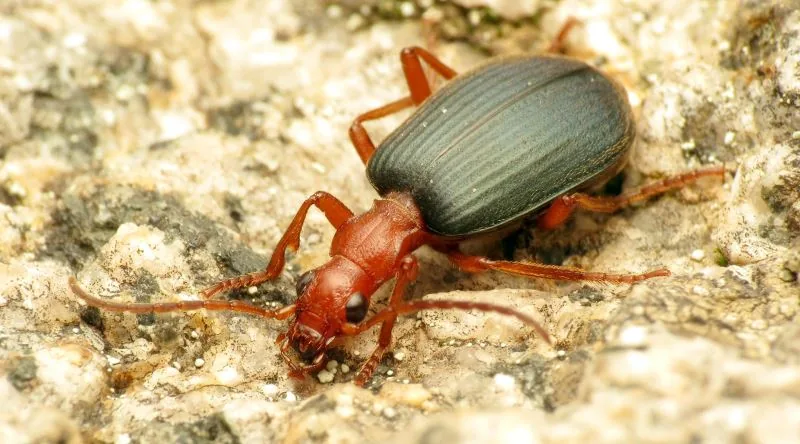
The bombardier beetle is a small ground beetle that defends itself by firing a boiling chemical spray from its rear end. When a predator gets too close, the insect mixes two ordinary chemicals inside its body and detonates them in a fraction of a second. The result is a hot, loud, foul-smelling blast that startles and repels whatever was bothering it. It is one of the most explosive defense mechanisms in the animal kingdom, and it happens at a scale you could hold on your fingertip.
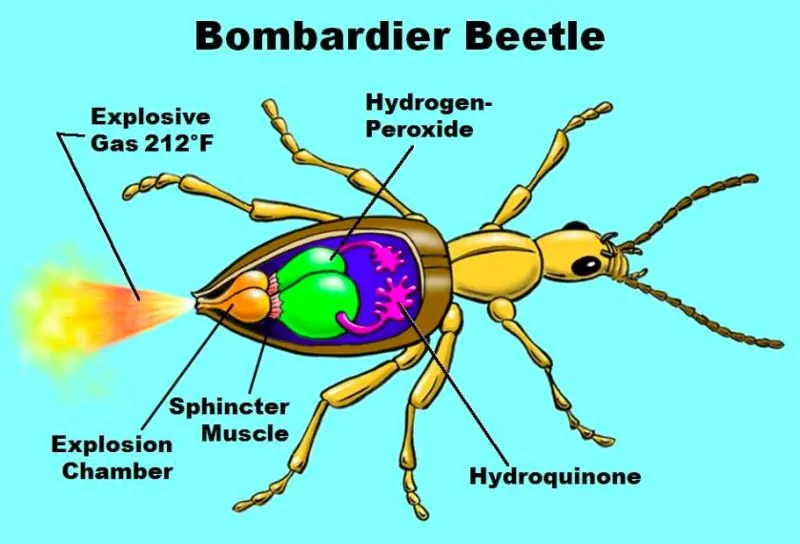
The bombardier beetle stores hydrogen peroxide and hydroquinone in separate chambers in its abdomen. When threatened, it squeezes both into a reaction chamber, where enzymes trigger a violent chemical reaction. The mixture heats to roughly 100°C and bursts out of the beetle as a pulsed spray, discouraging predators without permanently harming the beetle itself.
- Bombardier beetles belong to the ground beetle family Carabidae, and body size swings widely from one species to the next.
- The beetle stores hydrogen peroxide and hydroquinone in separate internal reservoirs until it needs them.
- When the chemicals meet in a reaction chamber, enzymes drive a reaction that heats the mixture to around 100°C.
- The spray leaves the beetle in rapid pulses rather than one continuous stream, firing from a turret-like tip it can aim in different directions.
- The defense is mainly deterrent: it startles and repels predators, and the beetle can fire more than once.
The Beetle That Fires a Boiling Chemical Shot
A bombardier beetle looks like nothing special. It is a small, dark, ordinary beetle that you could easily brush off a leaf without a second thought. Then something startles it, and the insect does something that seems borrowed from a movie monster: it fires a hot chemical spray out of the tip of its abdomen with a sharp, audible pop.
That bang is the whole reason for the name. When a bombardier beetle feels threatened, it ejects a cluster of chemical spray from the rear of its body, and the discharge comes with an explosive crack loud enough to register as a small detonation. The reaction is fast, violent, and entirely internal. Nothing about the beetle's calm, unremarkable appearance prepares you for it.
People who write about this insect often reach for the same comparison, calling it a modern-day dragon. It is not hard to see why. A creature barely the size of a fingernail, armed with what amounts to a built-in flame thrower, walking around in plain sight.
One detail worth handling carefully: you will often see the bombardier beetle described as measuring 1.2 to 1.8 centimeters long. That figure gets repeated a lot, but it is best treated as an often-cited number rather than a firm rule, since body size swings widely from one species to the next.
What is not in doubt is the behavior itself. The abdominal spray and the accompanying pop are among the better documented defensive tricks in the insect world, studied by entomologists and described in reference material maintained by institutions such as the University of Florida's entomology department. The beetle does not bluff. It fires, it makes a noise, and whatever was bothering it usually backs off.
Two Chemicals, Two Separate Tanks
Picture a bunker with two sealed tanks inside it. That is, roughly, what a bombardier beetle carries around in its abdomen: one set of structures that produces hydrogen peroxide, and a separate set that produces hydroquinones. The two never touch until the beetle decides it is time. That separation is the whole trick, and it is why the insect can walk around for weeks carrying a loaded weapon without blowing itself apart.
You have probably met both chemicals already, just not in the same room. Hydrogen peroxide is the compound older texts sometimes loosely call "oxygenated water," a label rather than a precise scientific name. Hydroquinones are the workhorses of traditional black-and-white photography, where they develop film in the darkroom. So the beetle's arsenal is built from the same shelf as a chemist's cabinet and a photographer's tray.
The reservoir itself works a little like a toilet cistern. When something startles the beetle, a valve opens and lets the watery solution in the storage chamber reach the entrance to the reaction chamber. From there, everything happens fast. The hydroquinones are released into the hydrogen peroxide stores, and the oxidation that follows is exothermic, meaning it throws off heat.
Keeping the ingredients apart is not just tidy housekeeping. Mix them early and the beetle would cook its own tissue. Instead, the heat and pressure spike forces the inlet valves of the reactive storage chambers to slam shut, sealing the beetle's internal organs off from the blast it is about to fire. The boiling, foul-smelling liquid then shoots out through the exit valve with a loud popping sound, straight at whatever threatened it.
The Reaction That Hits 100°C
Picture a beetle opening a valve the way you'd crack the tap on a bathroom reservoir. The moment the bombardier beetle feels threatened, it dumps its store of hydroquinones straight into the chambers holding hydrogen peroxide. What follows is not a slow leak. It is an exothermic oxidation, meaning the chemistry throws off heat as it runs, and the mixture climbs to roughly 100°C.
The equation behind that spike is tidy enough to fit on a notecard: C6H4(OH)2 + H2O2 → C6H4O2 + 2H2O. Hydroquinone meets hydrogen peroxide, and out comes p-benzoquinone plus water. The heat is the point. Some descriptions say about one-fifth of the mixture flashes into vapor, though that specific fraction is best read as an approximation rather than a settled measurement. The vapor is what turns a chemical reaction into a pressurized jet.
Here is the part that keeps engineers up at night. The same heat and pressure that will soon soak a predator also threaten the beetle's own insides. So the rising pressure forces the inlet valves of the reaction chambers shut, sealing the reservoirs off before the brew can back up into the beetle's organs. It is a self-closing door triggered by its own explosion.
Only then does the boiling, foul-smelling liquid leave the body, blasting out of the exit valve with a loud pop. The bombardier beetle has effectively built a combustion chamber inside its abdomen and survived firing it.
The Pop, the Smell, and the Aim
This is the moment the bombardier beetle stops being a small brown insect and becomes something closer to a tiny artillery piece. When the reaction chamber is primed, the boiling, foul-smelling liquid is forced out through an exit valve and sprayed hard at the attacker. The discharge arrives with a loud, explosive pop, closer to a firecracker than anything you would expect from a beetle.
And the spray goes where it needs to go. The beetle aims at whatever triggered the threat, so the unlucky source of the disturbance gets a face full of hot, stinking mist. The heat and the pressure behind it do the rest of the work.
The original account adds one line worth keeping in your pocket: if you ever meet one of these "modern dragons," it could easily burn you. Not a metaphor. A warning.
How Many Shots Does It Get?
Here is where the bombardier beetle stops looking like a one-trick novelty and starts looking like a walking arsenal. The source claims the beetle carries enough hydroquinone and hydrogen peroxide in its abdominal reservoirs to fire its spray roughly 20 more times. Treat that number as a rough figure rather than a fixed rule, since the actual count varies by species and by the conditions the insect is facing.
Think about what that means in practice. A single blast is already startling: a hot, foul-smelling jet thrown from the tip of the abdomen with a loud pop. But the beetle is not necessarily spent after one discharge, and the source describes it as ready to fire again. Twenty shots is not a lucky strike. It is a sustained barrage.
The source pushes the claim even further. It suggests that in a real fight, the bombardier beetle may carry enough ammunition to kill a predator outright. That is the dramatic version, and it deserves a raised eyebrow. The spray is best understood as a deterrent that can injure or incapacitate a small attacker, and broad lethality against predators is not firmly established. Still, the image the source leaves you with is hard to shake: a beetle the size of a fingernail, standing its ground, reloading.
If you ever cross paths with one of these creatures, the source warns, it would not take much for it to burn you. The sting is real. The twenty-shot magazine is, at minimum, the stuff of a very good story.
Why Evolution Is Still Arguing About This Beetle
Ask a biologist how the bombardier beetle got its cannon and you will get a shrug at the edges of the answer. The broad strokes are not in dispute: the adaptation is understood to have been shaped by natural selection working in small, incremental steps, each one a slight improvement on the last. What remains genuinely unsettled, as the original account puts it, is the precise sequence of those steps. The exact evolutionary history of the mechanism is not known.
That gap is what keeps the argument alive in classrooms and comment sections alike. It is not the spray itself that draws the skepticism. It is the plumbing. A beetle that carried a single tank of hydrogen peroxide and hydroquinones would be carrying a bomb with no fuse, and the two-chamber arrangement, one reservoir for each chemical, held apart until the moment of use, is exactly the kind of tidy engineering that looks designed rather than accumulated.
So the question becomes concrete. How do you build a two-tank chemical cannon one small step at a time? Each stage has to be useful on its own, or selection has nothing to reward. A valve that opens under pressure, a gland wall that resists its own contents, a reaction chamber that survives a burst of heat: none of these are worth much alone, and the finished system only pays off when every piece is in place.
Biologists cited in the original account do not treat that as a paradox. They treat it as a puzzle with a long, slow answer, the kind that gets assembled across generations rather than argued into existence in a single sitting.
Frequently asked questions
What is a bombardier beetle and how does it defend itself?
A bombardier beetle is a small ground beetle that defends itself by ejecting a hot, foul-smelling chemical spray from the tip of its abdomen with a loud, audible pop. This explosive discharge startles and repels attackers, and the reported size range of 1.2 to 1.8 centimeters is an often-cited figure rather than a firm rule.
How does the bombardier beetle's chemical spray reach 100°C?
When threatened, the beetle combines hydroquinones with hydrogen peroxide inside a reaction chamber. This exothermic oxidation reaction releases intense heat and pressure, pushing the mixture's temperature to roughly 100°C, which is hot enough to scald a predator on contact.
What chemicals are stored inside a bombardier beetle's abdomen?
The beetle stores hydrogen peroxide in one set of glandular reservoirs and hydroquinones in another, keeping them separate until needed. Hydroquinone is also familiar as a developing agent in traditional black-and-white photography, while hydrogen peroxide is the same compound sold as a household antiseptic.
Why doesn't the bombardier beetle burn itself with its own spray?
The heat and pressure generated by the reaction force the inlet valves of the reaction chambers shut, sealing off the beetle's internal organs from the caustic mixture. This built-in safety mechanism ensures the scalding liquid exits only through the outer nozzle, sparing the beetle any harm.
How many times can a bombardier beetle fire its defensive spray?
According to the original account, the beetle carries enough hydroquinone and hydrogen peroxide to fire roughly 20 more times after an initial discharge. That figure is an unverified claim from the source, and the exact number varies by species and conditions, so treat it as an approximation.
Can a bombardier beetle actually kill a predator with its spray?
The source suggests the spray may be lethal to a predator in a real confrontation, but this is not firmly established. The discharge is primarily a deterrent that can injure or incapacitate small attackers, and its capacity to kill larger predators remains uncertain. Editorial note: Details that remain unconfirmed or vary by species are presented as such, and figures such as spray temperature and firing frequency are approximate.
Got a take on this? Add your voice to the conversation below →
No comments yet. Be the first.