Babylonian Trigonometry: Born From Land, Not Stars
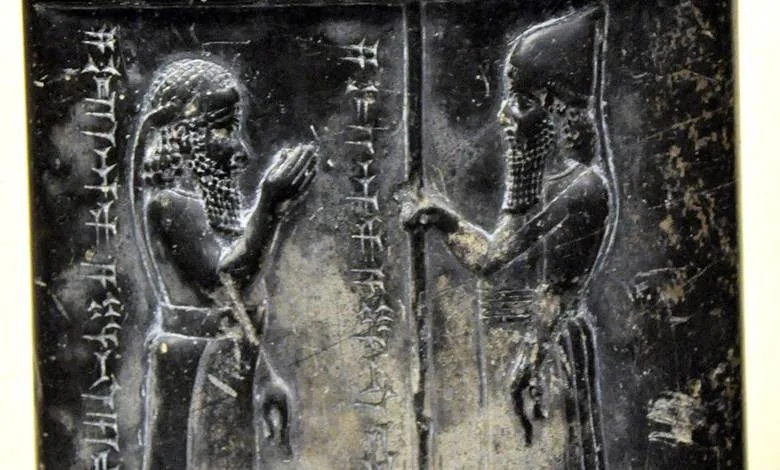
Babylonian trigonometry was not invented by stargazing priests. According to a 2021 study by UNSW Sydney mathematician Daniel Mansfield, two clay tablets from around 1800 BCE, Si.427 and Plimpton 322, show that the math we call trigonometry began as a practical tool for measuring land in ancient Iraq. It is a quiet correction to a story most of us learned in school. The Greeks did not hand us the first trigonometry. Mesopotamian surveyors did, and they did it to settle property lines.
- Si.427 is an Old Babylonian cadastral tablet, dated to roughly 1800 BCE, that records field boundaries and measurements in what is now Iraq.
- Plimpton 322, held at Columbia University, is a clay tablet of the same era listing Pythagorean triples in base 60 numbers.
- Daniel Mansfield of UNSW Sydney published the analysis linking the two tablets in 2021 in the journal Foundations of Science.
- The tablets suggest Babylonian scribes used ratio-based methods to keep surveyed plots rectangular and boundaries accurate.
- The base 60 system these scribes used still shapes how we divide hours and angles today.
In a nutshell
Babylonian trigonometry likely began as a land surveying tool, not an astronomy aid. Two Old Babylonian tablets, Si.427 and Plimpton 322, from roughly 1800 BCE, suggest scribes used ratios and Pythagorean triples to measure fields and fix exact right angles in what is now Iraq.
Babylonian Trigonometry Was Born in the Mud, Not the Stars
Babylonian trigonometry did not grow out of priests squinting at the night sky. It grew out of surveyors standing in wet fields, rope in hand, trying to settle who owned which strip of dirt. That is the counterintuitive heart of the story: the earliest known trigonometry, a practical geometry of right angles and measured rectangles, came from the ground up.
The people who built it lived between two rivers. Sumerians, Akkadians, Assyrians and Babylonians all rose in the land defined by the Tigris and the Euphrates, flourishing from roughly 3100 BCE to 540 BCE. That is close to three thousand years of continuous civilization, a run long enough to make most later empires look like a weekend project.
So why do we hear so little about them? Largely because their inscriptions were written in cuneiform, a script that stayed locked for centuries. Only when researchers finally cracked those wedge-shaped marks did the Mesopotamian mind come into view, and one of the first things to jump out was a number system built on sixty.
The Babylonians counted and calculated in base 60, the sexagesimal system. You still use its leftovers every time you check a clock. The 60-minute hour and the 60-second minute trace straight back to Babylonian sexagesimal usage, and the 360-degree circle with its 60-fold subdivisions of angles is widely attributed to the same inheritance. One correction worth making here, since the popular version often gets it wrong: the 24-hour day itself is not Mesopotamian. That division comes from Egyptian and Greek practice, not from the banks of the Euphrates. The sixties are Babylonian. The twenty-four is not.
Why Babylonian Surveyors Needed Perfect Right Angles
For most of early Mesopotamian history, the big tracts of farmland did not belong to the people who worked them. Temples and palaces held the land, and professional surveyors were sent out for one reason: to estimate how big the harvest would be. Nobody cared where one field ended and the next began.
Then, as the story goes, something changed during the Old Babylonian Period, roughly 1900 to 1600 BCE. Smaller fields reportedly began passing into the hands of ordinary individuals. Historians still argue about how sweeping that shift really was, and it varied from region to region, but the pressure it created was real. Once a plot belonged to a named person, its edges mattered. A farmer who thought his neighbor had swallowed a strip of his field wanted a line he could point to, and a surveyor who could draw that line exactly was worth hiring.
The tools of the trade were humble. The measuring rope and the rod did the work, and they stayed the standard equipment of Babylonian land surveying. But a rope alone will not settle an argument. So surveyors carved the land into clean shapes: rectangles, right triangles, and right trapezoids. And here is where the story gets interesting. According to the contested thesis advanced by Daniel Mansfield, a researcher at the University of New South Wales, they reached for Pythagorean triples to lock down exact 90-degree angles. That reading is not settled consensus, and plenty of scholars push back on it, but it is the thread that leads straight to the clay tablets at the center of this story.
Because an approximate corner is a legal problem waiting to happen. A right angle that is a degree or two off, stretched across a field, becomes a wedge of disputed soil. Babylonian trigonometry, if Mansfield is right, grew out of that very practical hunger for a corner that was truly square.
Si.427: The Tablet That Rewrote the Timeline
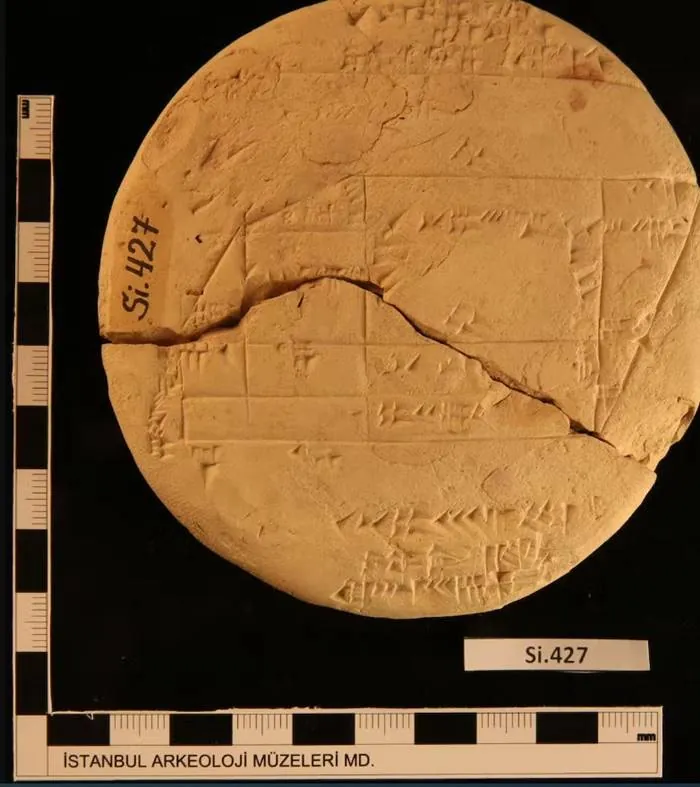
Somewhere in the collection of the Istanbul Archaeology Museums sits a palm-sized clay document known as Si.427. It is an Old Babylonian cadastral record, the kind of tablet a scribe drew up to fix the legal boundaries of a piece of land, and it reportedly concerns a small parcel bought from a man named Sîn-bêl-apli. That owner's name is shaky, but the tablet's purpose is not in doubt: this is paperwork, not poetry.
What the records do show is fussiness. The surveyors measured marshland areas with extreme care, tracing wet, shifting ground with the same attention they gave solid fields. Anyone who has tried to draw a straight line across a swamp knows why that matters.
The tablet's modern chapter is stranger. As the story goes, Si.427 sat on display at the Istanbul Archaeology Museums until Dr. Daniel Mansfield noticed it, and it is said to remain on exhibit there. Both the display status and the circumstances of that encounter are unconfirmed, so treat the museum-floor discovery scene as anecdote rather than record.
Here is where the claim gets technical. In Si.427, Mansfield reports that the corners are exactly 90 degrees, whereas earlier measurements achieved right angles only approximately. That is his specific technical claim, not an independently verified one. The proposed mechanism is the Pythagorean triple: a set of whole-number sides that satisfies the Pythagorean relation, easy to lay out with rope, and theoretically perfect in the angle it produces. The tablet reportedly contains three separate Pythagorean triples, though the exact count is unconfirmed.
If the reading holds, Babylonian trigonometry was not born in the observatory. It grew out of the surveyor's need to mark ground, and it suggests Babylonians were using the method in land surveying by at least 1900 BCE, the early edge of the Old Babylonian period. That date is not firmly established. Nor is Si.427 a lone curiosity: it has also helped scholars understand other Old Babylonian tablets, which is often how a single awkward document does its real work, by making the rest of the archive legible.
Plimpton 322: The $10 Tablet That Became a Treasure
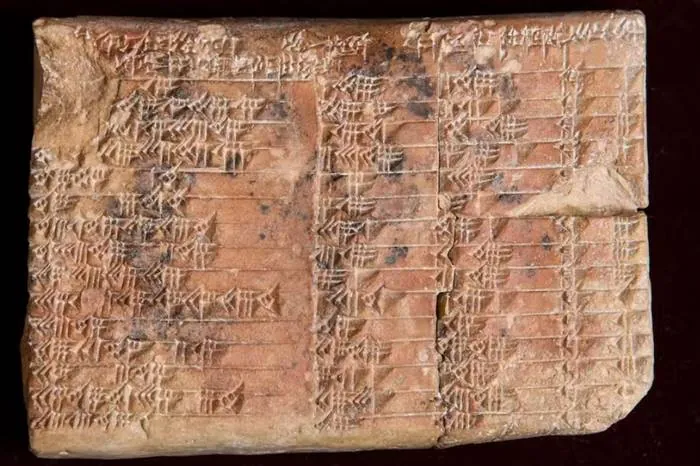
In 1922, George Arthur Plimpton, an American publisher who collected rare books and antiquities, handed over ten dollars for a small clay tablet. That tablet, now known as Plimpton 322, would become one of the most famous objects in the history of mathematics. A good share of what we know about ancient Mesopotamian mathematics came out of the slow work of deciphering it.
The object itself is modest. It measures roughly 13 cm in height and 9 cm in width, was made around 1800 BCE, and was most likely found somewhere in what is now southern Iraq. Small, broken, and unglamorous. And yet it changed how we read Babylonian trigonometry.
Why Not Every Pythagorean Triple Worked
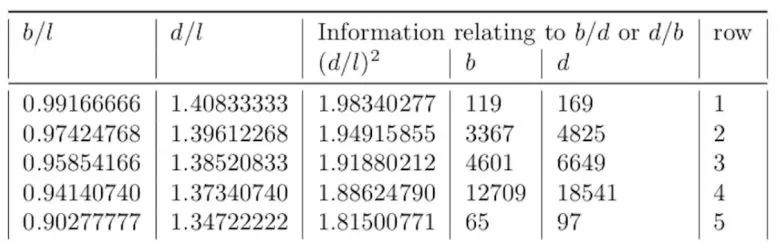
Here is the part that trips people up. A Pythagorean triple is not automatically useful to a surveyor. What made a triple practical was the character of its sides. The sides had to be "regular" numbers, and a regular number is one whose prime factors are only 2, 3 and 5. That narrow condition is what separated a triple you could actually lay out on the ground from one that would leave you with messy fractions.
A Table That Looks Like Trigonometry, But Isn't Quite
Plimpton 322 is a list of Pythagorean triples, and at a glance it looks strikingly like a modern trigonometric table. The resemblance stops there, though. Modern tables give you ratios between the sides of a triangle: sine, cosine, tangent. According to Daniel Mansfield's reinterpretation of the tablet, Plimpton 322 instead marks which sides in a triple are regular, and therefore usable in land surveying. The traditional reading holds it as a pedagogical or algebraic table rather than a surveyor's tool.
There is a third possibility worth sitting with. The tablet may have been made to solve one specific practical problem. We can never know the true intent of whoever pressed those marks into wet clay. What we can say is that its function likely sits somewhere between these two poles, a teaching list on one side and a working document on the other.
One thing is certain, and it is the part that still surprises mathematicians. The Babylonians conceptualized Pythagorean triples in an original way. Not as a borrowed trick, not as a footnote to someone else's geometry, but as their own idea, worked out for their own purposes.
So Was Babylonian Trigonometry Really First?
The short answer is that Babylonian trigonometry was not a formal system of sines and cosines, but Mansfield argues it was functionally equivalent to the trigonometry that ancient Greek astronomers later developed. The crucial difference is context: the Babylonian version grew out of land surveying, while the Greek version grew out of watching the night sky.
Some scholars, including Dr. Daniel Mansfield of the University of New South Wales, describe the Babylonian approach as "proto-trigonometry." That label is not universally accepted in the field. Not every historian of mathematics agrees that what appears on tablets like Si.427 and Plimpton 322 deserves the name trigonometry at all, and the debate over how to classify it is still open.
What is clear is the practical setting. Babylonian trigonometry arose in response to the needs of surveyors measuring the earth, not astronomers observing the sky. The measuring rope and the measuring rod were the everyday tools, and the goal was a reliable right angle on a plot of farmland, not a table of angles for celestial prediction.
Not everyone buys that leap, though. Mansfield argues that the Babylonian method accomplishes the same job as Greek trigonometry, but moving from "useful numerical table" to "trigonometry" is a big step, and plenty of scholars resist it. The traditional reading of Plimpton 322 treats it as a pedagogical or algebraic exercise rather than a trigonometric one. So the honest position is that Babylonian trigonometry is a compelling and well-argued interpretation, not a settled consensus.
What the tablets do show is a genuine conceptual achievement. The Babylonians worked with Pythagorean triples in an original way, and they applied that knowledge to a real practical problem: dividing land into rectangles, right triangles and right trapezoids so that boundaries could be fixed and disputes resolved. Whether we call it trigonometry or proto-trigonometry, the underlying idea was there, roughly a thousand years before the Greeks.
Frequently asked questions
What is Babylonian trigonometry and how did it work?
Babylonian trigonometry was a practical geometry that used Pythagorean triples and regular numbers to lay out exact right angles in land measurement. Surveyors worked with a measuring rope and a rod, dividing fields into rectangles and right-angled triangles. Regular numbers, whose prime factors are only 2, 3 and 5, made certain triples usable in the field.
Why did it develop from land surveying instead of astronomy?
Because land, not sky, created the demand. In the Old Babylonian Period, between 1900 BCE and 1600 BCE, large institutional holdings reportedly gave way to smaller fields owned by ordinary individuals. New private owners needed boundaries fixed and disputes settled, which pushed surveyors toward precise right angles rather than star charts.
What is the Si.427 tablet and what does it show?
Si.427 is an Old Babylonian cadastral document held in the Istanbul Archaeology Museums. According to the original account, it records the boundaries of a small parcel of land and its corners are exactly 90 degrees, where earlier measurements only reached approximate right angles. Its owner name is reported but cannot be reliably confirmed.
What is Plimpton 322 and why does it matter?
Plimpton 322 is a clay tablet made around 1800 BCE, most likely found somewhere in what is now southern Iraq. The American publisher and collector George Arthur Plimpton bought it in 1922 for $10. Measuring about 13 cm by 9 cm, it lists Pythagorean triples and visually resembles a modern trigonometric table.
Was Babylonian trigonometry really older than Greek trigonometry?
The surveyors' method is reported to date to at least 1900 BCE, roughly a thousand years before Greek trigonometry. That said, the "trigonometry" label is contested. Some scholars, including Daniel Mansfield, treat the approach as functionally equivalent to Greek trigonometry and call it proto-trigonometry, but neither term is universally accepted.
Why do we still use 60 minutes in an hour and 360 degrees in a circle?
Those subdivisions trace to the Babylonian base-60 system. The Mesopotamians used sexagesimal counting for calculation, and that inheritance survives in the 60 minutes of an hour, the 60 seconds of a minute, and the 360 degrees of a circle. The 24-hour day itself, contrary to the popular version, is not Babylonian. Editorial note: Details that remain unconfirmed by independent scholarship are presented here as claims rather than settled fact.
Got a take on this? Add your voice to the conversation below →
No comments yet. Be the first.