Shell Shock at Gallipoli: Ottoman Soldiers' Untold Trauma
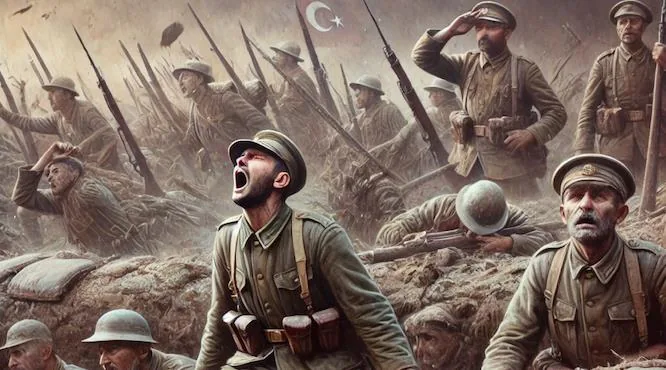
During the Gallipoli campaign of 1915, Ottoman soldiers showed unmistakable signs of shell shock, yet according to the available account the condition was never formally diagnosed in their army. The fighting on the peninsula was among the most intense of World War I, and the psychological wreckage it left behind has stayed largely outside the history books. A British observer's diary and an Ottoman physician's account both point to men broken by the constant roar of artillery. Their stories raise a question that still matters: whose trauma gets remembered, and whose gets left out?
At Gallipoli in 1915, Ottoman soldiers displayed clear symptoms of shell shock, including tremors, mutism, and collapse under artillery fire, but the condition was never formally recognized or diagnosed by the Ottoman military. Accounts by a British observer and an Ottoman physician suggest the trauma was widespread and largely unrecorded.
- The Gallipoli campaign unfolded on the peninsula from April 1915 to January 1916, pitting Ottoman defenders against Allied forces.
- British observer Aubrey Herbert recorded Turkish soldiers visibly shaken by the sound of machine gun and artillery fire.
- Ottoman physician Yahoub Garabetyan documented cases of psychological collapse among soldiers during the campaign.
- Historian Ben Shephard has noted accounts of Ottoman soldiers who died without visible wounds, consistent with the strain of combat.
- Shell shock was never formally diagnosed in the Ottoman army, leaving the condition largely absent from official records.
Did Ottoman Soldiers Get Shell Shock at Gallipoli?
During World War I, British, French and German troops on the Western Front were diagnosed with shell shock, the psychological collapse that artillery fire could carve into a man. The question that lingers over the Ottoman lines, and especially over Gallipoli (Çanakkale), is whether the same condition showed up there too. Did shell shock reach Ottoman soldiers at Gallipoli, and if it did, who was watching closely enough to write it down?
Start with the ground itself. At Çanakkale, naval guns and mobile artillery pounded every position, and no soldier sits safely inside that kind of drumming. Men are meat and bone, and fear does not check a passport at the trench wall. Under that weight, breakdown was not a possibility to be debated. It was close to inevitable.
And there is a record of it. Ottoman soldiers were noted in a state where the eyes seemed about to leave their sockets, staring blankly and meaninglessly, shock written on the face rather than the body. What the record does not show is a name. According to the account, shell shock was observed among Ottoman soldiers but was not diagnosed or conceptually named the way it was in Europe, so the same suffering sat in the ledgers without a word to hold it.
That gap between what was seen and what was said is where the story gets strange, and where the witness accounts begin.
Ben Shephard's Account: Seven Ottoman Soldiers, No Wounds
The following account, attributed to the British historian Ben Shephard, could not be independently verified and should be read as reported history rather than established fact. With that said, it is one of the strangest pieces of testimony tied to shell shock among Ottoman soldiers at Gallipoli. According to the account attributed to him, Allied troops who had captured an Ottoman trench after a heavy bombardment found seven dead soldiers seated together in a row. Their rifles still rested upright on their knees.
Picture that for a second. Seven men, arranged almost as if they had simply paused to rest. As reported, one of them had his arm draped around a comrade's neck, and his face carried a smile, as though he were cracking a joke in his final moment rather than dying. The detail that unsettles Shephard most is quieter than the smile. Only one of the seven bore a wound. The exploding shells had left no bodily mark at all on the other six.
That is the observation Shephard reaches for language to explain. It was, in his reported phrase, as if the soldiers' nerves had been crippled. Not their bodies. Their nerves. Whatever the shells did to those men, it happened somewhere invisible, and it happened to all of them at once.
The scene is gripping precisely because it refuses to resolve. A trench full of intact bodies and one smile is not how artillery is supposed to kill, and Shephard's account leaves the reader holding that contradiction rather than smoothing it over.
It is worth being careful here. Shephard is a real historian who wrote seriously about Gallipoli and about the concept of shell shock, but this specific anecdote has not been verified, so it belongs to the realm of reported history rather than settled record. Treat it as the story that made a scholar reach for the vocabulary of damaged nerves, and let the next accounts carry the weight of what can be checked.
Aubrey Herbert's Diary, June 13, 1915: A Soldier Imitating a Machine Gun
A diary entry attributed to Aubrey Herbert, a British intelligence officer stationed at Gallipoli and dated June 13, 1915, describes a scene that cannot be independently verified. As the entry tells it, he watched stretcher-bearers carry a wounded Ottoman soldier past him. The man was moaning in a steady, rhythmic way. Herbert assumed a bullet had torn through his brain.
He could not have been more wrong, and that is what makes the entry so chilling.
Curious, Herbert later went to the hospital to visit the soldier. He found a man with no wounds at all. Not a scratch, not a bandage, nothing a surgeon could point to. What had broken him was not a bullet but a shell that exploded nearby. The blast had shocked his nervous system, and his body was answering it the only way it knew how: by making involuntary sounds, over and over, as if he were imitating a machine gun.
According to the account attributed to Herbert's diary, the soldier's condition was not a physical injury at all. It was the sound of a mind still trapped in the bombardment, long after the shells had stopped.
This is what shell shock could look like among Ottoman soldiers at Gallipoli when it leaves no visible trace. Herbert was a real intelligence officer who kept diaries during the campaign, though the specific June 13 entry cannot be independently verified. Whether every detail holds up, the image does: a man on a stretcher, a rhythm that sounded like gunfire, and a body with nothing wrong that anyone could see.
For a generation of officers who had been trained to read wounds, this kind of case was baffling. There was nothing to treat, nothing to stitch, nothing to amputate. The injury lived somewhere no scalpel could reach.
Dr. Yahoub Garabetyan and the Soldier Who Froze in a Defensive Posture
An account attributed to an Ottoman physician named Yahoub Garabetyan describes a case that could not be independently verified. It begins with a pattern he noticed linking exploding artillery shells to nervous symptoms in Ottoman troops. On the Gallipoli battlefield, he reportedly observed a soldier standing with his arms hanging loosely at his sides. The man's upper body was bent forward, his head sunk between his shoulders. It was a posture frozen in place.
At a conference later, according to the account, Garabetyan described what he believed was happening. Each time a shell exploded, the soldier's abdominal muscles tensed. Over time, that defensive flinch became permanent. The body had learned to brace for the next blast and simply never stopped. It is a striking clinical observation, though neither Garabetyan's identity nor the specific description attributed to him could be confirmed. The case remains contested.
What makes it worth telling anyway is the timing. European medicine was already putting a name to these symptoms on the Western Front, where British, French and German soldiers were diagnosed with shell shock during World War I. Ottoman medicine, by most accounts, was not. The condition was observed but not formally diagnosed or conceptually named. Garabetyan's reported observation sits right at that gap, a physician's eye catching what the vocabulary of his time had not yet built a word for.
Why Wasn't Shell Shock Diagnosed in the Ottoman Army?
Ottoman soldiers at Gallipoli clearly broke under fire, yet the army that treated their bodies never gave the injury a name. According to the available record, shell shock cases were observed among Ottoman troops but were not diagnosed or conceptually framed the way they were in Europe. The trauma was real. The vocabulary to see it was not.
That gap is the whole story here. On the Western Front, British, French and German doctors had a working label, a set of symptoms, a place in the medical literature. On the Ottoman side, a soldier whose nerves had come apart could be carried to a dressing station, examined, found whole, and sent back without anyone writing down what had actually happened to him. No term meant no category, and no category meant no record, no pension, no paper trail for a historian to follow a century later.
The source is candid about the limits of what it can claim. Whether comparable cases appeared on the other Ottoman fronts is something the account explicitly says it does not know. But from what Gallipoli alone shows, the writer judges it highly likely that they did, because the conditions that produced such cases were not unique to one peninsula. A war fought with the same artillery, the same trenches and the same flesh and blood would not have spared a soldier simply because he stood on a different line.
So the question of shell shock among Ottoman soldiers at Gallipoli turns out to be less about whether it happened and more about who was equipped to name it. Europe gave the condition a diagnosis. The Ottoman side, as the account suggests, gave it nothing but silence.
Frequently asked questions
Did Ottoman soldiers experience shell shock during World War I?
Yes. According to the account, cases of what we now call shell shock were observed among Ottoman troops, particularly at Gallipoli, during the 1915 campaign. Soldiers there endured constant shelling from naval guns and mobile artillery, and the account reports that some men were seen staring blankly, eyes wide, under the shock of battle.
What did Aubrey Herbert observe about Ottoman soldiers at Gallipoli?
Aubrey Herbert, a British intelligence officer present at Gallipoli, reportedly recorded in a diary entry dated June 13, 1915, that a wounded Ottoman soldier carried past him on a stretcher was moaning rhythmically, which made Herbert think he had been shot in the brain, but the man later showed no wounds and was making involuntary machine-gun-like sounds.
Who was Yahoub Garabetyan and what did he witness at Gallipoli?
Dr. Yahoub Garabetyan was an Ottoman physician who, according to the account, observed a soldier at Gallipoli whose arms hung loosely, upper body bent forward and head sunk between his shoulders. Garabetyan later described at a conference how the man's body had permanently locked into a defensive posture from shell explosions.
Why was shell shock not diagnosed in the Ottoman army?
According to the account, the condition was observed among Ottoman soldiers but never terminologically defined or formally diagnosed the way it was in Europe. There was no equivalent conceptual name for it in Ottoman military medicine, so what appeared on the battlefield stayed unnamed in the records.
What did Ben Shephard write about Ottoman soldiers at Gallipoli?
The British historian Ben Shephard reportedly wrote that after a heavy bombardment at Gallipoli, Allied soldiers found seven dead Ottoman soldiers sitting together with rifles resting on their knees, one with an arm around a comrade's neck and a smile on his face. Only one was wounded, and the others bore no bodily marks. Editorial note: Details that remain unconfirmed are presented as such, and no claim here should be read as a formal diagnosis where the historical record is silent.
Got a take on this? Add your voice to the conversation below →
No comments yet. Be the first.