Why Can't You Divide by Zero? The Real Reason
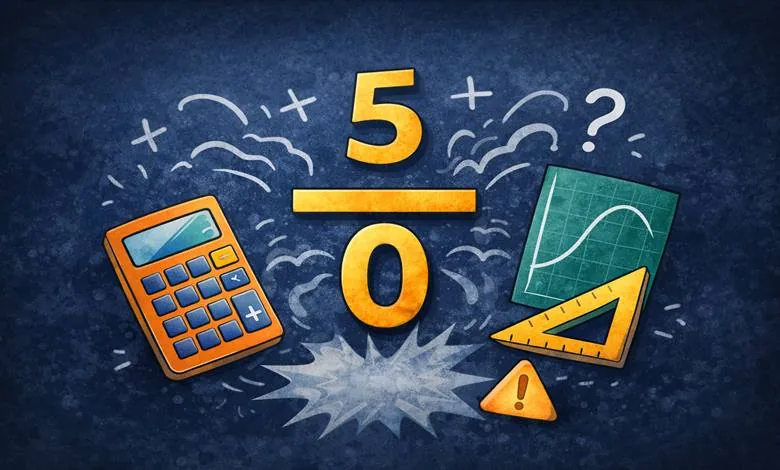
You can't divide by zero because it breaks the fundamental rules of arithmetic, creating contradictions like the famous false proof that 1 equals 2. This mathematical rule, established centuries ago, applies everywhere in math and science, and the answer is always "undefined", not infinity, not zero, but a concept that simply doesn't exist. The reason why can't you divide by zero comes down to the very definition of division as the inverse of multiplication, and once you see it, the logic becomes crystal clear.
Division by zero is undefined because no number multiplied by zero can produce a nonzero dividend. For zero divided by zero, any number could be the answer, so it's indeterminate. This rule holds in all standard arithmetic and is never allowed in algebra, calculus, or real-world calculations.
- Division is defined as the inverse of multiplication, so 6 ÷ 3 asks "what times 3 equals 6?", the answer is 2.
- For 6 ÷ 0, you'd need a number that times 0 equals 6, but zero times anything is always zero, so no such number exists.
- For 0 ÷ 0, every number times zero equals zero, making the answer ambiguous and indeterminate rather than undefined.
- The famous "1 = 2" proof relies on secretly dividing by zero, which is why the contradiction appears.
- Calculus handles division by zero using limits, which approach a value without ever actually reaching zero.
The Tempting Trap: Why 1 ÷ 0 Feels Like Infinity
You cannot divide by zero because mathematics defines that operation as undefined, a rule that protects the entire system from collapsing into contradictions. If division by zero were allowed, you could "prove" that 1 equals 2, which would destroy the consistency of all arithmetic. The rule is not arbitrary; it is a safeguard.
Here is the trap that catches so many students. Watch what happens when you divide 20 by smaller and smaller numbers. The calculation 20 ÷ 2 gives you 10, but 20 ÷ 0.0001 jumps to 200,000. The pattern is irresistible: shrink the divisor, and the result explodes upward. It feels completely natural to conclude that if you keep shrinking the divisor all the way to zero, the answer must be infinity. That is why so many people answer the question "why can't you divide by zero?" with a confident shrug and the word "infinity."
But approaching infinity and equaling infinity are two entirely different things. Infinity is not a number at all; it is a concept, a direction, a way of describing something that never ends. You cannot plug it into ordinary arithmetic the way you would plug in 3 or 7 or 42. When you try to treat infinity as a number, the rules of math begin to break down in strange ways.
Consider what division actually asks. The statement 100 ÷ 10 = 10 means you can subtract 10 from 100 exactly ten times before reaching zero. Now try that logic with 20 ÷ 0. The question becomes "how many times can I subtract zero from 20?" Subtracting zero changes nothing, ever. No matter how many times you subtract it, the 20 remains 20. The process never finishes, and no meaningful answer ever emerges.
Mathematicians did not ban this operation out of spite. They examined it, tested it, and found that it simply produces no sensible result. In the language of the field, division by zero is undefined. It is not forbidden like a rule in a game; it is meaningless, like asking for the color of a triangle's taste. And that distinction matters, because the moment you pretend it works, the entire structure of mathematics starts to wobble.
What Division Really Asks: The Never-Ending Subtraction
To see why why can't you divide by zero has such a stubborn answer, it helps to strip division down to its most basic chore. When you divide 100 by 10, you are really asking one simple question: how many times can you subtract 10 from 100 before you hit zero? Count it out, and 10 comes out of 100 exactly ten times, leaving nothing behind. That is why 100 ÷ 10 = 10, and it works like a charm every single time.
Now take that same question and aim it at 20 ÷ 0. What you are really asking is how many times you can subtract zero from 20 before the pile runs out. And here is the trap: subtracting zero changes absolutely nothing. You pull away zero, and the number still sits there at 20. Pull away zero again, and it is still 20. You can do this all day, every day, and the stack of twenty never shrinks by even a hair. The process simply never ends, because there is no amount of zero-subtraction that will ever bring you to zero.
That endless loop is the heart of the problem. Mathematicians do not call division by zero "forbidden" because they are being fussy about rules. They call it undefined because the operation itself fails to produce any meaningful result. When you try to divide by zero, you are not hitting a wall that says "no entry." You are stepping into a process that cannot finish, an instruction that has no possible answer. The subtraction never reaches its goal, and that is precisely why the whole thing falls apart.
The Multiplication Trap: Why No Number Works
The real reason you can't divide by zero comes down to a simple rule you already know: division is just multiplication in reverse. When you write 100 ÷ 10 = 10, you're really saying that 10 × 10 = 100. Every division problem is secretly a question about what number, when multiplied by the divisor, gives you back the original amount.
Now try that same logic with zero. If you claim that 20 ÷ 0 = c, then you're also claiming that 0 × c = 20. But here's the catch: any number multiplied by zero gives you zero. Not 20, not 5, not even 0.0001. Zero times anything is always zero. So there is simply no number c that can possibly satisfy that equation when you're starting with 20. No matter what number you try, the math refuses to cooperate.
This is why mathematicians call the result "undefined" rather than just "forbidden." It's not that we've made a rule to keep things tidy. It's that the question itself has no meaningful answer. The moment you ask "what number times zero equals 20?", you're asking for something that cannot exist.
Interestingly, mathematics does have a famous example of solving an impossible problem by inventing something new. The equation x² + 1 = 0 has no solution among the real numbers, since no real number squared gives you a negative result. The story often credits Leonhard Euler, the prolific 18th-century Swiss mathematician, with introducing the imaginary unit i where i² = -1. While Euler certainly popularized the symbol in the 1700s, the concept of imaginary numbers actually predates him by centuries. Either way, that invention worked because it didn't contradict the existing rules. It extended the number system in a way that stayed consistent.
Division by zero offers no such escape hatch. If you try to define a result for 20 ÷ 0, you don't extend the system. You break it. The contradiction isn't a minor inconvenience. It's a fundamental collapse, because the definition of division itself demands that multiplication by the divisor must recover the original number, and zero simply cannot do that for any non-zero value.
The 1 = 2 Proof: How One Forbidden Step Breaks Everything
If you've ever wondered why can't you divide by zero, the most convincing answer comes from a famous mathematical trick that appears to prove 1 equals 2. It's a short chain of algebra steps that looks flawless on paper, yet it ends in an absurdity that no mathematician could accept. The flaw hides in a single, seemingly innocent move.
Here's how the illusion works. Start by declaring that a and b are equal. Multiply both sides by a, and you get a² = ab. Subtract b² from both sides, giving you a² − b² = ab − b². Factor each side, and the equation becomes (a − b)(a + b) = b(a − b). Now comes the critical step: divide both sides by (a − b). That leaves you with a + b = b. Since a = b, substitute b for a and you get 2b = b. Divide by b, and there it is: 2 = 1.
Every step follows standard algebra except one. Because a equals b, the expression (a − b) is exactly zero. Dividing by it means dividing by zero, which is the one operation mathematics refuses to allow. That single forbidden move turns a valid chain of reasoning into nonsense.
This is why division by zero is undefined in mathematics, not merely discouraged. Allowing it doesn't just create a small error; it collapses the entire system. True statements and false statements blur together, and every number could be shown equal to every other number. The 1 = 2 proof is the clearest demonstration that this operation must remain off-limits.
Calculus: The Art of Almost Dividing by Zero
Isaac Newton faced a puzzle in the 1600s that would change mathematics forever: how do you find the exact slope of a tangent line touching a curve at a single point? The answer he crafted became calculus, and it works by sneaking up on that forbidden 0/0 expression without ever actually dividing by zero. Instead of performing the impossible division, calculus asks what value the slope approaches as two points on the curve nearly merge into one.
Here is the practical trick. Pick two points on a curve, draw a straight line through them, and calculate that secant line's slope. Then nudge the points closer together. Each time you do, the line looks a bit more like the true tangent at your target point. Keep going, and the two points end up almost on top of each other. At that moment, the slope expression creeps toward the dreaded 0/0 form. A direct calculation would collapse, but the limit saves the day: instead of dividing, you examine what value the ratio approaches as the points converge.
This is the crucial distinction. The expression 0/0 by itself gives no answer, but the process of approaching it can settle on one unique, meaningful value. Calculus does not divide by zero; it embeds that division inside a carefully controlled process. That single insight unlocked the ability to compute speed, acceleration, and rates of change across physics and engineering. The very rule that seems to forbid a calculation became the foundation for one of mathematics' most powerful tools. Newton's tangent line problem, solved by refusing to actually divide by zero, gave us the language to describe motion itself.
Got a take on this? Add your voice to the conversation below →
No comments yet. Be the first.