Viral Math Problem 6÷2(1+2): Why It's Ambiguous

The viral math problem 6÷2(1+2) is not about a single correct answer; it is a lesson in ambiguous notation that has fueled internet debates for years. This simple expression has split classrooms, offices, and social media into two camps, each convinced their answer is the only one. The real story here is not about arithmetic, but about how the way we write math can leave room for very different interpretations.
The viral math problem 6÷2(1+2) is ambiguous because the notation does not clearly define whether the implied multiplication binds tighter than the division. Depending on how you interpret the notation, you can get either 1 or 9. Neither answer is definitively wrong without additional context, so the problem's real takeaway is about clarity in mathematical writing.
- The expression 6÷2(1+2) has become a widespread internet phenomenon, sparking debates across social media platforms.
- People who apply a strict left-to-right order of operations often arrive at the answer 9 by treating multiplication and division as equally ranked left to right.
- People who treat the implied multiplication as binding tighter than the division sign frequently arrive at the answer 1.
- The core issue is that the notation 2(1+2) can be read as either 2 times the sum, or as a single grouped term, leading to two plausible interpretations.
- Mathematicians and educators generally agree that the problem is poorly written, and that the only way to get a definitive answer is to add parentheses to remove the ambiguity.
The Viral Math Problem That Splits the Internet
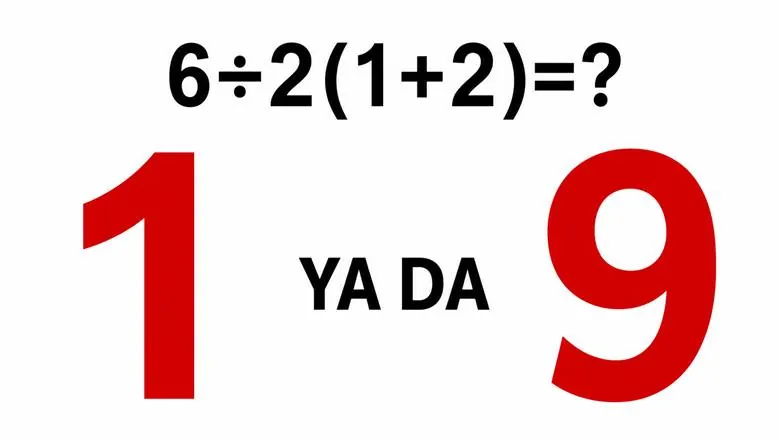
You've seen the headlines, probably dozens of times by now: "The math problem that split the internet" or "9 out of 10 people get this wrong." The culprit is usually a short string of numbers and symbols that looks like something from a third-grade worksheet. The expression 6 ÷ 2(1+2) has become the internet's favorite battleground, and depending on how you read it, you'll get either 9 or 1. Both answers have passionate defenders, and both sides are convinced the other is mathematically illiterate.
These puzzles look deceptively simple, almost embarrassingly easy. That's precisely why they spread like wildfire. You glance at it, the answer seems obvious, you type it out with total confidence, and then you scroll into the comments and see a wall of people arriving at completely different numbers. The debate stops being about arithmetic and becomes about interpretation, about which rule gets to boss around the others.
This particular expression has been circulating for years, resurfacing every few months to start fresh arguments. It's one of those rare things that unites people across the internet, not by agreement, but by sheer bewilderment. In this guide, we'll walk through how to approach this viral math problem and others like it, so the next time one crosses your feed, you'll know exactly what to look for before you jump into the fray.
What Is Order of Operations (and Why We Can't Just Read Left to Right)?
Order of operations is the rule that tells us which calculation to perform first when an expression mixes addition, subtraction, multiplication, division, parentheses, or exponents. Without this shared rule, the same string of numbers could produce different answers depending on who is solving it. It is the grammar of mathematics, and skipping it leads straight into the chaos of the viral math problem debates that flood social media.
Here is the thing about reading: Turkish and English both flow left to right, so our brains naturally want to attack a math expression the same way. But mathematics is its own language with its own syntax. Arabic reads right to left, Chinese reads top to bottom in some contexts, and math reads according to a hierarchy that has nothing to do with physical direction on the page.
Different English-speaking countries teach different acronyms for this hierarchy. Students in some places learn BODMAS, others learn PEMDAS, BEDMAS, or BIDMAS. The acronyms change, but the core idea stays the same: exponents first, then parentheses, then multiplication and division working left to right, and finally addition and subtraction working left to right.
Wait, that sequence deserves a second look because it trips people up. The acronyms are a memory device, not a strict instruction manual. Once you clear the exponents and parentheses, you handle multiplication and division as a single step moving left to right, then addition and subtraction as another single step moving left to right.
Consider two expressions: 3 × 4 + 2 and 2 + 3 × 4. Both equal 14. In each case, multiplication happens before addition, no matter where the numbers sit. The writing order does not change the rule. Someone reading left to right might solve the second one as 2 + 3 = 5, then 5 × 4 = 20. That answer is wrong. The error comes from treating a math expression like a sentence in a book, when it is actually a set of instructions with its own priority system.
This is exactly where the viral math problem traps so many people. They bring their daily reading habits into a domain that demands a different kind of attention. The numbers look simple, the operations look familiar, and then the comments blow up because half the people followed the rules and half just read left to right.
The good news is that the rule itself is simple to remember. The hard part is trusting it over your natural urge to go left to right. Once you internalize that multiplication outranks addition and that parentheses outrank everything, you have the tools to handle most of what the internet throws at you.
Parentheses Change Everything
Here is where parentheses step in and change the whole game. Think of them as the traffic signals of math, the little signs that tell you exactly which part of the expression to solve first, just like a comma can change the meaning of a sentence.
Look at what happens when we add them to our earlier examples. Take 3 × (4 + 2). The parentheses tell us to start with the addition inside, so we do 4 + 2 = 6 first, and then multiply by 3 to get 18. Now look at (2 + 3) × 4. Here, the parentheses wrap around the 2 + 3, so we do that first, getting 5, and then multiply by 4 to reach 20. Two expressions that looked similar now give completely different answers, 18 versus 20, all because of where those little curved lines sit.
Here is the honest truth though: in those first two examples, the parentheses weren't strictly necessary. The order of operations already told us to handle multiplication before addition, so 3 × 4 + 2 and 2 + 3 × 4 both naturally led us to 14 without any extra help. But that doesn't mean the parentheses were useless. They act as a clear sign saying "start here," removing any doubt about what the writer intended. When you see them, you know exactly where to begin, no second-guessing required. In a world where a simple viral math problem can spark a thousand comment-section arguments, that clarity is worth a lot.
Order of Operations Isn't Enough: Commutative and Associative Properties
Knowing the order of operations will carry you through most of these viral math problem debates, but it won't carry you through all of them. Sometimes you need two quieter rules that rarely get the spotlight: the commutative property and the associative property. These are the rules that tell you when you can rearrange numbers freely, and when you absolutely cannot.
The commutative property is the one that lets you swap things around. If you have an addition problem like a + b, you can flip it to b + a and get the same answer. Multiplication works the same way: 3 × 4 gives you exactly what 4 × 3 gives you. No surprises there.
Subtraction and division do not play by those rules. Try swapping 5 - 2 into 2 - 5 and you will get a different result entirely. The same thing happens with division. You cannot just flip the order and expect the answer to hold up.
You run into this in everyday life more than you might think. Ordering "orange juice and soda" versus "soda and orange juice" changes nothing about what you are getting. But "open the door, then go out" cannot be reversed. If someone tells you to go out first and then open the door, something has gone very wrong. The sequence matters because the actions depend on each other.
The associative property is a cousin of the first one, but it is about grouping rather than order. When you have several numbers being added together, it does not matter which pair you combine first. The same holds for multiplication. But subtraction and division are stubborn here too.
Watch what happens with a simple subtraction problem when you move the parentheses:
- (3 - 2) - 1 = 0
- 3 - (2 - 1) = 2
The numbers haven't changed, but the answer has, all because of where the parentheses landed. That is why you cannot group subtraction problems however you feel like it. The same caution applies to division.
So when a viral math problem shows up in your feed and the answer feels off, check whether someone has quietly swapped or regrouped something they should not have. The rules of order matter, but these two properties are the silent partners that decide whether your final number actually makes sense.
So, What's the Real Answer to 6 ÷ 2(1+2)?
The honest answer is that this viral math problem doesn't have a single correct answer, because the expression itself is poorly written. Depending on how you interpret the notation, you can legitimately arrive at either 9 or 1, and both readings have solid mathematical reasoning behind them. The real issue isn't your math skills; it's the ambiguous way the question was constructed in the first place.
Let's walk through both interpretations so you can see exactly where the split happens. The first camp follows the strict left-to-right reading of the conventional order of operations taught in schools, where parentheses, exponents, multiplication/division, and addition/subtraction are handled in sequence. Under this approach, you start with the parentheses: 1 + 2 = 3. That leaves you with 6 ÷ 2(3). Since multiplication and division carry equal weight, you work from left to right. So 6 ÷ 2 = 3, and then 3 × 3 = 9. Clean, simple, and defensible.
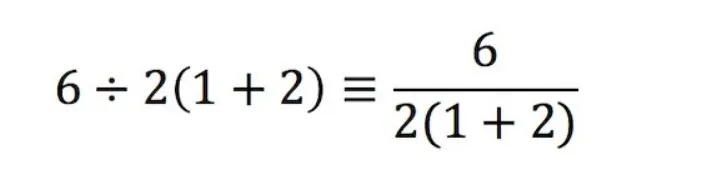
The second camp sees things differently. They treat 2(1 + 2) as a single bundled term, a form of implicit multiplication that binds more tightly than the division symbol. In this reading, you first calculate 2(1 + 2) = 2 × 3 = 6. Then the expression becomes 6 ÷ 6 = 1. This isn't sloppy thinking; it's a legitimate convention used in many advanced math contexts where juxtaposition implies a grouped quantity.
Here's the uncomfortable truth: both answers are defensible because the notation fails us. Many mathematicians prefer to avoid the ÷ symbol in ambiguous expressions for exactly this reason. It creates ambiguity that a fraction bar would eliminate instantly. If the intended expression is (6 ÷ 2)(1 + 2), the answer is 9. If it's 6 ÷ [2(1 + 2)], the answer is 1. The problem isn't the math; it's the sloppy way someone typed the question.
Final Thoughts: Don't Doubt Yourself, Doubt the Notation
Here's the thing about these viral math problems that keeps people scrolling and arguing in the comments section for hours: they're genuinely fun, but they're not always fair. Some of them are written with the specific goal of tripping people up, and that's a very different thing from testing whether you actually understand arithmetic.
When you come across one of these puzzles on social media, and you will, because they resurface every few months like clockwork, the first move is simple. Recall the order of operations. You know the drill: parentheses first, then exponents, then multiplication and division from left to right, and finally addition and subtraction from left to right. That framework will carry you through the vast majority of what you see online.
But here's the part that matters most. If you work through the problem carefully, apply the rules correctly, and the answer still feels murky, that is not a signal that you're bad at math. That is a signal that the person who wrote the expression did a sloppy job. The ambiguity is in the notation, not in your head.
Think back to the famous expression that started so many of these debates: 6 ÷ 2(1+2). The confusion there isn't about whether you know PEMDAS or BODMAS or whatever acronym your teacher drilled into you back in elementary school. The confusion is that the expression can legitimately be read two different ways. Under strict left-to-right order of operations, you get 9. If you treat 2(1+2) as a single bundled term, you get 1. Both readings are defensible, and that's the real problem. The expression itself is poorly written.
Real mathematicians tend to avoid this mess entirely. Many prefer fraction bars and extra parentheses to make their intentions crystal clear. If they mean 9, they write it in a way that leaves no room for doubt. If they mean 1, they do the same. The notation does the heavy lifting so the reader doesn't have to guess.
So the next time someone shares a viral math problem with a caption like "9 out of 10 people get this wrong," take a breath. Give it a shot. Enjoy the mental stretch. But if your answer doesn't match the crowd's, don't immediately assume you've forgotten everything you learned in school. Chances are good that the problem was never written clearly in the first place, and that's not on you. That's on the notation.
Frequently asked questions
What is the correct answer to 6÷2(1+2)?
The honest answer is that this expression is ambiguous, and it can legitimately be read as either 9 or 1. Under strict left-to-right order of operations, you divide first and get 9. But if you treat 2(1+2) as a single bundled term, the answer becomes 1. The real problem is the sloppy notation, not a lack of math skills.
Why do people get different answers for 6÷2(1+2)?
Because the expression genuinely supports two different readings. One camp follows the standard left-to-right rule: 6 ÷ 2 equals 3, then 3 × 3 equals 9. The other camp sees 2(1+2) as one inseparable chunk, computes it as 6, and then divides 6 by 6 to get 1. Both groups are applying reasonable rules to a poorly written problem.
What does PEMDAS stand for and how does it work?
PEMDAS stands for Parentheses, Exponents, Multiplication/Division, Addition/Subtraction. It tells you the order in which to tackle operations within a single expression. Crucially, multiplication and division are treated as equal in priority, so you work them from left to right. The same goes for addition and subtraction. That left-to-right detail is where most arguments begin.
Is the order of operations always the same worldwide?
Yes, the underlying rules are universal, even though the acronyms differ from country to country. You might see BODMAS, BEDMAS, or BIDMAS depending on where you learned math, but they all encode the same sequence: brackets first, then orders (exponents), then division and multiplication, then addition and subtraction. The labels change, the logic does not.
Why are subtraction and division not commutative?
Because swapping the order of the numbers changes the result entirely. With addition, 3 + 4 equals 4 + 3, and with multiplication, 3 × 4 equals 4 × 3. But 3 − 2 does not equal 2 − 3, and 6 ÷ 2 does not equal 2 ÷ 6. Subtraction and division are order-sensitive in a way that addition and multiplication simply are not.
How do parentheses affect the result in math expressions?
Parentheses act like punctuation in a sentence, telling you which operation to perform first. A tiny shift in placement can completely change the outcome. For instance, (3 − 2) − 1 equals 0, while 3 − (2 − 1) equals 2. Same three numbers, same two subtraction signs, but the grouping makes all the difference.
What is the associative property in arithmetic?
The associative property means that when you use an operation multiple times in a row, it does not matter which pair you group together first. Addition and multiplication behave this way: (2 + 3) + 4 gives the same result as 2 + (3 + 4). Subtraction and division do not cooperate like that, which is why grouping matters so much in those cases.
Why are viral math problems often poorly written?
Because ambiguity drives engagement. A problem that everyone can solve in one second gets forgotten, but a problem that splits the internet into two confident, shouting camps keeps getting shared. The ÷ symbol and missing parentheses are not accidents; they are the ingredients that make a viral math problem take off in the first place. Editorial note: Any facts which remain unconfirmed are presented as such, hedged to reflect that the exact origins of the viral spread are difficult to trace with certainty.
Got a take on this? Add your voice to the conversation below →
No comments yet. Be the first.