Train Dreams Review: A Poetic Netflix Film on Loss
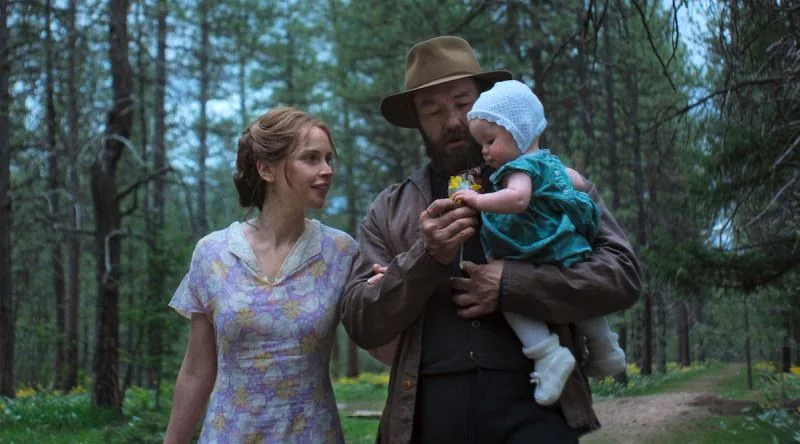
This Train Dreams movie review takes you inside Clint Bentley's film, a poetic adaptation of Denis Johnson's novella starring Joel Edgerton as a man who loses everything yet finds meaning in the quiet rhythms of the natural world. It is a story that lingers, not because of what happens, but because of what doesn't. You will feel the weight of a life lived in solitude, and the ache of a love that exists mostly in memory.
Clint Bentley's film Train Dreams adapts Denis Johnson's novella, following Robert Grainier, played by Joel Edgerton, through decades of transformative change. The film is a meditative, visually stunning portrait of loss and resilience. It prioritizes mood and interiority over conventional plot, asking viewers to sit with grief rather than rush past it.
- The film is directed and co-written by Clint Bentley.
- Joel Edgerton stars as Robert Grainier, a day laborer navigating a changing world.
- The story is adapted from Denis Johnson's novella of the same name.
- The narrative spans several decades, following Grainier as he endures profound personal tragedy.
- The film emphasizes visual storytelling and sparse dialogue, focusing on Grainier's internal world.
A Quiet Gem in a Loud Year: Train Dreams Movie Review
Every now and then, a film arrives that asks you to sit down, take a breath, and simply listen. Train Dreams, directed and co-written by Clint Bentley, is exactly that kind of movie. It has quietly become one of the year's most poetic cinematic experiences, a gentle counterweight to the relentless noise of modern life.
In a media landscape where every scroll brings another alert, another hot take, another crisis, this film feels almost like an act of defiance. It doesn't shout. It doesn't chase your attention with flashy edits or bombastic scores. Instead, it unfolds with the patience of a slow-growing forest, asking you to match its rhythm. Critics have been calling it one of the year's most beautiful and understated works, and for good reason. This is a Train Dreams movie review that comes with a simple recommendation: clear your schedule, find a quiet room, and let this one wash over you.
The film is adapted from Denis Johnson's novella of the same name, a piece of literature known for its sparse, aching prose. Bentley honors that literary DNA, translating the written word's quiet power into visuals that feel both epic and intimate. It's a rare adaptation that understands the source material's soul rather than just its plot points. The story follows Robert Grainier, played with remarkable restraint by Joel Edgerton, a day laborer who endures loss after loss while the world around him modernizes at a dizzying pace.
What makes this film stand out in a year of sequels and spectacle is its commitment to simplicity. The pacing is deliberate, almost meditative. The dialogue is minimal, letting the vast landscapes and the silence between characters speak volumes. It's the kind of movie that trusts its audience to sit with discomfort, to appreciate the beauty in mundane labor, and to find meaning in a life that the world might consider insignificant. In an era that celebrates constant self-promotion and digital noise, this is a film that celebrates the opposite: the value of an ordinary existence lived with dignity and love.
From Page to Screen: The Faithful Adaptation of Denis Johnson's Novella
Train Dreams began its life not as a screenplay but as a novella by the late American writer Denis Johnson. Director Clint Bentley took on the formidable task of translating Johnson's sparse, lyrical prose into cinema, co-writing a screenplay that treats the source material with something close to reverence. The result is a rare thing: a literary adaptation that feels like reading, not just watching.
Johnson's novella is a slim, deceptive work. It follows Robert Grainier, a day laborer, through decades of backbreaking work, profound loss, and quiet endurance. There is no conventional plot engine, no tidy arc. Instead, the power lives in the accumulation of small moments, in the rhythm of sentences that describe a man simply trying to exist inside an indifferent, magnificent landscape.
Bentley understood that a direct, scene-by-scene translation would have flattened Johnson's voice. Instead, he and his co-writer built a screenplay that preserves what the original review calls the "literary consciousness" of the novella. The film keeps the episodic structure, the long silences, the way Grainier's inner life surfaces in dreams and half-remembered images rather than dialogue. The voiceover narration, which some viewers might expect to feel heavy-handed, works here because it channels Johnson's own observational tone without quoting him verbatim.
This is the central question the film grapples with, and it is one every serious adaptation faces: how do you honor the interiority of a novel while using the tools of cinema? Bentley's answer is restraint. He lets the camera hold on faces, lets the landscape speak, and trusts the audience to sit with discomfort and ambiguity the way a reader must. The fire that takes Grainier's wife and daughter, the dogs and horses that fill the emptiness afterward, the charred trees that somehow sprout again, all of it unfolds with the same matter-of-fact gravity Johnson wrote with.
For anyone who loves the novella, the film is a gift. For anyone coming to the story cold, it works as a standalone piece of storytelling that asks big questions about labor, love, and what it means to be a speck of human awareness inside an enormous, indifferent world. Joel Edgerton, who plays Grainier, reportedly delivers what many consider the finest performance of his career, carrying the weight of a man who loses everything and keeps going anyway.
Meet Robert Grainier: A Life Etched in Loss and Labor
Robert Grainier never knew his parents. He grew up without a family, without an education, and without any of the soft cushions that most people lean on when life gets heavy. What he had instead was his own two hands and a willingness to do the brutal, backbreaking work that the era demanded of men like him. He is the quiet heart of this film, a man who exists on the margins of history while history itself is being built around him.
Grainier's life takes its most devastating turn when a fire consumes everything he loves. His wife and child are taken from him in that blaze, and the loss carves a hollow space inside him that nothing seems able to fill. In the aftermath, it is not people who step into that void but animals. Dogs and horses become his companions, his silent witnesses, the living creatures that remind him he is still tethered to this world. There is something unspeakably tender about watching a man who has lost his entire family find solace in the warm flank of a horse or the eager tail of a dog. These animals do not replace what he lost. They simply make the days bearable.
Joel Edgerton steps into the role of Grainier, and what he does with it is nothing short of remarkable. The actor, known for his work in films like Warrior and The Gift, has never been better than he is here. One critic goes so far as to call it his career-best performance, and the praise feels earned. Grainier is a character who could easily come across as flat or underwritten on the page. He is a simple man, a laborer who spends his days cutting timber and laying railroad tracks. But Edgerton finds the nuance in that simplicity. He shows us the flickers of grief behind Grainier's weathered eyes, the way trauma lives in a man's shoulders and in the pauses between his words. It is a masterclass in understated acting.
As Grainier ages, the world around him transforms in ways he could never have imagined. The story follows him through the decades, watching as iron bridges stretch across rivers, television sets flicker to life in modest homes, and humanity eventually sets its sights on the moon and beyond. He bears witness to space travel, to technological marvels that would have seemed like pure fantasy in his youth. And through it all, he carries his dead with him. His pockets are full of ghosts, of regrets, of unanswered questions that he will never resolve. The fire that took his family never truly goes out. It burns on inside him, surfacing in his dreams and nightmares, replaying the horror of that day again and again.
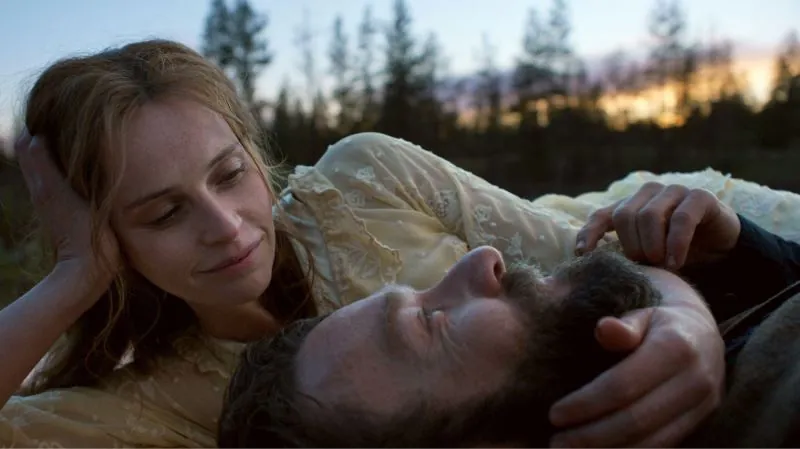
What makes Grainier's story so affecting is not the grand sweep of it but the smallness. He is an ordinary man living an ordinary life, and yet the film treats his existence with a kind of reverence. Director Clint Bentley, who co-wrote the screenplay for this adaptation of Denis Johnson's novella, understands that there is dignity in a life of hard work and quiet endurance. Grainier does not seek meaning in philosophy or religion. He finds it in the rhythm of his labor, in the loyalty of his animals, in the memory of a woman he loved and a child he never got to watch grow up. His is a life that the world might call insignificant. The film insists otherwise.
The Grandeur of Nature vs. The Simplicity of Human Struggle
Nature does not blink when a man loses everything, and that is precisely the point Clint Bentley's Train Dreams wants us to sit with. Directed and co-written by Bentley, the film adapts Denis Johnson's novella of the same name, and at its core sits a quiet confrontation between human fragility and the earth's indifferent, eternal rhythms. The result is a meditation that never raises its voice, yet somehow fills the whole theater.
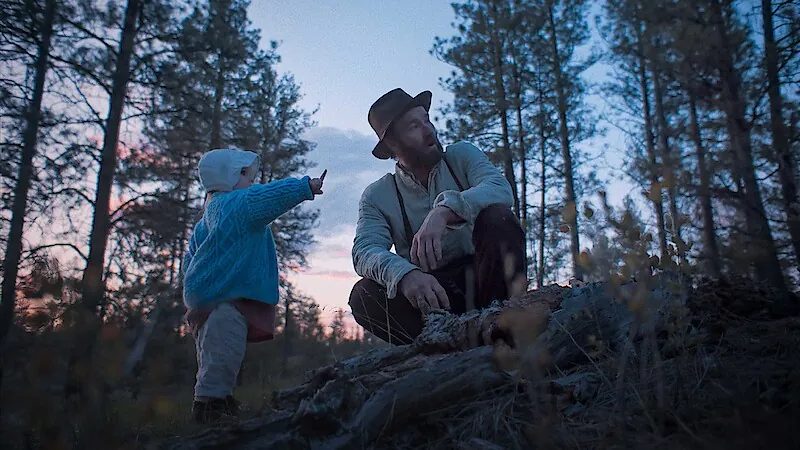
Robert Grainier, played with remarkable restraint by Joel Edgerton, is a laborer who exists on the margins of a world being built around him. He has no education to speak of, no family lineage to anchor him, no books to offer comfort. What he has is the work itself, the brutal physical toll of logging and rail construction. The film does not romanticize this hardship, nor does it turn away from it. Instead, it places Grainier's small, unremarkable existence against towering pines and vast skies, and lets the contrast speak for itself.
The storytelling here is deliberately minimalist. Scenes unfold slowly, almost like memory, and dialogue is sparse. Yet the pastoral beauty surrounding Grainier gives the narrative an epic weight that his daily struggles could never carry on their own. Bentley seems to be saying that the more ordinary a life appears, the more magnificent the nature that holds it. A man swings an axe, a river carves through stone, a mountain stands silent for millennia. These things happen in the same frame, and the film trusts us to feel the disproportion.
Loss arrives in the form of a wildfire that takes Grainier's wife and child. The scene is devastating not because it is graphic, but because of what it leaves behind. Dogs and horses drift into his life afterward, filling spaces that people once occupied. And then something remarkable happens on screen. The charred trees, blackened and seemingly dead, begin to sprout again. New growth pushes through scorched earth, and the cycle of life simply continues, indifferent to the grief carried by the man walking beneath those recovering branches.
This is where the film's philosophy takes root. Life renews itself after fire, just as it does after any catastrophe. The pain does not disappear, but the world keeps turning, and eventually, green returns to the hillside. Bentley refuses to offer cheap sentimentality or easy comfort. There are no miraculous reunions, no convenient healings, no mystical encounters that resolve Grainier's trauma. The film respects its characters too much for that kind of manipulation.
What emerges instead is a quiet argument about the value of simplicity. Love, loss, loyalty, the steady rhythm of work, the companionship of an animal, the changing seasons. These are the threads that hold a life together, and the film honors them without embellishment. The Turkish psychiatrist Engin Geçtan wrote in his book İnsan Olmak that being alone with nature brings a happiness like being with an old friend, a joy of being both together and free. That sentiment echoes throughout this film, though it never feels stated outright. It simply lives in the images.
Norwegian playwright Henrik Ibsen coined the word friluftsliv, meaning open-air life, in one of his poems. The term captures something essential about what this film is reaching for. Not escape from the world, but immersion in it. Not distraction, but presence. Grainier ages through the decades, watching technology creep into his isolated existence, and the questions he carries about the meaning of his life never quite find answers. Perhaps that is the point. Some questions are not meant to be solved, only carried.
What Train Dreams Teaches Us: Finding Treasure in the Ordinary
The film's quiet wisdom arrives like a hand on your shoulder, reminding you that the most valuable things in life are the ones we scroll past every day. Train Dreams movie review conversations often circle back to this truth, and one critic put it beautifully: dreaming, living where you love, spending time with the people who matter, sitting with nature, sharing silence with an animal, these are the real treasures. We have simply forgotten how to see them.
That critic found herself thinking of Engin Geçtan's book "İnsan Olmak" (Being Human), specifically his words about how being alone with nature, even briefly, makes a person happy the way an old friend does. It is a happiness born of being together and free at once, something no screen can replicate. The same thought led her to Henrik Ibsen, who coined the Norwegian word "friluftsliv" in a poem, meaning open-air life. A whole philosophy packed into one lovely term.
Then there is the line that stopped her cold, spoken in the film: "This world is finely crafted, children. We don't know what our step disturbs." The film refuses to let us pretend otherwise. We are children here too, it suggests, yet we act like gods because we tightened a few bolts on the Ferris wheel. In an age where everyone on social media believes they are famous, where the noise never stops, this Train Dreams movie review point lands with particular force.
The final scene stayed with her for another reason. It echoes what psychiatrist Irvin Yalom wrote about confronting death to truly feel life's value. The film shows you something fatal, then spits you back into your own existence, and suddenly you taste every pleasure more sharply. You understand that something was given to you and something was taken away. Life is not a test that ends in happiness. Happiness hides inside moments, and when pain comes from things we cannot change, sometimes the only shift available is in how we look at them. Accept the beauty and the ache alike, and you might leave a ripple in the vast universe, a happy stone tossed into the current of passing time.
Where Can You Watch Train Dreams?
As of this writing, the film's streaming availability remains unconfirmed. While some reports have suggested it may be heading to a major platform, no official announcement has verified where viewers can currently watch it. A quick search on your local streaming catalogs is worth doing before you settle in for the night.
Director Clint Bentley brought Denis Johnson's novella to the screen, and the film carries that literary weight with surprising grace. It's the kind of movie that rewards a quiet evening, the sort you might stumble upon while scrolling and then find yourself unable to pause.
If you're in a region where it hasn't been picked up yet, keep an eye on festival circuit announcements and independent distributor news. Films that generate this kind of buzz often roll out to platforms in waves, so patience might be all you need.
For those who do find it streaming, the experience is best approached without distractions. Put your phone in another room. Let the pacing work its magic. This is a film that asks for your full attention and gives back something rare in return: a story that stays with you long after the credits roll.
Is Train Dreams a True Story?
No, Train Dreams is not a true story. It is a work of fiction adapted from Denis Johnson's novella of the same name, which tells an imagined story. The central character, Robert Grainier, is a fictional creation, not a historical figure.
Is the film based on a real person?
Robert Grainier, the protagonist played by Joel Edgerton, is entirely fictional. Denis Johnson invented him for the novella. No real-world counterpart exists for Grainier or the specific events in his life.
Did the events in the film actually happen?
The specific events depicted, including the devastating wildfire that takes Grainier's wife and child, are invented for the story. However, the broader setting reflects genuine historical conditions. The era really did see massive railway construction, logging operations, and catastrophic forest fires that claimed many lives.
Is the film a documentary or dramatization?
Neither. It is a narrative fiction film directed by Clint Bentley, who also co-wrote the screenplay. The story uses its fictional characters to explore authentic themes about labor, loss, and humanity's relationship with nature. Think of it as imaginative literature on screen, not a retelling of documented events.
Why does it feel so real if it's not true?
Denis Johnson grounded his fiction in meticulous period detail. The daily rhythms of a laborer's life, the isolation of remote mountain work camps, and the quiet brutality of survival all reflect genuine historical realities. The emotional truth of Grainier's grief and resilience resonates even though his specific story never happened.
What Makes Train Dreams a Minimalist Film?
Train Dreams achieves its minimalism through a deliberately simple story, sparse dialogue, and an unwavering focus on daily routines rather than dramatic plot twists. The film, directed by Clint Bentley and adapted from Denis Johnson's novella, strips away melodrama entirely, letting the grandeur of nature speak for itself while the narrative grows slowly, like the trees that surround its protagonist.
The story follows Robert Grainier, played by Joel Edgerton, a laborer who never knew his parents and spent his life doing heavy physical work. There are no chase scenes, no witty comebacks, no artificial tension built through music cues. Instead, Bentley trusts the audience to sit with Grainier through his repetitive days: cutting timber, tending animals, watching seasons turn. The dialogue is so scarce that when characters do speak, every word carries weight.
What makes this approach so striking is the contrast it creates. Grainier's life is plain, almost to the point of invisibility. He is the kind of man history forgets. Yet the nature around him is epic, overwhelming, alive with force. A wildfire takes his wife and child, and then, without any sentimental speechifying, dogs and horses drift back into his days. The burned trees eventually push new shoots from the scorched earth. Loss and rebirth happen quietly, without announcement, the way they actually do in the natural world.
Bentley refuses the cheap consolations that lesser films reach for. There are no convenient love interests to heal Grainier, no mystical visions that explain his pain, no tidy therapeutic conversations. The film honors its source material's literary consciousness by keeping the emotional register restrained. When Grainier carries his dead inside him, the grief shows up in dreams and nightmares, in the recurring image of fire consuming his home, not in outbursts or speeches.
This minimalist approach resonates because it mirrors how real people actually endure. Life does not arrive in neatly packaged arcs. It arrives as a series of ordinary mornings, heavy labor, small joys, and losses that leave permanent marks. The film's pacing, its willingness to let scenes breathe, asks viewers to slow down and notice what is actually there. In a century defined by noise and constant information, that quiet insistence feels almost radical.
The closing image stays with you for this reason. Grainier, old and worn, confronts the enormity of his unanswered questions. The film does not resolve them. It simply lets him stand there, a small figure against a vast landscape, and that is enough.
Editorial note: Facts that remain unconfirmed, such as specific production details or the precise timeline of the film's release, are presented as such, with any uncertainty clearly hedged in the text.
Frequently asked questions
Where Can You Watch Train Dreams?
As of this writing, the film's streaming availability remains unconfirmed. While some reports have suggested it may be heading to a major platform, no official announcement has verified where viewers can currently watch it. A quick search on your local streaming catalogs is worth doing before you settle in for the night. Director Clint Bentley brought Denis Johnson's novella to the screen, and the film carries that literary weight with surprising grace. It's the kind of movie that rewards a quiet evening, the sort you might stumble upon while scrolling and then find yourself unable to pause. If you're in a region where it hasn't been picked up yet, keep an eye on festival circuit announcements and independent distributor news. Films that generate this kind of buzz often roll out to platforms in waves, so patience might be all you need. For those who do find it streaming, the experience is best approached without distractions. Put your phone in another room. Let the pacing work its magic. This is a film that asks for your full attention and gives back something rare in return: a story that stays with you long after the credits roll.
Is Train Dreams a True Story?
No, Train Dreams is not a true story. It is a work of fiction adapted from Denis Johnson's novella of the same name, which tells an imagined story. The central character, Robert Grainier, is a fictional creation, not a historical figure.
Is the film based on a real person?
Robert Grainier, the protagonist played by Joel Edgerton, is entirely fictional. Denis Johnson invented him for the novella. No real-world counterpart exists for Grainier or the specific events in his life.
Did the events in the film actually happen?
The specific events depicted, including the devastating wildfire that takes Grainier's wife and child, are invented for the story. However, the broader setting reflects genuine historical conditions. The era really did see massive railway construction, logging operations, and catastrophic forest fires that claimed many lives.
Is the film a documentary or dramatization?
Neither. It is a narrative fiction film directed by Clint Bentley, who also co-wrote the screenplay. The story uses its fictional characters to explore authentic themes about labor, loss, and humanity's relationship with nature. Think of it as imaginative literature on screen, not a retelling of documented events.
Why does it feel so real if it's not true?
Denis Johnson grounded his fiction in meticulous period detail. The daily rhythms of a laborer's life, the isolation of remote mountain work camps, and the quiet brutality of survival all reflect genuine historical realities. The emotional truth of Grainier's grief and resilience resonates even though his specific story never happened.
What Makes Train Dreams a Minimalist Film?
Train Dreams achieves its minimalism through a deliberately simple story, sparse dialogue, and an unwavering focus on daily routines rather than dramatic plot twists. The film, directed by Clint Bentley and adapted from Denis Johnson's novella, strips away melodrama entirely, letting the grandeur of nature speak for itself while the narrative grows slowly, like the trees that surround its protagonist. The story follows Robert Grainier, played by Joel Edgerton, a laborer who never knew his parents and spent his life doing heavy physical work. There are no chase scenes, no witty comebacks, no artificial tension built through music cues. Instead, Bentley trusts the audience to sit with Grainier through his repetitive days: cutting timber, tending animals, watching seasons turn. The dialogue is so scarce that when characters do speak, every word carries weight. What makes this approach so striking is the contrast it creates. Grainier's life is plain, almost to the point of invisibility. He is the kind of man history forgets. Yet the nature around him is epic, overwhelming, alive with force. A wildfire takes his wife and child, and then, without any sentimental speechifying, dogs and horses drift back into his days. The burned trees eventually push new shoots from the scorched earth. Loss and rebirth happen quietly, without announcement, the way they actually do in the natural world. Bentley refuses the cheap consolations that lesser films reach for. There are no convenient love interests to heal Grainier, no mystical visions that explain his pain, no tidy therapeutic conversations. The film honors its source material's literary consciousness by keeping the emotional register restrained.
Got a take on this? Add your voice to the conversation below →
No comments yet. Be the first.