The Cubic Equation Feud: Cardano, Tartaglia and a Broken Oath
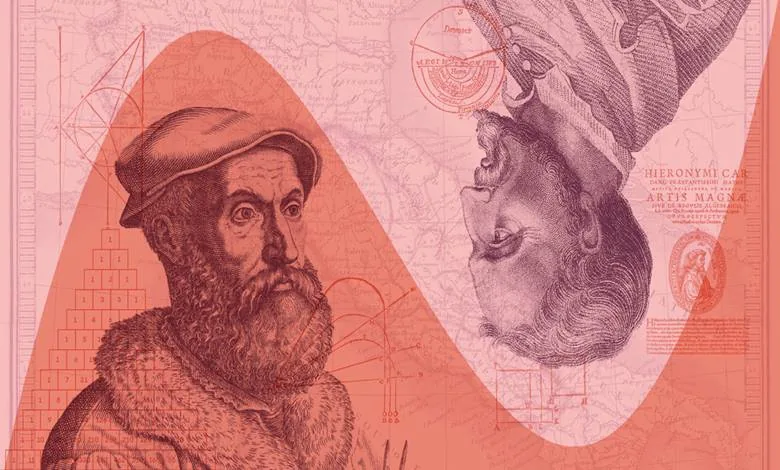
In 1535, a public mathematical duel pitted Niccolò Tartaglia against Antonio Fior over the secret solution to the cubic equation. The story that followed is not a tidy account of quiet discovery. It is a tale of sworn oaths, whispered formulas, and a betrayal that spilled into the streets of Renaissance Italy. Two brilliant, stubborn men guarded their knowledge like treasure, and one of them would pay a heavy price for trusting the wrong person.
In 1535, Niccolò Tartaglia defeated Antonio Fior in a public contest by solving cubic equations. Tartaglia shared his method with Gerolamo Cardano under an oath of secrecy. Cardano later published it in 1545 after learning Scipione del Ferro had solved it earlier, sparking a bitter feud.
- Scipione del Ferro, a professor at Bologna, is credited with discovering a solution to the depressed cubic equation before his death, though he kept it secret.
- Antonio Fior inherited del Ferro's secret method and challenged Niccolò Tartaglia to a mathematical duel in 1535.
- Tartaglia won the 1535 duel by independently deriving a method for solving cubic equations, gaining fame across Italy.
- Gerolamo Cardano persuaded Tartaglia to reveal the method in 1539 under a solemn oath not to publish it, then broke that oath in 1545 with the publication of Ars Magna.
- The feud escalated to a public debate in Milan in 1548, where Tartaglia was humiliated and Cardano's student Ludovico Ferrari was widely seen as the victor.
Before Symbols: Doing Cubic Equation History in Words and Pictures
Picture a mathematician in sixteenth-century Italy, and you probably picture a page of neat letters and little numbers. That picture is wrong. In the 1500s, algebra was still written in sentences. An equation we would now scribble as x³ + cx = d was spoken aloud as "a cube and some things equal a number." Cardano and Tartaglia worked in a world with no equals sign, no exponents, and no shorthand at all.
Two rules shaped everything. First, every coefficient had to be positive, because negative numbers were not accepted as legitimate. That single restriction split one modern equation into several unrelated problems. x³ + cx = d and x³ = cx + d were not the same statement rearranged. They were different questions, solved by different methods, with different names. Second, there was no idea of an unknown variable yet, no x sitting in the middle of the page waiting to be found. Mathematicians reasoned geometrically instead, and geometry kept them honest.
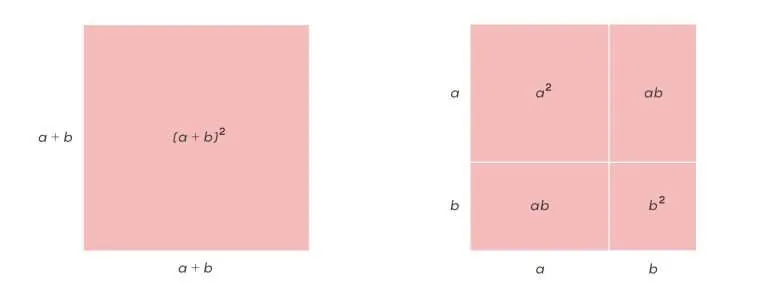
Take the identity (a + b)² = a² + 2ab + b². Nobody read that as symbol manipulation. They read it as a picture: the area of a square with side a + b equals the area of a square with side a, plus a square with side b, plus two rectangles measuring a by b. The algebra was a description of shapes you could point at.
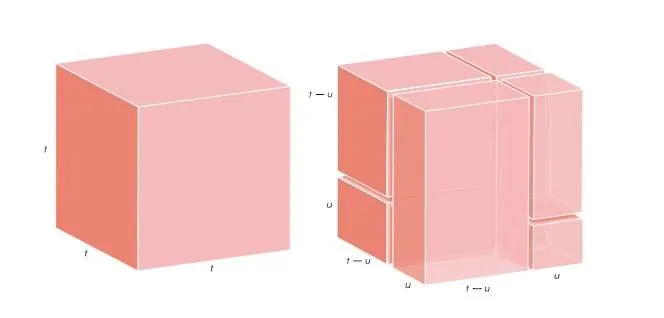
Cubes worked the same way. Slice a cube of side t into six pieces, and with t greater than u you get:
t³ = u³ + (t − u)³ + 2u(t − u) + u²(t − u) + u(t − u)²
Every term on the right is a block you could hold in your hand. Nothing here is abstract. This is the toolkit that Scipione del Ferro, a professor at the University of Bologna in the early 1500s, had to work with when he became the first person to solve the depressed cubic x³ + cx = d. He did it without symbols, without negative numbers, and without ever publishing it. That silence is where the trouble starts.
Scipione del Ferro's Secret and the Rise of the Mathematical Duel
Scipione del Ferro held the chair of mathematics at the University of Bologna in the early sixteenth century, and he is the man most historians credit with the first real breakthrough in the cubic story. Sometime around 1510 to 1515, he cracked a stubborn little puzzle: the depressed cubic, written as x³ + cx = d. No one before him had managed it. And almost no one knew he had.
That last part was not an accident. In del Ferro's world, publishing a theorem and basking in the credit was simply not how the game was played. Mathematicians challenged each other to what they called mathematical duels. You sent your rival a bundle of brutally hard problems, they sent you theirs, and whoever solved the most walked away the winner. Reputation followed the victor. So did paying students, which in a university town like Bologna meant money and status.
So discoveries became weapons. A clever method was not shared with the world. It was hoarded, tucked away, saved for the next duel the way a card player keeps an ace up a sleeve.
Which is why, for a long time, nobody could say for sure what del Ferro actually knew. The proof survives only because he taught the technique to his student Antonio Fior. After del Ferro died, Fior started bragging that he alone could solve the depressed cubic. That boast is the thread we pull on. Without it, one of the great turning points in this history might have vanished entirely.
Strip away the symbols and you are left with shapes. Mathematicians reasoned with geometry because they had nothing else, and that is the mental furniture del Ferro was working with when he found his solution. No tidy notation. No negative numbers. Just a cube, some pieces, and a secret he carried to his grave.
The 1535 Duel: Tartaglia vs. Fior
Niccolò Tartaglia was born in 1499 and died in 1557, and he never sat in a university chair. He taught himself mathematics, and by the 1530s he had cracked a type of cubic equation that the established scholars had not. That single achievement put him on a collision course with a man named Antonio Fior.
Fior had learned his mathematics from Scipione del Ferro, the Bologna professor credited with the first solution of the depressed cubic, the form written as x³ + cx = d. After del Ferro died, Fior bragged that he alone held the master's method. So in 1535 the two men agreed to a mathematical duel, the era's standard way of settling who really knew what. Each would send the other 30 problems. Each had one and a half months, 45 days, to solve them.
Fior's confidence made a certain kind of sense. He had inherited a working technique. Tartaglia had to build his own from scratch, and for most of those 45 days he did not have it.
Then, just days before the deadline, the method came to him. He worked through the equations Fior had sent and solved all 30 of them. Fior, meanwhile, could not solve a single one of Tartaglia's problems. Not one.
News of the upset spread quickly across Italy. A self-taught outsider had beaten the man who claimed del Ferro's legacy, and he had done it with almost no time to spare. Fior withdrew in great shame, and the story of the duel became the kind of gossip that mathematicians repeated for years afterward.
What almost nobody outside Tartaglia's own head knew was how he had done it. He kept the method locked away, exactly as the dueling culture of the day demanded. A secret technique was worth more than a published one, because it could win the next challenge too. That habit of secrecy is the reason this period reads less like a chain of discoveries and more like a series of heists.
The Oath, the Broken Promise, and the Man Who Solved Every Cubic
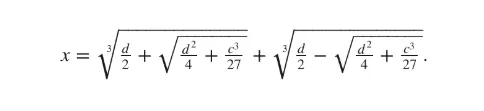
Gerolamo Cardano could not crack the cubic on his own. He tried to reproduce what Niccolò Tartaglia had done, failed, and then began pressing the man for his secret. Cardano offered something extraordinary for the 1530s: a sworn oath of secrecy. Tartaglia finally gave in during 1539, handing over his method, but he held back the reasoning that explained why it worked. In place of a proof, he gave Cardano the rule in verse form.
That was enough. Cardano worked out the underlying mathematics himself, and then he spotted the move that turned a trick into a general method. Take any cubic written as ax³ + bx² + cx + d = 0 and apply the substitution x = t − b/(3a). The squared term vanishes. What remains is a depressed cubic in t, exactly the stripped-down shape del Ferro and Tartaglia had wrestled with. Solve that for t, feed the answer back through the substitution, and you have x. Any cubic, not just one lucky case.
So this is where the story gets uncomfortable. Cardano had sworn an oath. He broke it, or at least bent it past recognition, by sharing the results with his most gifted student, Ludovico Ferrari. That turned out to be the best decision of his mathematical life. Ferrari pushed further than his teacher had, discovering that a quartic, a fourth-degree equation, can be reduced to a cubic. Between the two of them, Cardano and Ferrari became the first mathematicians able to solve every equation up to the fourth degree.
Cardano wanted to publish. He also knew that publishing meant admitting the secret was never entirely his. Then, in 1543, during a trip, he examined Scipione del Ferro's notebooks and found that the reduced cubic had been solved in Bologna long before Tartaglia ever put pen to paper. In Cardano's reading, that discovery dissolved whatever debt he still owed. Two years later, in 1545, he published Ars Magna, "The Great Art," carrying his own work and Ferrari's results on cubics and quartics into print.
1543 to 1545: Del Ferro's Notebooks, Ars Magna, and the Broken Oath
Gerolamo Cardano wanted the world to see the cubic solution, and the only thing standing in his way was his own word. In 1539 he had sworn a solemn oath to Niccolò Tartaglia (1499, 1557) never to reveal the method. Publishing it would mean breaking that promise. So for four years he sat on the most powerful piece of algebra in Italy, teaching it only to his brilliant young student Ludovico Ferrari.
Then came the trip that changed everything. In 1543, traveling through Bologna, Cardano and Ferrari examined the notebooks of Scipione del Ferro, the professor at the University of Bologna who is generally credited with the first solution of the depressed cubic x³ + cx = d around 1510 to 1515. There, in the dead man's own hand, was the solution to the reduced cubic, worked out long before Tartaglia ever cracked it. Cardano read it as a release. The secret, he reasoned, had never truly belonged to Tartaglia alone. Del Ferro had found it first, and the oath, in his mind, no longer bound him.
Two years later, in 1545, Cardano published Ars Magna (The Great Art) in Nuremberg. The book gathered his own work on the cubic together with Ferrari's results, including Ferrari's discovery that quartic equations can be reduced to a cubic. Between them, the two men could now solve every equation up to the fourth degree. The book also carried the substitution x = t − b/(3a), the trick that strips the squared term from any cubic and turns it into del Ferro's reduced form. It is the same maneuver students still learn today, and it is the beating heart of the story that runs through this piece.
Many people regard the publication of Ars Magna as a landmark of the algebra revolution, and some go further and call it the beginning of modern mathematics. That grander claim is a reported characterization rather than settled consensus, so treat it as a compliment the book has earned over the centuries, not a fact carved in stone. What is certain is that the oath was broken, the formula was out, and Tartaglia was furious.
The Fallout: Accusations, the Milan Debate, and Two Fates
Niccolò Tartaglia, the self-taught mathematician, did not take the 1545 publication of Cardano's Ars Magna quietly. He accused Gerolamo Cardano of two things: theft, and the breaking of a sacred oath. Cardano, for his part, deflected every accusation onto his loyal assistant, Ludovico Ferrari. The dispute dragged on for months through harsh, accusatory pamphlets exchanged between the parties.
What began as a war of words escalated into a mathematical duel between Tartaglia and Ferrari, and then into a public debate held in Ferrari's hometown of Milan in 1548. Tartaglia wanted to face Cardano directly, but Cardano refused. The details of what happened in that room are not fully known, but the outcome is not in doubt: the debate ended in a major humiliation for Tartaglia, with the enthusiastic Milan crowd firmly against him. The next day, when the debate was supposed to continue, Tartaglia had left the city.
Despite notable achievements beyond cubic equations, Tartaglia died in poverty and near obscurity. Cardano gained lasting fame. Many consider the publication of Ars Magna to mark the beginning of modern mathematics, though that sweeping claim is more a matter of reputation than settled consensus. The feud had claimed its winners and its casualties.
Beyond the Cubic: Abel, Galois, and the Limits of Formulas
Once the cubic and the quartic had fallen, mathematicians asked the obvious next question: how much further can we go? The answer, it turned out, was not very far at all. That discovery is one of the great turning points in the history of the cubic equation, because it closed a door that had been open since the Renaissance.
The first rigorous proof of this impossibility arrived in 1824, roughly three centuries after Ars Magna appeared in 1545. The author was Niels Henrik Abel, a Norwegian mathematician who showed that equations of the fifth degree and higher cannot generally be solved by radicals, meaning no formula built from the coefficients using ordinary arithmetic and roots will hand you the solutions. The hunt that began with del Ferro in Bologna simply had no general ending.
Then came Évariste Galois. According to the original account, in 1830, when he was around eighteen years old, he deepened Abel's result and went further: he established precise criteria for deciding whether a polynomial of any degree is solvable. The dating and the age framing in that account are inexact, so treat the year and the number with a little caution. What is not in doubt is the reach of the work. Galois did not just say where the wall stands. He explained exactly which equations get past it.
Two years later, in 1832, Galois died from wounds taken in a real armed duel. It was not a quarrel over mathematics.
His contributions left a legacy far beyond his years, and they reframed the whole question. For two centuries the goal had been to find the formula. Galois showed that the interesting question was never the formula at all. It was the structure underneath it.
Frequently asked questions
Who first solved the cubic equation in Renaissance Italy?
Scipione del Ferro, a professor at the University of Bologna, solved the depressed cubic x³ + cx = d sometime around 1510 to 1515, well before Niccolò Tartaglia. He kept the method quiet under the era's culture of secrecy, teaching it only to his student Antonio Fior, so word of his priority did not spread for decades.
What was the 1535 duel between Tartaglia and Fior?
In 1535, Antonio Fior and Niccolò Tartaglia (1499, 1557) challenged each other to a mathematical duel, each sending 30 problems with a 45-day deadline. Tartaglia cracked the method days before time ran out and solved all 30; Fior solved none, and news of Tartaglia's victory spread quickly across Italy.
Why did Cardano publish Tartaglia's method in Ars Magna?
In 1543, while traveling, Gerolamo Cardano examined del Ferro's notebooks and learned that del Ferro had solved the reduced cubic before Tartaglia. Cardano took this as releasing him from his oath of secrecy, and in 1545 he published Ars Magna, which contained the cubic solution and Ludovico Ferrari's work on quartics.
How did del Ferro solve the reduced cubic?
Del Ferro found a root of the reduced cubic x³ + cx = d, the special form in which the squared term is missing. He passed the technique to his student Antonio Fior, whose boasting about knowing it after del Ferro's death is how historians later confirmed the method existed.
Was Cardano wrong to break his oath?
Tartaglia accused Cardano of theft and of breaking a sacred oath, while Cardano deflected the blame onto his student Ferrari. The quarrel ran for months through bitter pamphlets and ended in a public debate in Milan in 1548, where Tartaglia was bested and left the city the next day.
Why can't quintic equations be solved with a general formula?
In 1824, the Norwegian mathematician Niels Henrik Abel published the first rigorous proof that equations of the fifth degree and higher cannot generally be solved by radicals. No formula built from ordinary arithmetic and roots can handle every quintic, so the long search that began with the cubic simply had no general answer.
What did Abel and Galois prove?
Abel gave the first rigorous impossibility proof in 1824, showing that higher-degree equations cannot generally be solved by radicals. Évariste Galois then established precise criteria for whether a polynomial of any degree is solvable, work that founded what we now call Galois theory.
Did Tartaglia ever get credit for the cubic formula?
Tartaglia won the 1535 duel and was celebrated across Italy, yet his method reached the world through Cardano's Ars Magna. Tartaglia died in poverty and near obscurity in 1557, while Cardano gained lasting fame, a striking reversal for the man who won the contest in the first place. Editorial note: Details that remain unconfirmed by primary records are presented here as uncertain or contested, and no claim is made beyond what the surviving evidence supports.
Got a take on this? Add your voice to the conversation below →
No comments yet. Be the first.