Superellipse: The Curve That Shaped Sergels Torg
There is a shape that refuses to pick a side. Not quite a rectangle, not quite an ellipse, it sits in the space between and quietly turns up in places as different as a World Cup stadium in Mexico City and a small self-righting object from Hungary. It is called the superellipse, a curve family tied to the French mathematician Gabriel Lamé, and its most famous built form is Sergels Torg, the central square of Stockholm, Sweden, redesigned in the 1950s. Once you know what to look for, you start seeing it everywhere.
The superellipse is a curve family tied to Gabriel Lamé that blends the properties of rectangles and ellipses. Danish mathematician Piet Hein later applied it to urban design, most famously at Stockholm's Sergels Torg in the 1950s. It also appears in the Azteca Stadium and the gömböc.
- Gabriel Lamé, a French mathematician, worked out the equation behind the superellipse, and the year 1818 is often attached to that work.
- Sergels Torg, the central square of Stockholm, Sweden, was rebuilt in the 1950s with a superellipse-shaped roundabout and central platform.
- Estadio Azteca in Mexico City hosted the World Cup in 1970 and 1986, and it is often cited as a superellipse-based structure.
- The gömböc, a self-righting homogeneous object, carries exactly one stable and one unstable equilibrium point.
- Piet Hein, a painter and mathematician living in Denmark, chose n = 2.5 for the Sergels Torg design.
A Curve Hiding in Plain Sight
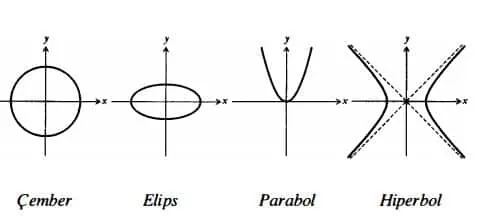
Most of us met the same handful of curves in school, and we met them in a fixed order. First came straight lines, the simple graphs of first-degree equations. Then second-degree equations arrived, and with them the whole family: the circle, the ellipse, the parabola, and the hyperbola.
Each one turns up in the world outside the textbook. A parabola is the arc traced by an object flying through the air. An ellipse is the path the planets trace around the Sun. The hyperbola is the shape a sundial's shadow tip sweeps out over the course of a day. Four curves, four familiar pictures.
But that list is not the whole story. There are other curves that either never show up in daily life, or show up so subtly that our eyes slide right past them. One of them is the superellipse, and the odds are good that you have walked across one without ever knowing it.
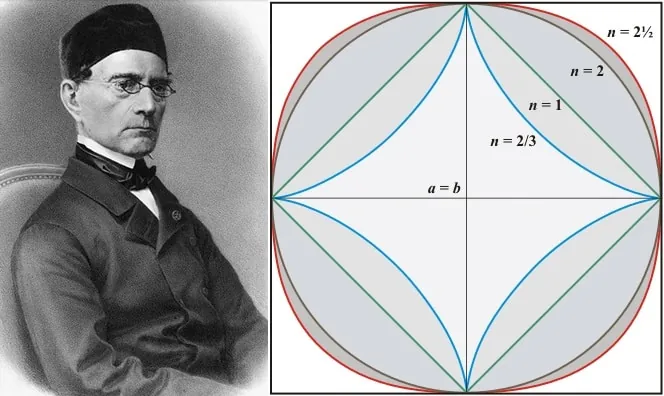
The ordinary ellipse has an equation most people have seen: (x/a)² + (y/b)² = 1, where a is half the length of the long axis and b is half the length of the short axis. In the nineteenth century, the French mathematician Gabriel Lamé (1795, 1870) began playing with that formula. He wondered what would happen if he changed the exponents instead of the axes, and the results he found are known today as Lamé curves, written as |x/a|ⁿ + |y/b|ⁿ = 1.
The family tree is stranger than you would guess. An ellipse is simply the Lamé curve where n = 2. Set n = 2/3 and you get the astroid, a four-pointed star shape. And for every value of n greater than 2, the Lamé curve has its own name: a superellipse. Rotate a superellipse with n = 2.5 and a/b = 6/5 around its axis, and you get a superegg.
Abstract? Maybe. But these curves have a habit of escaping the page and landing in the middle of a city.
Gabriel Lamé and the Equation That Wouldn't Stay an Ellipse
Start with the shape everyone can draw: the ellipse, written as (x/a)2 + (y/b)2 = 1, where a is half the long axis and b is half the short one. Gabriel Lamé, a French mathematician who lived from 1795 to 1870, looked at that tidy equation and wondered what would happen if the exponent itself were allowed to move.
Lamé was already playing with generalizations of the ellipse equation in the nineteenth century, and the year 1818 is often attached to that work, though it could not be reliably confirmed. What is certain is the formula he left behind: |x/a|n + |y/b|n = 1. Today we call it the Lamé curve, and it turns out to be a whole family wearing one name.
Push the exponent to n = 2 and you get the plain old ellipse back. Nothing exotic. But slide n down to 2/3 and the curve pinches into a four-pointed star, the astroid. Go the other way, to any n greater than 2, and the shape earns a new title: the superellipse. It is a rectangle with softened corners, an oval with flatter sides.
Then there is the odd one. Take a superellipse with n = 2.5 and a/b = 6/5, and rotate it around its own axis. What comes out is a superegg, a form that looks like it should topple over and simply does not. A single exponent, a single ratio, and a shape nobody had bothered to name before.
That is the thing about Lamé's equation. It sat quietly for decades as a piece of pure mathematics, a generalization with no obvious job. The interesting part is what happened when someone finally needed a curve that was neither a circle nor a rectangle, and remembered that the exponent was a dial all along.
The Problem of Sergels Torg
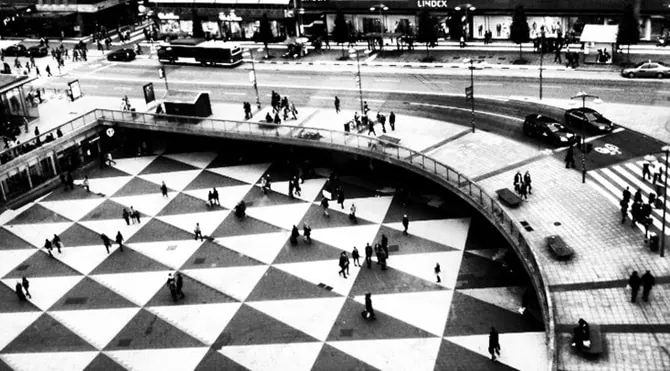
Sergels Torg is a public square in the heart of central Stockholm, and the pattern at its center is not a circle. It is a superellipse, a shape that sits between an oval and a rectangle, and the story of how it got there starts with a very practical headache.
In the 1950s, the planners redesigning Sergels Torg ran into a geometric question they could not wave away. They had a rectangular area to work with, and they needed to know the best possible shape for a walking path across it. A plain circle would leave odd gaps at the corners. A strict rectangle would feel rigid underfoot. So the architects working on the project went looking for help, and they found it in Denmark, in the person of Piet Hein, a painter and mathematician.
Hein's fix was elegantly simple. He took the familiar equation for an ellipse and changed the exponent. Instead of the standard squared terms, he let the power be some other number, which turns the smooth oval into something with flatter sides and tighter corners. After working through the options, he settled on n = 2.5 as the value that gave the best artistic match between the curved oval and the straight edges of the space.
That decision is why the roundabout pattern at the center of Sergels Torg looks the way it does today. The superellipse became a defining feature of the square, a piece of pure mathematics poured into pavement and walked over by thousands of people who have no idea an exponent is involved.
The shape traveled. Other architects reportedly copied Stockholm's superelliptical walking path, and Mexico City's Azteca Stadium is often cited as a building in the same form. That venue hosted the World Cup in 1970 and again in 1986. The superelliptical attribution is reported rather than firmly documented, so treat it as part of the story rather than settled engineering history. What is certain is that Hein's curve did not stay on the drawing board. It moved into stadiums, into objects, and eventually into the hands of designers who found they could not quite let it go.
The Superegg That Refuses to Fall Over
Piet Hein's imagination did not stop at the flat superellipse. The Danish painter and mathematician, the same man who had already reshaped a Stockholm square, kept pushing the curve into three dimensions. Rotate a superellipse with n = 2.5 and a/b = 6/5 around its axis and you get a superegg: a smooth, rounded solid that looks like an egg someone ironed flat at both poles.
Then comes the part that makes people pick it up and try again. A superegg can stand on either end without falling over. Set it upright on its narrow tip, let go, and it stays. Set it on its wide end, and it stays there too. For an object with no flat base, that is genuinely strange, and it is the property that turned a mathematical curiosity into a conversation piece.
Hein released superegg-shaped objects in various forms, and this is often placed in the 1970s, though that decade could not be reliably confirmed. What is clear is the range: the shape showed up as sculpture, as desk object, as design. Curious, pleasing things you wanted to touch. Over time his curves spread into everyday life and became fixtures for designers.
A superegg is a superellipse spun around its axis. Its party trick is simple and slightly unsettling: it stands on either end without toppling, no flat surface required.
That refusal to fall is the thread that leads somewhere unexpected. Hein's superegg was a beautiful answer to a design question, and the same puzzle, whether a smooth object can right itself, would later get a far more rigorous treatment. That is where the story turns next.
Gömböc: The Shape That Picks Itself Up
Vladimir Arnold, a Russian mathematician, predicted in 1995 that a strange object could exist: a solid, uniform body with exactly one stable resting point and one unstable one. Nobody had ever held such a thing. Eleven years later, in 2006, Hungarian mathematician and engineer Gábor Domokos and his student Péter Várkonyi proved the shape could exist in the real world, and in many forms.
The object is called a gömböc, Hungarian for "sphere," though it looks nothing like one. It is convex, homogeneous, and it carries exactly one stable and one unstable equilibrium point. Place it on a table in any position and it rocks, rolls, and pushes itself back upright, the way a flipped turtle scrambles onto its feet. The gömböc is considered the first and only three-dimensional homogeneous object with this property.
That turtle comparison is more than a metaphor. Domokos and Várkonyi studied how turtle shells are shaped to understand self-righting, and their findings on body form and the ability to flip back over fed directly into their explanation of gömböc geometry.
A gömböc sculpture stands in Budapest. Whether it is the largest one anywhere is something that is often claimed but could not be reliably confirmed.
The Turtle Shell Connection
Flip a turtle onto its back and you have handed it a life-or-death problem. Righting itself is not a party trick; it is survival. Some species manage the turn with surprising ease, rocking and pushing until they are upright again. That ordinary struggle is exactly what drew Gábor Domokos and his student Péter Várkonyi, the Hungarian pair who in 2006 proved the gömböc could exist in the real world, toward the zoo.
The two researchers reportedly spent a year at the Budapest Zoo, measuring and analyzing the shell shapes of different turtle species. That specific duration and location could not be reliably confirmed, so treat the details as reported rather than settled. What is clear is the goal: they wanted to know which body shapes make self-righting easy and which make it nearly impossible. The answers they found in those curved shells helped them explain the geometry behind the gömböc.
The parallel is almost too neat. A gömböc is considered the first and only three-dimensional homogeneous object with exactly one stable and one unstable equilibrium point. Leave it anywhere and it rolls back to its single resting position, much like a turtle hauling itself off its back. The difference is that the gömböc does it every time, on any surface, with no legs to push against. The turtle needs muscle and a bit of luck. The gömböc needs only its shape.
That is the quiet payoff of the superellipse story. An abstract curve, drawn first by Gabriel Lamé and later bent into a Stockholm plaza and a Danish egg, turns out to describe something a living animal has been doing for far longer. Domokos and Várkonyi did not invent self-righting. They simply wrote down the mathematics of a problem turtles had already solved.
Frequently asked questions
What is a superellipse, and how is it different from an ellipse?
A superellipse is a Lamé curve whose exponent n is greater than 2, written as |x/a|^n + |y/b|^n = 1. A plain ellipse is simply the case where n equals 2, so the superellipse trades the ellipse's soft curve for a shape that pushes outward toward a rounded rectangle.
Who invented the superellipse, and when?
The French mathematician Gabriel Lamé, who lived from 1795 to 1870, generalized the ellipse equation in the nineteenth century, and the resulting family is still called Lamé curves. The Danish painter, designer, and mathematician Piet Hein later applied the shape to real design problems.
Why did Piet Hein choose n = 2.5 for Sergels Torg?
When Stockholm planners needed a walking-path shape for the rectangular space at Sergels Torg in the 1950s, Piet Hein tested the exponent and decided that n = 2.5 struck the best artistic balance between a pure oval and straight sides. That value became the square's signature superelliptical pattern.
How is the Azteca Stadium connected to the superellipse?
Other architects reportedly copied Stockholm's superelliptical walking path. As the story goes, Mexico City's Azteca Stadium was built in the same shape, and that venue hosted the World Cup in 1970 and again in 1986.
What is a gömböc, and why is it special?
A gömböc is the first known three-dimensional homogeneous object with exactly one stable and one unstable equilibrium point. Because of that geometry it can be placed in any position and will always roll itself back to a single resting point, much like a turtle righting itself after being flipped onto its back.
Who proved the existence of the gömböc, and in what year?
Russian mathematician Vladimir Arnold conjectured in 1995 that such a homogeneous object could exist. The proof came in 2006 from Hungarian mathematician and engineer Gábor Domokos and his student Péter Várkonyi, who showed the gömböc can exist in the real world in many forms.
How did turtle shell research help explain the gömböc's geometry?
Domokos and Várkonyi reportedly spent a year at the Budapest Zoo measuring and analyzing the shell shapes of different turtle species. Their findings on body shape and self-righting ability helped them explain the gömböc's own geometry.
Where can you see the largest gömböc sculpture?
A gömböc sculpture stands in Budapest, and it is often described as the largest one. That claim about being the largest is unconfirmed, so it is safest to say simply that Budapest has a prominent gömböc sculpture on public display. Editorial note: Any facts that remain unconfirmed are presented as such in this article.
Got a take on this? Add your voice to the conversation below →
No comments yet. Be the first.