Stanislaw Chlebowski: The Painter of an Unfinished Conquest
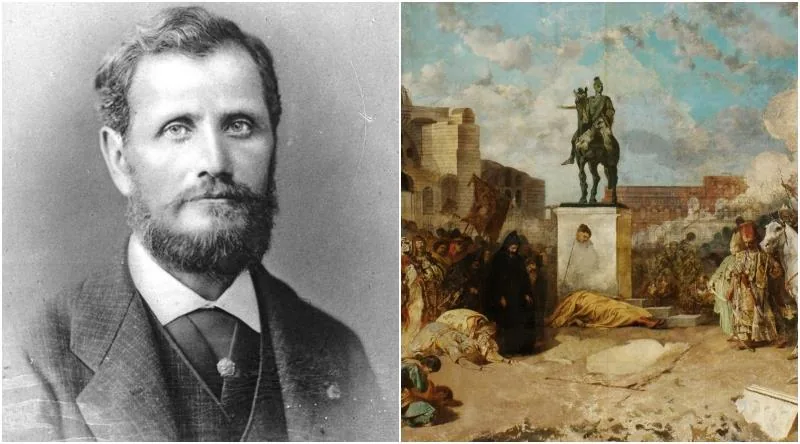
Stanislaw Chlebowski, a Polish painter who served as the Ottoman Sultan's court artist in the 19th century, left behind a monumental unfinished masterpiece, the Conquest of Istanbul painting, which now resides in a Krakow museum. His story is one of artistic ambition, imperial patronage, and a canvas that remains tantalizingly incomplete. The tale of this Polish artist in the heart of the Ottoman Empire is a fascinating blend of East and West, of power and paint, and of a project that time simply ran out on.
Stanislaw Chlebowski was a Polish painter who worked for Sultan Abdulaziz in Istanbul during the 1860s and 1870s. His most ambitious commission, a grand depiction of the 1453 Conquest of Istanbul, was left unfinished at his death. The incomplete canvas is now held in a museum collection in Krakow, Poland.
- Stanislaw Chlebowski served as court painter to Sultan Abdulaziz in Istanbul from the mid-1860s until 1876.
- The Conquest of Istanbul painting was a major commission from the sultan, intended to depict the 1453 fall of the city to the Ottomans.
- Chlebowski left the Ottoman Empire in 1876 and the painting remained unfinished at the time of his death in 1884.
- The unfinished canvas is currently part of the collection at the National Museum in Krakow, Poland.
The Painter Who Left a Masterpiece Unfinished
Stanislaw Chlebowski, a Polish painter who lived from 1835 to 1884, died at just 49 years old, leaving behind a massive canvas that would never see completion. His unfinished masterpiece, depicting the conquest of Istanbul, now rests in a museum storeroom in Krakow, Poland, where it has remained for generations.
Chlebowski's path to that fateful canvas began in earnest when he enrolled at the St. Petersburg Academy of Fine Arts in 1853. He spent six years there, graduating in 1859 with a gold medal that opened doors across Europe. The academy's scholarship then carried him to Paris, where he studied under the celebrated French orientalist painter Jean-Léon Gérôme for six years. Between lessons, he wandered through Spain, Italy, Germany, and Belgium, absorbing the light and color that would later define his Ottoman scenes.
Around 1865, Sultan Abdulaziz invited him to Istanbul, and Chlebowski accepted. He became the Ottoman court painter, a role that came with an unusual side duty: teaching the sultan himself how to paint. During his years in the capital, he produced battle scenes from Ottoman history, portraits of sultans, and intimate watercolors of everyday Istanbul life. He captured women praying in mosques, musicians playing in the streets, Circassian guards standing watch, and beggars at mosque doors, all rendered with the eye of an outsider who had fallen in love with the city.
His most ambitious project, however, was the one he would never finish. Chlebowski began painting the conquest of Istanbul, a monumental work meant to immortalize the city's fall in 1453. But when Sultan Abdulaziz was deposed in 1876, the painter's patron vanished, and Chlebowski fled to Paris. There, he kept working on the enormous canvas, but death caught him first in 1884, leaving the lower-right section of the painting permanently blank.
The Unfinished Conquest and the Flight to Paris
Stanislaw Chlebowski had the sultan's full backing when he picked up his brush to capture the fall of Constantinople on a monumental canvas. The Polish painter, who had served as court artist to Sultan Abdulaziz since arriving in Istanbul around 1865, poured his skill into depicting Mehmed II's triumphant entry into the city in 1453. But history had other plans for both the artist and his patron.
In May 1876, Sultan Abdulaziz was deposed from the Ottoman throne. Days later, he was dead. The palace that had sheltered Chlebowski for over a decade turned dangerous overnight, and the painter made a hasty decision. He abandoned Istanbul and fled to Paris, leaving behind a half-finished masterpiece that would never see completion.
Chlebowski carried the enormous canvas with him to France, determined to finish what he had started. He set up his studio in Paris and returned to the work with renewed focus. Yet the artist, born in 1835, would not live to see his vision realized. He died in 1884 at the age of 49, with the painting still incomplete.
The lower-right corner of the canvas remained blank, a permanent reminder of a life cut short. What Chlebowski had managed to paint showed the sultan at the center of a swirling scene of conquest, Ottoman banners raised high, the walls of Constantinople looming in the background. But that empty space in the corner told its own story, one of political upheaval, exile, and a career that ended before its final chapter could be written.
After his death, Chlebowski's sister arranged for the unfinished work to be transported to the National Museum in Krakow, Poland. There it would rest, a monumental fragment of Ottoman history preserved in a European gallery, waiting for someone to complete what the artist could not.
From Krakow to Ankara: The Painting's Journey
When Stanislaw Chlebowski died in 1884 at just 49 years old, his unfinished masterpiece could have vanished into obscurity. Instead, his sister stepped in and arranged for the massive canvas depicting the conquest of Istanbul to be transferred to the National Museum in Krakow, Poland. And there it sat, rolled up and forgotten, while no one in Turkey had the slightest idea it even existed.
The irony stings. Here was a painting of one of the most pivotal moments in Ottoman history, created by a court painter who had served Sultan Abdulaziz himself, yet it spent decades gathering dust in a Polish storage room. The lower-right section remained incomplete, a permanent reminder of the artist who died before he could finish his life's work.
Then came World War II, and everything shifted. According to the original account, after the war and the Soviet occupation of Poland, Polish diplomats organized an exhibition at their embassy in Ankara in 1945 to rally diplomatic support. Reportedly, they brought Chlebowski's unfinished conquest painting with them, giving Turkish eyes their first look at this hidden treasure. The story goes that a Turkish artist named Burhan Agah Ozak attended that exhibition, became captivated by what he saw, photographed the work, and later created his own copy that completed the missing lower-right section.
The painting itself, however, never made the journey home. Turkish authorities have reportedly spent years trying to bring this piece of Ottoman history back to Turkey, but the colossal canvas remains in the museum's storage to this day, a quiet ghost of a story that refuses to be finished.
The Turkish Painter Who Completed the Missing Corner
Burhan Agah Özak, an artist and the uncle of former Turkish minister Faruk Özak, reportedly saw the unfinished painting at a 1945 exhibition at the Polish embassy in Ankara and was so captivated that he photographed it. According to the original account, within a few years he created a copy that completed the missing lower-right section of Stanislaw Chlebowski's great work.
The story goes that the 1945 Ankara exhibition was organized by Polish diplomats as a diplomatic gesture in the years after World War II, when Poland had come under Soviet influence. The unfinished canvas was brought to the embassy for display, and among the guests was Özak, a painter himself. The moment he laid eyes on the massive composition, something clicked. He studied the brushwork, the crowded scene of Mehmed II's entry into Constantinople, and the awkward empty gap in the lower-right corner where Chlebowski's hand had stopped.
Özak pulled out a camera and photographed the painting on the spot. Back in his own studio, he set to work. The account says that over the next few years, he recreated the entire composition on his own canvas, and this time he painted the missing corner himself, completing what death had left undone. The result was a full version of the scene, a Turkish artist's answer to a Polish painter's unfinished masterpiece.
The article includes images comparing the two versions side by side: the original with its raw, empty lower-right section, and Özak's copy with the gap filled in. Seeing them together makes the loss tangible, and the quiet act of completion by a fellow painter feels like a hand reaching across generations.
Still in Storage: The Fight to Bring It Home
As of today, the unfinished masterpiece by Stanislaw Chlebowski remains locked away in the National Museum in Krakow's storage, with no successful repatriation achieved despite years of reported efforts by Turkish authorities. The massive canvas depicting the conquest of Istanbul has never made its journey back to Turkey, and the original remains incomplete to this day.
According to the original account, Turkish officials have reportedly spent many years trying to negotiate the painting's return to Turkey. Those efforts, as the story goes, have produced no tangible results. The enormous work sits in the Polish museum's depository, far from the city whose conquest it was meant to celebrate.
What makes the situation sting even more is the timing of the painting's rediscovery. When Chlebowski's sister arranged for the canvas to be transferred to the Krakow museum after his death in 1884, nobody in Turkey even knew the work existed. The painting's lower-right section remained unfinished because Chlebowski died before completing it, and that gap in the canvas became part of its strange legacy.
The painting reportedly resurfaced in public awareness after Poland fell under Soviet occupation following World War II. According to the account, Polish diplomats organized an exhibition at the Ankara embassy in 1945, bringing the half-finished "Conquest" painting to Turkey for the first time. A Turkish artist named Burhan Agah Ozak, reportedly the uncle of former minister Faruk Ozak, saw the mysterious work and was captivated. He photographed it and, over the next few years, created his own copy that completed the missing lower-right section Chlebowski never got to paint.
Yet even with that Turkish connection, the original never left Krakow. The account ends with a sobering note: the painting, which belongs to Turkish history, is "rotting" in the museum's storage. The unfinished work of Stanislaw Chlebowski, a painter who gave twelve years of his life to the Ottoman court, still waits for someone to bring it home.
Frequently asked questions
Who was Stanislaw Chlebowski?
Stanislaw Chlebowski was a Polish painter who lived from 1835 to 1884, dying at just 49 years old. He trained at the St. Petersburg Academy of Fine Arts between 1853 and 1859, then spent six years studying under French orientalist painter Jean-Léon Gérôme in Paris on scholarship before arriving in Istanbul around 1865 to serve as court painter to Ottoman Sultan Abdulaziz.
What is the unfinished Conquest of Istanbul painting?
The Conquest of Istanbul is a monumental canvas depicting Mehmed II's dramatic entry into the city after the 1453 siege. Chlebowski began the massive work while serving at the Ottoman court, but the lower-right corner remains conspicuously blank. The painting stands as one of the most significant visual interpretations of that historic conquest, frozen forever in its incomplete state.
Why did Stanislaw Chlebowski flee Istanbul?
Sultan Abdulaziz was deposed and killed in 1876, and Chlebowski's position at court evaporated overnight. Fearing for his safety after his patron's violent removal, the painter fled to Paris, where he attempted to finish his great canvas. The political upheaval that ended the sultan's reign also ended Chlebowski's comfortable life in the Ottoman capital.
Where is the unfinished painting stored now?
The unfinished canvas rests in the National Museum in Krakow, Poland, where it sits in storage rather than on public display. Chlebowski's sister arranged for the transfer of the massive work to the museum after his death in 1884. At the time, nobody in Turkey even knew the painting existed.
How did Burhan Agah Özak complete the painting?
According to the original account, Burhan Agah Özak, an artist and uncle of former Turkish minister Faruk Özak, saw the mysterious painting at a 1945 exhibition in Ankara. He reportedly photographed the work and later created a copy that filled in the missing lower-right section, completing what Chlebowski could not. His version offered viewers a glimpse of what the finished masterpiece might have looked like.
Did Turkey try to repatriate the painting?
Turkish authorities have reportedly made efforts over many years to bring the painting back to Turkey, yet the canvas remains in Krakow's museum storage. The painting's existence only came to light after World War II, when Poland fell under Soviet occupation. Despite diplomatic attempts, the monumental work continues to sit in Poland, its unfinished corner a permanent reminder of the painter who never saw his vision complete.
Got a take on this? Add your voice to the conversation below →
No comments yet. Be the first.