Principia Mathematica: The 360-Page Proof of 1+1=2
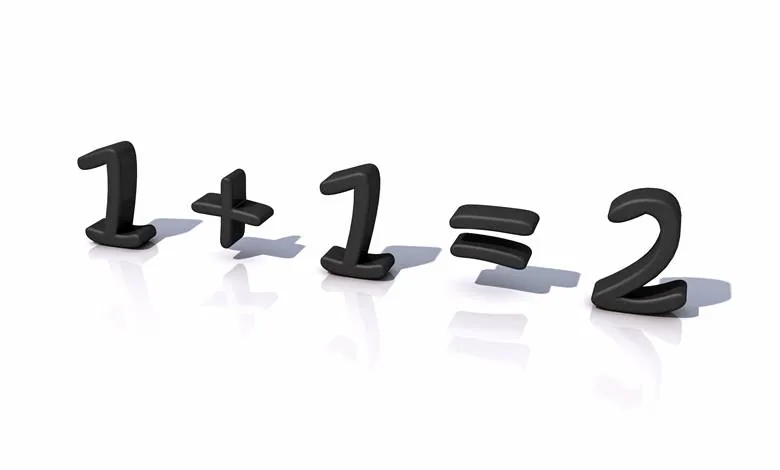
Principia Mathematica, published by Bertrand Russell and Alfred North Whitehead between 1910 and 1913, was an attempt to rebuild all of mathematics from pure logic. By popular legend, it took roughly 360 pages to reach the point where 1+1=2 could be stated as a formal theorem. The feat is often remembered as a punchline about academic excess, but it was really an act of intellectual nerve: two men trying to prove that the ground beneath mathematics would never give way.
In Principia Mathematica, Bertrand Russell and Alfred North Whitehead set out to derive mathematics from logic alone. Published in volumes from 1910 to 1913, the work reached 1+1=2 only after hundreds of pages of groundwork. Later, Kurt Gödel's incompleteness theorems undercut the project's grandest ambitions.
- Bertrand Russell and Alfred North Whitehead published Principia Mathematica in three volumes between 1910 and 1913.
- The work aimed to derive all of mathematics from a small set of logical axioms and rules.
- The statement that 1+1=2 appears only deep into the first volume, after hundreds of pages of preparation.
- Russell's paradox, which showed that naive set theory leads to contradiction, motivated the book's elaborate type theory.
- Kurt Gödel's incompleteness theorems, published in 1931, showed that no such formal system could be both complete and consistent.
Why Would Anyone Ask Why 1+1=2?
The sky is blue. The letter "a" comes before "b" in the alphabet. And one plus one always makes two. These are the things we never stop to check, the furniture of everyday life. So picture someone leaning over and asking, plainly, "Why does 1+1=2?" Most of us freeze. We say "because it does," or we hold up one apple and then another and call the matter settled.
For a small group of mathematicians at the start of the twentieth century, that answer was not good enough. Intuition and fruit were fine for the kitchen table, but the statement itself, they insisted, had to be proven from logic alone. That conviction launched one of the hardest projects in modern mathematics: Principia Mathematica.
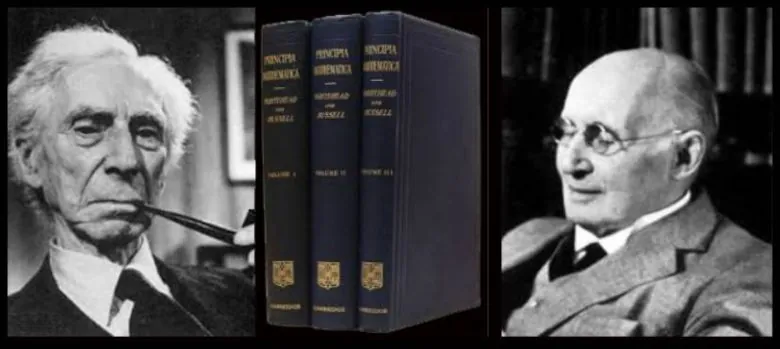
The two men behind it were Bertrand Russell and Alfred North Whitehead, both of whom made major contributions to mathematical logic and set theory. The connection was personal before it was scholarly. Whitehead had been Russell's teacher at Trinity College, Cambridge, in the 1890s, and the former student later joined his old instructor on the monumental work.
Here is the detail that tends to stop people in their tracks. The formal derivation of something as humble as 1+1=2 supposedly runs to hundreds of pages, and the figure most often repeated is 360. Treat that number as legend rather than a documented fact. The book itself is no popular science paperback. It is written almost entirely in a dense symbolic language, some of whose symbols have since fallen out of use. The point was never merely to answer the question about two apples. Russell and Whitehead wanted to derive the whole of arithmetic from pure logical axioms, and to do it while dodging the paradoxes and contradictions that had turned up in the set theory of the day.
The Crack in the Foundation Russell Wanted to Build On
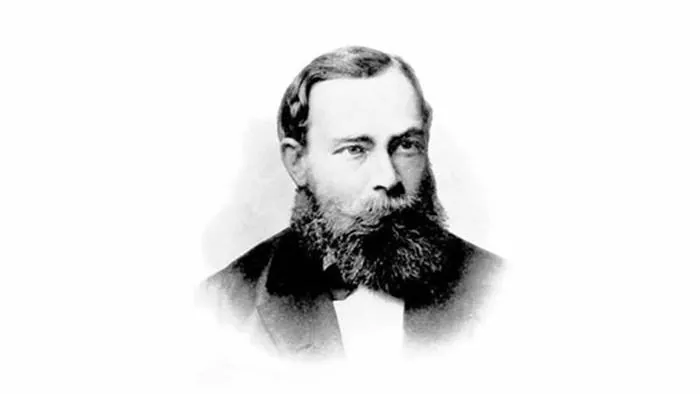
In 1879, the German mathematician and logician Gottlob Frege opened a new era in logic. His goal was audacious: build a symbolic, systematic notation from which all of mathematics could be derived from pure logic alone. Bertrand Russell's own conception of mathematics was heavily shaped by Frege's set theory and logicism. He admired the project. He wanted to extend it.
Then he found the hole.
Russell spotted a fundamental contradiction buried inside Frege's theory, a flaw that would come to be known as Russell's Paradox. The setup is deceptively simple. Consider the set of all sets that do not contain themselves. Now ask the obvious question: does that set contain itself? If it does, then by its own definition it shouldn't. If it doesn't, then it qualifies for membership and therefore should. Either way, the answer collapses into contradiction. The paradox showed that Frege's theory might be flatly inconsistent, and with it the dream of grounding everything in pure logic.
One chronological detail is worth flagging. It is often said that Frege built his ideas after Georg Cantor's groundbreaking research on sets, but that ordering is debated and not clearly established, so treat it as one telling rather than settled fact. What is not in doubt is the damage. Russell had come looking for bedrock and found a fault line running straight through it.
His response was not to abandon the project but to rebuild it. Russell developed type theory, a system in which every mathematical object is assigned a level in a hierarchy, and objects at any given level can only be assembled from levels beneath them. No set can loop back and swallow itself. The paradox loses its grip. That fix, and the enormous labor of carrying it through, is what eventually became Principia Mathematica, the work he would write with Alfred North Whitehead.
Type Theory: Building a Hierarchy to Stop the Loops
Russell's answer to the paradoxes in Frege's set theory was type theory, a system in which every mathematical entity is assigned a type inside a strict hierarchy. Objects of a given type can only be assembled from types below it, never from their own level or above. That single rule closes the door on the self-referential loops that had produced the paradox in the first place.
Picture it as a tall building with no elevators running in both directions. On the ground floor sit the simplest items. To build anything on the second floor, you may only use what is already on the first. A collection can never reach around and swallow itself, because a set of one type simply cannot contain a set of the same type. The contradiction that had shaken Frege's edifice, the set of all sets that do not contain themselves, becomes an ungrammatical sentence rather than a genuine object. You are not refuting the paradox so much as refusing to let it be written.
This ranked universe of types was the escape hatch Russell needed for the monumental project that became Principia Mathematica, published in three volumes in 1910, 1912, and 1913. Its aim was audacious: derive all of arithmetic from purely logical axioms, and do it while steering clear of the paradoxes that had infected Frege's system. Type theory was the scaffolding that made the derivation possible without the whole structure caving in on itself.
The trade-off was real. Climbing those floors one at a time made every proof longer, more layered, more laborious. But it also made the building stand.
Ten Years, Two Men, and a Page 360 That Isn't Quite Page 360
Alfred North Whitehead had been Bertrand Russell's teacher at Trinity College, Cambridge in the 1890s, and by the turn of the century the former student was pulling his old examiner into the most exhausting project either of them would ever touch. They worked on Principia Mathematica for about ten years, roughly 1900 to 1910. To keep the thing moving, Russell and his wife Alys moved house to be near the Whitehead family. Accounts mention Russell's attraction to Whitehead's young wife Evelyn during those years and the strain it put on his marriage, but the causal link is interpretive and not firmly established.
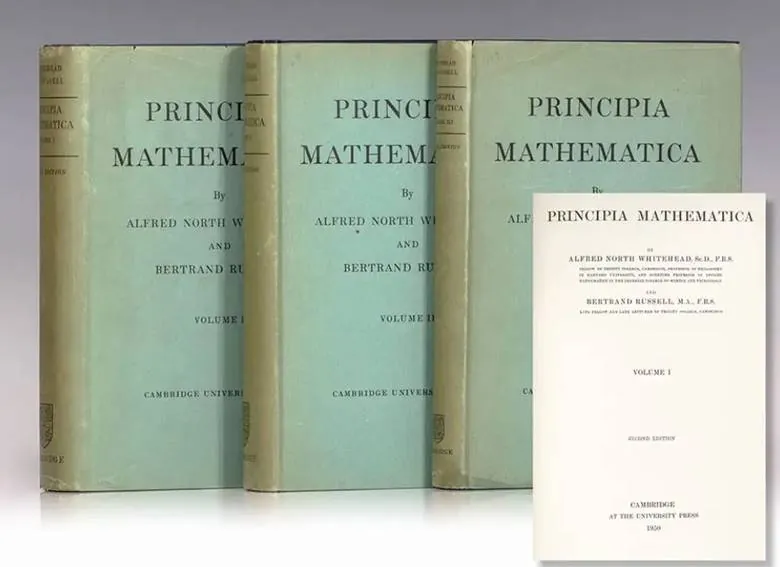
The grind did produce something. Three volumes came out through Cambridge University Press in 1910, 1912 and 1913. Some accounts say Russell did most of the later work, but that is disputed, and Whitehead's contribution to all three volumes was far from ornamental. What is not contested is the money. No commercial publisher wanted the manuscript, so the two men paid to print it themselves.
The legend You have probably heard that the proof of 1 + 1 = 2 runs to 360 pages, or that it sits on page 360, at item 54.43.
The first figure is folklore, not a documented fact. And the page number is simply wrong: proposition *54.43, the one that gives 1 + 1 = 2, actually falls around pages 379 and 380 of Volume I. The tidy version of the story does not survive contact with the book.
Another tidy explanation deserves the same treatment. The fourth volume, meant to cover the logical foundations of geometry, never appeared. Contrary to the version that blames the book's sheer thickness, the cited reasons were the crushing effort of the first three volumes and Whitehead's fading involvement in the project. Exhaustion, not page count, ended it.
Gödel's 1931 Blow: The Dream Meets Its Limit
In 1931, a short, startling paper appeared in a German scientific journal. Its author was Kurt Gödel, a 25-year-old at the University of Vienna, and its title ran: Über formal unentscheidbare Sätze der Principia Mathematica und verwandter Systeme, "On Formally Undecidable Propositions of Principia Mathematica and Related Systems." The monument was barely two decades old, and someone had just found the crack in its foundation.
What Gödel proved is often stated as a clean, brutal sentence: Principia Mathematica cannot be both consistent and complete. Pick one. If the system never contradicts itself, then there are statements inside it that are true but that its own rules can never prove. If it manages to prove everything, then somewhere in the machinery it contradicts itself. There is no third door.
Think about what that does to the dream. Whitehead and Russell had set out to pull all of arithmetic from pure logic, a chain of steps so tight that nothing could slip through. Gödel showed the chain has a natural limit. Any formal system rich enough to do real mathematics will carry true statements it cannot reach. The building still stands, still beautiful, still useful. But its grandest claim, that it could capture everything, was refuted from inside.
Russell lived long enough to collect honors that had nothing to do with that defeat. In 1949 he received the Order of Merit. The following year, 1950, he won the Nobel Prize in Literature. He kept writing and arguing to the end, and he died at 97 in Wales, in the country he loved, from influenza.
Frequently asked questions
Who were Russell and Whitehead?
Bertrand Russell and Alfred North Whitehead were the joint authors of Principia Mathematica. Whitehead had been Russell's teacher at Trinity College, Cambridge in the 1890s, and the two later collaborated for roughly a decade on their monumental logic project. Both men made significant contributions to mathematical logic and set theory.
When was Principia Mathematica published?
Principia Mathematica appeared in three volumes, published in 1910, 1912 and 1913 by Cambridge University Press. No commercial publisher showed interest in the project, so the authors had to subsidize the printing themselves. The work became one of the most influential texts in logic since Aristotle's Organon.
What was the main goal of Principia Mathematica?
The aim was to derive all of arithmetic from purely logical axioms, while steering clear of the paradoxes that had infected Frege's set theory. Russell and Whitehead wanted mathematics built on a foundation that could not contradict itself, starting from logic alone and working upward through every branch of the subject.
How did Russell's paradox lead to type theory?
Russell discovered a fundamental contradiction in Frege's theory, later known as Russell's Paradox, which exposed the system as potentially inconsistent. In response, Russell built a hierarchy of types, assigning every mathematical object to a level so that objects of one type can only be built from lower types. This blocks the self-referential loops that produced the paradox.
Why did it take 360 pages to prove 1+1=2?
The 360-page figure is a popular legend rather than a confirmed fact. The derivation of 1+1=2 appears much later in Volume I than commonly assumed, and the frequent assertion that it sits on page 360 as item 54.43 is inaccurate. Proposition *54.43 does concern 1+1=2, but it appears around pages 379 to 380.
What did Gödel's incompleteness theorems prove?
Kurt Gödel's 1931 paper, published when he was 25 at the University of Vienna, showed that Principia Mathematica cannot be both consistent and complete. Any such system will always contain statements that are true but unprovable within it. The dream of grounding all mathematics in a single formal system ran into a natural limit. Editorial note: Details that remain unconfirmed are presented as such and hedged in the text above.
Got a take on this? Add your voice to the conversation below →
No comments yet. Be the first.