Penrose Triangle: The Impossible Object Explained
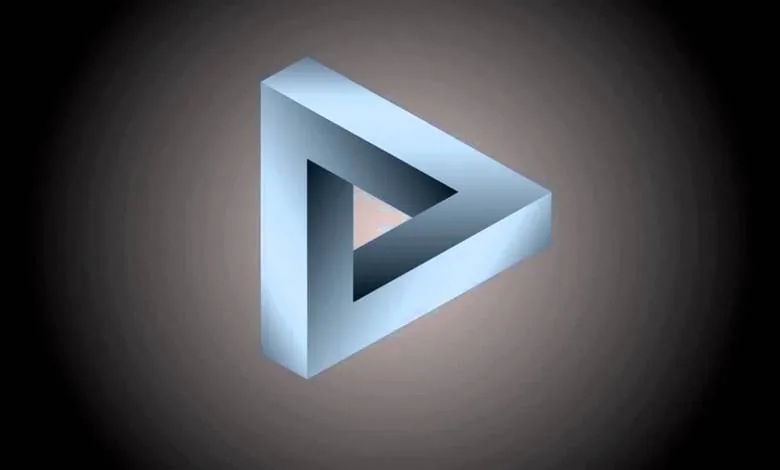
The Penrose triangle is an impossible object that Roger Penrose helped bring to the world's attention in 1958, and it remains a masterclass in how our brains can be fooled by geometry. This deceptively simple three-bar design, along with its cousin the Penrose stairs, has inspired everything from M.C. Escher's mind-bending prints to the dizzying architecture of Hollywood films like Inception.
The Penrose triangle is a two-dimensional drawing of a three-dimensional object that cannot exist in reality. Roger Penrose described it in a 1958 paper, and it works by tricking the brain into accepting impossible geometry. It inspired M.C. Escher's famous impossible drawings and continues to appear in art and film.
- Roger Penrose introduced the impossible triangle in a 1958 paper published in the British Journal of Psychology.
- The Penrose stairs, a variation on the same illusion, depict a staircase that loops endlessly upward or downward without ever gaining height.
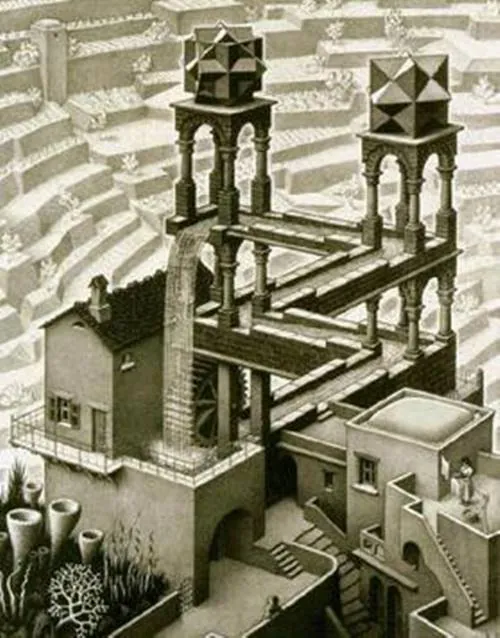
- M.C. Escher used the Penrose triangle concept in his 1961 lithograph "Waterfall," where water flows uphill before cascading down.
- The Penrose stairs appear in the 2010 film Inception, where characters navigate a looping staircase inspired by the impossible geometry.
- The illusion works because each corner of the triangle looks correct on its own, but the three corners cannot coexist in three-dimensional space.
The Illusion That Can’t Exist: What Is the Penrose Triangle?
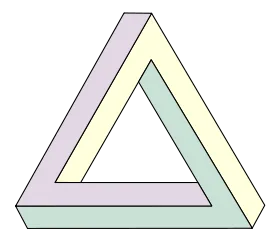
Look at a drawing of three thick bars meeting at right angles, and your brain will insist it’s seeing a solid three-dimensional object. It isn’t. The Penrose triangle is an impossible object, a geometric shape that exists only on flat paper and can never be built in physical space. Try to trace how those bars actually connect, and the whole thing falls apart. That contradiction is exactly what makes it so mesmerizing.
Impossible objects are shapes that can only exist on paper, never in the real world. They look perfectly plausible at first glance, but the parts that appear to join together simply cannot meet in physical space. The Penrose triangle is the classic example. Three thick bars seem to connect at right angles, forming a loop that tricks the eye into seeing a 3D structure. Yet when you try to follow each bar, you realize the geometry doesn't work. The right side appears to recede away from you while the left side seems to come forward, and your brain keeps flip-flopping between the two interpretations, never able to settle on one.
That visual tug-of-war is the heart of its appeal. The drawing isn't just a picture; it's a challenge to your perception. You know it's flat, but you can't stop seeing depth. You know it's impossible, but you can't stop trying to make it work. This is why the Penrose triangle captivates mathematicians, artists, and anyone who has ever stared at it for more than a few seconds.
A Swedish Artist’s Early Sketch (1934), But the Name Went Elsewhere
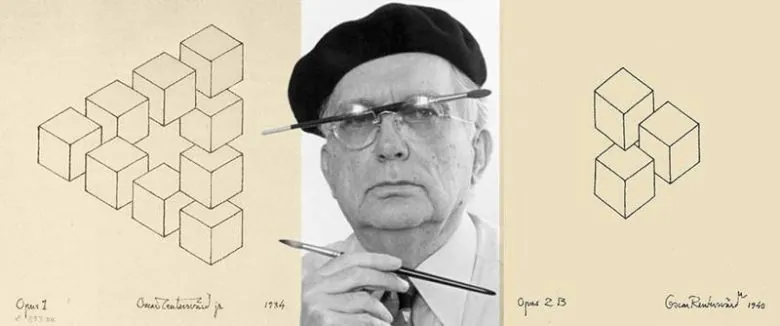
Oscar Reutersvärd drew an impossible triangle in 1934, but he never called it a Penrose triangle. That name belongs to a different creator entirely. The Swedish artist was among the first to explore physically impossible 3D forms, yet the label we use today honors someone who came later.
Reutersvärd was a graphic artist from Sweden, and in 1934 he sketched something that shouldn't exist in real space: three bars connected at right angles that form a triangle, yet could never be assembled in three dimensions. His notebooks filled with these kinds of drawings, and his work helped birth what we now call the "impossible figures" visual tradition. Artists before him had played with perspective tricks, but Reutersvärd treated the impossible form as a subject worth serious attention.
Here's the naming twist. The term "Penrose triangle" specifically refers to the work of Roger Penrose, the British mathematician who independently conceived the same shape in 1954 after attending the International Congress of Mathematicians in Amsterdam. Penrose later published a paper on impossible objects with his father, Lionel Penrose, in the British Journal of Psychology in 1958. That publication is what made the triangle famous, and so the name stuck to him, not to Reutersvärd.
So the shape has two separate origin stories, one Swedish and one British. Reutersvärd got there first, but Penrose got the credit in the history books.
Roger Penrose’s 1954 ‘Aha’ Moment in Amsterdam
In 1954, British mathematician Roger Penrose attended the International Congress of Mathematicians in Amsterdam. He wasn't just there for the lectures. Something clicked during his time at the congress, and that spark would lead Penrose to independently conceive what we now call the Penrose triangle.
Penrose had never met Escher. He hadn't seen the Swedish artist Oscar Reutersvärd's earlier impossible figures either. The idea came to him fresh, and it was inspired by the work of Dutch graphic artist M. C. Escher, whose pieces played with perspective in ways that bent the rules of physical space. Escher's work showed him that the eye could be convinced to see structures that could never actually exist in three dimensions.
The inspiration didn't stay in his head. Roger Penrose went home and teamed up with his father, Lionel Penrose, a psychiatrist with a taste for visual puzzles. Together they wrote a paper titled "Impossible Objects: A Special Type of Visual Illusion," published in the British Journal of Psychology in 1958. That paper helped the impossible triangle gain recognition and introduced it to a wide audience of scientists, artists, and curious readers.
Here's the interesting twist: while Reutersvärd had drawn an impossible triangle back in 1934, the term "Penrose triangle" is specifically tied to Roger Penrose's independent work from 1954. The name stuck because the Penroses published their findings in a respected scientific journal, giving the shape academic credibility it hadn't had before.
When Escher learned about the Penroses' paper, he was delighted. He wrote to them and soon began incorporating their impossible triangle into his own art. The most famous result came in 1961 with "Waterfall," where water appears to flow endlessly upward before cascading down, completing a loop that defies physics. The painting is built directly on the Penrose triangle structure, and it remains one of Escher's most beloved works.
That 1954 moment in Amsterdam, followed by the 1958 publication, transformed a clever visual trick into a cultural phenomenon. The Penrose triangle became a meeting point where mathematics, psychology, and art converged, and it continues to puzzle and delight viewers more than half a century later.
Escher’s Impossible Waterfall and the Penrose Stairs
M.C. Escher took the Penrose triangle and turned it into one of the most famous optical illusions in art history with his 1961 lithograph Waterfall. In that print, water flows along a channel, cascades over a mill wheel, and then appears to climb right back up to where it started, ending higher than it began. Physically impossible, visually mesmerizing.
Escher had learned about the Penrose triangle from the British mathematician Roger Penrose, who conceived the idea in 1954 after attending the International Congress of Mathematicians in Amsterdam. Penrose went on to publish a paper on impossible objects with his father, Lionel Penrose, in 1958 in the British Journal of Psychology.
When Escher got wind of this strange triangular paradox, he did what he did best: he built entire worlds around it. Waterfall uses the triangle's structure as the backbone of an architectural fantasy. The water seems to defy gravity, and your eye keeps trying to make sense of it, keeps failing, and keeps looking again.
The Penrose stairs work the same trick in a different form. Imagine a staircase that loops back on itself, so you can climb forever without ever gaining height. That's the closed loop at the heart of Escher's 1960 lithograph Ascending and Descending. Figures march along the steps, some appearing to climb, others descending, all moving in the same direction, none ever changing their actual elevation.
Escher loved this kind of visual paradox because it made the viewer's brain work overtime. The stairs look perfectly plausible at first glance. Then you trace the path with your eyes and realize the whole thing is a closed circuit. Up becomes down, down becomes up, and nobody gets anywhere. It's the kind of image that sticks with you, partly because it feels like a dream you've had before.
The Penrose stairs have since wandered far beyond Escher's prints. The 2010 film Inception featured a scene with an infinite staircase that works exactly this way, and audiences immediately recognized the impossible geometry from those old lithographs. The visual language Escher helped popularize now lives in blockbuster cinema, a strange afterlife for a shape that can't actually exist in three dimensions.
From Art to Hollywood: The Penrose Stairs in Pop Culture
The Penrose stairs found their way onto the silver screen in the 2010 film Inception, where a character walks along an infinite staircase that loops back to its starting point. It is one of the most recognizable uses of an impossible object in modern cinema. The scene captures exactly what makes these shapes so fascinating: the brain insists it is watching something real, even as logic screams that it cannot exist.
Christopher Nolan's dream-heist thriller leaned into the disorientation. The camera follows a character as he climbs a stairway that should logically lead nowhere but keeps returning him to the same landing. It is a perfect visual metaphor for a film about nested dreams and endless corridors of the mind. For audiences who had grown up with M. C. Escher prints in textbooks and dorm rooms, the moment felt like a wink of recognition.
The source material for this piece mentions that the Penrose stairs were also used in the 1998 film The Avengers, the one starring Ralph Fiennes and Uma Thurman, not the Marvel superheroes. That claim is unconfirmed, so we present it as such rather than as settled fact. What is certain is that the Penrose stairs, like the Penrose triangle before them, have traveled a remarkable distance. They started as a mathematical curiosity, moved into fine art through Escher's 1960 lithograph Ascending and Descending, and eventually landed in blockbuster cinema. The journey took roughly half a century, and along the way they never lost their power to make people stop and stare.
The stairs work because they exploit a quirk in how human vision constructs three-dimensional space from a two-dimensional image. Each individual step looks perfectly normal. It is only when the eye tries to follow the whole circuit that the impossibility becomes apparent. The brain keeps trying to resolve the contradiction, and that struggle is exactly what makes the image so compelling.
That same quality explains why the Penrose triangle remains such an enduring visual puzzle. It is simple enough to sketch on a napkin, yet it defies every attempt to build it in the physical world. The triangle and the stairs are siblings in the same family of impossible objects, and together they have crossed from academic journals into the shared visual vocabulary of popular culture.
Frequently asked questions
What is the Penrose triangle and why is it impossible?
The Penrose triangle is a two-dimensional drawing of three thick bars that appear connected at right angles, forming a closed loop that tricks the eye into seeing a solid three-dimensional object. It cannot exist in physical space because the bars would have to occupy the same position simultaneously. The illusion works because your brain tries to interpret flat lines as depth, and the drawing exploits that instinct.
Who created the Penrose triangle and when?
Swedish artist Oscar Reutersvärd sketched an impossible triangle in 1934, making him the first to draw such a figure. However, British mathematician Roger Penrose independently conceived the same shape in 1954 after attending the International Congress of Mathematicians in Amsterdam. Penrose later published a paper about it with his father Lionel in 1958, which is why the shape carries his name.
How does the Penrose stairs illusion work?
The Penrose stairs form a closed loop that appears to ascend or descend endlessly, yet brings you back to where you started with no actual change in height. The trick relies on perspective shifts that hide the fact that each corner is slightly misaligned. In reality, walking the loop would return you to your exact starting point, which is why such a staircase cannot be built in the real world.
Why did M.C. Escher use Penrose shapes in his art?
After learning about Roger Penrose's impossible triangle, Dutch graphic artist M. C. Escher incorporated the concept into his own work. In 1961, he created "Waterfall," where water appears to flow endlessly upward before cascading down, using the Penrose triangle structure to make the impossible seem natural. In 1960, he also produced "Ascending and Descending," which depicts the Penrose stairs with figures walking endlessly in both directions.
Where has the Penrose stairs appeared in popular culture?
The Penrose stairs appear in the 2010 film Inception, where a character walks an infinite staircase that loops back on itself within a dream world. Some sources claim the stairs also appeared in the 1998 film The Avengers, but that claim is unconfirmed. The confusion likely stems from both movies involving surreal, mind-bending visuals.
What is the difference between a Penrose triangle and a Penrose stair?
The Penrose stair is essentially a variation of the Penrose triangle, stretched and repeated to form a loop that seems to climb or descend indefinitely. While the triangle uses three bars at right angles, the stair multiplies that same impossible logic across multiple steps. Both rely on the same visual trickery, but the stair adds a sense of movement and progression that the triangle lacks.
Did Oscar Reutersvärd design the Penrose triangle before Roger Penrose?
Oscar Reutersvärd drew an impossible triangle in 1934, decades before Roger Penrose conceived his version in 1954. However, the term "Penrose triangle" specifically refers to Roger's later work, which he published with his father Lionel in 1958. Reutersvärd's earlier drawing was remarkable, but it never gained the same recognition, and the name stuck to the version that entered scientific literature. Editorial note: Any facts which remain unconfirmed are presented as such.
Got a take on this? Add your voice to the conversation below →
No comments yet. Be the first.