Paul Auster: His Life, Books, and Legacy
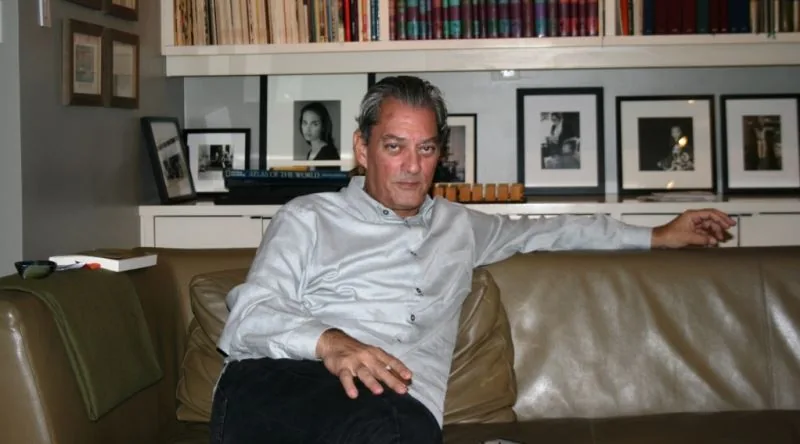
Paul Auster, the American novelist behind The New York Trilogy, died in April 2024 at the age of 77. For decades he wrote fiction that felt like a puzzle box, and readers loved him for it. His books asked what happens when identity slips, when chance takes over, when a person disappears into a city that never quite notices. He leaves behind a body of work that will keep being read, argued over, and admired.
Paul Auster was an American novelist, poet, and screenwriter best known for The New York Trilogy. He died in April 2024 at age 77. Reports at the time attributed his death to complications from lung cancer.
- Paul Auster was born in Newark, New Jersey, on February 3, 1947.
- The New York Trilogy, published as a collected edition in 1987, brought him wide recognition.
- His 2017 novel, 4 3 2 1, was his first novel in seven years.
- He wrote the screenplay for Smoke (1995) and wrote and directed two features of his own.
- He died in April 2024 at the age of 77.
Paul Auster, the Writer Who Disappeared Into His Own Stories, Dies at 77
Paul Auster died in April 2024 at the age of 77, and reports at the time attributed his death to complications from lung cancer. The exact day was reported in late April, around April 30, though it could not be fully confirmed. He was born on February 3, 1947, in Newark, New Jersey, and he worked as a novelist, essayist, translator, screenwriter, and poet, building a body of work that kept circling the same question: who is the person behind the name?
That question was never abstract for him. His novels read like mysteries because they are mysteries, though the crime is rarely the point. A man takes on another man's identity. A writer tails a stranger and loses track of where the job ends and he begins. Auster's plots are full of locked rooms, missing authors, and detectives who forget which side of the investigation they stand on, and under all of it runs a search for identity and personal meaning that critics never quite stopped arguing about. How much of this was him? The answer, as with so much of his fiction, stays slippery. What is certain is the shape of the career: a Newark kid who became a celebrated American writer, a man whose books kept returning to the self and its doubles.
The essentials: born February 3, 1947, in Newark, New Jersey. Died April 2024 at 77, from complications of lung cancer. A novelist, essayist, translator, screenwriter, and poet whose books turned on identity, memory, and the search for meaning, often dressed up as mystery.
From Columbia to Paris: The Apprenticeship Years
Before the novels that made him famous, Paul Auster put in years at a desk translating other people's sentences. He graduated from Columbia University, and after that he moved to France, where he translated leading French authors and began placing his own writing in American magazines.
Picture the work: dense, exacting, often difficult French prose that has to be carried across into English without losing its shape. Day after day, sentence by sentence, a young writer sits with another writer's voice in his ear. That is a strange kind of apprenticeship, but a real one. You learn rhythm. You learn how much weight a single word can hold. And you learn patience, which is the thing every first novel quietly demands.
The other half of those years was quieter still. He kept writing his own pieces and sending them out, and American magazines began to print them. No bestseller lists, no sudden fame. Just the slow accumulation of pages and the habit of finishing what he started.
The translator's desk and the magazine pages came first. The fiction that would define Paul Auster grew out of exactly that stretch of years, when he was reading French masters closely and learning to hear his own English more clearly.
It is tempting to skip ahead to the famous books. Resist that. The years in France are where the voice was being built, one translated paragraph at a time, long before anyone was waiting for the next Auster novel.
The New York Trilogy: The Book That Made Paul Auster Famous
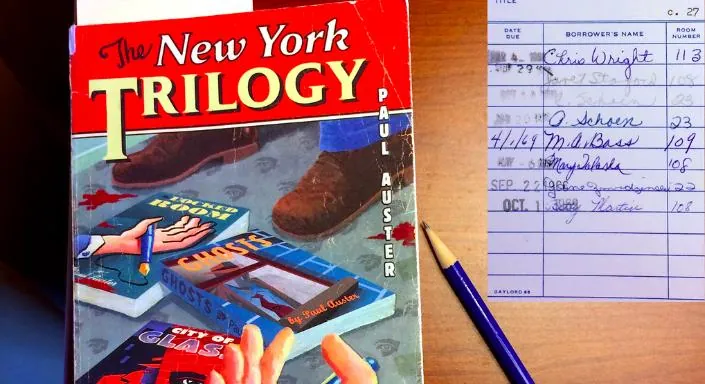
Paul Auster first rose to prominence with the experimental detective stories gathered together as The New York Trilogy in 1987. The collection consists of three short novels: City of Glass, Ghosts, and The Locked Room. Each one borrows the furniture of a mystery novel and then quietly rearranges it into something stranger, a story about identity and disappearance wearing a detective's coat.
Take City of Glass. A crime novelist stumbles into a real mystery and, before long, is slipping into a series of different identities. The writer who invents detectives suddenly has to play one, and the line between the two starts to dissolve. In Ghosts, a private detective named Blue is hired by a client called White to watch a man named Black. That is the whole setup, and the color-coded names tell you Auster is up to something more than a chase.
The Locked Room closes the set with another writer, this one digging into the life of a missing author and eventually taking on his identity. Three books, three people who lose the border between themselves and the story they are chasing. That conceit, of a self that keeps swapping places with someone else, is the thread running through the whole trilogy.
Moon Palace, Leviathan, and the Obsession With Chronicling
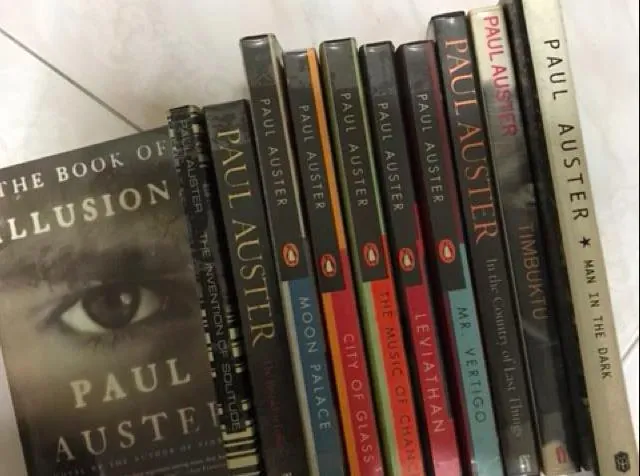
In 1989 Paul Auster published Moon Palace, and three years later, in 1992, came Leviathan. Both novels revolve around striking protagonists who cannot stop chronicling their own lives, narrators who watch themselves the way a stranger might, taking notes on their own unraveling. It is the same itch that runs through so much of his fiction: the sense that a life only becomes real once it has been written down.
That instinct for self-documentation reaches its clearest expression in The Invention of Solitude, published in 1982. It works on two levels at once. On one, it is a memoir of his father's death, a son sitting with the fact of a man now gone. On the other, it is a philosophical inquiry into the act of writing itself, an early map of the territory Auster would keep circling for the rest of his career.
The novels were never the whole picture. Alongside them, Auster built a parallel body of poetry and essays that showed how wide his range really ran. His poetry collections include Unearth (1974) and Wall Writing (1976). His essay collections include White Spaces (1980) and The Art of Hunger (1982).
| Work | Year | Form |
|---|---|---|
| Unearth | 1974 | Poetry |
| Wall Writing | 1976 | Poetry |
| White Spaces | 1980 | Essays |
| The Invention of Solitude | 1982 | Memoir / meditation on writing |
| The Art of Hunger | 1982 | Essays |
| Moon Palace | 1989 | Novel |
| Leviathan | 1992 | Novel |
Read that list in order and a pattern appears. A poet in the 1970s, an essayist at the turn of the decade, then a memoirist, then a novelist of obsession. The same voice kept changing clothes.
The Book of Illusions, Sunset Park, and the Late Novels
By the 1990s Paul Auster had already built a career on men who lose themselves inside a story, and the later novels push that obsession into stranger rooms. The Music of Chance arrived in 1990, followed by Mr. Vertigo in 1994, two books that turn gambling, flight and confined spaces into quiet fables about luck and control.
Then came The Book of Illusions in 2002, and it may be the purest expression of his grief-haunted side. A writer loses his wife and children in a plane crash, and in the fog of mourning he grows absorbed in the world of silent-film stars, chasing a vanished comedian through old reels and half-remembered screenings. It is a novel about watching, about the dead flickering back to life on a screen, and about how a person rebuilds himself out of someone else's vanished image.
Travels in the Scriptorium (2007) strips the machinery down to a single room. A man sits there trying to work out who he is and how he ended up in that space, and as he puzzles it out, characters from Auster's earlier books drift in. It reads like a writer walking through his own back catalog, checking the doors.
Man in the Dark (2008) keeps the confinement but moves it inside a sleepless night. An aging, unhappy literary critic lies awake and imagines a dystopian alternate reality, a parallel America built out of the same restlessness that keeps him from sleep. A year later, Sunset Park (2010) widens the frame to a group of young artists squatting in an abandoned building in Brooklyn, sharing a roof that was never theirs and improvising a life out of it.
Read side by side, these books are variations on one note: a self locked in a room, a self assembled from memory, a self invented because the real one will not hold. That is the Paul Auster signature, and in these late novels he keeps playing it in new keys.
How Much of Paul Auster Is in His Books? The Autobiographical Question
Critics kept circling the same question about Paul Auster: how much of the man actually ends up on the page? His fiction returns again and again to the self, and it carries his own identities, both the hidden ones and the public ones, so readers learned to look for him between the lines. The answer is that he blurred the line on purpose, then wrote books that stepped across it in plain sight.
Take Invisible (2009). Its protagonist looks a great deal like Auster himself, close enough that readers could feel the author's face behind the character. But the plot's murder and its incest are unmistakably invention. The resemblance is the doorway; the violence is the fiction.
Then came two books that dropped the mask. Winter Journal (2012) is non-fiction, fragmentary, and told in the second person, a voice that addresses the writer as "you" while threading his experiences, his choices and his travels into long meditations on himself. A year later, Report from the Interior (2013) offered a similarly spontaneous selection of memories, assembled with cinematic effects, and it even samples his correspondence with his ex-wife, the writer Lydia Davis.
After that, he turned back to invention and multiplied himself. 4 3 2 1 arrived in 2017 as his first novel in seven years, and it hands its hero, Archie Ferguson, four separate fictional lives. Four versions, four fates, one author's fingerprints on every page.
Essays, a Stephen Crane Biography, Screenplays, and a Lightning Strike
Paul Auster did not spend all his hours in the novel. In 2019 he gathered decades of nonfiction into Talking to Strangers: Selected Essays, Prefaces, and Other Writings, 1967, 2017, and in 2020 came Groundwork: Autobiographical Writings, 1979, 2012. A year later, in 2021, he published Burning Boy: The Life and Work of Stephen Crane, a full biography of the American writer Stephen Crane. The pace of the output never really slowed.
Film pulled at him too. He wrote the screenplay for Smoke (1995), the Brooklyn cigar-shop story. He also wrote and directed two features of his own: Lulu on the Bridge (1998) and The Inner Life of Martin Frost (2007).
Then there is the strange childhood fact that circled all the way back around. As a young man, Auster witnessed a friend's death by lightning. Years later he appeared in Act of God (2009), a documentary about people who survived lightning strikes, and described his own experiences there. The same event that shaped a boy became a scene in a film decades on.
One more collaboration belongs here. Here and Now: Letters 2008, 2011 collects his correspondence with the South African writer J.M. Coetzee, two novelists trading thoughts across continents for three years. Auster the letter-writer, it turns out, was always there underneath Auster the novelist.
Frequently asked questions
Who was Paul Auster and what did he write?
Paul Auster was an American novelist, essayist, translator, screenwriter, and poet, born in Newark, New Jersey, on February 3, 1947. He is best known for The New York Trilogy , and his fiction circles around identity, chance, and the search for personal meaning, often wrapped in mystery. He died in April 2024, at 77, from complications related to lung cancer.
What is Paul Auster's most famous book?
The New York Trilogy , published collectively in 1987, is the work that first brought Auster wide attention. It gathers three short novels: City of Glass , Ghosts , and The Locked Room . Experimental detective stories, they read less like whodunits and more like meditations on writing, chance, and the self.
What is The New York Trilogy about?
The trilogy follows writers and detectives who lose themselves in other people's identities. In City of Glass , a crime novelist stumbles into a mystery and starts wearing other lives. Ghosts tracks a private detective named Blue shadowing a man named Black for a client named White. The Locked Room follows a writer investigating a missing author and sliding into his identity.
How did Paul Auster die?
Auster died at 77 from complications related to lung cancer. His death was reported in late April 2024, around April 30, though the exact day is not fully confirmed. He had been born February 3, 1947, in Newark, New Jersey, which put him at 77 at the time of his death.
Did Paul Auster write screenplays?
Yes. Auster wrote the screenplay for Smoke (1995), and he both wrote and directed Lulu on the Bridge (1998) and The Inner Life of Martin Frost (2007). His film work sits alongside a much larger body of novels, memoirs, poetry, and essays that he produced from the 1970s onward.
Was Paul Auster married to Lydia Davis?
Yes, the writer Lydia Davis was his ex-wife. They were married in the 1970s, and their correspondence appears in his 2013 memoir Report from the Interior , which weaves samples of their letters into a loose, cinematic account of his own memories. The book is a companion to Winter Journal (2012).
What awards did Paul Auster win?
The record here does not cover Auster's awards, so I won't guess at them. What the record does show is a long, steady output: poetry collections in the 1970s, The Invention of Solitude in 1982, the trilogy in 1987, and novels and memoirs through 4 3 2 1 (2017) and Burning Boy (2021). Editorial note: Details that remain unconfirmed, including the precise medical circumstances of his death, are presented as reported rather than established fact.
Got a take on this? Add your voice to the conversation below →
No comments yet. Be the first.