The Man Who Fell to Earth: Bowie's 1976 Alien
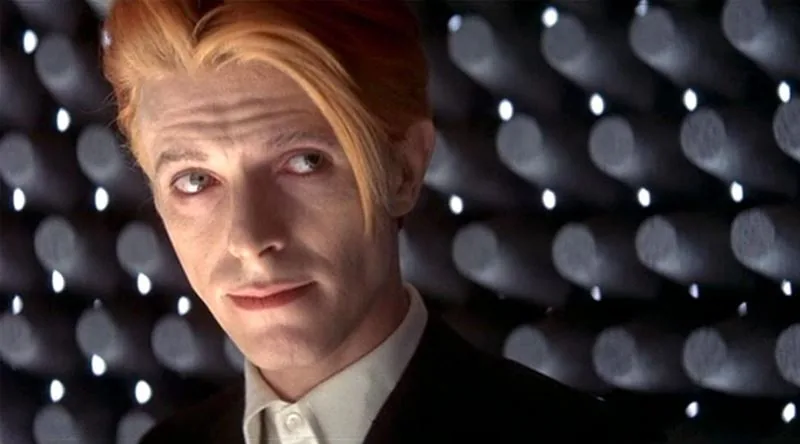
David Bowie starred as a stranded alien in Nicolas Roeg's 1976 film The Man Who Fell to Earth, a haunting science fiction drama about an extraterrestrial who comes to Earth to save his dying home world. His otherworldly, androgynous presence made the character feel genuinely alien. The film was not a conventional blockbuster. It moved slowly, asked uncomfortable questions about greed and surveillance, and left audiences unsettled long after the credits rolled.
In 1976, David Bowie played Thomas Jerome Newton, an alien who arrives on Earth to secure water for his drought-stricken planet. Directed by Nicolas Roeg, the film blends science fiction with a bleak meditation on corporate power, isolation, and human weakness.
- The Man Who Fell to Earth was released in 1976 and directed by British filmmaker Nicolas Roeg.
- David Bowie played Thomas Jerome Newton, an alien who comes to Earth seeking a way to transport water back to his home planet.
- The film was based on Walter Tevis's 1963 novel of the same name.
- Bowie's androgynous appearance and fragile screen presence became central to how critics understood the character.
- The film developed a cult following and is often discussed for its ambiguous ending and slow, dreamlike pacing.
The Man Who Fell to Earth: Bowie Lands on Earth
In 1976, Nicolas Roeg directed The Man Who Fell to Earth, a science-fiction adaptation that handed David Bowie his first major film lead. Bowie plays Thomas Jerome Newton, an alien who arrives on our planet with a single purpose: to find water for Anthea, the drought-stricken world he left behind. It is a strange, melancholy premise, and Roeg leans into every odd angle of it.
Newton does not come empty-handed. He brings a formula, or perhaps a metal, something unknown on Earth, and he does the one thing a clever stranger can do with it. He patents it. Within a short stretch of screen time, that single patent snowballs into a corporate empire, and Newton quietly takes control of one industry after another. The money is never the point. He wants water, and he wants a spacecraft built to carry him home.
Along the way he collects a few Earthly attachments. Friends, enemies, a girlfriend. Every so often his wife and children flicker into view before his eyes, waving him off in their yellow space suits, a memory he cannot shake. But finance capital and the CIA have other plans. Just as Newton is about to board his ship and leave, they catch him and lock him inside a luxury hotel suite. To make sure he never blends in and never escapes, they fix the lenses he wears over his eyes (his real eyes are yellow slits) directly onto his pupils. Stripped of any way out, he sinks into television and alcohol.
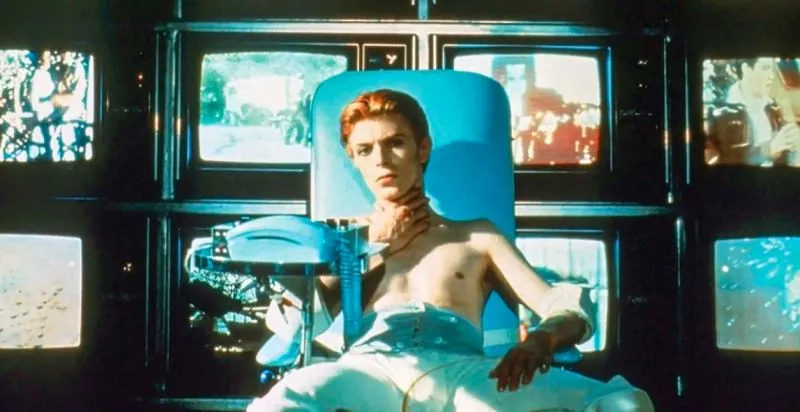
One of the film's most startling images is Newton planted in front of a wall of screens, watching somewhere between ten and fifteen television channels at once. Before the drinking takes hold, he is already an addict, hooked on the flood of images. Roeg is not subtle about the diagnosis, and he does not apologize for it.
Then comes the turn. Newton notices that the door of his gilded prison has been open all along. Nobody is watching him anymore. He walks out, slips back among ordinary people, and finds the waitress who once loved him. He even records an album. In the final scene he meets an old acquaintance and hands over the record as a gift, wearing a huge, odd black hat, his face powdered white, his red mouth caught somewhere between waiting to be kissed and ready to bite. He is drunk, mocking, worn down. He laughs, lowers his head, and the black circle of the hat swallows the frame. The picture freezes. The film ends.
Betrayal, Captivity, and the CIA
Thomas Jerome Newton builds an empire on Earth, and the planet builds a cage around him. In Nicolas Roeg's 1976 film The Man Who Fell to Earth, David Bowie's alien patents a formula and a metal unknown on this world, and the fortune that follows makes him powerful enough to be worth keeping. Finance capital and the CIA decide he is not going home, and their decision is the turning point of the whole story.
Before the trap closes, Newton collects what any stranger collects: a handful of Earthling friends, a few enemies, and a girlfriend. Then the visions start. His wife and children appear to him in yellow spacesuits, waving him off from a planet he may never see again. That image is the thing haunting him through every boardroom and every bottle.
He gets close. He is about to board his spacecraft, and that is the moment they catch him. Government agents and corporate interests lock him inside a luxury hotel suite, a penthouse that must have looked like a reward and functioned like a cell. Then comes the detail that still stings: to make sure he can never pass for himself again, they glue the lenses he wears to look human straight to his eyeballs. His eyes are actually yellow lines. The disguise becomes permanent, sealed onto his face.
So he turns to television and alcohol. Roeg shows him watching ten to fifteen channels at once, a wall of screens firing images at a man who cannot leave the room. The film wants us to see him as an image addict before the drinking takes hold. It is a strange, almost cruel way to break someone, and it works.
What makes the captivity land is Bowie himself. The androgynous icon who once seemed entirely of this world turns out to be, in this story, a total stranger in it, or perhaps the reverse. Roeg's camera is odd and unashamedly humanist at once, and it treats its fallen visitor as a kind of inverted Little Prince, or so the reading goes.
The Open Door and the Final Scene
One day Thomas Jerome Newton looks at the door of the luxury suite where he has been held and realizes it is open. Nobody is watching him anymore. He walks out, slips into the crowd, and goes looking for the waitress who used to be his girlfriend. That quiet exit is the hinge of the whole film: the prisoner nobody bothered to lock in.
Somewhere in this stretch he records an album. The popular version says it was called Visitor and that its cover showed an empty street. That detail does not hold up. The album cover in The Man Who Fell to Earth actually shows Newton's face, not a deserted road, so file the empty-street story away as a nice bit of misremembering.
Then comes the last scene, and it is a strange one. He meets an old acquaintance and hands over the album as a gift. He is wearing a large, odd black hat. His face is dead white, his mouth is red, and when he parts his lips you can see the two pointed teeth at the corners. He is drunk, mocking, cynical. He laughs, lowers his head, and the black circle of the hat swallows the screen. The frame freezes. The film ends.
That closing image is pure David Bowie: the smile that looks like it is waiting to be kissed and like it might bite the moment anyone leans in. It is the same face that made him such an uncanny fit for Nicolas Roeg's 1976 science-fiction adaptation, a face that belongs to this planet and somehow does not.
Roeg's Strange, Humanist Gaze
Nicolas Roeg's 1976 film is a strange animal: tender and melodramatic in one breath, deeply weird in the next. His camera regards Thomas Jerome Newton with a gaze that is unashamedly humanist and, at the same time, as odd as David Bowie himself. The movie wants to tell us something uncomfortable about what it costs to leave your own planet behind and be forced to mingle with wild humans.
Some viewers have read the whole thing as a kind of inverted The Little Prince, an interstellar traveler stranded among earthlings who cannot quite understand him. That framing is interpretive rather than settled, so take it as one lens among several. What is not in doubt is how Roeg builds the confusion into the texture of the film. The soundtrack slides and drifts, sounds that never quite settle. Bowie delivers his lines stiffly, carefully, like a man testing words he does not trust. Hallucinatory scenes cut in and out. Together they put you inside Newton's struggle to make sense of a world that will not hold still.
What startles him most is the sheer barrage of images. In one scene he sits watching somewhere between ten and fifteen television channels at once, a wall of screens all talking over each other. That moment is the film tipping its hand: he becomes an image addict long before he becomes an alcoholic. Roeg does not mind being shamelessly didactic when the point matters, and here the point lands hard.
Why Bowie's Androgyny Makes the Film
David Bowie is the single best decision The Man Who Fell to Earth makes. Nicolas Roeg's 1976 adaptation puts a performer who had already built a career out of blurring the line between man and woman, human and other, right at the center of a story about an alien stranded among us. The film leans on that, and then it complicates it.
Roeg opens up what you might call the David Bowie problematic. The movie treats him as the androgynous icon he presented to the world, and at the same time it refuses to let him stay one. In his own world this man has roots, possibly very familiar ones. On this world he is a total stranger. Or the reverse. The film never settles the question, and that refusal is the whole point.
Bowie himself played with that ambiguity constantly. At various points in his life he likened his own face to Katharine Hepburn, to certain photographs of Greta Garbo, to the young Catherine Deneuve, and to Julie Christie, as the story goes. He was a man who kept swapping the mask.
Then something changed. Reportedly, across the last quarter of his life he mostly appeared as a gentleman in a white suit. His music shifted too, deepening and darkening and growing up. But the stubborn, provocative, faintly slutty air of those old faces was gone. Boy George tried a version of it for a while, and by most accounts it went nowhere.
The teeth never left. Bowie had two that pushed out from the corners of his lips and caught the light in the dark right up until he died. Those lips, though, did not invite you to lean in for a kiss. Not according to this writer. In the days when he played with his faces, he carried a pull and a repulsion at once. That strange magnetism is what the film bottles.
Frequently asked questions
What is The Man Who Fell to Earth about?
The Man Who Fell to Earth is Nicolas Roeg's 1976 science-fiction adaptation starring David Bowie as Thomas Jerome Newton, an alien who lands on our planet to find water for his drought-stricken home world. He patents an unknown formula or metal from his own world, seizes control of a string of industries, and quietly builds toward one goal: a spacecraft that can carry him back home.
Why did David Bowie star in The Man Who Fell to Earth?
There is no settled account of Bowie's personal reasons for taking the part, and the film itself treats his casting as a question of meaning rather than motivation. What the film does with his presence is the point: it uses him as the androgynous icon he already was, and then refuses to leave him as only that.
How does The Man Who Fell to Earth end?
Newton records an album, and in the final scene he meets an old acquaintance and gives him the record as a gift. He is drunk, mocking, deeply cynical. He wears a large, strange black hat, his face is chalk white, and those two pointed teeth still show at the corners of his red mouth. He laughs, lowers his head, the black circle of the hat fills the screen, and the frame freezes.
What role does the CIA play in The Man Who Fell to Earth?
Finance capital and the CIA together stop Newton from going home. They catch him just as he is about to board his spacecraft and lock him in a luxury hotel suite. To make sure he never returns, they glue the lenses he wears to look human onto his eyeballs. He sinks into television and alcohol.
Was David Bowie's character in The Man Who Fell to Earth an alien?
Yes. Bowie plays a being who falls to Earth from a planet gripped by drought, sent to find water for a world that is dying. He is a stranger here in the fullest sense, and the film keeps circling the strangeness of a man who has roots somewhere else entirely.
What does the water symbolize in The Man Who Fell to Earth?
Water is the concrete thing Newton crossed space to find for his dying planet, and it drives the entire plot. Beyond that, the film leaves the symbolism open. It is the resource he came for, the reason he builds an empire, and the reason he is never allowed to leave.
How did Nicolas Roeg direct The Man Who Fell to Earth?
Roeg's film is faintly emotional and melodramatic, and very strange. His gaze on his hero is both shamelessly humanist and as odd as Bowie himself. A soundtrack of sounds that slide and drift, Bowie's halting speech, and hallucination-like scenes all pull attention to Newton's confusion as he tries to understand our world. The film is even unashamedly didactic at moments.
Did David Bowie's androgyny influence The Man Who Fell to Earth?
It is one of the film's strongest assets. The movie treats Bowie as the androgynous icon he presented to the world, and then declines to treat him as only that. In his own world this man may have familiar roots. Here he is a total stranger, or perhaps the reverse. Editorial note: Details that remain unconfirmed or open to interpretation are presented here as such.
Got a take on this? Add your voice to the conversation below →
No comments yet. Be the first.