Magritte's Common Themes: The Lovers' Hidden Meaning
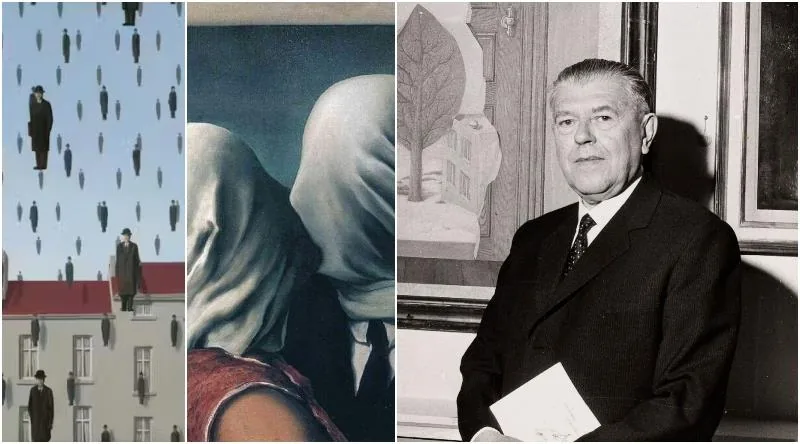
René Magritte's common themes, from The Lovers to Golconda, revolve around the hidden nature of reality, the limits of perception, and the quiet freedom found in everyday objects. The Belgian surrealist spent his career in Brussels, where he painted these philosophical puzzles from the 1920s until his death in 1967, and his work still stops viewers in their tracks today because it makes the familiar feel suddenly strange. You look at a pipe that is not a pipe, or a face hidden under cloth, and you feel the ground shift beneath your assumptions, which is exactly the feeling Magritte wanted to hand you.
René Magritte, a Belgian painter working in Brussels from the 1920s through the 1960s, repeatedly explored how perception deceives us and how ordinary objects can reveal hidden truths. His paintings like The Lovers, Golconda, and The False Mirror ask viewers to question what they see, presenting a philosophy of consciousness and freedom through precise, quiet imagery.
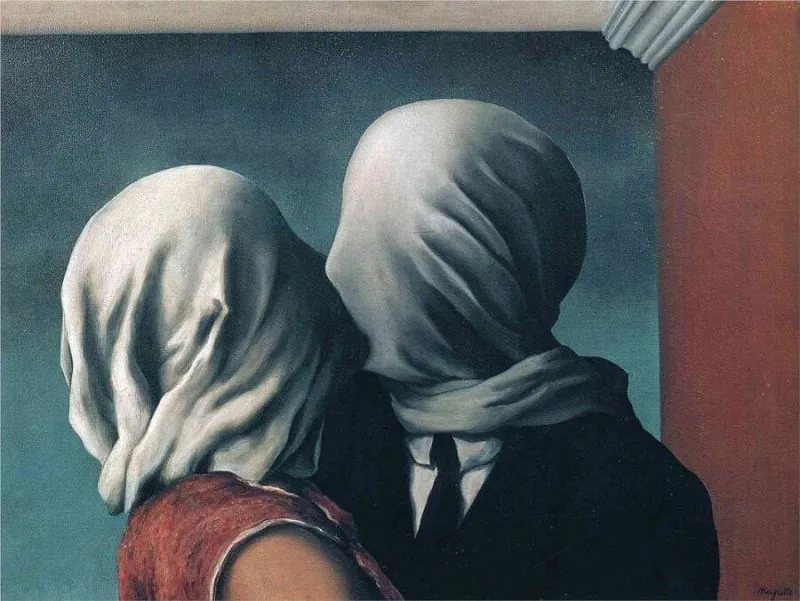
- Magritte painted The Lovers in 1928, showing two figures kissing with white cloths covering their heads, a meditation on how intimacy can obscure identity.
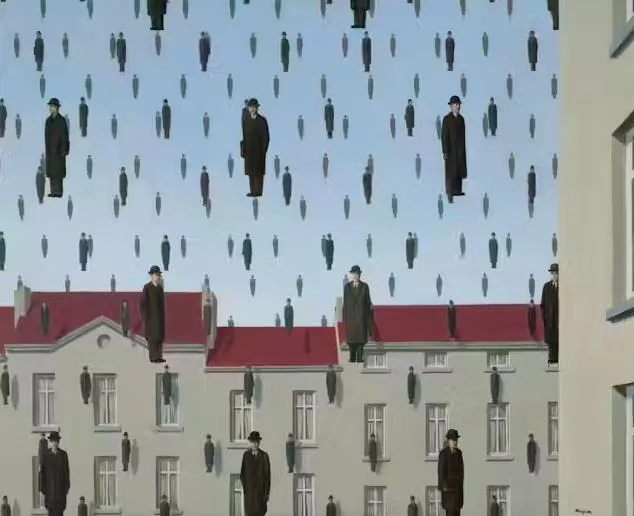
- Golconda, completed in 1953, depicts identically dressed men raining down over a row of brick buildings, reflecting on the anonymity and repetition of modern life.
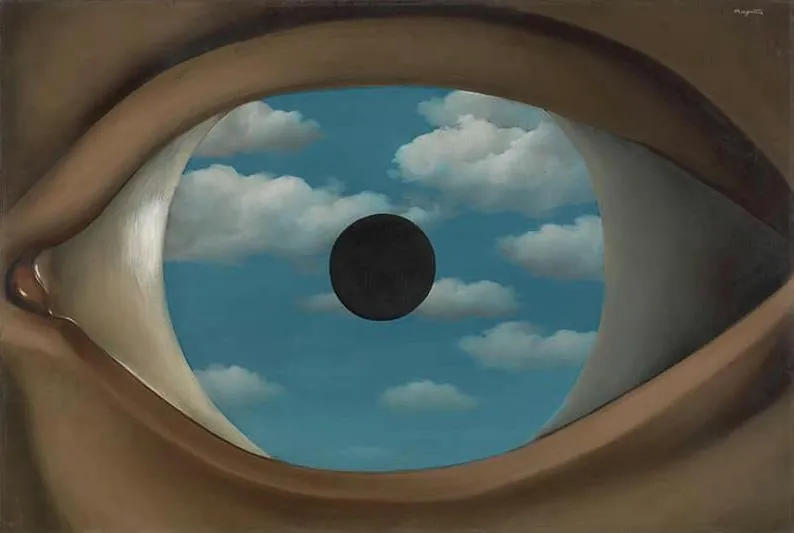
- The False Mirror shows a giant eye with clouds in the iris, challenging the idea that sight gives us direct access to reality.
- Magritte's famous painting The Treachery of Images pairs a pipe with the words "This is not a pipe," questioning the gap between objects and their representations.
- Throughout his career, Magritte returned to the same motifs of apples, bowler hats, windows, and stones, using them as recurring metaphors for hidden meaning and mental freedom.
The Puzzle Behind the Painter
René Magritte, born November 21, 1898, in Belgium, spent his life painting images that refuse to sit still in the mind. He died on August 15, 1967, but the questions his canvases raise keep multiplying. The real puzzle is not what his paintings show, but why the same strange currents keep surfacing across everything he made.
Magritte was a Belgian surrealist, a movement that tried to unlock the unconscious and bend everyday reality into something stranger. His tools were ordinary objects: apples, pipes, bowler hats, windows, curtains. Yet he arranged them so the familiar turned foreign. A pipe is painted with the words "this is not a pipe." An apple grows to fill an entire room. A train bursts out of a fireplace. The trick is that he never painted the impossible with drama or chaos. His style stayed cool, flat, almost commercial, which made the weirdness land harder.
Magritte's common themes keep circling back to one big question: what happens when the thing you paint isn't the thing you see? He did not care about copying the world accurately. He cared about what happens when you look at something and realize you cannot trust your eyes. His symbols stay deliberately ambiguous. A floating rock, a glowing candle, a bird made of clouds: none of them explain themselves. They wait for you to supply the meaning.
Consider The Lovers, painted in 1928. Two figures press their faces together for a kiss, but white cloth wraps both heads completely. No skin touches. No expression shows. The intimacy is there, and so is the total separation. It could be two people desperate to merge, or two people trapped in a forced encounter. The cloth makes it impossible to tell. The philosopher Gilles Deleuze once came to mind while looking at this piece, because Magritte loads the canvas with codes and then demands that you, the viewer, decode them yourself.
Then there is Golconda, from 1953. Dozens of men in identical dark overcoats and bowler hats drift down like heavy rain over a row of brick buildings. They hang in midair at different heights, all facing slightly different directions, none of them touching. Are they falling? Floating? Levitating in quiet defiance? Magritte does not say. The repetition makes the individual disappear into the crowd, and yet each figure seems oddly calm about it.
In The False Mirror, a single enormous eye fills the frame. The iris is not brown or blue. It is a bright sky with soft white clouds drifting across it, and a black pupil at the center like a dark sun. The eye looks outward, but what it reflects is the heavens. It suggests that seeing is never neutral. What you look at gets filtered through whatever sky you carry inside.
These works do not form a tidy system. Magritte never wrote a rulebook for his own symbols. But once you have seen a few of his paintings, you start to feel the pattern. The same obsessions return: hidden faces, displaced objects, scale turned upside down, and the stubborn gap between a thing and its image. That gap is where his art lives.
The Lovers: A Kiss We Can't Quite See
In 1928, René Magritte painted The Lovers (Les Amants), and it remains the clearest doorway into his strange world. A couple leans in for a kiss, but their faces are swaddled in fabric, turning a tender moment into something claustrophobic. It looks like a kiss, but it also looks like a suffocation.
The painting refuses to settle into a single meaning, and that refusal is exactly the point. Some viewers see two desiring bodies forced apart, their longing blocked by an invisible barrier. Others read it as a reluctant, painful encounter, something closer to an interrogation than an embrace. The cloth could be a shroud, a blindfold, or a gag. Magritte never tells us which.
This ambiguity is what makes The Lovers such a perfect example of Magritte's common themes. The Belgian surrealist, who lived from 1898 to 1967, built his entire career on symbols that resist explanation. He stages the relationship between an object and its painted image, then steps back and lets the viewer do the heavy lifting.
The French philosopher Gilles Deleuze worked the same way. When Deleuze talked about the connection between philosophical encounters and artistic production, he loaded his work with codes waiting to be solved, then demanded that the audience assign the meaning themselves. Magritte does precisely this with The Lovers. He gives us two bodies, a piece of cloth, and a gesture we recognize, then leaves the rest to us.
Read through a postmodern lens, the painting becomes something darker. It can symbolize our inability to truly reach the "other," the endless barrier that love throws up between two people. Sometimes something as simple as a kiss turns into an impossible dream. The cloth is not just fabric. It is the distance between us, the part of another person we can never fully touch or understand.
Magritte painted The Lovers in the same period he was producing The False Mirror, that famous eye with a sky filling its iris. Both works play with vision and its limits. In The Lovers, the figures cannot see each other at all. They can only feel, and even that feeling is muffled through layers of cloth. The painting asks a question it refuses to answer: is this intimacy or isolation? The answer depends entirely on who is looking.
Rain of Bowler Hats and an Eye Full of Sky
In 1953, René Magritte painted a sky full of men. Golconda shows dozens of identically dressed gentlemen in bowler hats and dark overcoats, suspended in midair like a slow, silent downpour. They hang there, perfectly spaced, some facing us, others turned away, as if gravity simply forgot its job one afternoon. The effect is both comical and unsettling, a quiet rebellion against the laws of physics and the monotony of middle-class dress.
Magritte's common themes often circle back to this kind of visual contradiction, and Golconda delivers it with a wink. The men fall, yet nothing about them suggests panic. They are weightless, patient, frozen in a moment that should be chaotic but reads as serene. It is the kind of image that makes you laugh first and question second, which is exactly where the Belgian surrealist, who lived from 1898 to 1967, liked to plant his hook.
Then there is The False Mirror, and here the trick is quieter but no less strange. A single enormous eye fills the canvas, but instead of an iris, we see a brilliant blue sky with soft white clouds drifting across it. The pupil is a dark, empty circle, like a hole punched through the heavens. It is a portrait of looking itself, and Magritte uses it to suggest that intense focus simplifies what we see. When you stare hard enough, the world reduces itself to a minimum, and what surfaces is not raw reality but an internal symbolization, a private code the mind projects outward.
That eye also splits the self in two: the watching subject and the watched object, and they never quite reconcile. It is a philosophical puzzle dressed up as a beautiful image, and it recurs across his work. The absences, the ironies, the small destructions of expectation, they all point back to this divided self, a mind forever observing its own observations. Whether it is a rain of bowler hats or a sky trapped in an eye, Magritte keeps staging the same drama: the world as we think we see it, and the world as it actually is, with all its gaps and silences.
The Philosophy Painted in Every Line
René Magritte, the Belgian surrealist who lived from 1898 to 1967, built something far more coherent than a collection of strange images. Across his entire body of work, a unified philosophy emerges: pure abstract consciousness, freedom, and the essence of objects, all rendered through the physical world's concreteness and rigidity as a metaphor for human subjectivity. The bowler-hatted men, the floating rocks, the glowing pipes, they are not random provocations. They are the vocabulary of a single, sustained meditation on what it means to be a thinking being trapped in a material body.
Consider how Magritte's common themes repeat themselves with almost obsessive precision. The Lovers, painted in 1928, shows two figures leaning toward each other for a kiss, their heads wrapped in white cloth. The intimacy is there, the desire is there, but the contact is impossible. That gap between what we reach for and what we can actually touch, that is the human condition as Magritte saw it. The physical world offers us objects, bodies, faces, but our consciousness can never fully merge with them. We are always behind the cloth, always observing from a distance, always interpreting rather than simply experiencing.
Golconda, from 1953, pushes the same idea in a different direction. Dozens of men in bowler hats descend from the sky like rain, identical in their suits and their stillness. They fall, but they do not move. They are everywhere, but they touch nothing. The painting captures the paradox of individuality within the crowd, the way each of us carries a private inner world while appearing interchangeable from the outside. The False Mirror, with its enormous eye filled with sky and cloud, makes the point even more directly. The eye is the organ of perception, but what it reflects is not the world as it is. It reflects a sky that exists only inside the gaze, a symbol formed from within rather than received from without.
This is where Magritte's philosophy becomes unmistakable. The objects he paints, the pipes that are not pipes, the apples that hide faces, the windows that open onto nothing, they all point to the same conclusion. The concrete world is not the enemy of consciousness. It is the medium through which subjectivity becomes visible. The rigidity of a stone, the weight of a suit, the blankness of a cloth, these are not limitations. They are the very things that make freedom meaningful. Without the physical to push against, there would be no inner life to speak of.
What holds every canvas together is this tension between what is shown and what is meant. Magritte does not explain his symbols, and he does not want to. He loads the image with unresolved codes and then steps back, letting the viewer complete the meaning. The philosophy is not stated in words. It is enacted in paint, in the stubborn presence of objects that refuse to behave as they should, in the quiet insistence that seeing is never simple and knowing is never final.
Frequently asked questions
What are the common themes in René Magritte's paintings?
Magritte's paintings consistently play with ambiguous symbols and stage the relationship between depicted objects and reality itself. Absence, irony, and destruction appear again and again, all serving a deeper philosophy about abstract consciousness and freedom. His work asks you to question what you are actually seeing rather than accepting the image at face value.
Why did Magritte paint The Lovers with covered faces?
The Lovers, painted in 1928, shows two figures with cloth wrapped around their heads leaning toward each other in what looks like a kiss. The meaning remains contested: it may represent the forced separation of desiring bodies, or alternatively a reluctant, painful encounter. In a postmodern reading, the covered faces symbolize our inability to truly reach another person.
What is the meaning of Magritte's Golconda painting?
Golconda, completed in 1953, depicts dozens of men in bowler hats descending from the sky like rain against a backdrop of ordinary buildings. The painting exemplifies Magritte's recurring themes of irony and the strange relationship between objects and reality. The identical figures falling in a uniform pattern create a dreamlike sense of order within absurdity.
How does The False Mirror reflect Magritte's philosophy?
The False Mirror presents a single enormous eye with a sky-filled iris and a black pupil, upending expectations about vision and perception. The painting illustrates how intense focus simplifies what we see, reducing the visual field to its minimum while revealing an internal process of symbolization. This reflects a self divided between the observing subject and the observed object.
How does Gilles Deleuze relate to Magritte's work?
Gilles Deleuze, the French philosopher known for his work on art and meaning, shares a striking kinship with Magritte's approach. According to the original account, both figures load coded material into their creations and then step back, letting the viewer assign meaning. The Lovers serves as a prime example of this dynamic, inviting endless interpretation rather than offering a single answer. Editorial note: Any facts which remain unconfirmed are presented as such, hedged where necessary to avoid overstating what is known.
Got a take on this? Add your voice to the conversation below →
No comments yet. Be the first.