Lev Landau: The Physicist Who Corrected Einstein
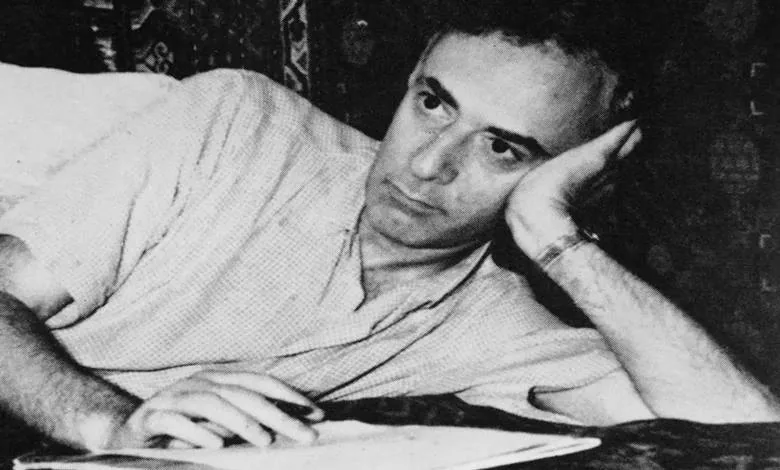
Lev Landau was a Soviet theoretical physicist who, as a widely repeated story goes, stood up at a 1930 conference in Leipzig at the age of 22 and told Albert Einstein his theory was wrong. The room went quiet. Einstein, the story says, did not dismiss him. Within a decade, the same young man would be explaining why liquid helium flows without friction, building one of the most feared physics schools in the world, and landing in Joseph Stalin's Lubyanka prison.
Lev Landau was a Soviet theoretical physicist born in Baku. He debated Einstein in 1930, studied with Niels Bohr in Copenhagen, survived a year in Lubyanka prison after his 1938 arrest, explained superfluidity, and won the 1962 Nobel Prize in Physics. He died in 1968 from injuries sustained in a car crash.
- Lev Landau was born in Baku, then part of the Russian Empire.
- At the 1930 Leipzig conference, the 22-year-old Landau challenged Albert Einstein's position during a public debate, according to a widely repeated account.
- Landau was arrested in April 1938 during the Great Purge and held at Lubyanka prison for about a year before his release.
- He was awarded the 1962 Nobel Prize in Physics for his theory of superfluidity.
- Landau died on April 1, 1968, at age 60, from complications of injuries suffered in a January 1962 car crash.
The 22-Year-Old Who Told Einstein He Was Wrong
Almost everyone knows the name Einstein. Far fewer know the name Lev Landau. Yet the two men share a strange distinction: both are placed in the very top rank of twentieth-century geniuses, and both were famous for thinking freely and living awkwardly.
The story that made Landau's reputation as a young firebrand is set in 1930, at a conference of the German Physical Society in Leipzig. Einstein had just finished a presentation, and the room was still wrapped in the polite admiration that followed him everywhere. Then a thin, disheveled young man with confident eyes asked for the floor. He was Lev Davidovich Landau, twenty-two years old.
Landau pointed to an error in Einstein's presentation. He worked through the equations and laid out a gap in the theoretical argument. The hall went silent. Sitting across from the most famous physicist alive was a student who had just told him he was wrong.
Einstein did not wave him away. He walked to the blackboard, thought for a few minutes, and then conceded the error. He confirmed Landau's observation and asked the audience to reject his earlier conclusions. It was a display of scientific honesty, and it became the anecdote people still repeat about Landau.
That anecdote, though, is exactly what it is: an anecdote. The date, the venue, and whether Einstein actually conceded are not firmly documented, and they vary from one account to the next. So the Leipzig scene is best told as the story goes, with the young challenger and the silent hall, rather than as a settled record.
What is not in doubt is who the challenger became. Landau was born to David Lvovich Landau, an engineer, and Lyubov Harkavy-Landau, a pharmacologist. He began his studies at Baku University in 1922 and moved to the physics department of Leningrad University in 1924. From there he went abroad on a state scholarship, working in Zurich, Copenhagen and Cambridge, and most importantly with Niels Bohr in Copenhagen. He came back to the Soviet Union in 1932 to head the theoretical physics department at Kharkov University, took the title of professor of physics in 1933, and in 1937 accepted an offer from the Institute for Physical Problems in Moscow to lead its theoretical physics department.
Who Was Lev Landau? Baku, Leningrad, and Bohr's Copenhagen
Lev Landau was born in Baku, the son of an engineer named David Lvovich Landau and a pharmacologist named Lyubov Harkavy-Landau. That household mixed machinery and medicine, and it produced one of the sharpest theoretical minds of the twentieth century. He enrolled at Baku University in 1922, then moved in 1924 to the physics department at Leningrad University, where physics stopped being a subject and became a calling.
Then came the years that shaped him. In the 1930s, on a Soviet state scholarship, Landau worked abroad in Zurich, Copenhagen and Cambridge. The name that mattered most in that itinerary was Niels Bohr. Bohr's way of circling a problem, arguing it out loud, refusing to accept a result just because it looked tidy, deepened Landau's pull toward theoretical physics and gave him a standard he never lowered.
He came home in 1932 and took charge of the theoretical physics department at Kharkov University. A year later, in 1933, he was a professor of physics. By 1937 he had accepted an offer from Moscow's Institute for Physical Problems and was running its theoretical physics department, the post that would define the rest of his working life.
His reputation traveled faster than he did. Landau was brilliant, and he was hard to read, sometimes flatly distant. He knew it. The sign he hung on his office door said it for him: "Landau. Beware! Bites." Colleagues learned to come prepared.
A widely repeated story places him at a German Physical Society conference in Leipzig in 1930, where the 22-year-old Landau reportedly challenged Albert Einstein over an error in his presentation and Einstein acknowledged it. The date, the venue and whether Einstein actually conceded all shift depending on who is telling it, so treat that scene as legend rather than record.
The Leaflet That Sent Him to Lubyanka
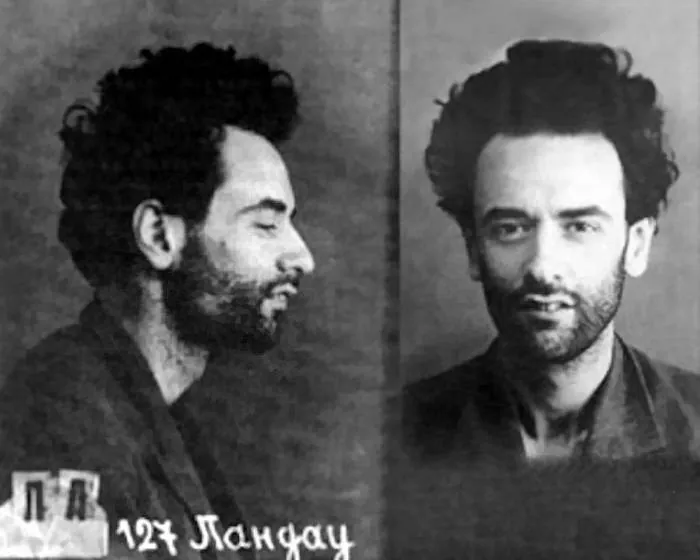
In April 1938, Lev Landau was arrested. The charge grew out of a leaflet he and a handful of friends had written and planned to hand out on May 1, the great Soviet holiday. The text criticized the Soviet regime, and that was enough. The man who had just taken charge of theoretical physics at the Institute for Physical Problems in Moscow, a post he accepted in 1937, was now a prisoner.
He spent roughly a year inside Lubyanka, the notorious Moscow prison run by the secret police. The cell, the interrogations, the waiting: it broke something in him that never fully healed. When he walked out, he did not walk out the same man.
Then came the strangest part of the story. Landau went back to work, and the work was extraordinary. Between 1941 and 1947 he published major papers across theoretical physics, and in that stretch he explained the superfluidity of liquid helium, the strange behavior that lets the stuff flow with no resistance at all. That body of work on liquid helium is the achievement the Nobel committee would eventually point to. The prison year had nearly erased him. The decade after it made him.
The Bomb Project He Never Chose
By the second half of the 1940s, Lev Landau was no longer only the theorist of liquid helium. He was inside the Soviet nuclear weapons program, working on calculations that fed both the atomic bomb and the hydrogen bomb efforts. It was a strange second act for a man whose real passion was pure theory, and it is one of the sharpest ironies in his story.
Here is the part that gets lost in the retelling. Landau never volunteered for the bomb work. He felt he had to commit himself to the Soviet Union's nuclear weapons projects to protect his freedom after the ordeal of his imprisonment. He had already spent a year in Lubyanka prison after his April 1938 arrest over an anti-Stalin leaflet, and the memory of that cell stayed with him. Joining the bomb program was not enthusiasm. It was a calculation about survival, made by a man who understood exactly how quickly a physicist could disappear.
The state knew how to reward what it demanded. Landau received the Stalin Prize and the Hero of Socialist Labour award for his contributions. In 1946 he was admitted as a full member of the Soviet Academy of Sciences. The recognition was real, and so was the trap. Every award tied him more tightly to a project he had not chosen, and to a regime that had once locked him away.
He kept working, because that was the only way he knew how to live. But the man who had once stood up in a lecture hall and challenged the biggest name in physics was now doing sums for a bomb, quietly, for the sake of staying free.
The Nobel, the Crash, and the Decades Lost
Lev Landau won the 1962 Nobel Prize in Physics for his theories of liquid helium, the work that had grown out of his superfluidity papers of the 1941 to 1947 stretch. He never got to travel to Stockholm and deliver a lecture. By the time the award was announced, he was lying in a Moscow hospital bed.
The crash happened on 7 January 1962, on the road from Moscow to Dubna. Landau was riding in a car when the accident occurred. Everyone else in the vehicle walked away with minor cuts and bruises. Landau took the full force of the impact and suffered severe internal injuries.
He was rushed back to Moscow, where he stayed unconscious for six weeks. Some accounts claim doctors declared him clinically dead several times during that stretch, though this is not consistently documented and is best treated as part of the legend that grew around his bedside. What is clear is that the scientific community mobilized on his behalf, and Niels Bohr, his old mentor, was among those who helped.
Then, remarkably, he woke up. Landau regained consciousness and, over the following months, recovered much of his physical function. He could walk again. He could read. He could talk about physics. But something essential had been taken from him. The creative engine that had produced the superfluidity theory and the classification of physicists into geometric shapes simply would not restart. The man who had once sorted physicists into categories from inverted triangle to triangle, reportedly placing Newton, Einstein, Heisenberg, Dirac and a few others at the summit, could no longer climb his own ladder.
He lived six more years. Lev Landau died on 1 April 1968, at the age of 60, from long-term complications of the accident. The Nobel had come too late to be celebrated, and the decades that might have followed, the papers he might have written, the students he might have trained, were lost on a winter road to Dubna.
Landau's Ranking System for Theoretical Physicists
Lev Landau sorted his fellow theoretical physicists the way a jeweler sorts stones, and he kept the whole ladder in his head. As the story goes, the system rested on three things: creativity, technical mastery, and scientific endurance. Each rank got its own geometric shape, and everyone he knew landed somewhere on the ladder.
At the very bottom sat the inverted triangle. These were physicists who could not originate an idea and could not develop anyone else's either. Landau's geometry left them no room to hide.
One step up came the square, the category he reserved for what he called the developers. They could not generate anything new, yet they could take an existing idea and refine it, sharpen the details, and push it forward. Useful hands, in other words, even if the spark belonged to someone else.
Then the diamond, and this one carried a sting. Diamonds had the big ideas, the kind that could reshape a field, but they lacked the technical command or the endurance to finish what they started. Brilliant beginnings, unfinished endings.
The triangle was the summit. This was the class for physicists who found major new ideas and also possessed every technique needed to develop them. Landau's short list at the top reportedly included Newton, Einstein, Heisenberg, Dirac and a few other leading physicists, names that between them rewrote mechanics, relativity, and quantum theory.
And here the accounts start to wobble. According to one retelling, once Landau worked out the superfluidity theory that would later earn him the 1962 Nobel Prize in Physics, he added his own name to that top category. The precise mapping of shape to rank varies from retelling to retelling, so treat the geometry as folklore rather than a published table. What nobody disputes is the confidence of a man who built a ladder to the sky and then climbed onto it himself.
Frequently asked questions
Who was Lev Landau?
Lev Davidovich Landau was a Soviet theoretical physicist, the son of engineer David Lvovich Landau and pharmacologist Lyubov Harkavy-Landau. He entered Baku University in 1922, moved to the physics department of Leningrad University in 1924, and went on to become one of the most influential physicists of the Soviet era, shaping both physics and mathematics there.
What happened between Landau and Einstein at Leipzig in 1930?
As the story goes, the 22-year-old Landau attended a German Physical Society conference in Leipzig in 1930 and publicly challenged Albert Einstein, pointing out an error in his presentation. According to the same account, Einstein considered the objection and conceded the mistake. The anecdote is widely repeated, but the exact date, venue, and whether Einstein actually acknowledged the error vary across retellings.
Why was Landau arrested in 1938?
In April 1938 Landau was arrested over a leaflet that he and friends planned to distribute on May 1. He spent roughly a year in Lubyanka prison before returning to scientific work.
How did Landau explain superfluidity?
Between 1941 and 1947 Landau published a series of papers that theoretically explained the superfluidity of liquid helium, developing what became known as the two-fluid model. This work on liquid helium later formed the basis for his Nobel Prize.
Did Landau work on the Soviet atomic bomb?
Yes. From the second half of the 1940s Landau was involved in the Soviet nuclear weapons program, contributing to both the atomic and hydrogen bomb projects. He never chose this work voluntarily, and he took it on to protect his freedom.
When did Landau win the Nobel Prize?
Landau was awarded the 1962 Nobel Prize in Physics for his theories of liquid helium, the same body of work he had built between 1941 and 1947.
How did Landau die?
Landau died on 1 April 1968 at the age of 60, from long-term complications of a car crash he suffered on 7 January 1962 on the road from Moscow to Dubna. He had remained unconscious for about six weeks after the accident.
What was Landau's ranking system?
As the story goes, Landau devised a classification system that sorted theoretical physicists into four categories, each represented by a geometric shape: an inverted triangle for the weakest, a square for those who develop others' ideas, a diamond for the creative but technically incomplete, and a triangle for the best. The precise mapping of these shapes is contested and varies across retellings. Editorial note: Details that remain unconfirmed, including some specifics of the 1930 Leipzig exchange and the circumstances of Landau's arrest, are presented here as reported rather than as settled fact.
Got a take on this? Add your voice to the conversation below →
No comments yet. Be the first.