Knot Theory: How Victorian Smoke Rings Built a Math Field

Knot theory, the branch of mathematics that studies tangled loops, traces back to 1867, when the physicist Peter Guthrie Tait began classifying knots after a demonstration by Lord Kelvin in Scotland. Kelvin had a strange and beautiful idea: that atoms themselves might be tiny knotted vortices swirling in the ether. If that were true, then telling one chemical element from another would mean telling one knot from another. Tait took up the challenge with pencil, paper, and enormous patience. What began as a detour into physics quietly became a field of its own.
In 1867, Lord Kelvin proposed that atoms were knotted vortices in the ether, prompting Peter Guthrie Tait to begin classifying knots. Although Kelvin's vortex theory of atoms was later abandoned, Tait's knot tables and classification work founded knot theory as a lasting mathematical field.
- In 1867, Lord Kelvin proposed that atoms were knotted vortex rings in the ether, a theory that made the classification of knots scientifically urgent.
- Peter Guthrie Tait, a Scottish physicist and close collaborator of Kelvin, began systematically tabulating and classifying knots in response.
- Tait's knot tables, built by hand in the late 19th century, listed knots by their number of crossings and remain a foundation of the field.
- Kelvin's vortex theory of atoms was eventually abandoned, but the mathematics Tait developed outlived the physics that inspired it.
- Knot theory is now applied in fields as varied as DNA research and theoretical physics.
The Day a Smoke Ring Changed Mathematics
There is no day in your life without a knot. Your shoelaces, your earbuds, the cord on the window blind. Nature was tying and untying them long before any human learned the trick. Some kinds of DNA form loops that tangle. So do certain proteins, magnetic fields and fluid vortices. All of it falls under one name: knot theory.
Now rewind to a Victorian room, where a physicist is about to blow smoke at a friend and accidentally launch a branch of mathematics.
One much-repeated account has it that in 1867 the Scottish mathematician and physicist Peter Guthrie Tait showed his friend Sir William Thomson a device that produced smoke rings. That exact year and framing are reported but not firmly confirmed. What is certain is the effect. Thomson, the man who would later give his name to the Kelvin scale, was captivated by the rings: their shapes, their stubborn stability, the way they drifted into each other and bounced.
That fascination carried him somewhere strange. Thomson proposed that different atoms were not solid balls at all, but knotted structures inside the ether, the invisible medium believed to fill all of space. A whole family of knots, each one slightly different, could explain why the chemical elements came in so many varieties. A stable vortex ring could explain why atoms endure.
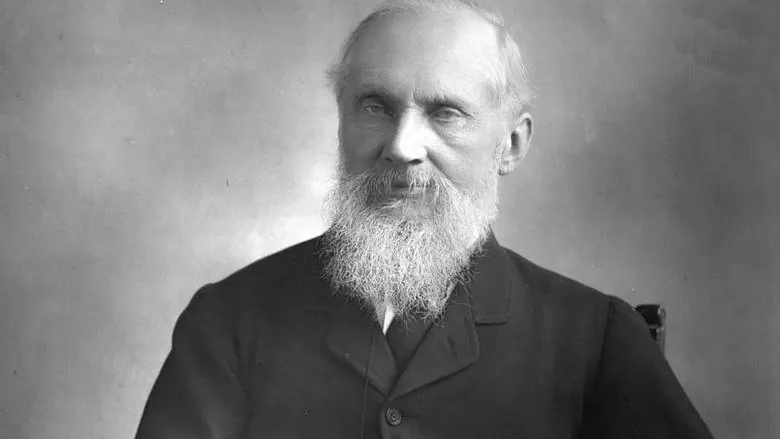
Thomson was born in 1824 and died in 1907, a Scottish physicist and mathematician remembered for his contributions to the formulation of the second law of thermodynamics, and also for magnetism, electricity and oceanography. He was not a man given to idle speculation, which is exactly why people took the vortex atom seriously.
Picture the demonstration itself. A puff of smoke, a ring that holds its shape as it travels, another ring chasing it, the two wobbling into a dance. Tait watched his friend fall in love with a shape. Neither of them knew that the shape would outlive the theory.
Why Victorian Scientists Took Vortex Atoms Seriously
Picture a box with a small round hole in one side, a puff of smoke, and a tap on the back. Out comes a clean ring of smoke, spinning, holding its shape as it drifts across the room. As the account goes, the Scottish mathematician and physicist Peter Guthrie Tait showed exactly this trick to his friend Sir William Thomson in 1867, and Thomson could not stop thinking about it.
Thomson, born in 1824 and dead in 1907, was a Scottish physicist and mathematician whose name now rides on the Kelvin temperature scale. He had already contributed to the formulation of the second law of thermodynamics and worked on magnetism, electricity, and oceanography. But the smoke rings did something else to him. He watched how they held together, how they slid through one another, how they never quite fell apart. Thomson proposed that atoms were not little solid balls at all, but knotted vortex tubes spinning inside the luminiferous ether, the invisible medium then believed to fill all of space.
It sounds like a fever dream now. In the 1860s, it was a serious research program. The vortex theory had real appeal. If every atom were a knot, then the sheer variety of knots, thousands of them, each one slightly different from the next, mirrored the sheer variety of the chemical elements. And because a vortex ring in a perfect fluid cannot simply dissolve, its stability explained something nothing else could: why atoms persist. Why matter does not just melt back into nothing.
So Tait started drawing. Knot after knot, page after page, working largely from his own geometric intuition rather than any systematic method. He classified all the prime knots with at most seven crossings when projected onto a plane, an achievement that looks less like calculation and more like a very patient act of observation.
Then the idea collapsed. By the late 1880s, Thomson had moved away from his own theory, as the account goes, though the precise timing of his retreat is reported rather than confirmed. Tait did not follow him out the door. He kept going, and the work he kept doing is often credited with founding the mathematical field known as knot theory, though the exact timing and the framing of him as sole founder are reported but not confirmed. At the end of the nineteenth century he learned that Kirkman and Little were chasing the same problem, and according to the original account the three of them together catalogued every prime knot up to ten crossings and most of those with eleven. That last part, the working together and the exact extent, is the kind of detail that tends to get lost in retelling. What survives without question is the table itself, and the fact that a physicist chasing smoke rings left mathematics a brand new field.
What Is a Mathematical Knot, Really?
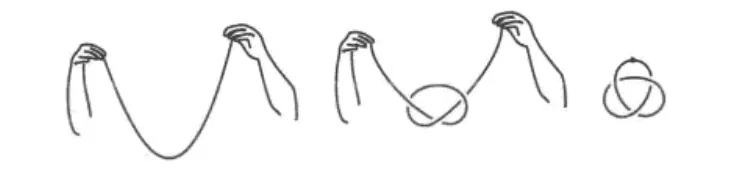
Take a piece of string. Tie an ordinary knot in it, the kind you use on a shoelace, and you have something you can pull loose in a second. That is not what a mathematician means by a knot. To build a mathematical knot, you take that same string and join its two ends together into a closed loop. Now the knot is trapped inside the loop, and no amount of pulling, twisting or yanking will free it. The only way out is to cut the string.
That single rule changes everything. A mathematical knot is not a tangle you happen to be holding; it is a fixed, closed shape whose structure cannot be undone. Because a knot behaves like flexible string, mathematicians file knot theory under topology, the study of how shapes can be bent, stretched and deformed without tearing. Picture a knot made of soft rope. You can shove it around, flatten it, rearrange it. What you cannot do is change the essential way its strands pass through one another.
Sometimes a knot can be opened up into a plain circle. Mathematicians call that the unknot, and it is the simplest object in the whole field. But most knots refuse to cooperate. Untying them is simply impossible, and that stubbornness is exactly what makes them worth studying.
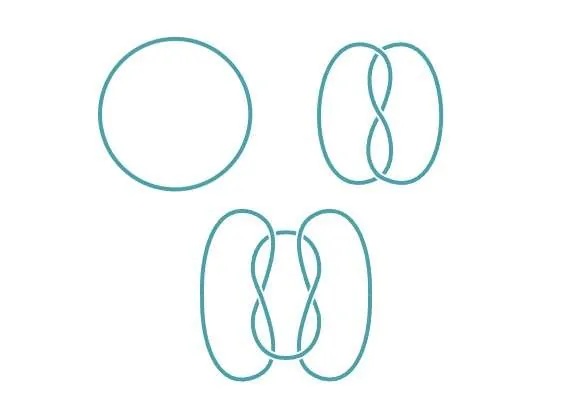
Where do you start? With the unknot, the humble circle that counts as a knot with nothing in it. Then comes the trefoil, a knot with three lobes that looks a little like a pretzel twisted on itself. After that, the figure-eight knot, a slightly more tangled cousin. These three are the first steps on a very long path, and the path keeps going.
This is the heart of knot theory: not the knots in your headphones, but closed loops whose structure is permanent. Once you accept that a knot cannot be undone, the natural question becomes obvious. How many different knots are there, and how would you ever tell two of them apart?
Gauss, Listing, and the Problem Tait Was First to Tackle
Peter Guthrie Tait did not invent the study of knots out of thin air. Long before he sat down with a pen and a stack of paper, two German mathematicians had already brushed against the idea. The first was Carl Friedrich Gauss, who, as the account goes, jotted notes and sketched examples about knots in his notebook around 1794. That specific year is reported but never fully confirmed, so treat it as a rumor rather than a settled fact. What is certain is that Gauss noticed something worth noticing.
The second name is Johann Listing, a student of Gauss. In 1847 Listing published a work titled Vorstudien zur Topologie, and in its pages he discussed knots directly. Here is the part that still echoes: the very word "topology" traces back to this work. So the vocabulary we use today for the study of shape and deformability was, in a real sense, coined by a man thinking about tangled loops.
Yet neither Gauss nor Listing asked the question that would define the field. That question was simple to state and brutal to answer: can we classify and catalogue all possible knots? Tait was the first to actually tackle it. He worked for years leaning only on his own geometric intuition, no computers, no collaborators at his elbow, and he managed to find and sort every prime knot with at most seven crossings when projected onto a plane. Seven crossings. By hand. By eye.
So the lineage runs like this: Gauss sketches, Listing names, and Tait builds the catalogue. The knot theory we know today stands on that foundation, and it started with a man who trusted his geometric instinct enough to draw every knot he could find.
Cataloguing Knots by Hand: Tait, Kirkman and Little
Peter Guthrie Tait did the foundational work of knot theory almost entirely alone, and he did it the hard way. For years he trusted nothing but his own geometric intuition, sketching and comparing loops on paper rather than running calculations. By the time he was finished with that first push, he had found and classified every prime knot with at most seven crossings when the knot is projected onto a plane. No computer, no algorithm, just a mathematician, a pencil, and a stubborn refusal to leave anything unverified.
Picture the scale of it. Each knot had to be drawn, checked against every other drawing, and tested to see whether it could be pulled loose into a plain circle. The number of possible crossings climbs fast as you add more, so the tables grew longer and the sketches denser. Every entry was a small act of faith that his eye had not missed a case.
Toward the end of the 19th century, Tait discovered he was not the only one at the table. According to the original account, he learned that Thomas Kirkman and Charles Little were working on the same classification problem, and the three of them went on to catalogue all prime knots with up to ten crossings and most of those with eleven. That collaboration and its exact reach are reported rather than confirmed, but the tables they produced became the backbone of the field.
And the field kept growing past them. Thousands of knot types exist, and telling them apart in a meaningful way is the job of topology. The hand-drawn tables Tait started were only the first attempt at that sorting, and later mathematicians inherited both the lists and the gaps he left behind.
Knot Invariants and the Unsolved Classification Problem
Knot invariants are properties that stay exactly the same no matter how you pull, twist or turn a knot, and they are the main tool mathematicians use to decide whether two knots are really the same. The catch is that no known invariant separates every pair of knots, so the complete list of all knots remains unfinished.
Picture the problem. You hold two tangled loops of string. Are they the same knot wearing different clothes, or two genuinely different knots? You cannot just stare harder. So over the last century, mathematicians built a clever set of tests. Each test hunts for a property that belongs to the knot itself, not to the particular drawing of it. Stretch the string, flip it over, shake it around: the number does not budge. That stubbornness is the whole point, and it is why the field calls these properties invariants.
Knot theory sits inside topology, the branch of mathematics that studies how shapes bend and deform. A topologist does not care whether a knot looks neat or messy, only whether it can be rearranged into another one without ever cutting the string. That looseness is exactly what makes the classification problem so slippery and so interesting.
Here is the frustration. Two knots can pass every test you throw at them and still be different creatures. They simply share the same invariant value, like two people with identical fingerprints on one finger. Different invariants catch different things, so researchers stack them up, one after another, hoping the pile will eventually be sharp enough. It never quite is.
That gap is why the catalog is still growing. Mathematicians have listed vast numbers of knots, and the tables keep expanding, yet nobody can say the list is finished. The full classification of knots is one of the field's great open questions, and it has stayed open for a very long time.
A knot invariant is a promise: however you contort the knot, this number will not change. The trouble is that the promise is not always enough to tell two knots apart.
So the search continues. Every new invariant is another pair of glasses, and every pair of glasses reveals a little more of the shape hiding inside the tangle. The list is not complete, and that is precisely what keeps mathematicians reaching for the next one.
From Fluid Dynamics to DNA: Knot Theory Comes Full Circle
Knot theory has wandered across mathematics for well over a century, and it just completed a full circle. It started life as an applied idea, when William Thomson tried to use knots to explain what matter actually is. Then it drifted into pure mathematics, a beautiful branch of topology with almost no practical use. In recent years, it has become an applied field all over again.
Researchers now reach for knot theory when they study how fluids behave, when they work through problems in electrodynamics, and when they examine knotted molecules. DNA is the clearest example. It is built from millions of atoms and carries the basic blueprint of life, yet its thread-like structure tangles easily, and those tangles make it hard for DNA to perform its core functions. A knot in a strand is not a small inconvenience. It can block the whole job.
Here is the part worth sitting with. While scientists were busy with other things, mathematicians kept preparing knot catalogues and building the tools needed to unlock their secrets. Nobody knew exactly what those tools would be used for. Then biology and physics came calling.
That pattern is not unusual in mathematics, but it is rarely this clean. A Victorian theory about the ether, abandoned and left for dead, turned out to hold the machinery that modern researchers needed. The knots Thomson once imagined inside atoms now show up inside the molecules of living things. The circle closed, and it closed on a question he never got to ask.
Frequently asked questions
What is knot theory and why does it matter?
Knot theory is the branch of mathematics that studies tangled closed loops, and it sits inside topology, the field that examines how shapes bend and deform. It matters because the same tangles show up in fluid vortices, magnetic fields, certain proteins, and the DNA packed inside living cells.
Who invented knot theory and when?
Peter Guthrie Tait, a Scottish mathematician, is often credited with founding the mathematical field of knot theory in the late 19th century. Earlier work came from Carl Friedrich Gauss, who reportedly filled a notebook with knot sketches, and from his student Johann Listing, whose 1847 book Vorstudien zur Topologie discussed knots and gave topology its name.
How did Lord Kelvin's vortex theory lead to knot theory?
William Thomson, later Lord Kelvin, proposed in 1867 that atoms were knotted vortex tubes spinning in the ether thought to fill space. The idea that countless slightly different knots could mirror the variety of chemical elements pushed Tait to start cataloguing knots, and the mathematical field grew out of that catalogue.
What is a mathematical knot compared to a regular knot?
A mathematical knot is a single closed loop: you join the two ends of a piece of string so there is no loose end left. Because the strand is flexible, you can bend and stretch it freely, but you cannot untie it without cutting. A knot that can be flattened into a plain circle is called unknotted.
Why is classifying all knots so difficult?
Mathematicians try to tell two knots apart by finding an invariant, a property that stays the same no matter how the knot is pulled or twisted. The trouble is that invariants do not always separate different knots, since two distinct knots can share the same value. That gap is why the complete list of knots remains unfinished.
What are knot invariants and how do they work?
A knot invariant is a property of a knot that does not change under any manipulation that avoids cutting the strand. If two knots give different invariant values, they are definitely different knots. If the values match, the question stays open, which is exactly where the classification problem gets stuck.
How is knot theory used in DNA research today?
DNA is a thread-like molecule built from millions of atoms, and the tangles that form along it can interfere with the basic jobs it has to perform. Researchers use knot theory to describe those entanglements and to understand how cells simplify them, alongside applications in fluid dynamics and electrodynamics.
Did Peter Guthrie Tait really catalogue knots by hand?
Yes. Tait worked largely from his own geometric intuition and classified all prime knots with at most seven crossings when projected onto a plane. Toward the end of the 19th century he learned that Kirkman and Little were working on the same problem, and their tables are reported to have reached all prime knots up to ten crossings. Editorial note: Details that remain unconfirmed are presented here as hedged rather than settled fact.
Got a take on this? Add your voice to the conversation below →
No comments yet. Be the first.