Hippias Quadratrix: Ancient Greek Angle Trisection
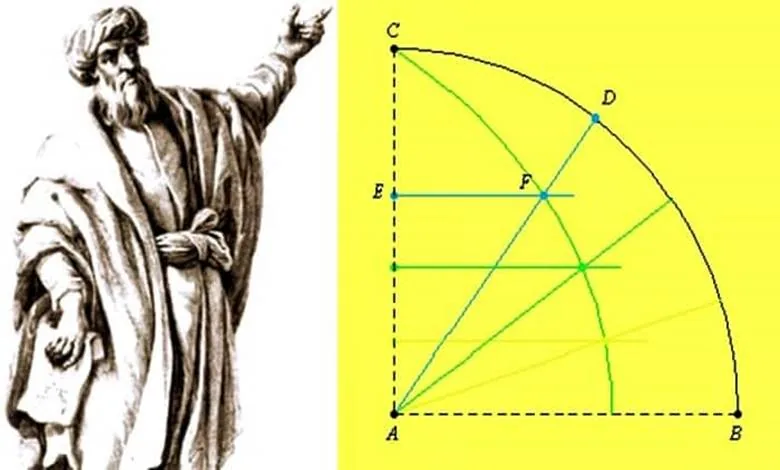
Hippias of Elis devised the Hippias quadratrix in ancient Greece as a tool for trisecting any angle, though the familiar date of around 420 BCE is a scholarly approximation rather than a firm record. It was a clever answer to one of geometry's most stubborn challenges, and it did something remarkable: it turned the measurement of angles into the measurement of straight lengths. For a thinker working with nothing but a compass, a straightedge, and a restless imagination, that was a genuine leap.
Hippias of Elis, a Greek sophist and geometer, devised a curve now called the Hippias quadratrix, though the customary date of around 420 BCE is an approximation. By tracing a point as a line sweeps across a square, the curve converts angle measurement into straight-line distance, allowing any angle to be divided into equal parts, including thirds.
- Hippias of Elis lived in the fifth century BCE and is credited with the curve that now bears his name.
- The quadratrix is generated by combining a rotating radius with a line moving at constant speed across a square.
- The curve lets a geometer trisect an arbitrary angle by dividing a straight segment into three equal parts.
- Later Greek mathematicians recognized that the same curve could also be applied to squaring the circle.
- Angle trisection with only a compass and straightedge resisted the classical tools, which is why special curves like this one mattered.
The Problem That Wouldn't Budge
Take any angle. Now cut it into three perfectly equal slices using nothing but a straightedge with no markings and a pair of compasses. That is angle trisection, and along with squaring the circle and doubling the cube, it stands as one of the three classical geometry problems of antiquity. It sounds like a lazy afternoon puzzle. It turned into a multi-century obsession.
Here is the detail that makes it brutal. The method has to work for any angle you hand over. Sure, a 90° angle splits neatly into three 30° pieces, and 45° gives you three tidy 15° slices. Those are the easy cases. The real demand was a general construction, one recipe that handles every angle without exception.
Greek mathematicians threw themselves at it for centuries. They beat their heads against the classical tools and kept losing. Then something shifted. Instead of forcing the compass and straightedge to do the impossible, they started inventing brand new tools, new curves, whole new kinds of objects that the old rules never allowed.
One of the strangest of those inventions belongs to Hippias of Elis, a thinker who lived around 460 BCE. His creation, the Hippias quadratrix, was a curve traced by two motions running at once, and it would eventually turn the angle problem into something almost embarrassingly simple. Almost. The catch, as we will see, is that the curve itself breaks the very rules the Greeks were trying to honor.
But before the curve, the man. Hippias was no cloistered scholar. He was a sophist, one of those traveling teachers who roamed from city to city and charged a fee for lessons. And his range was absurdly wide.
Who Was Hippias of Elis?
Hippias of Elis was a Greek sophist who lived around 460 BCE, a traveling teacher who charged a fee for lessons in cities across the Greek world. He is the man behind the curve that bears his name, the Hippias quadratrix, and understanding him means understanding the strange, restless world of the sophists.
Picture the sophists as the itinerant professors of their day. They moved from city to city, set up shop, and taught whoever could pay. Hippias fit that mold perfectly and then some. According to Plato's account, his teaching covered mathematics, astronomy, history, poetry, music, and rhetoric, a range that made him the ancient equivalent of a one-man university.
Most of what we know about him comes through Plato's dialogues, and that is where things get tricky. Plato had little patience for sophists and often painted them as flashy and shallow. So every portrait of Hippias needs a careful second look. In Plato's telling, he was a show-off who boasted that everything he wore or carried on his trip to Olympia, the ring, the cloak, the shoes, he had made with his own hands. Whether that is biography or satire is hard to say, but it captures the reputation: a man who wanted to be seen as master of every craft.
What the sources do agree on is his powerful memory and his wide-ranging curiosity, the traits of a born traveling teacher. That same appetite for many subjects is what led him, as the story goes, to develop his famous curve, though the precise date is a scholarly approximation rather than a firm record. He is chiefly remembered for that single mathematical achievement, and ancient testimony is too sparse to say with certainty whether he produced other mathematical work.
One thing is clear about the Hippias quadratrix: it was one of the first special curves ever defined beyond straight lines and circles, a genuine leap in how Greek mathematicians thought about what a construction could be.
The Curve That Turns Angles Into Lengths
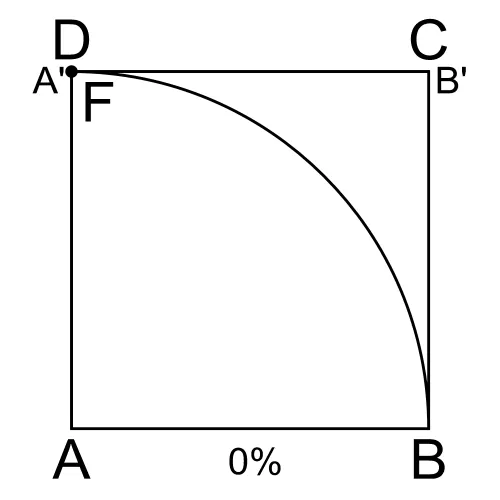
Picture a square, ABCD, sitting on a page. Now set two things moving at once. The side AD begins to rotate around the corner point A at a steady angular speed, sweeping toward AB. At the very same instant, a line labeled A'B' starts sliding straight down from the top edge DC, parallel to itself, at a steady speed, until it lands on AB. Where the turning line and the descending line cross, mark a point F. That crossing point is the whole trick: as both motions run, F drifts across the square and leaves a trail behind it. That trail is the Hippias quadratrix.
Notice what kind of curve this is. It cannot be produced with an unmarked straightedge and compass alone. It has to be built point by point, one intersection at a time, from those two synchronized motions. That alone made it remarkable, because it is widely counted among the first special curves defined beyond plain straight lines and circles.
Why the Name Misleads
The name is Latin, from quadratrix, and it means "squaring curve." That label is a little unfair to its inventor. Hippias did not build this curve to square anything. He built it to cut an angle into three equal parts. Only later, once others saw what the curve could do, did it get borrowed for the circle-squaring problem and pick up the name we still use.
What the Two Motions Buy You
Here is the payoff. The amount the turning line has rotated and the distance the sliding line has dropped stay locked in a fixed ratio. So an angle stops being an angle and becomes a length you can measure along a line. Once that conversion is in place, you do not trisect an angle directly at all. You trisect a straight segment instead, and the geometry hands you the angle back in three equal pieces.
The catch is the timing. The definition demands that both motions start together and finish together, perfectly. That is not a straightedge-and-compass operation, and critics were quick to point it out.
As for the curve's origin, the Hippias quadratrix is reliably his, though the familiar date of around 420 BCE is a scholarly approximation rather than something firmly pinned down. As the story goes, no other mathematical work can be confidently tied to him, but the ancient testimony is thin enough that a flat "nothing else" is a risky claim to make.
How the Hippias Quadratrix Trisects an Angle
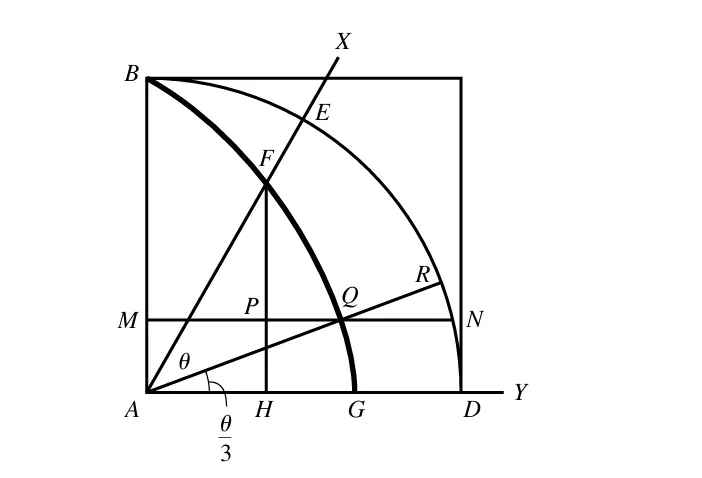
The Hippias quadratrix trisects an angle because it turns angle size into a straight length: on the curve, the position of the intersection point F stays in a fixed ratio to the angle the rotating line has swept. Divide the segment FH into three equal parts, and the original angle splits into three equal parts.
Here is the whole trick in one sentence: the curve is a translator. It takes a problem about opening an angle and rewrites it as a problem about cutting a line.
Picture the square ABCD from the construction. The line AD swings around point A at a constant angular speed while the line A'B' slides straight down from edge DC at a constant linear speed. Their crossing point is F, and the path F leaves behind is the red curve. Because both motions run at steady rates and finish together, the angle turned and the distance traveled stay locked in step. Whatever fraction of the full swing the rotating line has covered, F has dropped that same fraction of the way down.
That lockstep is what makes the trisection work. You never touch the angle with a compass. Instead:
- 1Divide the length FH into three equal parts.
- 2Draw horizontal lines through those division points until they cut the quadratrix.
- 3Join each intersection point back to A.
Those two joining lines are the trisectors. The angle is now in three equal pieces, and the only measuring you did was on a straight segment, which a straightedge can handle far more easily than an angle.
The reframing is the real payoff: trisecting an angle and trisecting a segment are the same problem wearing different clothes, and the Hippias quadratrix is the translator between them.
This is why the curve earned its place in the history of geometry. It did not sneak past the classical rules so much as step outside them, and the ancient critics noticed. The definition leans on two motions that must start and stop at exactly the same instant, which is not a straightedge-and-compass construction at all. Reportedly, later commentators raised precisely this objection.
Still, as a piece of thinking, it is hard to beat. One curve, one segment divided three ways, and an angle that had resisted every ruler-and-compass attempt for centuries finally yields.
The Catch: Why It Was Criticized
The Hippias quadratrix works, but it cheats. That was the charge, and it stuck. The definition of the curve rests on two motions that must start at exactly the same instant and stop at exactly the same instant: one line sweeping around a point, another sliding steadily down the square. Get that timing off by a hair and you no longer have the curve. Critics pointed out that this is not a construction you can carry out with an unmarked straightedge and a compass, the only tools the classical rules allowed. A moving line is not a drawn line.
Angle trisection was the friendlier case. Squaring the circle was worse. To convert the curve into a square of equal area, you need the point where the quadratrix finally meets the base of the square, and that point cannot be produced by the defining motions at all. The two lines only reach their meeting place at the very end of the sweep, when the rotation and the slide arrive together at zero angle. There is nothing to draw there. Mathematicians can only treat it as a limit point, a value the curve approaches but never hands you directly. As the original account puts it, that gap means the quadratrix does not deliver a valid classical solution to squaring the circle.
What the Objection Really Stakes Out
This is the moment the argument turns into something bigger than one curve. The complaint was not that Hippias made an arithmetic mistake. It was that he stepped outside the game. Straightedge and compass constructions build figures from finitely many drawn lines and circles, each step following from the last. A curve traced by two simultaneous motions belongs to a different category altogether, and ancient critics said so plainly.
Why It Still Mattered
And yet the curve earned its place. The Hippias quadratrix is one of the earliest special curves defined beyond straight lines and circles, a deliberate reach past the classical toolkit when the toolkit came up short. It converts an angle into a length, then lets you trisect a segment instead of an angle, an idea that outlived the objections. For all its flaws, it marks the point where Greek geometers stopped treating the three classical problems as puzzles to be solved with the old tools and started inventing new mathematics to get at them.
Frequently asked questions
What is the quadratrix of Hippias and how does it work?
The Hippias quadratrix is a curve traced by the meeting point of two synchronized motions inside a square. One line rotates at a constant angular speed while a parallel line slides down at a constant linear speed. Their intersection, point F, sweeps out the curve. Because the two speeds stay locked together, each angle of rotation maps to a matching distance along the base.
How did Hippias of Elis try to trisect an angle?
Hippias of Elis, a sophist active around 460 BCE, turned the angle into a length. On the quadratrix, the distance FH corresponds directly to the size of the angle. You divide FH into three equal parts, draw horizontal lines through those points to hit the curve, then join the intersections back to point A. The original angle splits into three equal pieces.
Why is the quadratrix not constructible with compass and straightedge?
The curve depends on two motions that must start and finish at exactly the same instant. That kinematic requirement cannot be reproduced by a plain unmarked straightedge and compass. Ancient critics made precisely this objection, and it is why the Hippias quadratrix sits outside the classical rules rather than inside them.
Was the quadratrix used to square the circle?
Yes, though it never delivered a valid classical solution. Later thinkers applied the Hippias quadratrix to circle squaring, but the curve's final endpoint on the base cannot be constructed directly. It exists only as a limit point, so the method fails under strict straightedge-and-compass rules even though the curve itself is genuinely useful.
Who was Hippias of Elis?
Hippias of Elis was a sophist who lived around 460 BCE. Sophists were itinerant teachers who traveled between cities and taught for a fee. Plato reports that Hippias lectured on mathematics, astronomy, history, poetry, music and rhetoric, and much of what we know about him comes from Plato's dialogues, which call for cautious reading given Plato's critical stance toward sophists.
What are the three classical geometry problems?
Antiquity's three classical construction problems are angle trisection, circle squaring and cube doubling. Each was meant to be solved with only an unmarked straightedge and compass. Angle trisection is the one the Hippias quadratrix was built for, and circle squaring is the one the curve was later borrowed for.
Did the quadratrix solve angle trisection?
It gives a working method, but not a solution within the strict straightedge-and-compass rules. The Hippias quadratrix converts an angle into a segment, and that segment can be divided into three. Special angles like 90° and 45° are easy to trisect anyway; the real prize was a general method, and the curve delivered one that stepped outside the classical toolkit. Editorial note: Details about Hippias's life and the exact origins of the curve remain uncertain, and any facts that are not firmly confirmed are presented here as such.
Got a take on this? Add your voice to the conversation below →
No comments yet. Be the first.