Hermann Grid Illusion: Why You Can't See All 12 Dots
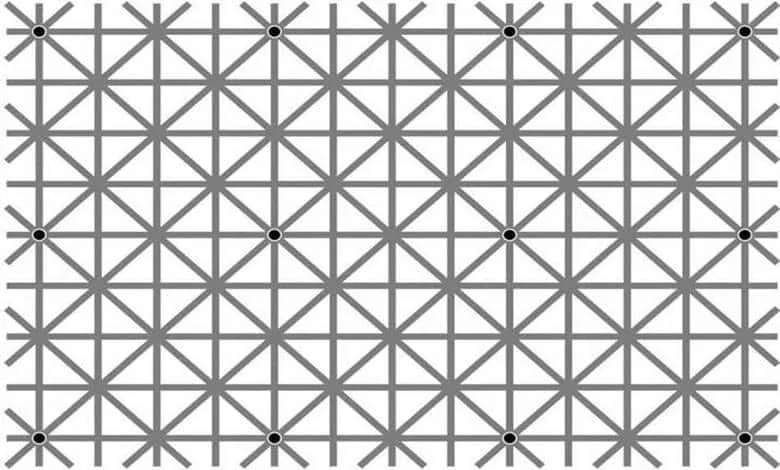
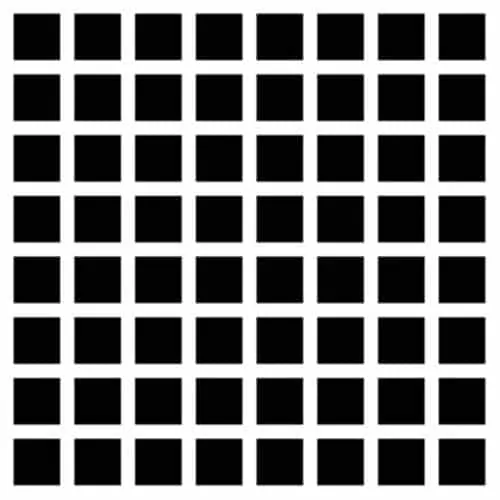
The Hermann Grid illusion is a classic optical illusion, first described by German physiologist Ludimar Hermann in 1870, in which ghostly grey smudges appear at the intersections of a white grid on a black background. Stare at any single intersection and the smudge vanishes, only to reappear the moment your gaze drifts away. That small betrayal of your own eyes is what makes the illusion so hard to shake. It also explains why a popular version of the grid, the one with twelve black dots on grey lines, refuses to let you see all twelve at once.
The Hermann Grid illusion was first described by Ludimar Hermann in 1870. It makes grey smudges appear at the intersections of a white grid on a black background, and they vanish when you look directly at them. A later variant hides twelve black dots on grey lines, and most people can only ever see a few at a time.
- Ludimar Hermann, a German physiologist, described the grid illusion that carries his name in 1870.
- In the classic version, grey smudges seem to flicker at the intersections of a white grid on a black background.
- In the twelve-dot variant, black dots sit at the intersections of grey lines and appear to vanish when viewed directly.
- The leading textbook explanation attributes the effect to lateral inhibition among retinal ganglion cells.
- Modern researchers have challenged that account, and no single theory fully explains every version of the illusion.
The Grid That Plays Tricks on Your Eyes
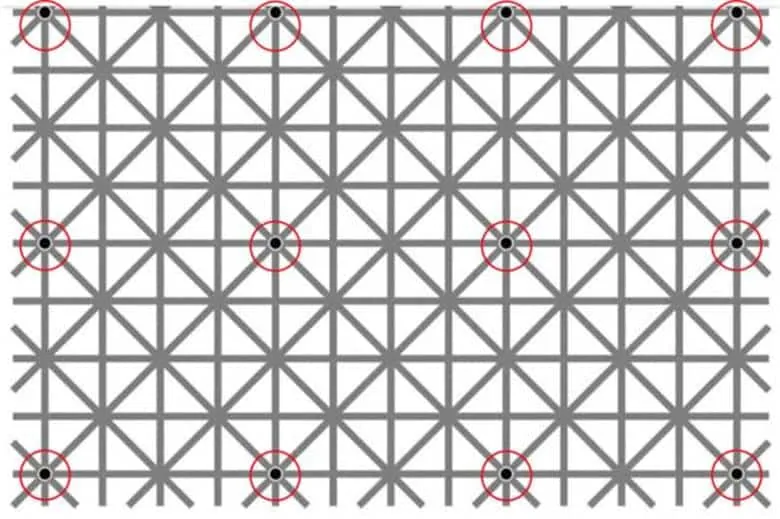
Count the black dots in the picture. There are 12 of them, arranged where the lines cross. Now try to hold all 12 in view at once. You can't. A few stay put, the rest flicker, slide, or blink out of existence the second your attention drifts toward them.
Here is the part that should bother you: those grey dots you keep "seeing" at the intersections are not printed on the page. Nothing is there. Your visual system is manufacturing them, intersection by intersection, and deleting them again as soon as you look straight at one. This is the Hermann Grid illusion, and it sits in a strange category of experience. The grey dots have no physical counterpart in the outside world, which puts them closer to a hallucination than to ordinary seeing. You are, in a small and harmless way, hallucinating on demand.
It is not quite the classic hallucination either. Someone who reports a pink elephant in an empty room is seeing something with no object behind it at all. The Hermann Grid is different: the grey dots appear only while you are staring at a real thing, the grid itself. The trigger is right there in front of you. The ghost is not.
Most people never notice how odd this is, because the effect feels like a property of the image rather than a property of their own eyes. It isn't. The dots are a perceptual side effect, produced by the human visual system and projected outward onto a page that contains only black lines and white space.
Once you know the trick, the grid stops being a picture and becomes a question. Why would a system built for accurate vision invent dots that aren't there, and then hide them the moment you try to pin them down? The answer starts with a German physiologist and a physics textbook, and it has been argued about for more than 150 years.
Who Was Ludimar Hermann and How Did He Stumble on This?
Ludimar Hermann was a German physiologist who lived from 1838 to 1914, and the famous grid illusion that carries his name was not discovered in a laboratory. He was simply reading a physics book. The figures in that book were printed in a matrix-like layout, rows and columns of small shapes packed tightly together, and as his eyes moved across the page something strange happened at the intersections. Dark smudges flickered into view, then vanished the moment he looked straight at them.
Most of us would have rubbed our eyes and turned the page. Hermann did not. He wrote the observation up and published it in an article in 1870, which is why the phenomenon is known today as the Hermann Grid illusion. Two years later, in 1872, the physiologist Ewald Hering noticed a closely related effect using the opposite arrangement: a black grid with white squares. Because the two men described such similar grid phenomena, the effect is sometimes called the Hermann-Hering illusion, a joint credit that Hermann never asked for and Hering never claimed.
Here is where the internet version of the story drifts from the record. The twelve-dot grid that circulates on social media is often credited online to the Japanese professor Akiyoshi Kitaoka, who is said to have first shared it. That attribution is contested, and for good reason: the underlying illusion predates Kitaoka by well over a century. As the story goes, the twelve-dot version simply repackages Hermann's 1870 observation in a more shareable form. Likewise, you will sometimes read that a scientific paper published in 2000 finally explained where the illusion came from. A 2000 paper by Ninio and Stevens in the journal Perception did explore variations on the Hermann Grid, but the claim that it explained the illusion's origins is unverified, and the key historical descriptions still reach back to the 1870s.
What Hermann stumbled onto at that reading desk was something rarer than a printing quirk. The grey dots have no physical existence on the page at all. They are perceptual side effects manufactured by the human visual system, which is why the effect belongs in the same broad family as a hallucination, though a mild and reliable one. You see the dots only while you are not looking at them, and the grid itself is the perfectly ordinary object sitting in front of you the whole time.
Why the Dots Vanish: Retinal Ganglion Cells and Lateral Inhibition
The Hermann Grid illusion comes down to cells in the back of your eye that carry visual signals to the brain: retinal ganglion cells. Each one watches a small patch of the visual field called a receptive field, built as a center point plus a ring around it. Cells fire either as center-active (ON) or surround-active (OFF), depending on how much brighter the center is than the ring.
Now picture a single intersection on the grid. An ON cell sitting there has four bright squares pressing in around it. That much surround light drives strong lateral inhibition, so the cell quiets down and sends less signal. A cell parked on a line between two intersections only has two bright squares beside it. Less inhibition, stronger signal, brighter look. The intersections end up darker than the lines to your eyes, and that is the ghost dot.
So why does the dot evaporate the moment you stare straight at it? Because the fovea, the tiny central patch of the retina you use for sharp focus, packs cells with far smaller receptive fields. They read only the light hitting their center and pay almost no attention to the surround. Aim your gaze at an intersection and the inhibition machinery stops manufacturing the phantom. The illusion also shows up with the colors reversed, and OFF cells running the same center-versus-surround comparison are thought to account for that version too.
This is the classic lateral inhibition explanation, and it is worth knowing that it is now considered insufficient. The illusion is reported to persist when the grid is scaled up, and it can fade when the grid is distorted, which a purely retinal story struggles to predict. Modern theories point toward the visual cortex, where the brain is thought to measure contrast across many spatial filters at once.
Why Modern Brain Science Says the Eye Alone Isn't Enough
For decades, the standard answer to the Hermann Grid illusion lived entirely inside the eyeball. The classic account, associated with Baumgartner, pointed to retinal ganglion cells, the neurons behind the eye that carry visual signals to the brain. Each of these cells watches a small patch of the visual field, called a receptive field, built as a center point ringed by a surround. Their firing depends on the difference in light intensity between center and surround.
At a grid intersection, an ON cell sits surrounded by four bright regions, so its surround gets flooded with light and suppresses its response. Along a line, the same cell has only two bright neighbors, so it fires harder. Fewer signals at the crossings means they look darker to us. It was a tidy story. It just doesn't hold up.
Baumgartner's lateral-inhibition explanation was influential in its time, but it is now considered insufficient. The illusion is reported to persist when the grid is enlarged, and it can disappear when the grid is distorted, patterns the simple retinal model does not predict. The structure of retinal cells is thought to be too complex to explain the effect through eye processes alone.
So where does that leave us? Modern theories focus on processes in the brain's visual cortex. According to this view, the brain measures contrast across multiple spatial filters corresponding to different receptive-field sizes. Illusions like the Hermann Grid are thought to arise not just in the eye but during the brain's visual interpretation stage. The dots you can't quite catch are being built, in part, behind your eyes, not in front of them.
Frequently asked questions
What is the Hermann Grid illusion?
The Hermann Grid illusion is a pattern of light lines on a dark background, or dark lines on a light one, where faint grey smudges seem to flicker at the intersections. Those dots are not printed anywhere on the image. Your visual system manufactures them, which is why they vanish the instant you try to stare one down.
Why can't I see all 12 dots at once?
Because the effect lives at the edges of your attention, not at its center. Retinal ganglion cells sitting on the intersections are suppressed more strongly than cells sitting on the lines, so your brain reads those crossings as darker. The moment you aim your gaze straight at a spot, the illusion drops away.
Who discovered the Hermann Grid illusion?
The German physiologist Ludimar Hermann, who lived from 1838 to 1914, noticed the effect while reading a physics book whose figures were printed in a matrix-like layout. He published the observation in an article in 1870, in Pflügers Archiv. In 1872, Ewald Hering described a related version using a black grid with white squares, which is why the phenomenon is sometimes called the Hermann-Hering illusion.
How do retinal ganglion cells explain the illusion?
These neurons behind the eye each monitor a small patch of the visual field called a receptive field, built as a center surrounded by a ring. At an intersection, four bright regions crowd the surround, producing heavy lateral inhibition and a weak signal. On a line, only two bright regions touch the surround, so the cell fires harder and the line looks brighter.
Why does the illusion disappear when you look directly at a dot?
Foveal cells, the ones handling whatever you fixate on, have far smaller receptive fields than cells in the periphery. They respond almost entirely to light falling on their center and pay little attention to the surround. With the surround effectively ignored, the inhibition that would darken a crossing never builds up, and the grey dot simply is not there.
What do modern theories say?
Baumgartner's lateral-inhibition account, which credits retinal ganglion cells with center-surround receptive fields, is now considered insufficient. The illusion is reported to survive when the grid is scaled up, and it can weaken when the pattern is distorted, neither of which the simple model predicts. Contemporary explanations therefore point to cortical processing in the visual cortex, where the brain measures contrast across many spatial filters at once.
Did Akiyoshi Kitaoka create the 12 dots illusion?
No, and the claim is unverified. The illusion predates him by over a century, since Ludimar Hermann published his observation in 1870. Kitaoka, a Japanese professor, is often credited with popularizing the 12-dot version online, and that popularization is a different thing from discovery.
Was the Hermann Grid illusion first noticed in 1870?
Yes. Ludimar Hermann published his observation of the grid effect in an article in 1870, after noticing the pattern in a physics book he was reading. Ewald Hering added a related inverse variant around 1872, and the two names have been linked to the illusion ever since. Editorial note: Details that remain unconfirmed or contested in the scientific literature are presented here as such, and no claim should be read as settled fact.
Got a take on this? Add your voice to the conversation below →
No comments yet. Be the first.