Free VPN Risks: Why Your Data Isn't Safe
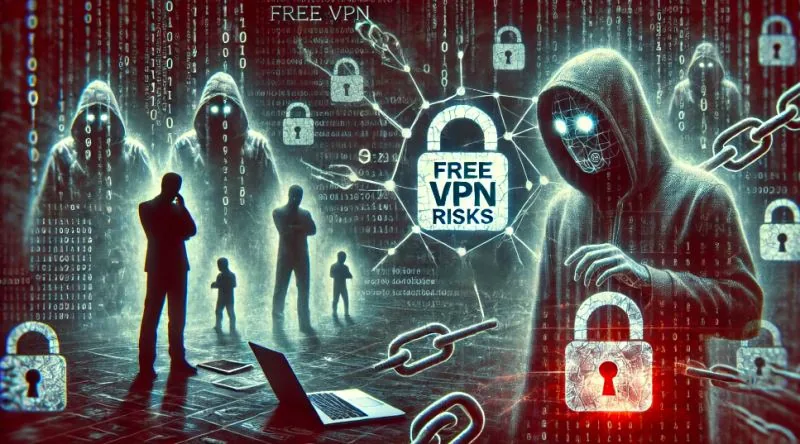
Free VPN risks are real, and they show up the moment you trust one with your traffic instead of paying for protection. The apps are free because someone else is covering the bill, and that someone is usually interested in you. Your browsing history, your login details, and your location can all become the product. That is the trade most people never see when they tap install.
Many free VPNs fund themselves by logging your activity and selling it to advertisers or data brokers, and some ship with weak encryption that leaves your traffic readable. On public Wi-Fi, that combination can, depending on the provider, expose passwords and personal data to anyone on the same network.
- Free VPNs usually earn money through advertising, data collection, or selling aggregated user information, since they charge no subscription fee.
- Some free VPN apps have been found to leak DNS requests or user IP addresses, which defeats the purpose of hiding your identity.
- Weak or outdated encryption in a free VPN can let attackers on the same public Wi-Fi network intercept unencrypted data.
- Free VPN providers often cap speed and data, pushing users toward paid tiers or third-party offers.
- A paid VPN with a published no-logs policy and independent audits is generally considered the safer option for sensitive browsing.
The Real Price of a 'Free' VPN
Nothing online is truly free, and a VPN is no exception. Many free VPN providers collect and sell your data to generate revenue, which means the price of "free" is paid with your own information. That is the core risk people rarely stop to consider before installing one.
On 4 November 2024, a writer posting as pegassi laid this out on Ekşi Şeyler under the İNTERNET channel. The argument was blunt: the moment you switch on a free VPN, the company behind it starts gathering and processing everything you do online. Which sites you visit, what you search for, the small trails you leave behind, all of it gets folded into a data store. From there it can be sold to advertising companies, and in the worst cases, to malicious actors.
Think about how little it takes to identify you. A handful of likes on Facebook or Instagram is often enough to work out who you are. Now imagine every browsing habit you have sitting in someone else's hands. That is a far more powerful profile than any single post or photo could ever give away.
This is not just about one company's bad behavior. Research into Android VPN apps has found that a substantial share of free providers monetize through advertising, tracking, and the sharing or selling of traffic data. That is the whole business model. If you are not paying for the product, you are the product being traded.
A Turkish Detour: When the Leak Already Happened
Here is the part that makes a Turkish reader shrug instead of panic. In Turkey, the idea that your internet data might fall into the wrong hands barely raises an eyebrow, because so much of it is reportedly already out there. According to the account, reportedly leaked government data has put hospital records, property and tapu records, and just about every other category of critical information into the hands of hackers and malicious actors. No authoritative source has confirmed the exact scope of that claim, so treat it as the writer's assertion rather than a settled fact.
That aside hits harder than any warning about free VPN risks ever could. If your medical history and your deed are already floating around somewhere, what is one more company logging which sites you visit? That resignation is the real story here, and it is a strange kind of armor. It does not make the underlying problem smaller. It just means the alarm bells have been ringing so long that people have stopped hearing them.
What a VPN Is Supposed to Do, and What Free Ones Skip
A VPN has one job above all others: scramble your internet traffic into unreadable code so that nobody sitting between you and the website you are visiting can read it. That is the promise. When you switch one on, everything you send and receive is supposed to travel inside an encrypted tunnel, and your privacy is supposed to stay yours.
Now look at what a lot of free services actually deliver. Researchers at CSIRO and UNSW in Australia examined hundreds of free VPN apps for Android and found that many of them either skipped encryption entirely or leaned on weak, outdated protocols. Think about that for a second. You install a shield, and the shield has a hole in it. Without strong encryption and a solid security protocol, your traffic is simply unprotected, and unprotected traffic is traffic that can be read, copied and attacked.
Here is the scenario that should make you wince. You are on a low-quality free VPN and you log into your social media account. Your username and your password leave your device and travel to the server unencrypted. Anyone positioned on that network can intercept the transmission and walk away with your credentials. The image used is blunt: a hacker with a very simple program watches the traffic go by and lifts your login details without breaking a sweat. A VPN with no real security protocol is not a locked door. It is an open one with a sign on it.
Free providers also tend to run servers around the world that are cheaply configured, poorly managed, or not secured at all. On those machines your data is either wrapped in the flimsiest possible encryption or left completely bare, and hackers who breach those servers can scoop up whatever is being processed there. So the weak link is not only the tunnel. It is the building at the other end of it.
None of this means every paid provider deserves your trust. As the author points out, you cannot honestly say that all paid VPNs are reliable. But on the specific question of encryption, the paid services are clearly a step above the free ones, and that gap is exactly where the free VPN risks pile up.
How a Hacker Reads Your Login in Real Time
Picture the moment you type your username and password into a social media login box while a cheap free VPN is running. If that connection lacks strong encryption, your credentials travel to the server as readable text, and an attacker who has stepped onto the same network can intercept them in transit. That is the core danger of free VPN risks: the tunnel you trusted as cover becomes the open door.
The tool they need is almost insultingly basic. A hacker runs a simple monitoring program, watches the traffic moving across the network, and lifts the login details as they pass. There is no brute force, no clever exploit, just a quiet listener on a shared connection. When strong security protocols are missing, the VPN connection becomes a windfall for an attacker, and it is easy to see why: everything you send is already flowing past them.
Now put yourself in a cafe, on the free Wi-Fi, working through email and a few accounts. You connect the free VPN and assume you are covered. Across the room, someone joins the same network and begins watching. Because the VPN never bothered with real encryption, your email correspondence, your passwords and your private details sit within easy reach. Public Wi-Fi is already an untrusted environment, and a free VPN that skips encryption does nothing to change that.
This is why the phrase "free" deserves a second look. A VPN exists to encrypt your traffic and protect your privacy, and when the security protocols are weak or absent altogether, the protection simply is not there. Paid providers are not automatically trustworthy, but the gap in encryption quality between paid and free services is real and consistent. Next time a free app offers to hide your traffic, ask what it is actually wrapping around your data. Often, the honest answer is nothing.
Weak Servers, Then Public Wi-Fi: The Risk Stack
Plenty of free VPN companies run servers scattered across the world that are poorly configured, running outdated protocols, or sitting behind no encryption at all. The CSIRO and UNSW study of Android VPN apps in 2016 and 2017 found exactly this pattern: traffic that should have been wrapped in strong encryption moving across the wire either weakly protected or completely bare.
That gap matters because a server is a target. Hackers go after these machines to pull out whatever data happens to be passing through them. When the provider behind the service does a sloppy job of managing its own infrastructure, the weakness stops being the company's problem and becomes yours.
Now stack public Wi-Fi on top of that. Picture a café, a free network, a coffee going cold beside your laptop. You tap the free VPN on, and the little icon tells you that you are covered. The person two tables over is on the same network. They can watch the connection you think is protecting you, and because the encryption protocols were never doing their job, the door they need is already open.
The account of this scenario goes further, claiming that using a free VPN on public Wi-Fi significantly increases your risk of cyberattack and data exposure. Treat that as a reported warning rather than settled math. How much danger you actually face depends heavily on which provider you picked, since some free services are far worse than others. What is well documented is the underlying mechanism: without strong encryption, a skilled attacker can reach email correspondence, passwords, and private information moving across that connection.
None of this means every paid VPN is a saint. It does mean that when a service is free, the security corners being cut are usually the ones standing between you and the stranger on the café Wi-Fi.
So Should You Stop? What the Source Concludes
Yes, skipping free VPNs is the sensible call, and the reasoning is blunter than you might expect. The account lands on a simple verdict: free VPN risks are not worth the trade, because the product you are not paying for is usually you. But it also refuses to hand paid providers a free pass. Not every company charging a monthly fee deserves your trust either. The dividing line it draws is narrower and more honest than "free bad, paid good."
Where that line sits is encryption. On this one measure, paid services are clearly ahead of the free ones. A subscription funds the strong, properly maintained protocols that a free app has no revenue to support, and that gap is the whole argument. It is not that money magically buys integrity. It is that encryption costs something to build and run, and someone has to pay for it. When nobody pays, the shortcuts show up in exactly the place you need strength most.
So the conclusion is not a blanket endorsement of the paid market. It is a warning against the free tier specifically, paired with a nudge to check who you are actually handing your traffic to before you trust a logo and a price tag.
Frequently asked questions
Why are free VPN services considered risky for your privacy?
Free VPN providers have to make money somehow, and many do it by collecting and selling your data. A 2016 study by researchers at CSIRO and UNSW found that a substantial share of free Android VPN apps monetize through advertising, tracking, and sharing or selling traffic data. So the "free" product is really you.
What kind of data do free VPN providers collect and sell?
Everything that passes through the tunnel: which sites you visit, what you search for, and when. That browsing history gets packaged and sold on to advertising companies, and potentially to malicious actors. A single like on Facebook or Instagram is often enough to identify who you are, so a full record of your internet habits is worth far more.
How can a free VPN expose your passwords on public Wi-Fi?
Without strong encryption, your traffic travels in the open. Log into a social media account through a weak free VPN and your username and password are sent to the server unencrypted, where anyone on the same network can read them with a simple program. The same applies to your email correspondence and private messages on open Wi-Fi.
Do free VPNs use weak encryption protocols?
Very often, yes. The CSIRO and UNSW research found that many free VPN apps did not encrypt traffic at all or relied on weak protocols. Many free VPN companies also run servers worldwide with weak configurations, outdated protocols, or no encryption, so the data passing through them sits barely protected or completely exposed.
Are paid VPNs always trustworthy compared to free ones?
No. Not every paid VPN provider is reliable, so paying is not a guarantee on its own. What is clear is that paid providers generally invest in much stronger, audited encryption than free ones, which tend to cut security corners to keep the service free. Paying at least removes the incentive to sell your browsing history. Editorial note: Details that remain unconfirmed are presented as such, and readers should verify specific provider claims before relying on them.
Got a take on this? Add your voice to the conversation below →
No comments yet. Be the first.