Thales of Miletus: The Eclipse That Halted a War
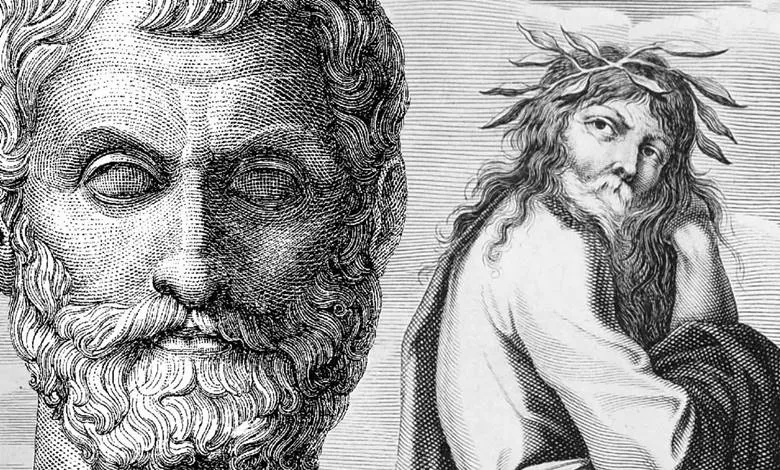
Thales of Miletus, a Greek thinker who lived in the sixth century BCE, is often called the first philosopher and the first scientist. He is traditionally credited with predicting a solar eclipse in 585 BCE, though historians debate whether he actually did, and an event that reportedly stopped a battle in its tracks. According to later tradition, he measured the height of the pyramids using shadows and geometry, though the historicity of that feat is uncertain. And he proposed that everything in the universe began with water, a wild idea that somehow launched an entire tradition of rational thought.
Thales of Miletus was a sixth-century BCE Greek thinker, widely considered the first philosopher and scientist. He is traditionally credited with predicting a solar eclipse in 585 BCE, with measuring pyramid heights through geometry, and with arguing that water was the fundamental substance of all things.
- Thales lived in Miletus, an ancient Greek city on the coast of what is now Turkey, during the sixth century BCE.
- He is credited with predicting a solar eclipse that occurred in 585 BCE, which allegedly halted a battle between the Lydians and the Medes.
- According to tradition, he calculated the height of the Egyptian pyramids by measuring their shadows at the moment when a person's shadow equals their height.
- Thales proposed that water is the arche, the fundamental substance from which everything else derives.
- He was counted among the Seven Sages of Greece, a group of revered early thinkers and statesmen.
The Man Who Started Asking Different Questions
Around 620 BCE, in the Ionian Greek city of Miletus on the coast of Asia Minor, in what is now Turkey, a man was born who would change how humans think about the world. His name was Thales of Miletus. He died around 550 BCE, and in the roughly seventy years between those two dates, he became the person Aristotle would later call the first philosopher.
That label is not a casual compliment. In Book I of the Metaphysics, Aristotle identified Thales as the originator of inquiry into first principles, the man who first asked what everything is made of rather than which god caused which event. Plato went further in the Protagoras, naming Thales among the Seven Sages of antiquity alongside Pittacus, Bias, Solon, Cleobulus, Myson, and Chilon. Being on that list was not about wealth or military victory. It was about wisdom, and Thales earned his place.
He was also the first of the pre-Socratic natural philosophers and the best-known founder of the Milesian school. But calling him only a philosopher undersells him. Thales practiced astronomy, geometry, and natural science. He watched the sky, measured the land, and poked at the strange behavior of rubbed amber. He was, in the truest sense, the first scientist in Western history, a man who looked at the world and expected it to make sense on its own terms.
Why does someone who lived 2,600 years ago still matter? Because he was the first to treat nature as a puzzle with a solution rather than a stage for the gods. Every scientist who has ever run an experiment, every philosopher who has ever asked "why," every student who has ever learned a theorem in a classroom is walking a path that Thales cleared. He did not have all the answers. He did not even have most of them. But he was the first to insist that the questions were worth asking.
The Eclipse That Stopped a War
On May 28, 585 BCE, the sky over Asia Minor went dark in the middle of a battle. Two armies had been fighting hard, and then daylight simply vanished. According to the account in Herodotus's Histories, Book I, Thales of Miletus had foretold that this eclipse would come. That report from Herodotus is the firm part of the story: the ancient historian does credit Thales with predicting the event that ended the fighting.
What happened next is the part that grabs people. Both sides reportedly stopped fighting and declared a truce when the sun disappeared. Picture it: soldiers on a field in western Anatolia, weapons in hand, watching the light drain out of the day. The eclipse became the reason the killing paused.
Here is where the story gets slippery, and it is worth being honest about that. The battle is traditionally described as one between the Lydians and the Persians, but Herodotus himself names the Medes, not the Persians, as the second army. So the identity of that opposing force is contested. And historians still debate two bigger questions: whether Thales actually predicted the eclipse at all, and whether the eclipse truly coincided with the battle. Those parts of the tale are uncertain, however famous they have become.
One thing the anecdote does give us is a rough anchor. This is how we roughly date the lifetime of Thales of Miletus, placing him in the sixth century BCE. A single darkened afternoon, remembered and retold, became the marker by which later writers fixed when the first philosopher lived.
Pyramids, Shadows, and the Birth of Geometry
Ancient writers say Thales of Miletus sailed to Egypt to study geometry, the science the Egyptians had already pushed further than anyone else. Diogenes Laërtius, Plutarch, and Proclus all pass along the story, though historians today suspect the trip may be a later embellishment rather than a documented fact. What nobody disputes is the reputation it earned him: the man who carried Egyptian measurement home to Ionia and turned it into something closer to proof.
The feat everyone remembers is the pyramid. According to the old accounts, Thales figured out how tall those monuments stood without climbing a single step. His trick came in two parts. When a pyramid's shadow happened to match its height exactly, you simply measured the shadow and you were done. When the shadow did not match, he reached for proportional triangles instead, comparing the shadow of a staff to the shadow of the pyramid and scaling up. Diogenes Laërtius and Plutarch both credit him with the method, but whether he actually pulled it off is uncertain. The same proportional reasoning, the story goes, let him calculate how far a ship sat from the shore, and later how far it lay from the top of a tower.
Tradition also attributes to him a small theorem that still shows up in classrooms: a triangle with two equal sides is isosceles. Proclus attributes the statement to him, though the attribution is traditional rather than firmly documented. Simple stuff, yes. But simplicity was the point. Those modest geometric truths cracked open a door that mathematicians have been walking through ever since.
Then there is the strangest entry on his résumé. Aristotle and Diogenes Laërtius report that Thales noticed something odd about amber. Rub a piece of it against fur, and it will pull in light things like chaff or dust. He had no word for what he was seeing, no theory of charge, no idea that he was watching the behavior of the electron. He just saw an invisible force reaching out of a stone and wrote it down. That single observation makes him the first person on record to notice and record electrostatic phenomena.
Everything Is Water: The First Materialist
Strip away the geometry, the eclipse, the olive presses, and what is left of Thales of Miletus is one strange, stubborn sentence: everything is water. Historians of philosophy file this under materialist monism, the claim that the whole of reality can be traced back to a single substance. For Thales, that substance was water, and nothing else came close.
Why water? The reasoning may have come from plain observation. Plants drink it, animals need it, people are made of it and cannot last long without it. Or it may have come from watching a puddle vanish under the sun and leave behind a crust of earth, as though water were quietly turning into solid ground. Either way, the leap is enormous: not a god, not a myth, but a physical stuff behind all things.
Water rewards that bet better than almost any other candidate. It is the one everyday material that shows up as solid, liquid, and gas, and shifts between those states before your eyes. Ice melts to water, water rises as vapor, vapor falls back as rain. If a single substance could wear three faces, why not everything?
Thales also held that the Earth floats on water, an idea Aristotle reports without much sympathy. The roots of that picture may reach back into myth, toward Poseidon, the ocean god, and the older Greek habit of treating the sea as the floor of the world. Whether Thales pictured that floating Earth as flat or as a sphere is genuinely contested. Some scholars argue his astronomy pushed him toward a globe; the evidence is ambiguous, and the debate has never been settled.
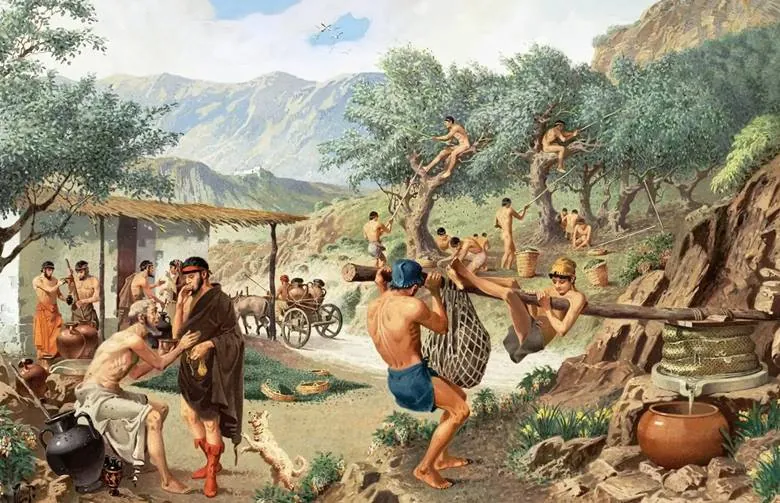
Then there is the story that keeps him human. Aristotle, in Book I of the Politics, tells how Thales used his reading of the stars to foresee an unusually bountiful olive harvest. Before the season turned, he quietly secured the rights to the olive presses. When the crop came in heavy and every grower suddenly needed to turn fruit into oil, Thales held the presses and made a fortune. Aristotle's point was not that philosophers should chase money, but that they easily could, if they cared to.
Two Deaths, One Man: Heatstroke or a Well
Thales of Miletus died around 550 BCE, and antiquity could not agree on how. Diogenes Laërtius hands down one version: the old man collapsed of heatstroke while watching an athletic contest, possibly the Olympic Games. It is a strangely fitting end for a thinker who spent his life outdoors, measuring shadows and squinting at the sky.
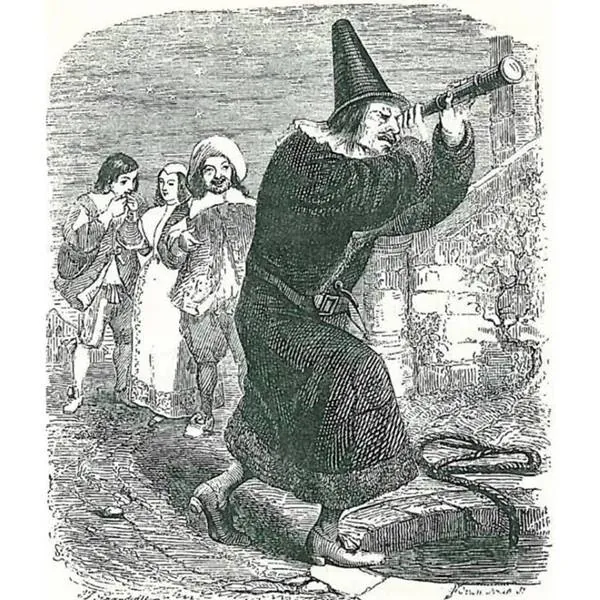
Then there is the other story, the one almost everyone has heard. Plato, in the Theaetetus, describes Thales tumbling into a well because he was too busy studying the stars to watch where he was walking. A servant girl, the tale goes, laughed at the man who knew everything about the heavens but nothing about the ground beneath his feet. Contrary to the popular version, this is not a death account at all. Plato offers it as a philosophical joke about absent-mindedness, a portrait of the dreamer so lost in thought he forgets the world around him.
Read the two together and something interesting surfaces. One tradition remembers a practical sage who died among crowds, at a festival, in the heat of a public spectacle. The other remembers a man with his head tilted permanently upward, oblivious to his own two feet. Practical sage, dreamy stargazer. Antiquity kept both versions alive because both felt true.
His real legacy does not live in either story. It lives in the geometry classroom. Every student who learns Thales' theorems, the ones about triangles and circles and proportion, says his name without ever thinking about wells or heatstroke. Twenty-six centuries after his death, that is the version of Thales of Miletus that keeps showing up.

Frequently asked questions
Who was Thales of Miletus and why is he called the first philosopher?
Thales of Miletus was born around 620 BCE in Miletus, an Ionian Greek city in Asia Minor, and died around 550 BCE. Aristotle, in Metaphysics Book I, treated him as the first philosopher because he was the first to ask what everything is made of. Plato also listed him among the Seven Sages.
How did Thales predict the solar eclipse of 585 BCE?
Herodotus, in Histories Book I, reports that Thales foretold the solar eclipse that fell on May 28, 585 BCE, though historians debate whether he actually did. How he did it is unknown, and whether the eclipse truly coincided with the battle it supposedly halted is also contested.
How did Thales measure the height of the Egyptian pyramids?
As the story goes, Thales measured the pyramids using similar triangles and shadow proportions. Diogenes Laërtius and Plutarch attribute this method to him, though the historicity of the feat is uncertain and may be legendary rather than documented.
What did Thales believe everything was made of?
Thales held that everything originates from water and that the Earth floats on water, as Aristotle reports. This doctrine is classified in the history of philosophy as materialist monism, the idea that all things can be traced back to a single material principle.
How did Thales die according to Plato?
Contrary to the popular version, Plato's Theaetetus does not present the well as Thales' cause of death. That story, of him falling into a well while stargazing, is an anecdote about absent-mindedness. Diogenes Laërtius records a different account: heatstroke while watching an athletic contest, possibly the Olympic Games.
Why is Thales considered the first scientist?
Thales is considered the first scientist for several reasons. He is credited as the first person to observe and record electrostatic phenomena, noting that amber rubbed with fur attracts light materials like dust. He applied geometry to real problems, and per Aristotle he foresaw a bountiful olive harvest and profited from olive presses.
What was the Milesian school?
The Milesian school was the pre-Socratic natural philosophy school that Thales founded in Miletus. It was the first tradition of thinkers to explain the world through natural causes rather than myth, and Thales was its first and best-known figure.
Did Thales really stop a battle between Lydia and Persia?
Herodotus reports that the eclipse halted a battle between the Lydians and the Medes. Whether Thales actually predicted that eclipse, and whether the eclipse truly coincided with the battle, is debated. The story is traditionally told, but the details remain uncertain. Editorial note: Details about Thales's life and achievements come from later ancient accounts, and any facts that remain unconfirmed are presented as such.
Got a take on this? Add your voice to the conversation below →
No comments yet. Be the first.