Feynman Restaurant Problem: The 1970s Notepad Solved
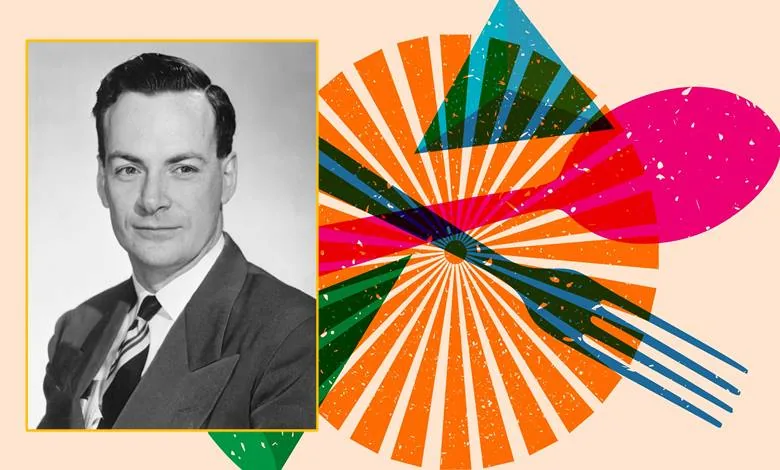
The Feynman restaurant problem reportedly began in the late 1970s, when physicist Richard Feynman filled a notepad with a question about how people choose what to order. The setting, as the story goes, was a dinner with a friend who could never settle on a dish. Feynman turned that small frustration into a formal puzzle about optimal stopping. Decades later, researchers tested his reasoning and found he had it essentially right.
Reportedly in the late 1970s, Richard Feynman worked out a notepad model of how a diner should choose from a menu. He framed it as an optimal stopping problem with a finite set of options. A later study reportedly confirmed that his solution matched how people actually behave.
- The problem reportedly took shape in the late 1970s, during a meal with a friend who could not decide what to order.
- Richard Feynman was a Nobel Prize winning physicist at the California Institute of Technology.
- He reportedly wrote the puzzle out by hand in a notepad, treating the menu as a sequence of choices to be evaluated one by one.
- Decades later, a study in PNAS reportedly examined whether people solve the dilemma the way Feynman proposed.
The Lunch That Became a Math Problem
Richard Feynman shared the 1965 Nobel Prize in Physics for his work on quantum electrodynamics, the theory that describes how light and matter interact. That is the official version of Feynman. The version that matters here is smaller and stranger: a physicist at a restaurant table, watching a friend freeze over a menu.
As the story goes, Feynman and his friend Ralph Leighton ate often at a Thai place in Glendale, California, sometime in the late 1970s. Leighton reportedly had a favorite there, ginger chicken, and that dish is where the whole thing starts. Night after night he ordered it. Then came the evening he hesitated: the usual, or something new that might be better?
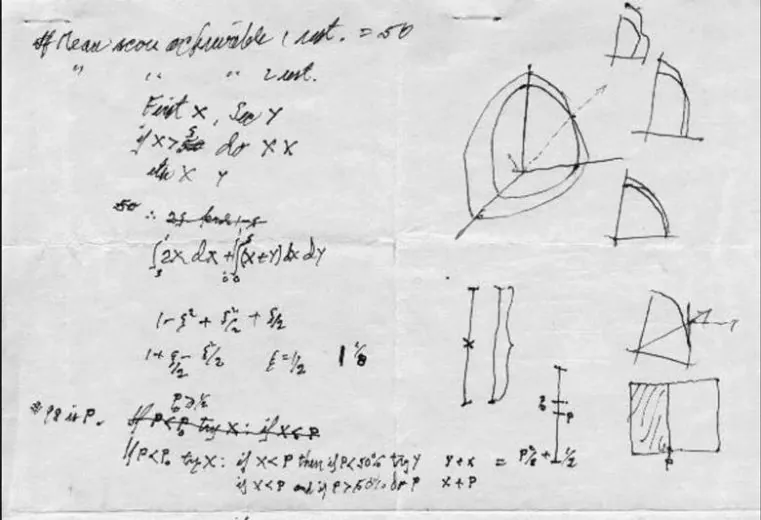
Feynman did what Feynman did. According to the original account, he turned the choice into a mathematical problem and worked it out on a notepad page right there at the table. The equation answered a question every diner knows: at what point do you stop gambling on the unknown and settle in with the dish you already trust?
That is the Feynman restaurant problem in its original form, and it is worth sitting with for a second. It is not really about food. It is about how much of your remaining time is worth spending on hope.
How the Notepad Survived for Decades
Ralph Leighton kept the page. That single sheet of paper, covered in Richard Feynman's cramped handwriting, sat somewhere safe for years while the Feynman restaurant problem stayed locked inside it. Feynman himself never published the analysis. He died on February 15, 1988, and the math he scratched out between bites of lunch went with him, at least as far as the public record was concerned.
Leighton did not let it disappear. Years after those lunches, he sat down with the page and worked through Feynman's thin, hard-to-read script as far as he could. He got partway there, a partial deciphering rather than a full one. According to the original account, he described the whole effort in a piece published online in the early 2000s, which is how a scrap of lunchtime arithmetic first reached an audience wider than one physicist's close friend.
Then it went quiet. For roughly a decade, the problem sat untouched.
Around 2013, the cognitive scientist Tom Griffiths reportedly picked it up. As the story goes, he was working on a book at the time with Brian Christian, a writer with a background in computer science and cognitive science. Griffiths reportedly went further than Leighton had, producing what is described as the first complete transcription of the notes. Even that did not restart the conversation. The problem slipped back into silence for nearly another decade.
Two things stand out in that stretch. First, the page survived at all, which depended entirely on Leighton deciding a scribble was worth keeping. Second, the gap between a solved problem and a recognized one was not measured in months. It was measured in decades, and the Feynman restaurant problem waited through every one of them.
What the Feynman Restaurant Problem Actually Asks
Picture yourself landing in a city you have never visited, with seven dinners ahead of you and no idea where to eat. Each night you face the same fork in the road: walk into some unfamiliar place, or go back to the best restaurant you have found so far. Your goal is not to find the single best restaurant in town. It is to squeeze the most total pleasure out of the whole week.
Mathematicians have a name for this family of questions. They call it an optimal stopping problem, and once you notice the shape of it, you start seeing it everywhere. House hunting is one. So is choosing a job, or circling a crowded block for parking. In each case you have to decide, with limited information and a clock ticking, whether what you have in hand is good enough or whether you should keep looking.
The restaurant version has a twist that the house and the job do not. Miss out on a house and it is gone. Miss out on a job offer and someone else takes it. But a restaurant you liked is still standing tomorrow night. You can always walk back in. That single difference changes what you are optimizing. You are not hunting for the peak. You are arranging a week of meals so that the sum comes out as high as possible.
A quality threshold is the minimum level a place has to clear before you stop exploring and settle in. Set it too low and you lock onto a mediocre dinner on night one. Set it too high and you spend the week searching while your favorite table sits empty.
Feynman's notes reportedly describe a strategy built on exactly that threshold, and the threshold moves. According to the original account, it starts high at the beginning of the trip, because you still have plenty of nights left and every new restaurant is a live possibility. Then it slides downward as the week runs out. By the final evening, the bar for trying somewhere new has dropped low, since a gamble now costs you a dinner you could have spent somewhere you already know is good.
That falling threshold is the whole trick, and it is the detail that makes the Feynman restaurant problem more than a cute anecdote about a physicist who liked Thai food. It is a rule you can actually follow, and as later work would suggest, it is a rule close enough to optimal that the difference barely shows up on the bill.
2021: Christian and Griffiths Reopen the Problem
Brian Christian and Tom Griffiths reportedly picked the Feynman restaurant problem back up in 2021. By Christian's own telling, the two of them had finally understood what Feynman's cramped notes were actually saying. Understanding, though, was not the same as finishing. There was still a lot of work left to do.
So they did it. The researchers reportedly confirmed that Feynman had genuinely found the optimal solution all those years earlier, not an approximation, not a lucky guess, but the real thing. They then reportedly went further and solved a more general version of the problem, one that stretched the same logic past the narrow case Feynman had scratched out by hand.
The findings reportedly appeared in the Proceedings of the National Academy of Sciences, with the source listing the paper as Christian, B., Russek, E. M. & Griffiths, T. L., Proc. Natl Acad. Sci. USA. The exact June 1 publication date attached to that paper is not something we can confirm, so treat the date with a little caution.
What matters is the arc. A physicist doodles a solution on a notepad, a friend keeps the page, and decades later two cognitive scientists sit down and prove him right.
Testing Feynman's Strategy on 2,520 Real People
Proving that Richard Feynman's threshold rule was mathematically optimal was only half the job. The researchers wanted to know something messier: do actual humans, dropped into the same dilemma, behave anything like the physicist's ideal calculation?
To find out, the team reportedly recruited 2,520 participants online and handed them a digital version of the scenario. Instead of a single street of restaurants, players reportedly faced a grid of restaurants scattered across a virtual city. Every restaurant reportedly carried a hidden quality score, and that score stayed invisible until the moment you walked in for the first time. The task was simple to state and hard to play: rack up the highest possible total points across a fixed number of nights. As the story goes, each participant got exactly one run at the game, no retries, no second chances to learn the map.
What the data reportedly showed was not a city full of tiny Feynmans. People did not execute the optimal strategy to the letter. Instead they reportedly leaned on a simpler rule, and the shape of it is familiar to anyone who has ever planned a trip. At the start, participants were picky. A restaurant had to clear a high bar before they would commit and stop exploring, because with plenty of nights still ahead, the odds of finding something better felt strong. As the days drained away, that bar dropped. Near the end, people settled for places they would have walked past on night one.
Here is the part that reportedly surprised the researchers. That rough, intuitive rule did not just work. It worked remarkably well, reportedly landing at roughly 90 percent of the outcome Feynman's mathematically perfect strategy would have delivered, though that figure cannot be independently confirmed. A shortcut built on gut feeling, it turns out, gets you most of the way to the summit.
Why "Good Enough" Beats "Perfect" and What It Means for AI
The Feynman restaurant problem ends with a quiet twist about how real minds work. People are not perfect calculators. They never were. What they do instead is spend limited time, attention and mental effort efficiently, and that turns out to be a strategy worth studying.
According to the original account, the result reportedly lines up with an approach in cognitive science known as resource rationality. The idea is simple enough to state and hard to live by: the human mind often does not find the perfect solution, but it does pick a practical, workable one. In the restaurant version, that meant a simpler rule than Feynman's threshold, one that still landed close to the ideal outcome.
This is where the story stops being about dinner. Most AI systems assume humans behave as perfectly rational actors, which means they are built to predict a kind of person who does not exist. This study suggests humans are flawed but effective decision makers, and that gap matters. An AI trained on the fantasy of the flawless optimizer will misread the actual person sitting across from it.
So the practical takeaway is forward-looking. AI systems that model human behavior more realistically could perform better in the future, whether they are recommending, negotiating or simply trying to guess what someone will do next.
There is one more detail worth holding onto. Richard Feynman died in 1988 and never published his restaurant analysis. The notes he scribbled during lunch were reportedly re-solved more than forty years later, though the timeline cannot be confirmed. He solved it for a friend's menu, not for a journal, and the answer waited decades for someone to finish the arithmetic.
Frequently asked questions
What is the Feynman restaurant problem?
The Feynman restaurant problem is a diner's choice between a familiar favorite and a risky new dish, reframed as an optimal stopping problem. The goal is not simply to find the single best restaurant. It is to maximize your total enjoyment across an entire trip, night after night.
How did Richard Feynman solve the restaurant dilemma?
According to the original account, Feynman reportedly worked out a "quality threshold" strategy on a notepad page. The threshold starts high early in the trip, when there is still time to explore, and drops as the trip nears its end, when returning to a known good option makes more sense.
Why do people not use the optimal strategy when choosing restaurants?
In an experiment reportedly involving 2,520 online participants, people did not follow Feynman's exact strategy. They reportedly used a simpler rule instead, growing less selective as the nights ran out, and still reached about 90% of the optimal outcome. The account links this to the "resource rationality" approach in cognitive science.
Who transcribed Feynman's handwritten notes about the restaurant problem?
Ralph Leighton, Feynman's friend, reportedly kept the notes and partially transcribed the difficult handwriting, sharing his interpretation online in the early 2000s. Years later, cognitive scientist Tom Griffiths reportedly completed what is described as a full transcription of the notes.
Was Feynman's restaurant solution actually optimal?
Reportedly, the researchers confirmed that Feynman had indeed found the optimal solution, and they extended it to a more general version of the problem. Their findings reportedly appeared in the Proceedings of the National Academy of Sciences.
Did Feynman ever publish his restaurant problem analysis?
No. Richard Feynman, the Nobel Prize-winning physicist, died in 1988 and never published his restaurant analysis. The notes he scribbled during lunch were reportedly re-solved more than forty years later, turning a casual mealtime puzzle into a formal mathematical study. Editorial note: Details that remain unconfirmed are presented as such and hedged in the text above.
Got a take on this? Add your voice to the conversation below →
No comments yet. Be the first.