Euler Line and Nine-Point Circle: Geometry's Hidden Order
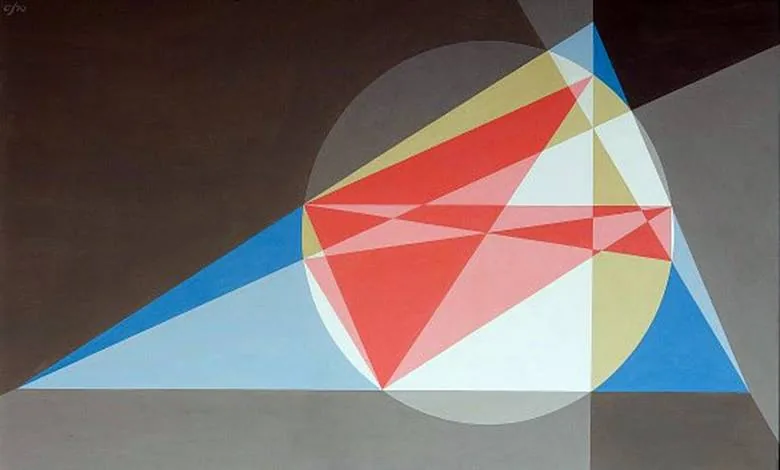
The Euler line and nine-point circle are two of geometry's most elegant discoveries, showing that a triangle's centroid, circumcenter, and orthocenter always sit on one straight line, while nine special points always land on a single circle. Leonhard Euler addressed the collinear result in 1763, and the full nine-point circle came together over the following decades. These aren't coincidences. They're hidden order baked into every triangle, no matter how lopsided it looks.
In any triangle, the centroid, circumcenter, and orthocenter always lie on a single line called the Euler line, with the centroid sitting two-thirds of the way from the orthocenter to the circumcenter. Separately, nine specific points, including the midpoints of the sides and the feet of the altitudes, always fall on one circle whose radius is half the circumradius.
- Leonhard Euler addressed why a triangle's centroid, circumcenter, and orthocenter are always collinear in 1763, a line now called the Euler line.
- The nine-point circle passes through the three side midpoints, the three altitude feet, and the three midpoints between each vertex and the orthocenter.
- The nine-point circle's radius is exactly half the triangle's circumradius, and its center lies at the midpoint of the orthocenter and circumcenter.
- Karl Wilhelm Feuerbach proposed his tangency theorem about the nine-point circle in 1822, showing it touches the incircle and the three excircles.
- The centroid divides the Euler line so that the distance from the orthocenter to the centroid is twice the distance from the centroid to the circumcenter.
The Triangle's Hidden Meeting Points
Draw any triangle on a scrap of paper. Now grab a ruler and a pencil and try three completely unrelated constructions on it. Mark the midpoint of each side and draw a line straight through it at a right angle. Then connect each corner to the midpoint of the side facing it. Then drop a perpendicular from each corner down to the opposite side. Three different rules, three different sets of lines, and yet each set quietly collapses into a single point. That is the small miracle sitting under every triangle you have ever sketched.
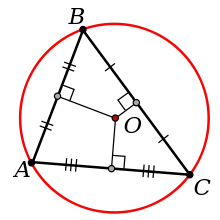
Geometry teachers give these meeting points names. The perpendicular bisectors, the lines that cut each side in half at a right angle, all cross at the circumcenter, usually written O, because it is the center of the circle that passes through all three corners. The medians, the lines from each vertex to the midpoint of the opposite side, all cross at the centroid, G, the triangle's balance point. And the altitudes, the perpendiculars dropped from each vertex to the opposite side, all cross at the orthocenter, H. Same triangle, three separate agreements about where to meet.
Here is what makes it strange. Nothing in the definition of a perpendicular bisector mentions medians. Nothing in a median mentions altitudes. They are built from different ingredients, chasing different goals, and yet on any triangle you can draw, acute, obtuse or right angled, they behave as if they had agreed on a schedule in advance. A single point from each family, sitting there on the page, waiting to be noticed.
So a natural question follows. Do these three points know about each other? Is there some hidden thread running between the circumcenter, the centroid and the orthocenter, or is their coexistence just a coincidence of drawing? That question is exactly what the Euler line and nine-point circle eventually answer, and the man who first pinned it down was Leonhard Euler, the Swiss mathematician who lived from 1707 to 1783.
Three Points, One Line: Euler's 1763 Discovery
Leonhard Euler, the Swiss mathematician who lived from 1707 to 1783, asked a question in 1763 that most people had never thought to ask. Why do three points that seem to have nothing to do with each other always end up sitting on a single straight line?
Picture the setup. Take any triangle. Find the point where the three perpendicular bisectors meet, the circumcenter, the center of the circle that passes through all three corners. Find the point where the three medians meet, the centroid, the triangle's balance point. Find the point where the three altitudes meet, the orthocenter. These three centers are built from completely different constructions. There is no obvious reason they should care about one another.
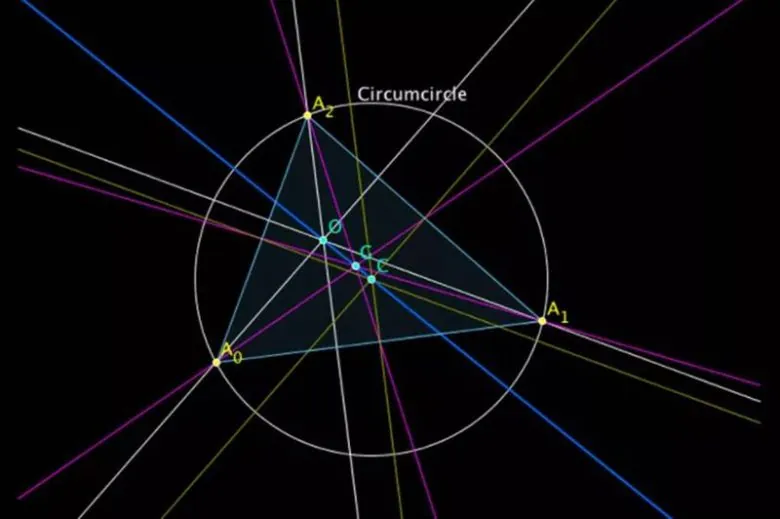
And yet they do. Euler showed that the circumcenter, the centroid, and the orthocenter are always collinear. A single line runs through all three. It carries his name now: the Euler line.
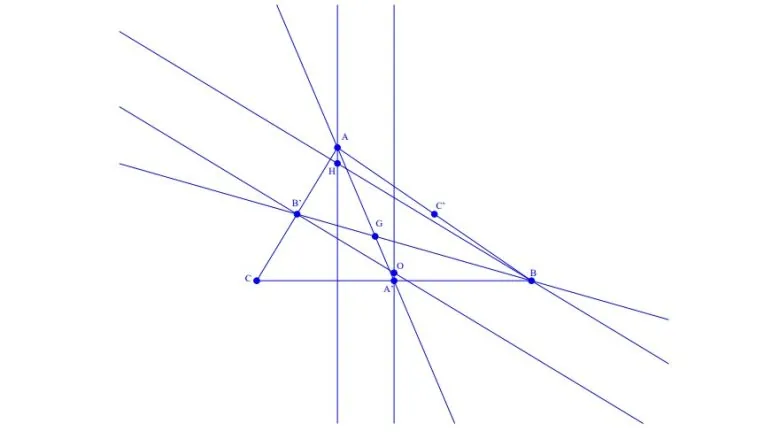
The relationship gets even tighter. If H is the orthocenter, G the centroid, and O the circumcenter, then HG = 2·GO. The centroid divides the segment from orthocenter to circumcenter in a clean 2:1 ratio. Know where two of the points sit, and the third follows.
What makes this hold up is that it never breaks. Draw a sharp acute triangle, a sprawling obtuse one, or a right triangle, and the three centers still line up. The collinearity survives every shape you can throw at it.
There is one more piece that ties into the nine-point circle. The nine-point center, the center of that circle, lies on the Euler line too. All four points, orthocenter, centroid, circumcenter, and nine-point center, share the same line.
The Nine-Point Circle and Its Nine Points
Draw any triangle. Now mark nine points on it, and something almost unreasonable happens: all nine land on a single circle. Three of them are the feet of the altitudes, the spots where the perpendiculars dropped from each vertex meet the opposite side. Three more are the midpoints of the sides. The last three sit halfway along the segments that run from each vertex to the orthocenter, the point where the three altitudes cross. That circle is the nine-point circle, and it is the quiet partner of the Euler line.
Three points always define a circle, so a fourth point landing on it is already a small miracle. Nine? That took mathematicians a while. Leonhard Euler, the Basel-born giant who lived from 1707 to 1783, got part of the way there. What he actually proved, in the mid-eighteenth century, was that six of these points, the three side midpoints and the three altitude feet, lie on one circle. Contrary to the popular version, Euler did not establish all nine. The remaining three waited until 1820, when Charles Julien Brianchon and Jean Victor Poncelet published a proof that they join the same circle. Two years later, in 1822, Karl Wilhelm Feuerbach (1800-1834) pushed further still, proposing a theorem showing that this circle touches the triangle's incircle and its three excircles. That tangency carries his name today.
Now the part that trips people up. The nine-point circle has a center, obviously, and plenty of sketches place it in the wrong spot. Here is the correction: the nine-point center is the midpoint of the segment joining the orthocenter H to the circumcenter O. It is not the midpoint of the segment from H to the centroid G. That second claim shows up often, and it is simply false. Get the right pair of points, and the center falls exactly where it should.
Two elegant facts follow. Because the nine-point center sits midway between H and O, the nine-point circle has radius R/2, where R is the circumradius. Flip that around: the diameter of the nine-point circle equals the radius of the circumcircle. And since the midpoint of HO lies on the line through H, G, and O, the nine-point center takes its place on the Euler line alongside the orthocenter, the centroid, and the circumcenter. Four special points, one straight line.
Who Found the Nine-Point Circle? A Story in Stages
No single mathematician woke up one morning holding all nine points. The nine-point circle arrived in pieces, spread across roughly sixty years and three different countries, and the popular version that hands the whole thing to Euler gets the history wrong.
Start with Leonhard Euler (1707-1783), the Basel-born giant who spent his final years in St. Petersburg. Around 1765 he proved something genuinely striking: take a triangle, mark the three midpoints of its sides and the three feet of its altitudes, and those six points all sit on one circle. Six, not nine. That is the piece Euler actually earned, and it is worth saying plainly because the myth that he proved all nine points lie on a circle is simply false.
The gap stayed open for more than half a century. Then in 1820, two French mathematicians, Charles Julien Brianchon and Jean Victor Poncelet, published an article in Gergonne's Annales de mathématiques pures et appliquées proving that the remaining three points fall on that same circle. Those last three are the midpoints of the segments joining each vertex to the orthocenter, the point where the triangle's three altitudes meet. With Brianchon and Poncelet, the full set of nine finally closed.
Two years later, in 1822, a German mathematician named Karl Wilhelm Feuerbach (1800-1834) pushed the story somewhere new. In his book Eigenschaften einiger merkwürdigen Punkte des geradlinigen Dreiecks, published in Nürnberg, he proposed a theorem about the nine-point circle that still carries his name. Feuerbach's theorem says the nine-point circle is tangent to the incircle and to the three excircles. That tangency is why you will sometimes hear the figure called the Feuerbach circle, and the touchpoint with the incircle called the Feuerbach point.
So the honest answer to who found it is: nobody, alone. Euler found six points. Brianchon and Poncelet finished the set in 1820. Feuerbach gave it its tangency theorem in 1822. The Euler line and nine-point circle belong to a relay race, not a single sprint.
Frequently asked questions
What is the Euler line of a triangle?
The Euler line is the single straight line that carries three special centers of any triangle: the circumcenter (O), the centroid (G), and the orthocenter (H). It exists for acute, obtuse, and right triangles alike. Leonhard Euler (1707-1783) addressed why these centers fall on one line in a paper presented in 1763.
What is the nine-point circle?
The nine-point circle passes through nine specific points of a triangle: the three altitude feet, the three side midpoints, and the three midpoints of the segments joining each vertex to the orthocenter. Its radius is exactly R/2, where R is the circumradius, so its diameter equals the circumcircle's radius.
Where is the nine-point center located?
The nine-point center (N) is the midpoint of the segment joining the orthocenter (H) and the circumcenter (O). Because it sits on that segment, it also lies on the Euler line, alongside the orthocenter, centroid, and circumcenter, which are all collinear.
What is the ratio HG = 2·GO?
The centroid G divides the segment from the orthocenter H to the circumcenter O in a 2:1 ratio, so HG = 2·GO. This means that if you know the position of any two of these centers, you can derive the third, a striking consequence of the Euler line.
Who discovered the nine-point circle?
The discovery came in stages. Leonhard Euler showed that six of the points (the side midpoints and altitude feet) are concyclic. In 1820, Charles Julien Brianchon and Jean Victor Poncelet proved the remaining three points lie on the same circle. Karl Wilhelm Feuerbach (1800-1834) then proposed his tangency theorem in 1822. Editorial note: Any facts that remain unconfirmed are presented as such, and readers should treat uncertain details with appropriate caution.
Got a take on this? Add your voice to the conversation below →
No comments yet. Be the first.