Emerald Cockroach Wasp: The Sting That Erases Escape
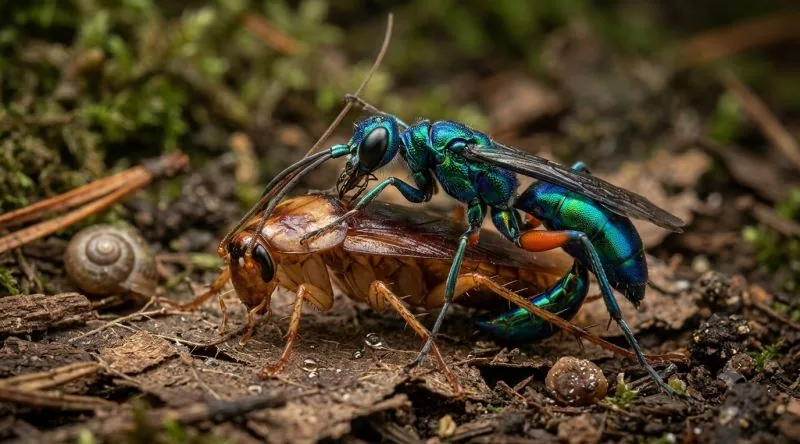
The emerald cockroach wasp, a metallic-green jewel wasp, performs one of nature's most precise acts of mind control: it stings a cockroach twice, and the second sting strips the insect of its will to flee. The first sting quiets the roach just long enough for the second. That second sting goes straight into the brain, and what walks away is no longer in charge of its own legs. The wasp then takes the roach by the antenna, like a leash, and walks it home to a burrow where it will be eaten alive.
The emerald cockroach wasp stings a cockroach twice. The first sting temporarily paralyzes its front legs. The second delivers venom into the brain, removing the roach's urge to escape while leaving it able to walk. The wasp then leads it underground to a burrow, where a larva consumes it alive.
- The emerald cockroach wasp is a solitary parasitoid wasp, and the female stings the cockroach's thorax first, briefly paralyzing its front legs.
- The second sting is delivered directly into the brain's subesophageal ganglion, the nerve cluster in the head.
- The second sting does not kill or paralyze the roach; it removes the insect's spontaneous urge to walk or flee while preserving its ability to move when led.
- The wasp grips the roach by one antenna and walks it to a prepared burrow, where she lays a single egg on the roach's body and seals the entrance.
- The hatched larva feeds on the still-living cockroach from the inside over several days, sparing vital organs until the end.
The Emerald Cockroach Wasp: A Jewel That Hunts the Unkillable
Meet Ampulex compressa, the emerald cockroach wasp. Its body glows in metallic green and blue, so vivid that it looks less like an insect and more like a tiny piece of jewelry that learned to walk. And that shimmering little jewel has picked one of the toughest targets on earth: the cockroach, an insect so famously hard to kill that popular legend has it surviving even a nuclear scenario.
But here is the twist that makes this story worth telling. The emerald cockroach wasp never tries to win by brute force. It does not tear its prey apart. It does not flood the cockroach with poison until the insect simply dies. Instead, it slips into the cockroach's nervous system and quietly rewrites the software running inside it, more like a surgeon than a predator.
That distinction matters. When most of us picture a wasp and its prey, we imagine a violent struggle, a sting, a body going limp. What actually happens between this wasp and this cockroach is stranger and far more precise. The cockroach is not overpowered so much as edited. Something in the way it decides to move, to flee, to survive gets switched off, and the wasp is the one holding the switch.
So before we get to the two stings and the long walk to a dark burrow, sit with the image for a moment. A small, brightly colored insect hunting the one bug we half-jokingly believe could outlast the end of the world. And winning not by killing it, but by taking the wheel.
How the Emerald Cockroach Wasp Hijacks a Cockroach Brain in Two Stings
The emerald cockroach wasp does not overpower its prey. It performs surgery. The first sting goes straight into the nerve center inside the cockroach's thorax, and the front legs go limp for just a few minutes. That is the whole point: a short, quiet window of stillness that lets the wasp line up the shot that actually matters.
Think about the scale of what is happening here. The cockroach is the larger animal, armored, famously fast, built on reflexes that fire before conscious thought even enters the picture. The wasp is much smaller. So it never tries to win a wrestling match. It goes after the wiring instead, hitting the thoracic ganglia first, the cluster of nerve tissue that runs the front legs. The paralysis that follows lasts only a few minutes, according to the experimental work done on Ampulex compressa. Not long. But long enough.
Then comes the second strike, and this is where the story turns strange. The wasp drives its stinger into the cockroach's head, targeting the nerve nodes there, the subesophageal ganglion. Some accounts describe microscopic sensors along the stinger that help the wasp find the exact patch of brain tissue it wants, but that detail is not firmly established in the literature. What is documented is the precision of the placement. This is not a wild stab. It is closer to a needle finding a specific address.
And the venom itself? It does not kill. It does not shut the cockroach down. If you watched only the body, you would see nothing wrong at all. The legs work. The muscles are intact. The cockroach can still respond to a poke, a draft, a shadow. What the venom actually does is alter neurotransmitter activity in one specific region of the brain, disrupting the escape reflex and something subtler still: the motivation to start moving in the first place.
That distinction is the entire horror of the mechanism. A paralyzed animal is trapped by its own body. This cockroach is trapped by something else. It retains every physical capacity it needs to run, and it simply never receives the impulse to use any of it. The body is fine. The decision is gone.
Two stings, two targets. The first buys time. The second rewrites what the cockroach wants to do.
Why the Stung Cockroach Can Walk but Never Run
Sting a cockroach with the emerald cockroach wasp and it will not fall over. Its legs still work, its muscles are untouched, and it still reacts when you poke it. What has vanished is the spark that says there is danger, I must flee. The body is whole. The will to use it is gone.
That is the part researchers keep circling back to. The venom of Ampulex compressa does not kill the roach or shut its system down. It alters neurotransmitter activity in a specific region of the brain, disrupting the escape reflex and the motivation to start moving at all. Nothing is severed. Nothing is numbed into stillness. The machinery hums along perfectly while the ignition stays cold.
So the insect becomes something stranger than a victim. It is a docile, meat-and-chitin robot, parked and waiting for a mechanical command from outside. Push it and it walks. Leave it alone and it does nothing. The cockroach cannot initiate its own survival behavior anymore, and that is a far more unsettling state than classic paralysis. A paralyzed animal at least signals that something is broken. This one looks fine.
Watch it for a minute and the wrongness settles in. Every reflex that should fire in the presence of a threat is still wired up, still capable, still ready. The command just never arrives. It is a body fully capable of running, held in place by a silence where its fear used to be.
The Antenna That Becomes a Leash
With the cockroach standing still and unresponsive, the emerald cockroach wasp turns to a strange piece of housekeeping. She severs one of her victim's antennae at the base and drinks the fluid that seeps out, a quick meal that restores the energy she burned during the struggle. Then she takes hold of the remaining antenna near its base, the way a person grips a dog's leash, and begins to walk.
The cockroach is many times heavier than she is. It does not matter. Step by step, tugged along by that single antenna, the much larger insect follows her across the ground and down into her burrow. From a distance the pair looks almost domestic, a small keeper leading a docile animal home. The real leash is not the antenna at all. It runs deeper, into the rewired circuitry inside the cockroach's head.
Inside the burrow, the wasp lays a single egg on the cockroach's thorax. Then she seals the entrance with stones and bits of debris, packing the doorway shut until the chamber is dark and closed. The cockroach stays inside. It is still alive, and it can still walk. It simply makes no attempt to leave. The cockroach remains alive and does not try to escape, though the exact reason is not fully understood. The idea that escape is somehow absent from its brain is a human way of framing an insect's silence, not a settled fact of neuroscience.
What happens next is the part that lingers. Over several days the egg hatches, and the larva begins to feed on the living cockroach from the inside. It works through the non-vital tissue first and saves the vital organs for last, a strategy that keeps its meal fresh and functioning for as long as possible. The cockroach remains alive through much of it, a host waiting inside its own sealed grave.
How the Emerald Cockroach Wasp Compares to Other Zombie Parasites
Nature has a whole gallery of parasites that hijack a host's behavior, and the emerald cockroach wasp (scientific name Ampulex compressa) sits in that gallery alongside some genuinely unnerving company. A horsehair worm drives its mantis host to water. Toxoplasma gondii strips fear from mice and leaves them easy prey for cats. Ophiocordyceps fungi zombify ants and lock them to a leaf. Each one is real, and each one has been documented in the scientific literature.
But watch the wasp work and the comparison starts to tilt. The horsehair worm drowns its host. Toxoplasma loosens a fear response. Ophiocordyceps takes over an ant's body and marches it up a stem. The wasp does something tighter: it performs two separate, precisely placed stings, one into the cockroach's thoracic nerve center and one into the subesophageal ganglion in the head, and the result is a host that is not paralyzed, not dead, and not even sick in any obvious way. Its legs work. Its muscles are intact. It can still react to a poke. What is gone is the impulse to start moving on its own.
That is the difference in kind, not just degree. The other parasites change what an animal does. The wasp changes whether the animal wants to do anything at all. And it does it with an injection so small and so targeted that the cockroach's body never registers the loss.
Which is why the ending of this story lands the way it does. We like to believe free will and the survival instinct are bedrock. Nature disagrees. A very long stretch of blind selection produced a small, bright insect with a needle that can switch off the single word "run" and leave everything else running perfectly. No dystopian sci-fi scenario is as jarring as that, because the wasp does not need to invent anything. It already exists, and it has been doing this quietly for a very long time.
Frequently asked questions
How does the emerald cockroach wasp turn a cockroach into a zombie?
The emerald cockroach wasp, scientifically named Ampulex compressa, stings a cockroach twice. The first sting hits the thoracic nerve center and briefly paralyzes the front legs for a few minutes. The second sting delivers venom into the subesophageal ganglion in the head, disrupting the cockroach's escape reflex and its motivation to start moving, without killing it.
What does the jewel wasp inject into the cockroach's brain?
The jewel wasp injects a specialized venom into or near the cockroach's subesophageal ganglion, a cluster of nerve tissue in the head. This venom does not kill the cockroach or shut its system down. Instead, it alters neurotransmitter activity in a specific brain region, suppressing the escape circuitry and the urge to initiate movement.
Why can a stung cockroach still walk but not run away?
After envenomation, the cockroach is not paralyzed. Its legs work, its muscular system stays intact, and it can still respond to external stimuli. What it loses is the ability to initiate escape behavior. The physical capacity to run is there, but the internal command to flee has been switched off.
Where exactly does the emerald cockroach wasp sting a cockroach?
The emerald cockroach wasp stings in two precise locations. The first sting targets the thoracic nerve center, the nerve tissue in the cockroach's chest. The second and more consequential sting is directed into the head, where the wasp injects venom into or near the subesophageal ganglion, the nerve cluster that helps govern the cockroach's behavior.
What happens to the cockroach after the wasp seals it in a burrow?
The wasp leads the cockroach by its remaining antenna into an underground burrow, lays a single egg on the cockroach's thorax, and seals the entrance with stones and debris. Inside, the cockroach stays alive and able to walk but makes no attempt to escape. The hatched larva then feeds on the living host over several days.
Is the cockroach dead or alive while the wasp larva feeds on it?
The cockroach remains alive while the wasp larva feeds on it. The larva consumes the cockroach's non-vital tissues first and leaves the vital organs for last, a strategy common among parasitoid insects. The cockroach stays in the sealed burrow, a living food source, until the larva finally reaches those vital organs. Editorial note: Details of this behavior are drawn from published entomological research, and any points that remain unconfirmed or vary by study are presented as such.
Got a take on this? Add your voice to the conversation below →
No comments yet. Be the first.