Double Indemnity: Wilder's 1944 Noir Masterpiece
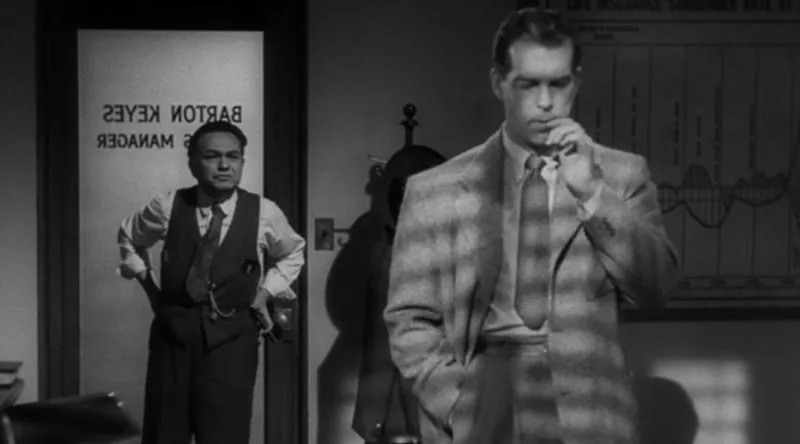
Double Indemnity, Billy Wilder's 1944 film noir, turned a sordid insurance murder into one of Hollywood's most enduring classics. It arrived in theaters when the genre was still finding its voice, and it gave that voice its sharpest tongue. Barbara Stanwyck's Phyllis Dietrichson is not a victim of circumstance but a woman who calculates every glance. The salesman who falls for her is no hero either, just a man who mistakes desire for a plan. Together they make a case study in how ordinary greed can curdle into something far darker.
Double Indemnity is a 1944 film noir directed by Billy Wilder, starring Barbara Stanwyck as the wife who draws an insurance man into murdering her husband for a payout. Written with Raymond Chandler from James M. Cain's novella, it became a defining noir and a lasting influence.
- Double Indemnity was released in 1944, directed by Billy Wilder and co-written by Wilder and Raymond Chandler.
- Barbara Stanwyck plays Phyllis Dietrichson, the femme fatale who draws an ambitious man into murder.
- It adapts James M. Cain's 1936 novella of the same name.
- The story follows an unhappy, ambitious housewife, her wealthy husband, and the insurance man pulled into her plan.
- Miklós Rózsa composed the score, and the film's dialogue, music and pace keep it gripping decades later.
Double Indemnity: The 1944 Noir That Still Burns
Double Indemnity hit theaters in 1944, and somehow it never aged out of the conversation. Billy Wilder, born June 22, 1906, and gone since March 27, 2002, directed it, and the screenplay carries his name alongside Raymond Chandler's. That pairing alone should make you curious.
The source material came from James M. Cain, who published the story in 1936. It is technically a novella, though plenty of people call it a novel, and the distinction hardly matters once Wilder and Chandler get their hands on it. What matters is the mood: smoke, shadows, a woman on a staircase, and a man who should have known better.
Barbara Stanwyck plays Phyllis Dietrichson, and her performance became one of the defining femme fatale turns in cinema history. She is cold and composed, and her danger is so quiet it feels almost polite. Miklós Rózsa wrote the score, and it does exactly what a great noir score should do. It tightens the air around every scene.
If black-and-white films usually make you reach for the remote, this one tends to change minds. It moves fast, it talks sharp, and it looks gorgeous in a way color rarely manages. Double Indemnity is not a museum piece. It is a film that still works on a Tuesday night, with the lights down and your phone face up on the table.
A Flashback Structure That Was Ahead of Its Time
Double Indemnity opens by showing us the ending first, and then it makes us wonder how anyone got there. A wounded man walks into a Los Angeles office late at night, and the film's whole engine becomes one question: how did things get to this point? For the 1940s, that reverse-order storytelling was genuinely unusual, and it still pulls you forward instead of letting you settle back.
What follows is a trap built in slow motion. An unhappy, ambitious housewife wants her wealthy husband gone, and she draws an ambitious man into the scheme through sheer allure. They call it the perfect murder, and the plan comes from a man who sells insurance for a living. He knows exactly what a fatal accident is worth, especially when a double indemnity clause promises twice the payout. Who better to design a killing than someone who prices death for a paycheck?
On paper, it is flawless. In practice, life refuses to cooperate. Unexpected misfortunes pile up, an investigation begins, and the people we met at the start start to change under the pressure. Fear of getting caught and dreams of a rich future turn the couple against each other, and once the masks come off, the only goal left is pinning the crime on the other person.
"When two people commit murder, they ride a tram together. One cannot get off before the other. They stick together to the end of the line. The end of the line is the cemetery."
That line is the movie in miniature, and the confrontations and betrayals that follow never let the tempo drop. Keyes, the insurance investigator, is the character you remember longest, and the scene where he rattles off suicide percentages is a small masterpiece of its own. Billy Wilder answers every question by the final frame except one, and it is the silliest one: how did those matches light with just one hand?
Barbara Stanwyck and the Femme Fatale Archetype
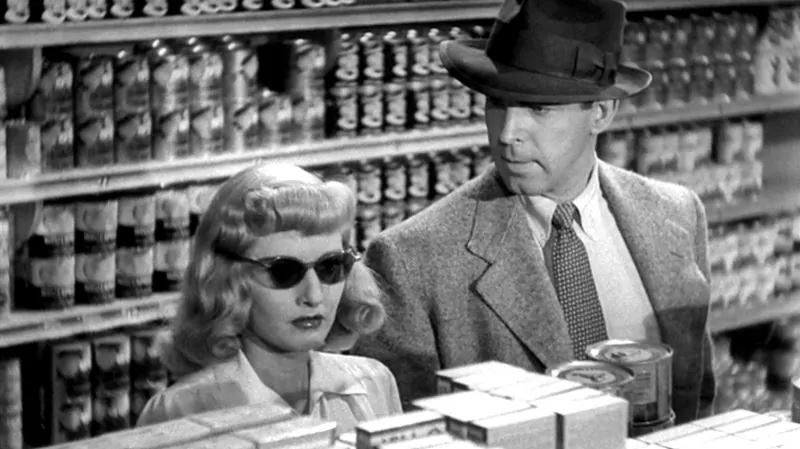
Barbara Stanwyck walked into Double Indemnity in 1944 and gave film noir its coldest woman. As Phyllis Dietrichson, she plays the unhappily married wife who wants her wealthy husband gone, and she plays her without a flicker of warmth. She is a woman without warmth, and the performance stands as one of the most successful femme fatale roles cinema has produced.
What makes the character work is the trap she sets. She pulls an ambitious man into her orbit, and the sexual tension between them is the engine of the whole noir atmosphere. The plan they build together comes down to a single seductive question: how do we commit the perfect murder? She never begs and she never explains. She simply makes the idea feel inevitable.
Stanwyck's restraint is the reason the film still holds up. She refuses to soften Phyllis into a victim or a monster, and that refusal is a key reason Double Indemnity endures. Stanwyck's Phyllis is the template for every cool, calculating femme fatale that followed.
A Personal Obsession: Hunting Down Double Indemnity on DVD
One viewer, posting as axellennox, turned Double Indemnity into a personal quest. The name kept surfacing everywhere, always attached to the same phrase: the summit of film noir. Months passed without a screening. Then a DVD copy finally turned up, and the mood was right, so the disc went into the player and the lights went down.
The opening credits alone justified the wait. Miklós Rózsa's score rolls out over a simple, striking image: a man approaching on crutches. Rózsa composed the music, and that title sequence is the kind you rewind just to sit inside it again.
Then the first line of dialogue landed like cold water. No subtitles. An English-language DVD with no subtitle track at all. The disc went back in its case after one more pass through those opening credits.
Obsession does not negotiate. A DivX version came next, three gigabytes, two full days of downloading. To watch it properly on a big screen, the file was burned to CD and fed into a DivX player. The contributor does the math with a grin: DVD money plus the internet bill equals a double indemnity, paid in full. Worth every lira.
Along the way came the claims that had fueled the hunt. Woody Allen's Manhattan Murder Mystery is said to be stuffed with references to Double Indemnity, according to the original account, though that link is contested. The same goes for the Coen brothers: Blood Simple and Fargo were reportedly lifted straight from Double Indemnity rather than from noir in general. Treat both as fan lore, not settled film history.
What is settled: Billy Wilder directed Double Indemnity in 1944, from a screenplay he wrote with Raymond Chandler, adapting James M. Cain's novella. Barbara Stanwyck's Phyllis Dietrichson remains one of cinema's definitive femme fatales. And Wilder, who lived from 1906 to 2002, left one question the film never answers. How do those matches light with one hand?
Billy Wilder: The Master Behind the Camera
Billy Wilder was born on June 22, 1906, and died on March 27, 2002, and in the ninety-five years between those dates he did something rare: he made films that belong to American cinema and to world cinema at the same time. Double Indemnity, which he directed in 1944, is the clearest proof of that. Watch it once and the argument is settled.
What makes his filmography so rewarding to dig through is range. He could build suspense, he could make you laugh, and often he did both inside the same scene. His cleverly crafted films are still sitting there waiting to be discovered by anyone who assumes black and white means boring. They are not dusty artifacts. They are sharp, funny, mean, and alive.
Double Indemnity is the best place to start. It is based on James M. Cain's novella, with a screenplay by Wilder and Raymond Chandler, and it stars Barbara Stanwyck as Phyllis Dietrichson, the femme fatale whose cold, calculating presence has been cited ever since as one of the finest examples of the role in film noir. The score came from Miklós Rózsa, and it does half the work of making your skin crawl.
There is a reason the film keeps pulling people back. It is the combination of a tight, cleverly constructed plot and a director who never wasted a shot. Wilder understood that suspense lives in the pause before the door opens, not in the door itself. That instinct runs through everything he touched, which is why his films still feel essential rather than merely historic.
If you have been putting off Double Indemnity because it is old, because it is in black and white, or because you think a 1944 movie cannot possibly hold your attention in the age of streaming, start there and work outward through the rest of Wilder's catalog. You will likely find, as so many viewers have, that the years fall away within the first few minutes.
Frequently asked questions
What makes Double Indemnity a classic film noir?
Double Indemnity, released in 1944, built its reputation on a reverse-order narrative that reveals the crime up front and then asks how events reached that point. Add a femme fatale, an insurance scam, and characters with no clean moral ground, and you have the template that film noir is measured against.
Who directed and wrote Double Indemnity?
Billy Wilder directed Double Indemnity, and he co-wrote the screenplay with Raymond Chandler. The film adapts James M. Cain's 1936 novella. Wilder, who lived from 1906 to 2002, shaped the picture from first frame to last, and that authorship is a large part of why it still holds up.
Why is Barbara Stanwyck's performance iconic?
Barbara Stanwyck played Phyllis Dietrichson, the femme fatale at the center of the scheme. Her portrait is cold, emotionless and sexy at once, and it is regularly counted among the most successful femme fatale roles in cinema history. The performance carries the film's sexual tension without ever raising its voice.
Was Double Indemnity based on a true story?
No. Double Indemnity is based on James M. Cain's 1936 novella of the same name, not on a real case. Wilder and Chandler turned that fiction into the screenplay, and the insurance murder plot is Cain's invention rather than a documented crime.
Did Double Indemnity win any Oscars?
The source material does not cover the film's Academy Awards record, so this account cannot confirm any wins or nominations. What it does document is the craft behind the film: Billy Wilder's direction, the Wilder and Chandler screenplay, and Miklós Rózsa's score.
How can I watch Double Indemnity today?
The source does not specify where or how to watch Double Indemnity now. What it does record is one viewer's long hunt for a copy, first a DVD without subtitles, then a downloaded file and a disc burned for the television, all to finally sit down with the film. Editorial note: Any details that remain unconfirmed are presented as such, and no unverified claims have been asserted as fact.
Got a take on this? Add your voice to the conversation below →
No comments yet. Be the first.