Earth's Rotation Speed: Why 2024 Saw a Shorter Day

Earth's rotation speed is not the steady tick we assume, and in recent years the planet has turned faster than it did through most of the last century, producing some of the shortest days on record. The change is tiny, measured in milliseconds, yet it matters because our clocks and our planet no longer agree. Atomic time marches ahead at a fixed rate while the spinning Earth drifts, and that gap has quietly forced scientists to add leap seconds for decades. Now the drift has flipped direction, and the world's timekeepers are weighing something they have never done before.
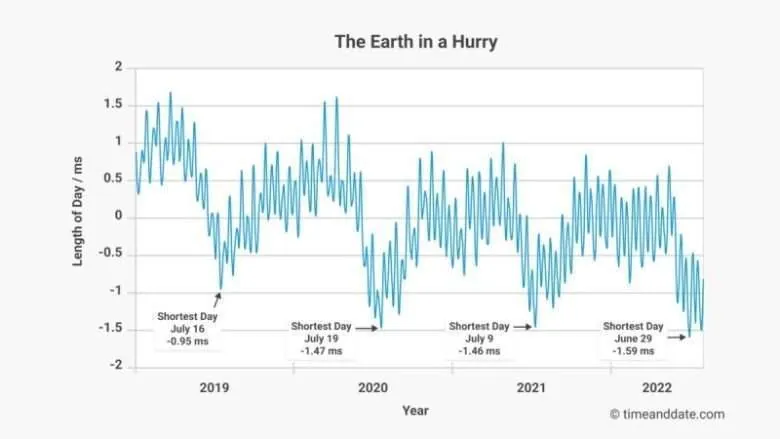
Earth's rotation speed varies slightly from day to day, and in recent years the planet has completed some rotations in less than 24 hours, setting records for the shortest days measured. Because atomic clocks keep steady time, this speed-up has prompted international discussions about a possible negative leap second, a step never taken before.
- Earth's rotation speed is measured against atomic clocks, which keep time far more steadily than the planet's spin.
- In recent years the Earth has logged some of its shortest days since precise measurements began, though the difference amounted to only milliseconds.
- The Moon's gravitational pull, known as tidal friction, gradually slows Earth's rotation over long timescales.
- The leap second system, used since 1972 to keep civil time aligned with Earth's rotation, faces a long-term plan for abolition, though the timeline is debated.
- Coordinated Universal Time, or UTC, is the global time standard that leap seconds are designed to protect.
Why Does Earth's Rotation Speed Keep Changing?
Earth's rotation speed is not completely constant. A full turn of the planet on its axis can run milliseconds longer or shorter from one day to the next. That tiny wobble sounds like a rounding error, but it sits underneath every clock, satellite and navigation system we depend on.
For most of human history, broadly speaking, people read the time off the Sun. The common picture is a day that ran from one sunrise to the next, and that was close enough for farming, sailing and prayer. Nobody could have guessed that the planet itself was quietly drifting out of step with the sky above it.
Then came the 1950s. Scientists built atomic clocks that could measure time with a precision no pendulum or sundial ever approached, and the first practical cesium atomic clock arrived in 1955. Almost immediately, the instrument revealed something its makers had not expected. It showed that Earth's rotation is nowhere near as tidy as everyone had assumed.
The modern second is now officially defined as roughly 9 billion vibrations of a cesium atom, precisely 9,192,631,770 cycles of cesium-133. According to the International Bureau of Weights and Measures, a day is 86,400 of those seconds. Clean, exact, and on paper, perfect.
The trouble is that Earth never signed that contract. Atomic clocks made it plain that a day does not always contain exactly 86,400 atomic seconds. The planet's rotation period shifts by century, by month, and even by day, which means the planet itself is always slightly out of step with the clocks.
So the next time you glance at a clock and assume the day is a fixed unit, remember what happened in that 1955 laboratory. The most accurate timekeeper ever built did not just measure the world. It caught the world cheating.
Why Is Earth Speeding Up After Billions of Years of Slowing Down?
For billions of years, the story of Earth's rotation speed has been a story of slowing down. The Moon's gravity drags on our oceans, tidal friction eats away at our spin, and the days get longer. Then, around 2020, something strange happened. The planet started speeding up instead.
This is not a subtle shift hidden in a lab notebook. Before 2020, the length of a day hovered just a few milliseconds below the long-term average. Over the last five years, according to the pattern reported in recent coverage, days have been running up to half a millisecond shorter than average, with the effect showing up most often in July and August. On July 5, 2024, atomic clock readings cited in coverage put the day at roughly 1.66 milliseconds shorter than average, though that precise figure is hard to confirm independently. The number is almost comically small. It also matters enormously, because the global systems that run modern life depend on timekeeping that is far more exact than that.
To feel how strange this is, you have to zoom way out. During the Roman Empire, one estimate holds that a day ran about 40 milliseconds shorter than it does today, though that figure is contested and may be too large. Over the roughly 66 million years since the dinosaurs went extinct, the length of a day is estimated to have grown by about half an hour in total, a figure that is approximate rather than confidently settled. Millisecond by millisecond, century by century, the planet has been winding down.
Which is exactly why the recent reversal has caught researchers off guard. The long arc still points toward longer days. The short arc, right now, points the other way. Somewhere deep inside the planet, or in the way its mass is distributed, something has changed just enough to nudge the spin faster, and the days have quietly gotten shorter while almost nobody was looking.
Why Earth Spins Faster or Slower: The Ice Skater and the Core
Picture a figure skater mid-spin. Arms tucked in tight, she whips around fast. Arms flung wide, and she slows down. That single image explains more about Earth's rotation speed than any equation, because our planet obeys the exact same law of physics: conservation of angular momentum. When mass moves closer to the axis of spin, rotation speeds up. When mass drifts outward, rotation slows. Earth is that skater, and its "arms" are oceans, ice, atmosphere, and molten rock.
So when some chunk of the planet's mass shifts from one place to another, the total spin rate has to adjust to compensate. Simple as that. And the biggest of those shifts happen far below our feet, in the molten interior.
Here's where it gets genuinely strange. Those deep inner layers trade angular momentum back and forth with the rest of the planet. One hypothesis holds that when the core slows down, the outer layers speed up in response, and some researchers have pointed to this exchange as one possible explanation for the unusually short days we've seen lately. But whether core dynamics are the major cause remains an open question. The physics of core-mantle coupling is real. Naming it the single culprit is not settled science.
The core isn't the only hand on the dial. A study published in Nature in 2024 reportedly found that climate change is quietly working against the speed-up, though that specific finding cannot be confirmed and should be read as a reported result rather than settled fact. As polar ice melts, that water spreads across the oceans, pushing mass farther from Earth's axis. Think of the skater extending her arms. The spin eases off, just a little.
Then there are the seasonal wobbles. Shifting air masses are documented contributors to these fluctuations. Animal migrations and even tree leaf growth have also been floated as factors, but those claims are dubious and lack scientific support, so it is safer to set them aside. The idea is that in spring, leaves lift mass off the ground; in autumn, it drops back down. Each shift alone is tiny. Stacked together, the thinking goes, they nudge the planet's spin into a gentle ripple.
What emerges isn't one cause but a tug-of-war. Core dynamics pulling one way. Melting ice pulling the other. Seasonal mass shifts adding small tremors on top. Earth's rotation speed is the sum of all these competing forces, which is exactly why it refuses to hold still.
The Moon Has Been Slowing Earth Down for 4.5 Billion Years
Pull back far enough from the last few years and the picture changes completely. The Moon's gravity drags on the oceans and raises tides, and those tides crash against the continental shelves every single day. That relentless tidal friction has been braking Earth's rotation since the Moon formed roughly 4.5 billion years ago. On the cosmic timescale, nothing else comes close.
Compare that to the forces we usually talk about. Melting ice, shifting air, churning core material: each one nudges Earth's rotation speed by a sliver. Stacked against a single continuous force that has been acting for billions of years, they barely register. The Moon is the long game.
Which leads somewhere strange. If the Sun were not going to swell into a red giant and swallow Earth in about 5 billion years, the tidal braking would keep running until Earth's rotation matched the Moon's orbit. The planet would stop turning relative to the Moon and show it the same face forever, the way the Moon already does to us. That is where the physics points in theory, but the scenario stays speculative and unconfirmed, because the Sun's red-giant phase arrives first and ends the experiment before it can finish.
For decades, scientists assumed the slowdown would simply continue. Days would keep stretching, century after century, with no interruption. That assumption held until the recent speed-up broke it. Earth is currently spinning a touch faster than it was, and days have been running short.
Do not read that as a permanent reversal. The temporary speed-up comes from irregular changes in the planet's outer core, and it will not outlast the tide. In the long run, tidal friction dominates again, and the days start lengthening once more. What we are living through is an anomaly inside a trend, not a new direction for the planet.
The Negative Leap Second: A Y2K-Style Risk Hiding in Our Clocks
The leap second system was established internationally in 1972, as a joint framework under the International Bureau of Weights and Measures and the International Telecommunication Union, to reconcile the atomic-clock day with Earth's actual rotation period. Contrary to the popular version of the story, the National Institute of Standards and Technology did not create it alone; NIST took part, but the system was never a single laboratory's invention.
Here is how it works. When the gap between atomic time and Earth's rotation crosses a threshold, the International Earth Rotation and Reference Systems Service announces that an extra second has to be inserted. The General Conference on Weights and Measures requires Coordinated Universal Time to stay within one second of Earth's rotation, so the correction cannot wait indefinitely.
Since 1972, only seconds have been added. Removing one has hardly been considered. That is the strange part: for more than fifty years the system has only ever run in one direction.
If Earth continues to speed up, the only way to correct the difference would be a negative leap second, meaning a second taken out of the system instead of added to it. No such deletion has ever been performed.
Some timekeeping experts reportedly regard this as a risk comparable to the Y2K panic, on the grounds that digital systems may not be prepared for it. That comparison is not confirmed as a widely held expert view, so treat it as a reported concern rather than a consensus.
Authorities do plan to abolish the leap second entirely. According to some accounts, the change could come as early as 2027 and allow up to one hour of difference between Coordinated Universal Time and Earth's rotation. That version does not match the record: the General Conference on Weights and Measures decided in 2022 to abolish leap seconds by 2035, and the tolerance involved is far smaller than an hour.
Whatever solution is chosen, the planet keeps turning. Sometimes a little faster, sometimes a little slower, and never quite as perfectly as a clock.
Frequently asked questions
What is Earth's rotation speed and why does it change?
A day is officially 86,400 atomic seconds, but Earth's actual rotation wobbles around that figure by milliseconds. The International Bureau of Weights and Measures sets the 86,400-second day, while tidal friction, shifts in the molten core, and moving mass all nudge the real spin. Earth's rotation speed is therefore a moving target, not a fixed constant.
Why did Earth spin faster in 2024?
Since roughly 2020, Earth has been logging unusually short days, reversing a long-term slowing trend. One possible explanation involves angular momentum exchange inside the planet: when the molten core slows, the rest of Earth may speed up. That core effect is a suspect, not a verdict, and researchers still debate how much it truly explains.
How does the Moon slow down Earth's rotation?
The Moon's gravity pulls on the oceans, creating tides that drag against the continents. That tidal friction has been braking Earth ever since the Moon formed about 4.5 billion years ago. The effect is tiny per day, but across deep time it adds up, which is why days today are longer than they were in the distant past.
What is a negative leap second and why might we need one?
Since 1972, timekeepers have only ever added leap seconds to Coordinated Universal Time, never removed one. A negative leap second would do the opposite: delete a full second from the clock to correct for Earth spinning slightly fast. It has never been used, and if Earth keeps speeding up, it may become the only fix available.
Was July 5, 2024 the shortest day ever recorded?
July 2024 did produce some remarkably short days, and July 5 is often cited as the standout. According to coverage, atomic clocks put that day at 1.66 milliseconds below average, though the precise figure is hard to confirm independently. Treat the exact number as reported rather than settled.
Did climate change affect Earth's rotation speed?
A 2024 study in Nature reportedly found that melting polar ice partially counteracts the recent speed-up, though that specific finding cannot be confirmed. As glaciers melt, water spreads across the oceans, pushing mass away from the poles. Like a skater extending her arms, that redistribution slows the spin a little, working against the core-driven acceleration.
How do atomic clocks measure Earth's rotation?
The SI second is defined by 9,192,631,770 transitions of a cesium-133 atom, roughly 9 billion vibrations. Cesium atomic clocks built in the 1950s made that precision possible. By comparing this relentless atomic tick against the observed spin of the planet, scientists can detect variations of just a few milliseconds.
Why are scientists planning to abolish leap seconds by 2027?
Reports suggest authorities want to retire the leap second as early as 2027, allowing up to an hour of drift between Coordinated Universal Time and Earth's rotation. The confirmed timeline differs: the General Conference on Weights and Measures decided in 2022 to abolish leap seconds by 2035. Treat the 2027 date and the one-hour tolerance as unconfirmed. Editorial note: Details that remain unconfirmed or are still under scientific discussion are presented here as such, and no figures have been invented.
Got a take on this? Add your voice to the conversation below →
No comments yet. Be the first.