Doggerland: Europe's Lost Land Under the North Sea
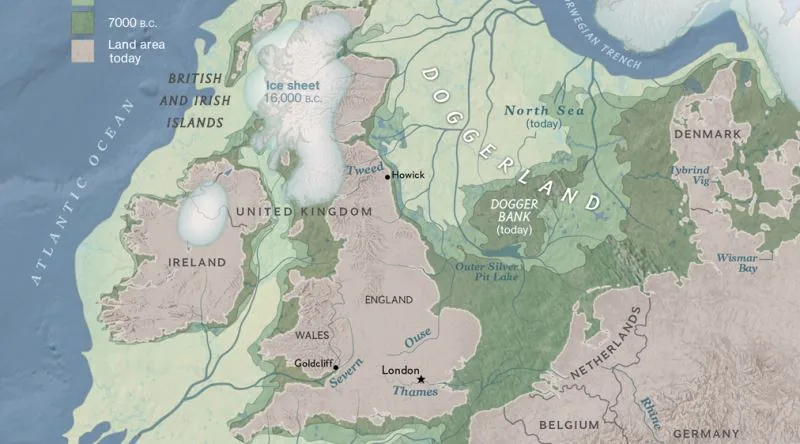
Doggerland was a vast, low-lying plain that connected Britain to mainland Europe until it was slowly drowned by rising seas and finally devastated by a massive tsunami around 6200 BCE. This lost Mesolithic world, now buried beneath the North Sea, was home to hunter-gatherers, herds of mammoths, and dense forests. For centuries, its story was hidden, but today, fishermen's nets and modern seabed surveys are pulling its secrets to the surface, turning a myth into a tangible, haunting chapter of human history.
Doggerland was a submerged land bridge between Britain and continental Europe that existed during the last Ice Age. Rising sea levels gradually flooded it, and a catastrophic tsunami from an underwater landslide in Norway finished the job around 6200 BCE. Its remnants, including ancient animal bones and stone tools, are now found by trawlers and studied by archaeologists on the North Sea floor.
- Doggerland connected the east coast of Britain to the Netherlands, Germany, and Denmark during the Mesolithic period.
- The land was lost to a combination of post-glacial sea level rise and the Storegga tsunami, which struck around 6200 BCE.
- Fishing trawlers in the North Sea have accidentally dredged up mammoth bones, flint tools, and even a human skull fragment from the lost landscape.
- Modern seismic surveys, often conducted for wind farm construction, have revealed ancient river systems and lakes beneath the seabed.
- The only known Neanderthal fossil from Doggerland, a skull fragment nicknamed Krijn, was recovered from the seafloor off the Dutch coast.
The Lost World Beneath the North Sea
Doggerland is a real place you cannot visit, because it sits 40 to 50 meters beneath the cold, gray waters of the North Sea. Thousands of years ago, this sunken landscape stretched all the way from Britain to Denmark, the Dutch coast, and the northern plains of Germany. It was not a myth or a legend; it was solid ground where people lived, hunted, and raised families.
Picture the tail end of the Pleistocene, the final chapter of the Ice Age. Back then, sea levels stood roughly 120 meters lower than they do today, which meant vast stretches of what we now call ocean were dry, open land. The Thames and the Rhine met somewhere out there, their waters weaving through a mosaic of lakes and marshes. Oak and birch forests covered the hills, and the ground shook under the weight of mammoths, woolly rhinos, giant deer, and sabertooth cats.
For the Mesolithic hunter-gatherers who called this place home, it was paradise. Camps dotted the riverbanks, and the coastal strips offered an unbeatable combination of seafood and game. Seasonal migrations were easy along the waterways, and every season brought its own harvest. Some researchers wonder whether Europe's first real civilization might have been taking root here, only to be wiped away by the rising tides.
Today, modern archaeology is piecing this lost world back together. Fishing trawlers working the shallow banks have pulled up relics from the deep, and researchers keep finding new clues about the people who once walked this now-submerged terrain. The story of Doggerland is still being written, one discovery at a time.
The Storegga Tsunami and the Sinking of Doggerland
Around 6500 to 6200 BCE, a catastrophe of almost unimaginable scale struck the North Sea region. A massive underwater landslide, known as the Storegga slide, tore loose from Norway's continental shelf and plunged into the Atlantic, triggering a tsunami with waves that towered over 20 meters high. For the Mesolithic hunter-gatherer communities living on the low-lying plains of Doggerland, this was not just a storm or a bad flood. It must have felt like the end of the world itself.
The numbers behind this event are staggering. The Storegga landslide displaced roughly 3,000 cubic kilometers of sediment, a volume of earth so vast it is difficult to picture. When that colossal mass of material hit the water, it sent a wall of energy racing southward across the shallow seas. The wave that slammed into the coastlines of what is now Norway, Scotland, and the Shetland Islands carried enough force to reshape the landscape in a matter of hours.
For the people of Doggerland, there would have been little warning. One moment, they were living in a world of rivers, lakes, and birch forests, a place where the Thames met the Rhine and mammoths still wandered. The next, the sea simply rose and kept rising, swallowing entire hunting grounds and campsites in a single, terrifying surge. The exact extent of the flooding is still debated among researchers, but the consensus is clear: the Storegga tsunami likely submerged the last remaining high ground of this lost land.
What makes this even more haunting is the timing. The ice sheets of the last Ice Age had been melting for thousands of years, and sea levels were already creeping upward. The Storegga event was not the beginning of Doggerland's troubles, but it may well have been the final blow. A land that had been home to generations of families, a place rich with game and fish, disappeared beneath the cold gray waters of the North Sea in what must have felt like an instant. Today, the story of that drowning is written in the sediment layers and the scattered artifacts that trawlers still pull up from the deep.
Fishermen's Nets and Ancient Treasures
The North Sea gives back what it took, one trawl at a time. Fishing boats working the shallow grounds of Brown Bank, Leman Bank, and Ower Bank have hauled up objects that belong in a museum, not a fish hold. A 40,000-year-old mammoth molar here, an 8,000-year-old bone harpoon there. Neanderthal-era skull fragments. Prehistoric tools that last saw human hands when the North Sea was dry grassland.
These finds are real, though the exact ages attached to them are not always reliably documented. Some specimens have been studied and dated; others have passed from nets to collectors to display cases with stories that grew in the telling. What is certain is that the objects exist, and they ended up in the water because the land they came from sank beneath it.
Today these artifacts sit in museums as silent witnesses to that lost world. A mammoth tooth that once crunched through oak and birch leaves now rests behind glass, its ridges still sharp enough to tell the story of a creature that roamed the Doggerland plains. A harpoon carved from bone speaks to the skill of hunters who knew these rivers and lakes better than any map could show. Together they form a scattered archive, one that grows every time a trawler drags its net across the wrong patch of seabed.
The finds also raise a question that archaeologists are only beginning to answer: if this much is turning up by accident, what else is down there, waiting? The North Sea floor is a burial ground for an entire landscape, and every recovered artifact is a small resurrection.
Digital Reconstruction: Bringing Doggerland Back to Life
Professor Vince Gaffney of the University of Bradford led the "Europe's Lost World" project, which turned terabytes of oil industry data into a stunning digital map of a world that vanished beneath the waves. The project reanalyzed seismic data collected by oil and gas companies, who had gathered it for purely commercial purposes. What they saw as noise, Gaffney's team recognized as a landscape waiting to be rediscovered.
The seismic surveys, originally meant to locate underground fuel deposits, instead revealed the bones of Doggerland itself. River systems emerged from the data, winding their way across what is now the North Sea floor. Lake basins appeared, along with valleys carved by ancient currents and hills that once caught the morning sun. The digital reconstruction was so detailed that scientists can now predict where salmon spawned some 8,000 years ago, and which elevated ridges would have given a hunter the best view of mammoth herds moving across the plains below.
It is a strange thought: the same acoustic technology that powers modern energy extraction has become the key to unlocking a Mesolithic world. Gaffney's work transformed industrial noise into something approaching memory, giving Doggerland back its shape after millennia of silence.
From Mammoths to Wind Turbines: Dogger Bank Today
The name Dogger Bank comes from the Dutch word "dogger," which simply means fishing boat, a fitting title for a place that has fed people for millennia. Today, that same stretch of shallow North Sea water is covered by massive wind farms, with turbines reaching 200 meters in height. These spinning giants stand above hills where mammoths once grazed 10,000 years ago, creating one of the strangest meetings of ancient and modern the world has to offer.
The irony is hard to miss. The very spot where prehistoric herds once roamed, where Mesolithic hunters tracked their prey across open grassland, is now the front line of renewable energy. The Dogger Bank Wind Farm, sitting in waters that hide the remnants of Doggerland beneath them, represents humanity's push toward a cleaner future. Yet the turbines hum over a landscape that remembers a completely different world, one where the North Sea was dry land and the British Isles were still connected to mainland Europe.
Standing on the deck of a maintenance vessel, looking up at those towers, it takes a moment to process what you are actually seeing. The blades sweep through air that once carried the calls of woolly rhinos and the thunder of mammoth herds. Below the waves, hidden from view, lie riverbeds and forests that have not seen sunlight in thousands of years. The same geological forces that sank that world now power our modern one, as wind rushes across the flat sea surface and spins those enormous blades.
It is a strange comfort, knowing that the past and present can share a space so completely. The turbines are not just machines; they are monuments standing over a graveyard of a lost era. And as the sun sets over Dogger Bank, casting long shadows across the water, you can almost imagine the mammoths still there, watching the blades turn above their ancient grazing grounds.
Did Farming Begin in Doggerland?
Maybe. The University of Bradford's "Lost Frontiers" project has turned up hints that agriculture could have started in Doggerland, but no definitive published findings back this up yet. If it ever gets confirmed, Europe's Neolithic revolution might have its roots in these now-submerged lands, which would force historians to rethink where civilization actually took hold.
The idea is tantalizing, and it comes from a team that knows how to read the sea floor. The Lost Frontiers researchers have been drilling into sediment cores and mapping ancient river systems beneath the North Sea, trying to understand what life looked like when this landscape was dry ground. Their work has revealed a world of lakes, forests, and waterways that would have been prime territory for early settlers.
But here is where the story gets careful. The claim about farming in Doggerland remains speculative, according to the original account. No peer-reviewed paper has yet demonstrated that Mesolithic hunter-gatherers in this region planted crops or domesticated animals. The evidence so far points to a rich hunting and fishing culture, not an agricultural one.
Still, the possibility keeps researchers digging. If farming did emerge here, it would predate or rival the earliest known agricultural sites in the Fertile Crescent, which date to around 9600 BCE. That would rewrite the timeline of human innovation, placing the North Sea at the center of one of history's biggest transformations. For now, though, it stays a question mark, a compelling maybe from a team that has already changed how we see this lost world.
Krijn: The Neanderthal of Doggerland
Krijn is a Neanderthal skull fragment, and he has a story that begins somewhere between 50,000 and 70,000 years ago, long before the North Sea existed as we know it. His remains were dredged up from the sea floor, pulled from the cold, dark waters that now cover what was once a vast, living landscape. Krijn is our most personal connection to the Neanderthals who called Doggerland home.
Here is the remarkable thing about Krijn: he was not found by archaeologists on a dig site, and he was not unearthed during a port construction project, as some versions of the story claim. He was pulled up by a dredger, scooped from the bottom of the North Sea along with gravel and sand. This single fragment of bone, a piece of the skull above the right eye, tells us something profound about the lost world beneath the waves. Doggerland was not just a route for modern humans; it was a critical habitat for Neanderthals, a place where they lived, hunted, and thrived for tens of thousands of years.
Think about what that means. The Neanderthals were here, on this now-submerged land, for a very long time. And when modern humans, our own ancestors, began to move into Europe, the story goes that they would have encountered these other people. It is entirely possible that some of the very last encounters between Homo sapiens and Neanderthals happened right here, on the plains and riverbanks that now lie silent beneath the cold waters of the North Sea. Krijn's skull fragment is a quiet witness to that possibility.
The dating of Krijn, between 50,000 and 70,000 years ago, places him in a fascinating period. This was a time when the climate was fluctuating, when the great ice sheets were advancing and retreating. Doggerland, with its rivers and lakes, its herds of mammoths and reindeer, would have been a refuge, a place of relative plenty. The fact that a Neanderthal was living and dying here, in this specific corner of the world, reminds us that the story of Doggerland is not just a story of geology and rising seas. It is a story of people, of families, of individuals like Krijn, whose lives were lived out on a land that time and tide have taken back.
Moorlog: Ghosts of Doggerland Forests
Stormy weather along the Norfolk coast brings more than just rough seas. It washes up dark, compressed blocks of peat that locals call "moorlog" or "turf stones." These unassuming chunks are actually remnants of the Doggerland forests, dating back 8,000 to 10,000 years. Some popular accounts claim they are only 4,000 to 6,000 years old, but the evidence points to a much older origin, placing them squarely in the Mesolithic era when Doggerland was still above water.
Picture this: you are walking along the beach after a particularly violent storm, and your foot catches on something that looks like a strange, blackened stone. It is rough, fibrous, and oddly light. That unremarkable object might be the last surviving trace of a tree that stood in a landscape now buried beneath the North Sea. It could be the very oak that Stone Age children once climbed, or the trunk a Mesolithic hunter crouched behind while watching herds of mammoths move across the plains. The peat formed when those forests died and were compressed under layers of sediment, only to be exposed and washed ashore thousands of years later.
These turf stones are not just curiosities for beachcombers. They are tangible connections to a vanished world, a world where the land bridge between Britain and mainland Europe still existed. When you hold a piece of moorlog in your hand, you are literally holding a fragment of that ancient forest, a silent witness to a time when Doggerland was a thriving landscape of rivers, lakes, and woodlands. The next time you see a dark, odd-looking stone on the shore, take a closer look. It might just be a ghost from a lost land, telling a story that spans ten millennia.
Frequently asked questions
What was Doggerland and where was it located?
Doggerland was a vast low-lying landmass that connected Britain to mainland Europe, stretching toward Denmark, the Netherlands, and Germany. Today it sits submerged beneath the cold waters of the North Sea, roughly 40 to 50 meters below the surface, holding the secrets of a world that vanished thousands of years ago.
How did Doggerland disappear?
Rising sea levels after the last ice age slowly swallowed the land, and around 6200 BCE a massive underwater landslide off Norway's coast triggered a tsunami that likely finished the job. The Storegga slide displaced roughly 3,000 cubic kilometers of material and sent waves over 20 meters high crashing across the remaining lowlands. Whether that single event caused the final submergence is still debated, but it certainly marked the end of an era.
What artifacts have fishermen found?
Trawlers working the shallow banks of the North Sea have pulled up mammoth molars, carved bone harpoons, and fragments of Neanderthal skulls, along with countless prehistoric tools. Some of these finds are reportedly tens of thousands of years old, though the exact ages of many specimens remain uncertain. Each object offers a tangible link to the people and animals that once roamed this lost world.
Who is Krijn?
Krijn is the name given to a fragment of a Neanderthal skull dredged from the North Sea floor, dated to roughly 50,000 to 70,000 years ago. The find proves that Neanderthals lived in Doggerland long before modern humans arrived. It remains one of the most personal connections we have to the region's ancient inhabitants.
How do scientists reconstruct Doggerland?
Researchers analyze seismic data originally collected by oil and gas companies, using the reflections to map buried river systems, lake basins, valleys, and hills. The Europe's Lost World project, led by Professor Vince Gaffney of the University of Bradford, turned terabytes of commercial survey data into detailed digital reconstructions. Now scientists can even predict where salmon once spawned or which ridges offered the best views for spotting mammoth herds.
Did farming begin in Doggerland?
Some research from the University of Bradford's Lost Frontiers project hints that early agricultural activity may have started in Doggerland, but this remains speculative. If confirmed, it would suggest Europe's Neolithic revolution began on ground that now lies beneath the sea. For now, the evidence is intriguing but far from conclusive, leaving the question open for future discoveries.
Got a take on this? Add your voice to the conversation below →
No comments yet. Be the first.