Carnian Pluvial Event: When It Rained for 2 Million Years
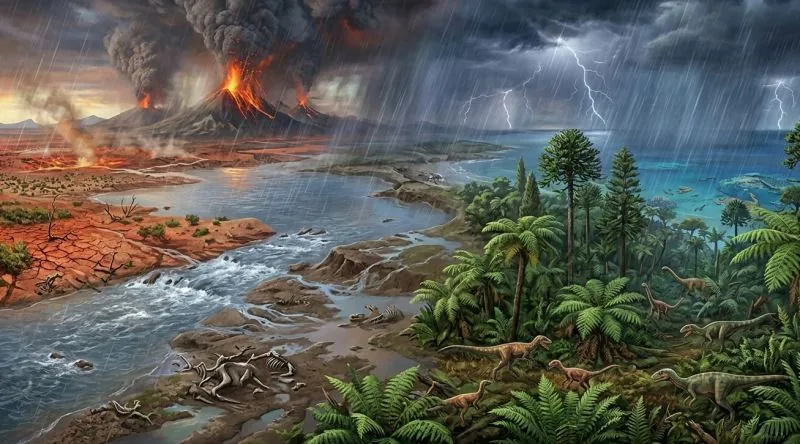
The Carnian Pluvial Event was a roughly 2-million-year period of intense rainfall around 232 million years ago during the Late Triassic, a climate shift that triggered a major extinction and cleared the way for dinosaurs to become Earth's dominant land animals. It was a time when the world, still clustered in the supercontinent Pangaea, seemingly would not stop raining, and life had to adapt or perish. Picture a planet where the skies opened up and simply never closed, transforming arid landscapes into swollen river systems and muddy floodplains. This wasn't just a bad weather season; it was a planetary reset that rewired the course of evolution.
Around 232 million years ago, the Carnian Pluvial Event brought roughly 2 million years of heavy rain to the supercontinent Pangaea. This dramatic shift in climate caused widespread extinctions among existing species, while dinosaurs and other groups that tolerated the wetter conditions thrived and expanded, setting the stage for their long dominance.
- The Carnian Pluvial Event occurred approximately 232 million years ago during the Late Triassic period.
- The event lasted for about 2 million years, marking a period of unusually high rainfall across the Pangaea supercontinent.
- This prolonged wet spell is linked to a mass extinction that wiped out many marine and terrestrial species.
- Dinosaurs, which had been relatively minor players, experienced a major diversification and rise to dominance following the event.
- The climate shift is believed to have been triggered by massive volcanic eruptions in the Wrangellia Large Igneous Province.
The Sky Opened Up: A 2-Million-Year Rainstorm
Around 232 million years ago, Earth stopped being a desert planet and became a sopping wet one, with dramatically increased rainfall lasting roughly one to two million years. That soggy stretch is now called the Carnian Pluvial Event, and it ranks among the wildest climate swings our world has ever endured. It was not a gentle drizzle, but a series of planet-shaping downpours that wiped out species and cleared the stage for the age of dinosaurs.
Set the scene in the Late Triassic. The supercontinent Pangaea dominated the globe, and most of it was bone-dry desert. Life was still limping back from the Permian mass extinction, the most devastating die-off in Earth's history, and conditions were brutal: hot, arid, and unforgiving. Then everything cracked open.
In what is now western Canada, the Wrangellia volcanic region erupted on a colossal scale. Those eruptions blasted trillions of tons of carbon dioxide and other gases into the atmosphere, supercharging global warming and acidifying the oceans. The water cycle went haywire, and the arid expanse of Pangaea transformed into a world of monstrous monsoon rains that carved new rivers, filled new lakes, and simply would not let up.
Contrary to the popular version that claims two million years of uninterrupted rain, the evidence points to a series of humid pulses rather than one endless storm. Still, the shift was dramatic enough to leave its mark in the rocks. Red desert sands gave way to black shales and coal layers, and carbon isotope records show a massive negative shift that betrays just how violently volcanic activity had scrambled the atmosphere.
For life, the cost was staggering. Marine groups like ammonoids, conodonts, and crinoids suffered major losses, and many land reptiles and plants vanished under acid rain, flooding, and destroyed habitats. Some accounts put the extinction toll at roughly half of all species, though that figure remains debated. What is certain is that this event often gets overlooked, squeezed between the five great mass extinctions like a hidden catastrophe that rewired the planet.
But nature abhors a vacuum. The wetter climate let ferns and conifers spread fast, and dinosaurs, which had been small and unremarkable, suddenly diversified and grew. The rains had cleared away many of their older reptile rivals, and the dinosaurs surged into the empty ecological niches to become the dominant land animals for the next 170 million years. Even modern corals trace their origins to this reshuffling of ocean ecosystems. Had the Carnian Pluvial Event never happened, the Jurassic might have looked very different indeed.
What Caused the Carnian Pluvial Event?
The Carnian Pluvial Event was triggered by a series of colossal volcanic eruptions in the Wrangellia region, an area that today corresponds to western Canada. These eruptions pumped trillions of tons of carbon dioxide and other gases into the atmosphere, setting off a chain reaction that rewired the planet's climate system. The result was a dramatic shift from a dry, desert world to one drenched in monsoon rains.
Picture the scene roughly 232 million years ago, during the Late Triassic. The supercontinent Pangaea dominated the globe, and vast stretches of it were arid, harsh, and unforgiving. Life was still recovering from the Permian mass extinction, and conditions were tough: hot, dry, and relentless. Then, in what geologists call the Wrangellia Large Igneous Province, the ground split open. Volcano after volcano erupted, spewing greenhouse gases on a scale that is almost impossible to wrap your head around.
That influx of carbon dioxide drove rapid global warming. Oceans began to acidify as they absorbed the excess CO₂, and the water cycle went haywire. The arid Pangaea that had existed for millions of years suddenly transformed into a wet world. Monsoon rains battered the deserts, carving new rivers across the landscape and filling basins that became lakes. And the rain kept coming.
The evidence for this dramatic shift is written in the rocks. Sedimentary layers from this period show a striking transition: red desert sands give way to black shales and coal deposits, which only form in wet, swampy conditions. Geologists also detect pronounced negative carbon isotope excursions in these layers, a chemical fingerprint that points directly to massive volcanic activity disrupting the atmosphere. It wasn't a gentle drizzle that caused all this, but a planetary-scale climatic upheaval that left its mark on every continent.
A Hidden Mass Extinction: Half of All Species Vanished
Scientists estimate that roughly half of all species on Earth disappeared during the Carnian Pluvial Event, though the exact figure remains a matter of debate among researchers. Some studies suggest the losses may have approached 50 percent, while others argue for a lower toll. Either way, this was no minor disturbance.
The seas took the first hit. Ammonoids, those coiled shelled creatures that once filled ancient oceans, suffered catastrophic declines. Conodonts, tiny eel-like animals with tooth-like fossils that paleontologists use to date rock layers, nearly vanished from the record. Crinoids, the feathery "sea lilies" that waved from the ocean floor, saw their numbers collapse across the globe.
On land, the carnage was just as real. Many reptiles that had thrived in the dry Triassic world simply could not adapt to the sudden wet. Acid rain fell from skies thick with volcanic gases, burning vegetation and poisoning soils. Floods carved through former deserts, drowning habitats that had existed for millions of years. Whole plant communities disappeared, taking the herbivores that fed on them down with them.
Yet here is the strange part. This extinction event barely registers in most textbooks. The "Big Five" mass extinctions get all the attention, the famous die-offs that ended the Ordovician, Devonian, Permian, Triassic, and Cretaceous periods. The Carnian Pluvial Event sits between the cracks, a hidden catastrophe that reshaped life on Earth without ever earning a spot on the poster.
Part of the reason it stays overlooked is timing. The event unfolded roughly 232 million years ago, in the late Triassic, a period already marked by upheaval. The Permian extinction that came before it had been so devastating that everything afterward seemed modest by comparison. And the Triassic-Jurassic extinction that followed, about 201 million years ago, would claim the spotlight next.
But the fossil record tells a different story. Across Europe, Asia, and the Americas, rock layers show a sudden shift from red desert sands to dark shales and coal deposits, the unmistakable signature of a world that had turned wet. Pollen records confirm the change, with drought-resistant plants giving way to moisture-loving ferns and conifers in a geological instant.
What makes this extinction so significant is not just what died, but what survived and thrived in the aftermath. The dinosaurs, until then small and unremarkable, suddenly diversified and grew. The rain had wiped out their competitors, leaving ecological gaps waiting to be filled. Modern corals trace their origins to this period as well, with reef ecosystems rebuilding themselves from the ashes of the old.
So the next time someone rattles off the famous mass extinctions, remember the quiet one. The Carnian Pluvial Event may not have the name recognition, but it set the stage for everything that came after, including the age of dinosaurs that would dominate the planet for the next 170 million years.
Dinosaurs Take Over: The Silver Lining of the Rain
When the skies finally cleared around 232 million years ago, the world that emerged was almost unrecognizable. The vast deserts of Pangea, the supercontinent that held most of Earth's land, had been scrubbed clean by what geologists now call the Carnian Pluvial Event. The relentless downpours had carved new rivers, filled fresh lakes, and transformed the landscape into something far more welcoming. The survivors of that brutal wet spell found themselves in a world of opportunity, and none seized it more dramatically than the dinosaurs.
Before the rains, dinosaurs were small, unremarkable creatures living in the shadow of more established reptile groups. They were minor players, easily overlooked. But the Carnian Pluvial Event wiped out many of their rivals, clearing the ecological stage. As the humid climate settled in, ferns and conifers spread rapidly across the land, creating a lush buffet for any animal that could eat them. The dinosaurs, with their efficient upright posture and adaptable diets, were perfectly positioned to take advantage. They diversified and grew with astonishing speed, filling the empty niches left by their departed competitors.
It wasn't just the land that was reshaped. In the oceans, the event also left its mark. Modern corals and some marine organisms trace their origins back to this precise period, as the new conditions allowed reef systems to take root in ways they never had before. On land, the ancestors of early mammals managed to survive the chaos, but they were now small, wary creatures living in the shadows. The age of dinosaurs had truly begun, and for the next roughly 170 million years, they would rule the Earth.
How Do We Know? The Evidence in the Rocks
The rocks themselves tell the story, and they do not whisper. Across Europe, Asia, and the Americas, sedimentary layers from roughly 232 million years ago show abrupt, unmistakable shifts that pin down the timing of the Carnian Pluvial Event.
Red desert sands suddenly give way to black shales and coal beds, the kind of deposits that only form in wet, swampy conditions. The chemical fingerprints agree: carbon isotope records show a sharp negative swing, the signature of massive volcanic CO₂ flooding the atmosphere and scrambling the global carbon cycle. Pollen tells the same tale from a different angle. In layer after layer, drought-tolerant plants like ancient conifers and cycads fade out, replaced by moisture-loving ferns and horsetails that spread across what used to be arid plains.
Then come the footprints. Dinosaur tracks appear in the rock record almost immediately after the event's telltale layers, as if the creatures had been waiting in the wings for their cue. Before the Carnian Pluvial Event, dinosaurs were small, marginal players in a world ruled by older reptile groups. After it, their tracks multiply and diversify, marking the moment they stepped into the ecological vacuum left by the extinction. The evidence locks together: the volcanic trigger, the climate collapse, the biological turnover, all recorded in stone and pollen and bone, all pointing to the same dramatic turning point in Earth's history.
Frequently asked questions
What was the Carnian Pluvial Event?
The Carnian Pluvial Event was a dramatic climate shift roughly 232 million years ago, during the Late Triassic period. It was a time when intense rainfall and humidity transformed Earth's landscapes, replacing vast deserts with rivers, lakes, and lush vegetation. This wasn't a simple rainstorm; it was a planetary-scale environmental upheaval that reshaped life on Earth.
Why did it rain for 2 million years?
Contrary to the popular image of continuous rainfall, the Carnian Pluvial Event actually consisted of humid pulses spread over roughly one to two million years. The trigger was massive volcanic eruptions in the Wrangellia region, near present-day western Canada. These eruptions released trillions of tons of carbon dioxide and other gases, driving global warming and disrupting the water cycle.
Did it lead to dinosaur dominance?
Yes, the Carnian Pluvial Event paved the way for dinosaurs to become the dominant terrestrial animals. Before this period, dinosaurs were relatively small and insignificant creatures. The humid conditions and environmental changes wiped out many competing reptile groups, creating ecological gaps that dinosaurs rapidly filled by diversifying and growing in size.
Was it a mass extinction?
According to the original account, approximately half of all species disappeared during this event, making it a significant extinction episode. Marine groups like ammonoids, conodonts, and crinoids suffered major losses, while many terrestrial reptiles and plants vanished due to acidic rain, flooding, and habitat destruction. It's often described as a hidden mass extinction overshadowed by the five major ones.
What evidence do we have?
Geologists have found clear evidence in sedimentary rock layers across Europe, Asia, and the Americas. Red desert sands gave way to black shales and coal deposits, indicating wetter conditions. Pollen records show a shift from drought-resistant plants to moisture-loving species, and dinosaur footprints appear in strata right after the event, as if they were waiting in the wings.
When did it occur?
The Carnian Pluvial Event took place in the Late Triassic, roughly 234 to 232 million years ago. This was during the reign of the supercontinent Pangea, when much of Earth was covered by arid deserts. The event lasted about one to two million years, with its most intense phase occurring around 232 million years ago.
Got a take on this? Add your voice to the conversation below →
No comments yet. Be the first.