Abraham de Moivre: The Mathematician Who Predicted His Own Death?
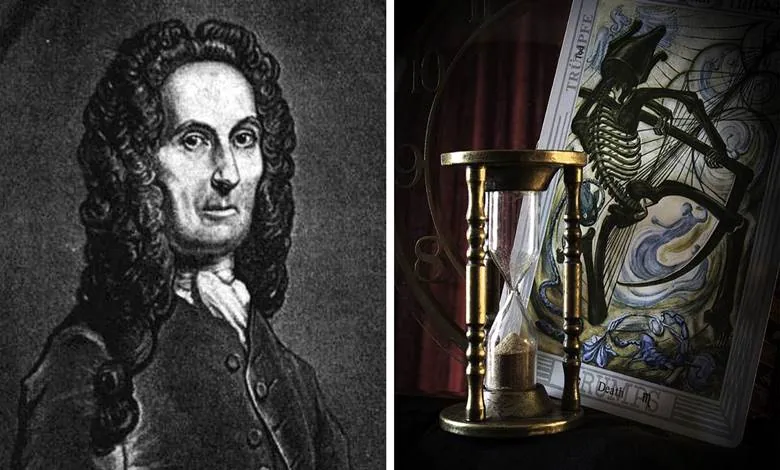
Abraham de Moivre was a Huguenot mathematician who fled religious persecution in France, became a pioneering figure in probability theory in early 18th-century London, and is famously said to have predicted the exact date of his own death in 1754. His life is a story of resilience, brilliant friendship with Isaac Newton, and a mind so orderly it allegedly calculated its own final day with chilling precision. De Moivre’s work quietly shaped modern statistics, yet his personal legend is one of quiet poverty and an unshakable devotion to numbers.
Abraham de Moivre was a French-born Protestant mathematician who settled in London after 1685, where he wrote the influential "Doctrine of Chances" and befriended Isaac Newton. He is best remembered for a legend that he used an arithmetic sleep pattern to predict the very day of his death in 1754, a story widely repeated but not independently verified.
- Born in Vitry-le-François, France, in 1667, de Moivre was a Protestant who left for England following the revocation of the Edict of Nantes.
- In London, he became a close associate of Isaac Newton and was elected to the Royal Society in 1697.
- His 1718 book, "The Doctrine of Chances," laid early groundwork for probability theory and the normal distribution.
- The famous death prediction story claims he calculated his own demise based on a daily increase in his sleep time, dying on November 27, 1754.
- Despite his mathematical genius, he never secured a formal university professorship and lived much of his life in modest circumstances.
The Mathematician Who Out-Calculated Death
Abraham de Moivre, born in 1667 in Vitry-le-François in France's Champagne region, built his legacy on probability theory, including the formula that still carries his name and one of the earliest mathematical versions of the normal distribution. But the story that has clung to him for centuries is stranger than any equation. As the legend goes, the mathematician calculated the exact date of his own death by tracking how his sleep patterns lengthened each night, then died precisely when his arithmetic said he would. We will come back to that tale at the end, after we have walked through the life that made it so believable in the first place.
De Moivre arrived in England in 1688, a Huguenot refugee fleeing religious persecution after King Louis XIV revoked the Edict of Nantes in 1685, which had previously granted French Protestants a measure of religious freedom. He had been forced to convert to Catholicism and, according to the account, spent more than two years confined in a monastery before escaping. In London he built a new life teaching mathematics to wealthy families' children and offering mathematical advice in coffeehouses, helping gamblers calculate odds, evaluating pension payments, and advising clients on insurance matters. Those practical problems would later shape his theoretical work, though the path there was anything but direct.
From Champagne to Exile: The Making of a Mathematician
Abraham de Moivre was born in 1667 in Vitry, a town in the Champagne region of France, into a family that would soon find itself on the wrong side of religious politics. His father was a Protestant doctor, which in late seventeenth-century France meant navigating a landscape of shrinking freedoms and mounting danger.
De Moivre studied first in Vitry, then moved through Sedan, Saumur, and finally Paris. But the classroom never contained his curiosity. He devoured Christiaan Huygens' work on probability and sought out private lessons from the leading mathematicians of his day. This hunger for knowledge would define him, even as the world around him grew more hostile.
The trouble had deep roots. In 1598, Henri IV had issued the Edict of Nantes, granting Huguenots, as French Protestants were called, a limited measure of religious freedom. That fragile peace lasted nearly a century. Then, in 1685, Louis XIV revoked the edict entirely. Pressure on Protestants intensified overnight, and thousands of Huguenots fled France, scattering across Europe.
De Moivre found himself caught in this crackdown. According to the account, he was forced to convert to Catholicism and held in a monastery for more than two years before escaping to England in 1688. The broad outline of this story is plausible, though the specific details, the exact duration of his confinement and the precise year of his escape, are not consistently documented in reliable sources. What is certain is that he ended up in England, where he would spend the rest of his life.
One common misconception deserves correction: the idea that de Moivre added "de" to his name after arriving in London. His family name was already de Moivre back in France. He never changed it.
Life in England was not easy. De Moivre earned his keep by tutoring the children of wealthy families in mathematics. He also set himself up in London coffeehouses, offering mathematical consulting to anyone who needed it. Gamblers wanted odds calculated for their games of chance. People evaluating pension payments needed help understanding their numbers. Clients dealing with insurance calculations came seeking clarity. These coffeehouse consultations were humble work, but they planted the seeds for the probability theory that would later make him famous.
Coffeehouse Calculations and a Friendship with Newton
Abraham de Moivre's life took a sharp turn the moment he opened Isaac Newton's Principia Mathematica. Here was mathematics unlike anything he had read before, dense and revolutionary, and de Moivre recognized its importance instantly. The book pulled him into a new world, one where he would soon stand shoulder to shoulder with the greatest scientific minds of late 17th century England.
According to the commonly repeated account, de Moivre met Edmond Halley in 1692, when Halley served as secretary of the Royal Society. The year is often given but not firmly established in primary sources, so treat that date with some caution. What followed is better documented: de Moivre soon met Isaac Newton himself, and the two men fell into long, animated discussions about Newton's differential calculus. These conversations must have been electric, two brilliant minds trading ideas about the mathematics that would reshape science.
De Moivre's standing in London's scientific community grew quickly. In 1695, he presented his first work on differential calculus to the Royal Society, and in 1697, he was elected a Fellow. Newton came to respect de Moivre's mathematical talent deeply, and a warm friendship developed between them. The great Newton, already legendary for his work on gravity and motion, found in de Moivre a worthy intellectual companion.
Yet here is the strange irony of de Moivre's career. Royal Society membership, a close friendship with Newton, and a steady stream of publications should have opened every door. They did not. De Moivre never secured a permanent university position, and his foreign status stood as a serious obstacle. Efforts by Leibniz and Johann Bernoulli to find him a post on the continent also came to nothing. So de Moivre kept doing what he had done since arriving in London: tutoring wealthy families' children, advising gamblers on odds, and helping clients puzzle through insurance calculations in the city's coffeehouses. His brilliance was undeniable, but the academic world kept him at arm's length, and he made his living where he could.
The Doctrine of Chances and the Birth of Actuarial Science
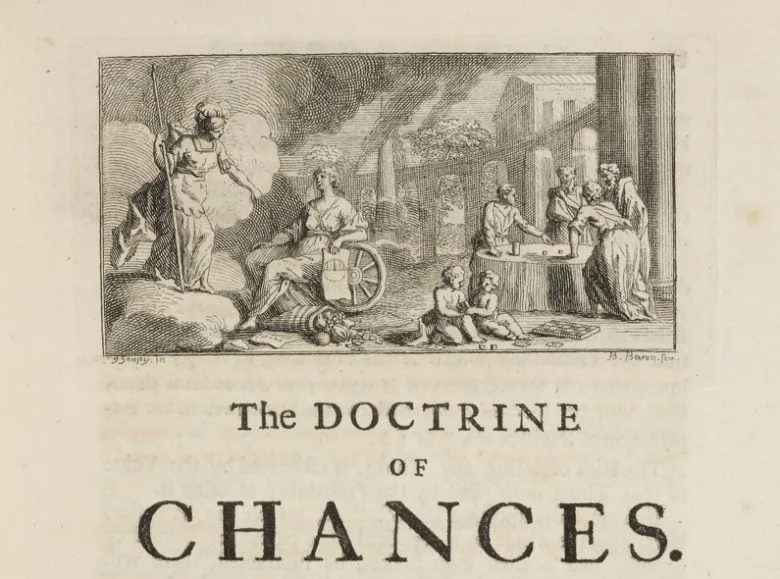
In 1718, Abraham de Moivre published the work that would cement his reputation: The Doctrine of Chances: A Method of Calculating the Probabilities of Events in Play, a book he dedicated to Isaac Newton. The timing was no accident. De Moivre had spent years tutoring wealthy families' children in London and advising gamblers in coffeehouses who wanted to know their odds. That practical experience poured directly into the book's pages.
The first edition appeared in 1718, with expanded versions following in 1738 and, after his death, in 1756. Each edition grew richer, incorporating new problems and sharper methods. But de Moivre's ambition reached beyond dice and cards. He had noticed that Edmond Halley, back in the 1690s, had used mortality tables to figure out reasonable premiums for life insurance. De Moivre took that thread and pulled it much further, developing formulas for annuities and life expectancy calculations that insurers could actually use.
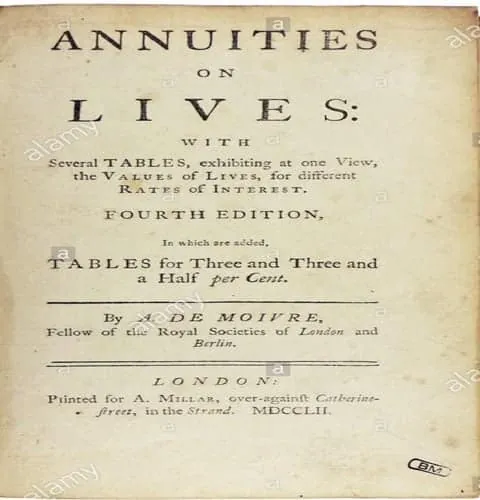
He gathered those efforts into Annuities upon Lives, published in 1725. The book went through several reprintings and became a foundational text in insurance mathematics. It was the kind of work that mattered in the real world, not just in academic journals. When someone needed to price a pension or calculate how long a policyholder might live, de Moivre's formulas gave them a place to start.
For all his intellectual success, de Moivre lived alone and in modest circumstances until his death. The income from his books never provided a regular or sufficient living, yet he largely accepted his situation and stayed faithful to his beliefs. He never secured a permanent university post, a fact that frustrated his supporters on the continent, including Leibniz and Johann Bernoulli, who tried on his behalf without success.
Recognition did arrive, though the timing is a bit tangled. According to some accounts, the Prussian Academy of Sciences and the French Academy of Sciences both elected him in the last months of his life. The record shows he was elected to the French Academy in 1754, but the Prussian Academy had actually welcomed him much earlier, in 1735. Whatever the exact sequence, the honors came, and de Moivre saw his contributions formally acknowledged even without a chair at any university.
The Death Prediction Legend: Fact or Folklore?
Did Abraham de Moivre really calculate the exact date of his own death? No reliable historical evidence shows that he did. The story, while frequently told, is an apocryphal legend that grew around his fame rather than a documented mathematical prediction.
The tale goes like this. In his final years, de Moivre reportedly noticed he was sleeping about 15 minutes longer each night. He supposedly assumed this increase would continue unchecked, and he set out to calculate when his daily sleep would reach 24 hours. His arithmetic reportedly landed on November 27, 1754, and as the story goes, he died on that very day.
The math itself is straightforward enough. If his initial daily sleep was s hours, the number of days needed to reach 24 hours would be (24−s)/0.25, which simplifies to 4(24−s). But here is the catch: the anecdote never tells us how many hours he was sleeping at the start. Without that starting figure, the November 27 date cannot be independently verified. Anyone could work backward from the supposed outcome.
What we do know is this: no contemporary source from the 1750s mentions any such calculation. The story does not appear in the records of the Royal Society, where de Moivre had been a fellow since 1697, nor in the correspondence of his colleagues. It surfaces only in later retellings, long after his death.
So how should we read it? The legend fits neatly with the image of a man who spent his life reducing chance to numbers. De Moivre, after all, wrote the book on probability with _The Doctrine of Chances_ in 1718, and he built formulas for life expectancy in _Annuities upon Lives_ in 1725. A man who could price an annuity might plausibly price his own remaining days. The story feels right, even if it never happened.
The truth is more modest. De Moivre died on November 27, 1754, in London, in the quiet and humble circumstances that had marked his entire English life. The date of his death is a fact. The prediction is folklore, a tribute wrapped around a real man's real fame.

Frequently asked questions
Who was Abraham de Moivre?
Abraham de Moivre was a Huguenot mathematician born in 1667 in Vitry, France, who fled religious persecution to England in 1688. He made foundational contributions to probability theory and statistics, including one of the earliest mathematical forms of the normal distribution. Today he is best remembered for the formula that carries his name.
What is De Moivre's formula?
De Moivre's formula is a mathematical theorem that connects complex numbers with trigonometry. It states that for any real number x and integer n, (cos x + i sin x)^n equals cos(nx) + i sin(nx). The formula, which he is best known for today, became a cornerstone in the study of complex analysis.
How did Abraham de Moivre predict his death?
According to a widely told story, de Moivre noticed his nightly sleep lengthening by about 15 minutes each night and calculated when it would reach 24 hours. The date he arrived at was November 27, 1754, the very day he died. However, no reliable historical evidence supports this anecdote; it is considered an apocryphal legend.
Why did Abraham de Moivre leave France?
As a Protestant in Catholic France, de Moivre faced escalating persecution after Louis XIV revoked the Edict of Nantes in 1685. The story goes that he was forced to convert to Catholicism and held in a monastery before escaping to England. He settled in London in 1688, where he built his mathematical career.
What was the Doctrine of Chances?
The Doctrine of Chances was de Moivre's most important work, first published in 1718. It was a systematic treatise on calculating the probabilities of events in games of chance. The book went through expanded editions in 1738 and posthumously in 1756, cementing its place as a foundational text in probability theory.
Did Abraham de Moivre know Isaac Newton?
Yes. De Moivre encountered Newton's Principia Mathematica and was deeply impressed by it. He soon met Newton himself, and the two developed a close friendship and working relationship. Newton reportedly respected de Moivre's mathematical talent greatly and even referred people to him for help with mathematical questions.
What contributions did De Moivre make to statistics?
De Moivre developed one of the earliest mathematical forms of the normal distribution, a key concept in statistics. His 1725 work Annuities upon Lives laid foundations for actuarial science and insurance mathematics by providing formulas for calculating life expectancies and annuity values, work that grew directly from his practical consulting in London.
Got a take on this? Add your voice to the conversation below →
No comments yet. Be the first.