Why Doesn't Earth Fall Through Space? The Barycenter Explained
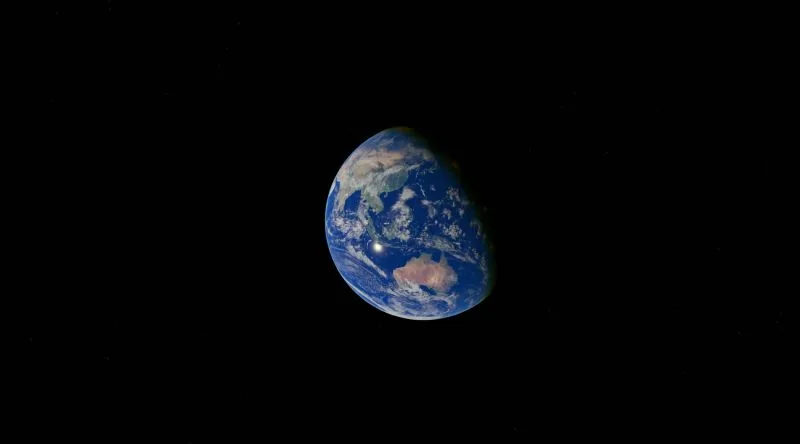
Earth does not fall into the Sun and it does not hang motionless in space. Instead, Earth is in a constant state of free fall around a shared center of mass with the Sun, a point astronomers call the barycenter. That single idea answers the question of why doesn't Earth fall, and it also explains why astronauts float, why planets orbit instead of dropping, and what would really happen if the Sun vanished tomorrow. Once you see the Solar System as a set of objects falling together rather than a set of objects held up, the whole picture changes.
Earth is not suspended in space or slowly dropping into the Sun. It is falling freely around the barycenter, the shared center of mass it forms with the Sun. That sideways motion combined with gravity keeps it in a stable orbit rather than a collision course.
- Earth orbits the Sun at roughly 30 kilometers per second, and that sideways speed is what keeps it from dropping straight into the Sun.
- The barycenter of the Earth-Sun system lies inside the Sun, because the Sun holds more than 99 percent of the mass of the Solar System.
- Astronauts float on the International Space Station because they are in free fall around Earth, not because gravity has switched off.
- If the Sun disappeared, Earth would continue along a nearly straight path rather than instantly flying off or stopping, though other bodies would still tug on it.
- There is no universal "down" in space, only the direction toward whatever mass is closest and strongest.
Why "Falling" Is Something We Invented Down Here
Ask why doesn't Earth fall, and you sound like a child tugging at a sleeve. But the question hides a trap, because "falling" is not a law of the universe. It is a word we built from what we watched on the ground.
The Turkish verb düşmek, to fall, describes something very specific: an object picking up speed as it moves toward a gravitational pull. A dropped glass, a kicked stone, a ripe fig letting go of the branch. Every one of those scenes needs two ingredients. There has to be a force pulling, and there has to be motion headed that way. Take either one away and the word stops meaning anything.
So what does falling look like once you leave the surface? The reference point we lean on down here, the ground beneath our feet, simply isn't there anymore. Gravity itself does not switch off in space. Its effect just weakens as you move farther from Earth. Isaac Newton worked this out in his Principia in 1687: the range of gravity is infinite, but its strength at any given distance is not. Far enough out, the tug gets faint, though it never quite reaches zero.
Then a natural question follows. If we are going to fall toward something, what is the nearest thing worth falling toward? The Moon is close. The planets are out there too. But the obvious candidate is the Sun, simply because of how much mass it carries. That is why our motion around the Sun is the closest thing we have to a fall.
Here is the twist, and it is a good one. We do not fall toward the Sun in the way a stone falls toward a pond. In a system of two bodies, there is a shared center of mass, and it does not sit politely between them. Two equal masses put that point exactly halfway. Make one body heavier and the point slides toward it. The Sun so outweighs Earth that the shared center sits almost inside the Sun itself.
Both bodies free-fall around that point, together. The Sun barely notices. Earth's plunge is the visible part. And "falling," it turns out, is relative, measured against some reference body, because out there "down" is not a fixed direction at all. It is whatever you decide to point at.
Gravity Doesn't Vanish in Space, It Just Weakens
Step outside the atmosphere and something strange happens to the word "down." Gravity is still there. It never packed up and left. What changes is its grip, and that grip loosens with every kilometer you put between yourself and Earth. Isaac Newton spelled this out in his Principia in 1687: gravity's reach is theoretically infinite, but its strength at any real distance is not. Double the distance and the pull drops to a quarter. The force fades, it does not disappear.
So if you drift out past the Moon, what exactly is pulling on you? The Moon is close. The planets are out there too. But the obvious candidate, the one that dwarfs everything else nearby, is the Sun. It holds roughly 99.86% of all the mass in the Solar System, which means its gravitational hand on Earth is by far the strongest one in the neighborhood. If any motion deserves the label "falling," it is our slow, endless arc around the Sun.
Here is where the popular picture starts to bend. You have probably heard that Earth falls toward the Sun. In a loose, convenient sense that works, the way a diagram of a small ball circling a big one works. But the real arrangement is not one body parked in place while the other swings around it. Two objects always share a common center of mass, a single point their combined mass balances around. When the masses are equal, that point sits exactly midway between them. As one mass grows, the point slides toward it.
Now put the Sun and Earth on the scale. The Sun is so much heavier that the shared center of mass lands almost inside the Sun itself, roughly 450 kilometers from its center, well within a solar radius of about 696,000 kilometers. Both bodies free-fall around that hidden point. The Sun wobbles a little. Earth swings a lot. The result looks like one small world circling a giant, but it is really two bodies falling together around a balance neither of them can see.
Which brings us back to that nagging question, why doesn't Earth fall? Because falling, in space, is not a fixed direction. It only means anything relative to some reference body. The Sun and Earth fall around each other, and neither one needs a floor to land on. If the Sun vanished tomorrow, the story goes, Earth would not plunge or tumble but would drift off along a path close to a straight line. That version is a simplification, since other bodies would still tug at us, but it captures the point. There is no absolute "down" out here. There is only the nearest mass worth falling toward, and for us, that is the Sun.
The Sun Doesn't Sit Still While Earth Circles It
So why doesn't Earth fall? Here is the part that surprises almost everyone: the tidy picture of a fixed Sun with Earth swinging around it is a convenience, not what actually happens. In reality, the Sun and Earth both fall freely around a shared point, and that point sits inside the Sun.
That shared point is called the center of mass, or barycenter. In any two-body system, it is mass-weighted. If the two masses were equal, the barycenter would sit exactly midway between them. As one mass grows larger, the barycenter slides closer to it. The Sun holds roughly 99.86 percent of the Solar System's mass, so the Sun-Earth barycenter ends up about 450 kilometers from the Sun's center. The Sun's radius is around 696,000 kilometers, which means that balance point is buried deep inside the Sun, nowhere near the surface.
This reframes the whole question. The Sun is not bolted to one spot while Earth does all the moving. Both bodies fall around the common center of mass, and because the Sun is so much heavier, its wobble from that shared dance is barely perceptible. Earth's motion, meanwhile, looks exactly like falling toward the Sun. That is the hidden geometry behind why doesn't Earth fall straight in.
And "falling" itself is a relative idea. Down is not absolute in space. It only means something when measured against a reference body. In a simplified model, if the Sun simply vanished, Earth would not fall or do anything fall-like at all. It would drift along a path close to a straight line, though other bodies would still tug on it. That scenario is an oversimplification, but it captures the point: the fall you feel is defined by what you are falling toward.
If the Sun Vanished, Earth Wouldn't Fall, It Would Drift
Take the Sun out of the picture and Earth stops falling. There is no downward pull left to chase, no curve to bend into. In a simplified model, the planet would coast through space along a path that is very nearly a straight line, carrying the momentum it already had, though other bodies would still tug on it. That is the thought experiment that flips the whole question on its head.
It sounds strange only because we keep borrowing a word from the ground. On Earth, falling means accelerating toward something, and that something is always defined by a reference body. Out in space there is no absolute "down." Falling is relative, measured against whatever mass you happen to be near. Strip away the Sun and the reference disappears with it.
This is how a Turkish-language explainer, published on Ekşi Şeyler on 18 December 2025, framed the puzzle. As the original account presents it, the picture is a thought experiment rather than a settled prediction. The reason is simple enough: even with the Sun gone, the Moon, the planets and the rest of the galaxy would still tug on Earth. So the clean "straight line" answer is an oversimplification, a way of seeing the idea rather than a forecast anyone could actually test.
Still, the core of it holds. A body in motion keeps moving in a straight line unless something pushes or pulls it. Earth is not hovering on a invisible shelf, and it is not clinging to nothing. It is moving, always has been, and the Sun's gravity is what keeps bending that motion into the familiar yearly loop. Remove the bend and what is left is the drift.
There Is No "Down" in Space
Here is the sentence that unties the whole knot: in space, falling is relative. "Down" is not a fixed direction waiting somewhere out in the dark. Albert Einstein's general relativity, published in 1915, replaced the old picture of gravity as an invisible rope with something stranger and more elegant: mass and energy curve the space around them, and anything moving freely simply follows that curve. "Down" only means "toward whatever is pulling hardest right now."
That is the quiet reason astronauts seem to drift. They are not floating beyond gravity's reach. They are falling, constantly, around Earth at just the right sideways speed that they keep missing it. Free fall and weightlessness are the same experience. You feel heavy on the ground because the floor is pushing back against your fall, not because gravity has somehow switched on.
So when we ask why doesn't Earth fall, the question quietly smuggles in an assumption that was never true. It imagines a cosmic floor, a universal "down," some absolute bottom of things. There is no such floor. Earth is already falling. It has been falling toward the Sun for about 4.5 billion years, and the reason it never arrives is that it keeps sailing past the target. A fall that never lands stops looking like a fall and starts looking like an orbit.
Run the thought experiment one more time. Take the Sun away, and Earth would not plummet anywhere. In a simplified model, it would coast onward along something close to a straight line, because with no dominant mass to define a direction, there is no "down" left to fall toward, though other bodies would still tug on it. That is the whole trick of it. Earth is not suspended in space, defying gravity. It is in motion, and motion is what keeps it up.
Frequently asked questions
Why doesn't Earth fall into the Sun?
Earth never falls into the Sun because it is not standing still waiting to drop. Our planet moves sideways at enormous speed while the Sun pulls it inward, and those two motions balance into a stable orbit around a shared center of mass. Earth is falling, but it keeps missing.
What is a barycenter and where is it located?
The barycenter is the shared center of mass of two bodies. If their masses are equal, it sits exactly midway between them; as one grows heavier, the point slides toward it. For the Sun and Earth, the barycenter lies about 450 kilometers from the Sun's center, well inside the Sun itself, since the Sun holds roughly 99.86 percent of the Solar System's mass.
Is Earth actually falling through space?
In a real sense, yes. Earth and the Sun both free-fall around their common barycenter, and the Sun wobbles only slightly because its mass dwarfs ours. What Earth is not doing is dropping "down" toward anything the way a dropped stone does. It is in continuous free fall, forever curving around the Sun.
What would happen if the Sun suddenly disappeared?
According to the original account, Earth would not fall or make any fall-like motion. It would instead drift through space along a nearly straight path. That picture comes with a caveat, though: other bodies would still tug on Earth, so "perfectly straight" is a simplification rather than a precise forecast.
Why does "down" have no meaning in space?
Because "down" is never absolute. On Earth we define it relative to the ground beneath us, but in space there is no fixed floor. Falling and "down" only make sense relative to some reference body, which is why the whole idea of Earth falling depends entirely on what you measure it against. Editorial note: Details that remain unconfirmed or depend on simplified models are presented here as such, and figures are given as widely accepted approximations rather than exact measurements.
Got a take on this? Add your voice to the conversation below →
No comments yet. Be the first.