Vitruvian Man Geometry: Why Da Vinci's 1490 Drawing Still Fascinates
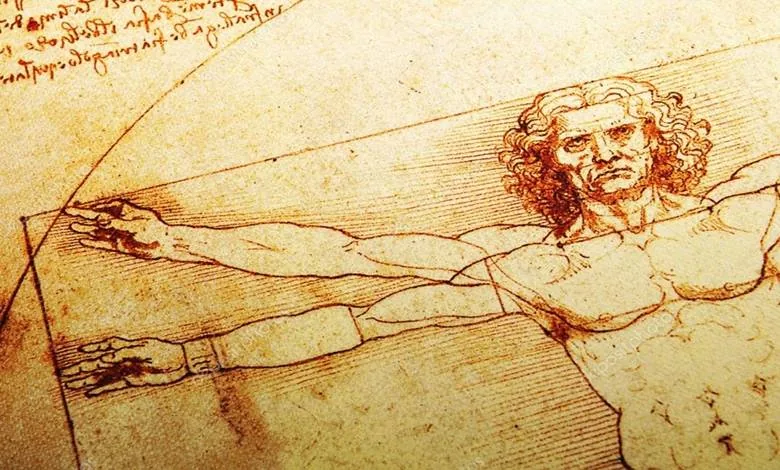
Leonardo da Vinci's Vitruvian Man is a cultural touchstone because it merges ancient Roman architectural theory with Renaissance ideals of human proportion, creating a visual puzzle that still captivates scientists, artists, and historians today. The pen-and-ink drawing shows a nude man in two superimposed positions inside a circle and a square, and its quiet perfection invites us to ponder what it means to be human, measured, and connected to the cosmos.
Leonardo da Vinci drew the Vitruvian Man in the late 15th century, illustrating the proportion theories of the ancient Roman architect Vitruvius. The drawing places a man inside both a circle and a square, symbolizing the harmony between divine perfection and earthly reality. It is now kept in Venice's Gallerie dell'Accademia.
- Leonardo da Vinci created the Vitruvian Man in the late 15th century, based on the writings of the Roman architect Vitruvius.
- The drawing shows a single male figure in two overlapping poses, one with arms outstretched to fit a square, the other with arms raised to fit a circle.
- The artwork is accompanied by Leonardo's mirror-written notes describing the proportional relationships of the human body.
- The Vitruvian Man is currently housed at the Gallerie dell'Accademia in Venice, Italy, where it is rarely displayed due to its sensitivity to light.
- The drawing has become a universal symbol of Renaissance humanism, blending art, science, and classical learning into a single iconic image.
The Man in the Circle and the Square
There is one drawing that manages to capture the entire Renaissance in a single image, and it starts with a nude man standing in two positions at once. Leonardo da Vinci's Vitruvian Man, created in the late 15th century, places that figure inside both a circle and a square, and the geometry of the piece has fascinated artists, scientists, and mathematicians for over five hundred years.
Look closely at the drawing and you will see something remarkable. The man stretches his arms and legs into two separate poses, one fitted neatly into a perfect circle, the other into a square. Leonardo's own handwritten notes, mirroring the text around the figure, describe the work as a study based on proportions first laid out by a Roman architect named Vitruvius in his ten-book work De Architectura. That connection between an ancient engineer and a Renaissance master is exactly why the image feels so powerful. It is not just a sketch of a body. It is a statement that art and science belong together, and that the human form mirrors the harmony of the universe itself.
Marcus Vitruvius Pollio lived in the 1st century BC, serving as an architect and engineer under Julius Caesar and later Augustus. In his writings, he made a bold claim: the navel is the center of the human body. Place a compass point at the belly button, he argued, and a circle drawn around a man lying with arms and legs extended will touch his fingertips and toes. He also observed that a person's height nearly equals the width of their outstretched arms. These were not abstract musings. Vitruvius believed the human body was a model of perfect proportion, one that architecture itself should imitate.
Centuries later, Leonardo took up that challenge. But the geometry hides a puzzle that took real ingenuity to solve, and solving it meant breaking a rule that had stumped thinkers for ages. The circle and the square simply cannot share the same center if both are to fit the human form. Leonardo's solution was elegant, and it changed how everyone saw the problem.
Before Leonardo: The Long, Shifting Story of the "Ideal" Man
Long before Leonardo da Vinci picked up his pen in the 1490s, men were being measured against impossible standards. Every era had its own version of the perfect male form, and those ideals shaped everything from fashion to philosophy. The geometry that would later captivate the Renaissance did not appear out of thin air; it was the product of centuries of humans obsessing over what the male body should look like.
In Ancient Egypt, the ideal man was slender and athletic, with symmetrical facial features and a youthful glow. Grace mattered as much as strength. Egyptian men wore makeup, layered on precious jewelry, and styled their hair with care, all to broadcast status and beauty. A polished appearance was not vanity; it was a statement of who you were.
The Ancient Greeks shifted the focus to muscle. A toned, proportionate physique signaled both physical excellence and moral virtue. Their sculptures captured this ideal, suggesting that a balanced body reflected a balanced soul. The Greeks believed that looking good and being good were deeply connected.
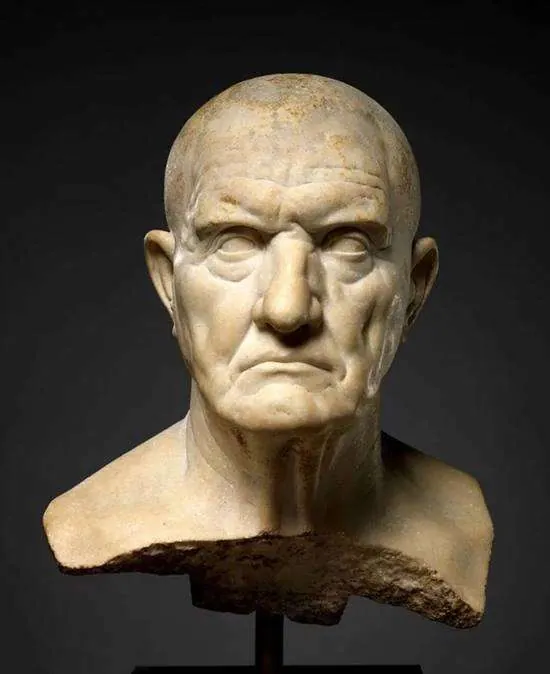
Rome took a different angle. There, age and wisdom were woven into the definition of male beauty. A man did not need to be young to be admired. What mattered was a harsh, strong appearance that spoke to authority and experience. Wrinkles could be assets if they came with gravitas.
Then came the Medieval period, when physical beauty took a back seat to spiritual values. Virtue, religious devotion, and moral character defined a man's worth more than his cheekbones. The knightly ideal celebrated courage and loyalty, with long hair and beards serving as markers of strength and masculinity. A man's soul, not his silhouette, was the measure of his beauty.
By the Renaissance, the human body returned to center stage as a model of perfection. Artists and thinkers looked back to classical sources, eager to reconcile the physical with the divine. This renewed fascination set the stage for Leonardo's exploration of ideal proportions.
Who Was Vitruvius, the Roman Behind the Ideal Proportions?
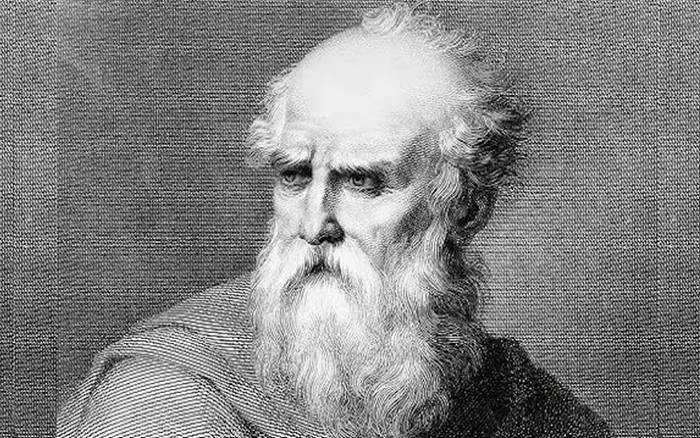
Marcus Vitruvius Pollio was a Roman architect, engineer, and author who lived in the 1st century BC, and he wrote the ancient world's most comprehensive surviving work on architecture, engineering, and city planning. His ten-book masterpiece, De Architectura, laid out a bold idea that would echo across nearly two thousand years: the human body itself is the perfect model of measure and proportion, and buildings should follow its lead. He was not merely a builder, but also a philosopher and scientist who wove mathematics, geometry, astronomy, and physics into his approach to design.
Within the pages of De Architectura, Vitruvius made observations that still spark curiosity today. He noted that the navel serves as the true center of the human body; if you plant a compass needle there, a perfect circle can be drawn around a person with outstretched limbs. He also observed that a person's height nearly equals the span of their arms when extended sideways. These geometric insights sat largely dormant for centuries, waiting for someone with the vision to bring them to life. That someone turned out to be Leonardo da Vinci, who would eventually translate these ancient measurements into the iconic drawing the world now knows as the Vitruvian Man, a fusion of art and science that continues to captivate viewers.
The Geometry Puzzle: How Leonardo Solved What Others Couldn't
Leonardo da Vinci cracked the geometry problem in the late 15th century by realizing something his predecessors had missed: the circle and the square could not share the same center. That single insight, separating the two geometric centers, turned an impossible drawing into the iconic image we recognize today.
Before Leonardo, plenty of talented artists had tried their hand at this same challenge. The Roman architect Marcus Vitruvius Pollio, writing in the 1st century BC, had laid out precise proportional rules in his ten-book work De Architectura. He said the navel serves as the body's natural center, allowing a compass anchored there to trace a perfect circle around an outstretched figure. He also observed that a person's height nearly equals the span of their outstretched arms. Those instructions sound simple enough on paper, but translating them into a single coherent drawing proved maddeningly difficult.
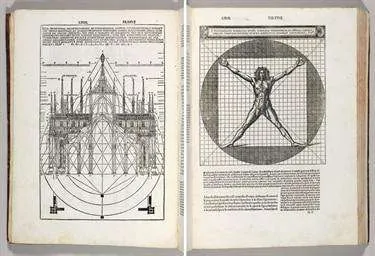
Francesco di Giorgio, a Sienese architect and artist who worked in the decades before Leonardo, produced one such attempt in his architectural treatise. His drawing, like many others of the era, failed to achieve the correct proportions and geometric harmony that Vitruvius described. The anatomy looked wrong, or the circle and square refused to align convincingly. Nobody had managed to honor Vitruvius's text while also creating something visually harmonious.
Leonardo took a different path. He had little formal schooling in mathematics, and his relationship with the mathematician Luca Pacioli was collaborative rather than a formal course of study. What is not in dispute is the quality of Leonardo's geometric thinking. As he worked through the problem, he recognized a fundamental obstacle. If both the circle and the square shared the same center, he would be attempting to square the circle, a famous puzzle asking for a square with the same area as a given circle, constructed using only an unmarked ruler and compass. Mathematicians had struggled with that problem for centuries, and for good reason: it is impossible to solve with those tools alone.
Leonardo sidestepped the trap entirely. Instead of forcing both shapes to share one center, he separated them. The circle is centered on the navel, just as Vitruvius described. The square, however, sits lower on the figure. This subtle offset allowed Leonardo to satisfy both geometric constraints without falling into the squaring-the-circle trap. The figure finally fit both shapes naturally, and the drawing achieved a harmony that had eluded so many earlier attempts.
That solution, elegant and deceptively simple, is what makes the Vitruvian Man so remarkable. Leonardo did not just illustrate an ancient text. He solved a puzzle that had frustrated artists for generations, and he did it by questioning an assumption everyone else had quietly accepted.
A Masterpiece That Rarely Sees the Light
The Vitruvian Man calls the Gallerie dell'Accademia Museum in Venice, Italy its home today, though you would be hard pressed to actually see it there. The museum has reportedly preserved this Leonardo da Vinci drawing since 1822, though the exact acquisition date is difficult to confirm.
Here is the thing about this iconic piece of Renaissance art: it is extraordinarily fragile. The paper it lives on is extremely sensitive to the damaging effects of time, including light, humidity, and even the breath of curious onlookers. That is precisely why the museum keeps it tucked away in a climate-controlled environment, rarely putting it on public display. When you visit the Gallerie dell'Accademia, you are far more likely to encounter a reproduction or an empty case than the actual drawing itself.
And yet, the physical rarity of seeing the original does nothing to diminish its reach. The Vitruvian Man has seeped into our collective consciousness in ways that transcend the paper it is drawn on. Think about it: this single ink drawing, created in the late 1400s, has become shorthand for the harmony between human proportion and the universe. It appears in textbooks, on merchandise, in architecture lectures, and in art history courses across the globe. It has inspired scientists, artists, and philosophers for over five centuries.
What makes this so remarkable is that most people have never stood before the actual artwork. They know it from photographs, from reproductions, from the endless copies that circulate in digital spaces. The physical object may be almost hidden from view, but the idea it represents, that the human body holds within it the keys to cosmic order, has proven utterly immortal. The drawing endures not because we can see it whenever we want, but because it speaks to something fundamental about how we understand ourselves and our place in the world.
So while the original might stay safely locked away in Venice, protected from the very admirers who cherish it, the Vitruvian Man lives on. Its legacy in art, in science, and in the long story of human thought has made it far more permanent than any single sheet of paper could ever be.
Frequently asked questions
Who was Vitruvius and why is he important to architecture?
Marcus Vitruvius Pollio was a Roman architect, engineer, and writer who lived in the 1st century BC and served under Julius Caesar and Augustus. He authored De Architectura , a ten-book work covering architecture, engineering, and city planning that remains the most comprehensive surviving text on these subjects from the ancient world. What makes Vitruvius so central to architecture is how he connected building design to the human body. He argued that a temple's proportions should mirror the symmetry found in a well-formed person, with measurements relating each part to the whole. This idea, buried in a Roman textbook, would wait over a thousand years before a Renaissance artist picked it up and turned it into one of the most famous drawings in history.
What does the Vitruvian Man drawing by Leonardo da Vinci represent?
Leonardo da Vinci's Vitruvian Man, created in the late 15th century, depicts a nude male figure in two superimposed positions, one inscribed within a circle and another within a square. Leonardo's own notes describe the work as a study of the proportions outlined by Vitruvius in De Architectura , making it both an anatomical observation and a geometric investigation. The drawing captures a moment when art and science were not separate pursuits. Leonardo was not simply illustrating an ancient text; he was testing whether the human body could truly fit both geometric forms at once. The image has become a symbol of the Renaissance belief that humans are the measure of all things, standing at the center of a perfectly ordered universe.
How did Leonardo da Vinci solve the squaring the circle problem in the Vitruvian Man?
Leonardo solved the challenge by separating the centers of the circle and the square rather than forcing them to share one point. The circle is centered on the navel, while the square sits lower on the figure, allowing both shapes to contain the body without geometric contradiction. Squaring the circle, the ancient problem of constructing a square with the same area as a given circle using only compass and straightedge, was a puzzle that had frustrated mathematicians for centuries. Leonardo's approach did not actually solve the mathematical problem in the strict sense, but his drawing demonstrated a clever visual compromise. By shifting the centers, he created a figure that honors both Vitruvian proportions and geometric possibility within a single composition.
Why are the circle and square centers different in the Vitruvian Man?
The circle centers on the navel because Vitruvius wrote that the navel is the natural midpoint of the human body, from which a compass can trace a perfect circle touching the fingertips and toes. The square requires a different alignment because a standing figure's proportions, with arms extended horizontally, demand a lower center point. If both shapes shared the same center, the geometry simply would not work. Leonardo recognized this constraint and positioned the square lower on the torso. This careful adjustment is what makes the drawing feel both harmonious and mathematically honest.
Where is the original Vitruvian Man drawing kept today?
The original Vitruvian Man is preserved at the Gallerie dell'Accademia museum in Venice, Italy, where it reportedly has been housed since 1822. The drawing is extremely sensitive to light and environmental conditions, so it is rarely displayed to the public. Visitors to Venice will not simply stumble upon it in a permanent gallery. The work spends most of its time in controlled storage, emerging only for special exhibitions with strict conservation measures. Despite its fragility, the drawing remains one of the most requested and celebrated works in the museum's collection, drawing scholars and art lovers from around the world whenever it does appear.
Did Leonardo da Vinci study mathematics with Luca Pacioli?
Leonardo did not receive formal mathematics education in his youth, but he had a collaborative relationship with Luca Pacioli, a respected mathematician and Franciscan friar active in the late 15th century. Pacioli provided mathematical knowledge while Leonardo contributed illustrations for Pacioli's book De Divina Proportione . The two men shared an interest in proportion and geometry, and their partnership reflects how Renaissance thinkers crossed disciplinary boundaries. Whether this counts as formal study or mutual exchange remains a matter of interpretation, but the influence is clear in Leonardo's notebooks, which are filled with geometric diagrams and mathematical observations alongside his anatomical sketches.
How did male beauty standards change from ancient Egypt to the Renaissance?
Male beauty standards shifted dramatically across eras, moving from athletic youth in ancient Egypt to muscular proportion in Greece, aged wisdom in Rome, spiritual virtue in the Middle Ages, and finally to measured idealization in the Renaissance. Each civilization projected its values onto the male body. Ancient Egyptian ideals favored slender, athletic figures with symmetrical faces and youthful features, with men using makeup and jewelry to enhance their status. Greek standards celebrated muscular, balanced bodies as signs of moral excellence. Roman culture added age and authority to the equation. The medieval period downplayed physical beauty in favor of knightly virtues like courage and loyalty. Then the Renaissance turned back to the body as a source of perfection, culminating in Leonardo's Vitruvian Man, which merged classical proportion with humanist philosophy in a single iconic image. Editorial note: Facts that remain unconfirmed, such as the exact date of creation or the precise identity of the model, are presented here as possibilities rather than certainties.
Got a take on this? Add your voice to the conversation below →
No comments yet. Be the first.