Turkish Word Şey: The Most Flexible Language Tool
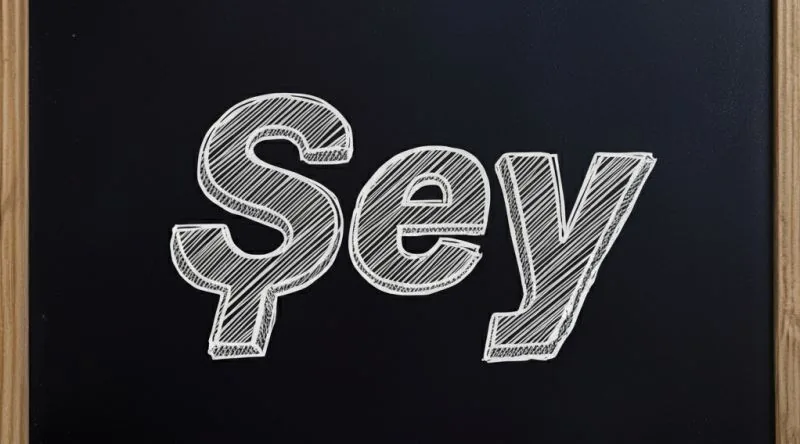
The Turkish word "şey" (pronounced "shey") is the language's ultimate linguistic chameleon, meaning "thing" and serving as a placeholder for nearly any noun, concept, or pause in conversation. Rooted in everyday speech across Turkey and inspired by philosopher Alan Watts' notion that a "thing is a think," this small word carries surprising philosophical weight. Whether you are a language learner or a curious thinker, understanding "şey" unlocks a deeper appreciation for how Turks navigate ambiguity, politeness, and even the nature of reality itself.
In Turkish, "şey" translates to "thing" and functions as a flexible placeholder for anything unnamed or unsaid. It is used daily across Turkey to fill pauses, soften requests, or reference objects without naming them. Its philosophical resonance echoes Alan Watts' idea that a "thing is a think," making it a bridge between language and perception.
- "Şey" is the Turkish word for "thing," used as a noun in all contexts, from casual chats to formal writing.
- It acts as a filler word in spoken Turkish, similar to "um" or "uh" in English, giving speakers time to think.
- Alan Watts famously described a "thing" as a "think," a philosophical lens that illuminates how "şey" shapes Turkish thought.
- In Turkey, "şey" can replace any noun in a sentence, making it a practical tool for learners and a poetic device for writers.
- Unlike "bu" (this) or "şu" (that), "şey" is intentionally vague, referring to an unnamed or undefined entity.
The Little Word That Does Everything
In Turkish, the word şey means "thing," and it might be the most flexible word in the entire language. It stands in for objects, events, ideas, emotions, and anything else you can name, or can't quite name. The question at the heart of it all is simple: what exactly is şey?
You hear it everywhere, woven into the fabric of daily conversation. Bir şey means "something," hiçbir şey means "nothing," and başka bir şey is "something else." It slides into phrases when the precise word escapes you, when you're reaching for a concept that's just out of reach, or when you want to keep things delightfully vague. It can be concrete, like a physical object sitting on a table, or utterly abstract, like a feeling you can't quite put your finger on.
Philosopher Alan Watts captured its essence beautifully when he said, "A thing is a think, it is a unit of thought." The English version sounds almost poetic: "A 'thing' is a 'think,' it is a unit of thought." If words are the shapes we use to carve up the world, then şey is the playdough. It's amorphous, boundless, ready to represent a subatomic particle or an entire universe. Most words constrain and limit, directing the listener's imagination toward one specific idea. But şey does the opposite. It invites the listener to bring their own imagination to the table, to fill in the blanks with whatever fits the moment.
A Word That Refuses to Be Pinned Down
The Turkish word şey is the linguistic equivalent of a wildcard, slipping effortlessly into conversations to stand in for eşya (goods), hal (state), iş (work), madde (matter), olay (event), or söz (word). It refuses to commit to being concrete or abstract, which is precisely what makes it so remarkably flexible.
Try to imagine a single word that could mean a subatomic particle one moment and the entire universe the next. That is şey. It is amorphous, boundless, almost like linguistic play-dough waiting to be shaped by context. When you say "bir şey" (something) or "hiçbir şey" (nothing), you are giving your listener permission to fill in the blanks with their own imagination. Most words work by narrowing possibilities; şey does the opposite, opening them up.
There is a persistent misconception floating around that the Turkish Wikipedia entry for şey redirects to a concept in mystical Islamic philosophy about infinity and Wahdat al-Wujud. The story goes that you would be led down a rabbit hole of Sufi metaphysics. In reality, the Turkish Wikipedia article for şey is a straightforward dictionary-style definition of the word meaning "thing" or "object." No mystical detours required.
Similarly, some claim the English Wikipedia article for "thing" is titled "non-physical entity," which would suggest the concept is inherently abstract. That is not accurate either. The English Wikipedia page covering the general concept of "thing" is titled "Object (philosophy)" or "Thing (concept)." The word is not confined to the ethereal; it can point to something you can hold in your hand just as easily as something you can only hold in your mind.
Philosopher Alan Watts captured this duality beautifully in his 1966 book The Book: On the Taboo Against Knowing Who You Are when he wrote, "A 'thing' is a 'think', it is a unit of thought." The English original has a poetic ring to it that translations often lose. The idea, though, is profound: the things we name are really just units of our own thinking, carved out of the continuous flow of experience.
What makes şey so special is that it does not just name a thing; it becomes the placeholder for whatever cannot be named in the moment. It is the gap-filler of Turkish conversation, the word you reach for when the precise term escapes you or when the concept itself is too slippery to pin down. Compared to "bu" (this) or "şu" (that), which require a frame of reference and a sense of position, şey floats free. It does not demand that you know where something is, only that it exists somehow, somewhere, in some form. That freedom is what makes it one of the most generative little words in any language.
Alan Watts and the "Think" Behind the Thing
Philosopher Alan Watts delivered the most elegant definition of the Turkish word şey: "A 'thing' is a 'think', it is a unit of thought." That line appeared in his 1966 book The Book: On the Taboo Against Knowing Who You Are, and it captures something profound about how language shapes reality.
Watts argued that when we name something, we freeze it. The word "thing" itself comes from the Old English þing, which originally meant a meeting or assembly. Over centuries it shifted to mean any object of thought. Watts played with that etymology: a thing is literally a think, a mental unit we carve out of the continuous flow of experience.
This is exactly what şey does in Turkish conversation. It is the linguistic equivalent of play dough, formless and infinitely moldable. When someone says "bir şey" (one thing) or "her şey" (everything) or "hiçbir şey" (nothing), they are not pointing at a fixed object. They are inviting the listener to shape the meaning together.
Most words constrain. They filter infinite possibility down to a specific idea. Şey does the opposite. It releases the listener's imagination and lets it wander toward whatever the speaker has in mind. In this sense, şey is not a filler word at all. It is a productive tool, a way of thinking out loud before the thought has fully crystallized.
Contrast this with "this" or "that" in Turkish, which require a frame of reference, a spatial or conceptual anchor. Şey needs no anchor. It floats freely between the concrete and the abstract, between an atom and an entire universe. That flexibility is precisely why it appears so often in everyday speech, not because people are being vague, but because thought itself is often vague before it becomes precise.
Why "Şey" Beats "Bu" and "Şu"
If you point at a coffee cup on the table, "bu" (this) works perfectly. If you nod toward a mountain in the distance, "şu" (that) fits just fine. But try using either one for a feeling you cannot quite name, a half-formed idea, or that vague something hovering at the edge of your thoughts, and both fall flat. That is exactly where the Turkish word şey steps in and leaves its demonstrative cousins behind.
Think about how "bu" and "şu" actually function. They demand a referent, something concrete the speaker and listener can both locate in space or in the immediate context. "Bu" pulls attention close; "şu" pushes it a bit farther away. Either way, you need a shared physical or situational anchor. The moment the topic turns abstract, that anchor disappears. What exactly are you pointing at when the subject is a complicated emotion or a philosophical puzzle? Nothing you can see, that is for sure.
Şey, by contrast, does not require any spatial map at all. It works as a kind of linguistic placeholder, a flexible container that can hold absolutely anything: an object, an event, a thought, a process, a word you cannot remember in the moment. The source writer puts it nicely, arguing that "bu" and "şu" need a reference frame the speaker is consciously aware of, while şey stays loose and adaptable, especially for abstract topics. You can drop it into almost any sentence and instantly signal, "I mean something here, and we both know roughly what, even if I am not naming it precisely."
That flexibility is what makes şey feel less like a pointing finger and more like open hands. "Bu" and "şu" narrow the field, pinning down one specific thing. Şey widens it, inviting the listener to fill in the blanks with their own imagination. In that sense, it is not restrictive but generative, a small word that leaves room for infinite possibility.
The Play-Doh of Language
Turkish word şey is the closest thing language has to play-doh: amorphous, endlessly moldable, and ready to become absolutely anything. One moment it is a subatomic particle, the next it is the entire universe, and the moment after that it might be the thought you cannot quite put into words. That flexibility is not a flaw. It is the whole point.
Most words work by narrowing things down. When you say "apple" or "democracy" or "Tuesday," you are cutting away millions of possibilities to point at one specific slice of reality. The Turkish word şey does the opposite. It refuses to cut anything away. Instead, it hands the listener a lump of unformed potential and lets their imagination do the shaping.
Think about what happens in conversation. You are trying to explain an idea, and you reach for something like "you know, that şey I mentioned earlier." The person listening does not get a precise definition. They get an invitation to pull the idea from their own memory, their own context, their own imagination, and bring it to the table. The word is generative rather than restrictive.
The philosopher Alan Watts captured this beautifully in his 1966 book The Book: On the Taboo Against Knowing Who You Are when he wrote, "a 'thing' is a 'think,' it is a unit of thought." The English pun works in Turkish too, because şey is exactly that: a unit of thought that has not yet been forced into a fixed shape.
This points at something deeper about how language works. Words can never fully mirror the world; reality is too dense, too fluid, too strange for any vocabulary to capture it completely. But language does not need to mirror the world to be useful. It needs to offer possibilities, and the Turkish word şey is the simplest embodiment of that truth. It is the word you reach for when the perfect term does not exist, when the thought is still forming, when you need a placeholder that somehow holds everything at once. It is proof that sometimes the vaguest word in a language is also the most honest one.
Frequently asked questions
What does the Turkish word şey mean?
The Turkish word şey means "thing," and it serves as a wonderfully flexible placeholder in everyday conversation. You can use it for something concrete like a physical object in your hand, or for something completely abstract like an idea, event, situation, or even a word you cannot quite recall at the moment.
Why is şey considered the most flexible word in Turkish?
Şey earns its reputation for flexibility because it can step in for countless nouns and adapt to virtually any context. Whether you are talking about an object, a situation, a substance, an event, or a thought, şey fills the gap effortlessly. It acts like linguistic play dough, ready to take whatever shape the moment requires.
How does Alan Watts define the word 'thing'?
The philosopher Alan Watts offered a memorable definition when he said, "A thing is a think, it is a unit of thought." His poetic phrasing captures something profound about how we use language to break the world into manageable pieces. Words become the forms through which we divide and understand reality.
How is şey different from bu and şu?
While bu (this) and şu (that) might seem similar at first glance, they actually work quite differently. These demonstratives demand a specific referent, something the speaker is consciously aware of and can point toward. Şey, by contrast, thrives on vagueness and abstraction, allowing you to gesture at ideas without pinning them down.
What is the origin of the Turkish word şey?
The source material does not trace a specific etymology for şey, though it stands as one of the most common words in the language. What matters more than its roots is how it functions today, as a verbal safety net that catches whatever you need to express. Its power lies not in where it came from, but in what it lets you say.
Got a take on this? Add your voice to the conversation below →
No comments yet. Be the first.